Pine Script to MQL4: Moving Your TradingView Strategy to MetaTrader 4

A Pine Script to MQL4 converter is a process — manual, not automated — that transforms your TradingView indicator or strategy into an MT4 Expert Advisor. Here's the honest verdict: no one-click tool exists, and anyone claiming otherwise hasn't tried it. But a successful conversion is absolutely possible if you know what you're getting into.
I've spent weeks perfecting Pine Script strategies on TradingView, only to hit the same wall — great analysis, no automated execution. You'll build a solid indicator, watch it generate clean signals, and then realize your broker account lives on MetaTrader 4. The code won't cross the gap by itself.
Think of it like reconstruction, not translation. Pine Script's Python-like syntax and bar-by-bar execution model have nothing in common with MQL4's C++ structure and tick-driven loops. But I've done this multiple times, and when the strategy is proven, the effort pays off.
Pine Script vs MQL4: What Changes During Conversion
These two languages aren't different versions of the same tool. They serve completely different jobs.
Pine Script: TradingView's Analysis Language
Pine Script was designed for chart analysis on TradingView:
- Beginner-friendly syntax — basic math skills are enough to get started
- Excellent visualization — creates readable charts and indicator plots
- Locked to TradingView — your code can't run outside the platform
- Analysis-only — great for spotting patterns, can't execute live trades
- Fast prototyping — ideal for testing "what if" scenarios in minutes
MQL4: MetaTrader 4's Automation Language

MQL4 was built for automated trading:
- C++-based structure — steeper learning curve, more control
- Real trade execution — buys and sells assets directly through your broker
- Direct broker connection — no webhooks or third-party routing
- Tick-level backtesting — simulates every spread change and execution detail
- 24/7 automation — Expert Advisors run without manual supervision
The short version: Pine Script helps you analyze. MQL4 helps you trade.
Why Go Through the Conversion
I've converted strategies for several currency pairs, and the single biggest reason is automation. Here's what you actually gain.
Automated Execution
Your Pine Script generates signals, but someone still needs to click "buy" or "sell." In MQL4, the Expert Advisor handles every trade. I don't miss entries at 3 AM anymore.
Direct Broker Access
TradingView requires third-party services for trade execution. MQL4 connects straight to your MT4 broker, which means:
- Orders execute instantly through your broker's infrastructure
- No webhook delays or connection failures
- Full control over position sizing and order types
- Pending orders, trailing stops, and advanced order management
Better Backtesting
MT4's Strategy Tester works at the tick level. It models spreads and slippage in ways TradingView's bar-based backtesting can't. When I converted a EUR/USD scalping strategy back in April 2025, the MQL4 backtest showed an extra 4% drawdown that Pine Script had missed entirely. That alone saved me from live trading a flawed strategy.
Portfolio-Level Control
MQL4 lets you manage multiple pairs, apply risk rules across positions, and coordinate trades in ways Pine Script wasn't designed for.
Build Better Pine Script Before You Convert
A bad strategy in Pine Script won't magically work in MQL4. If your signals are inconsistent or your logic has edge cases you haven't tested, converting just moves those problems to a new platform.
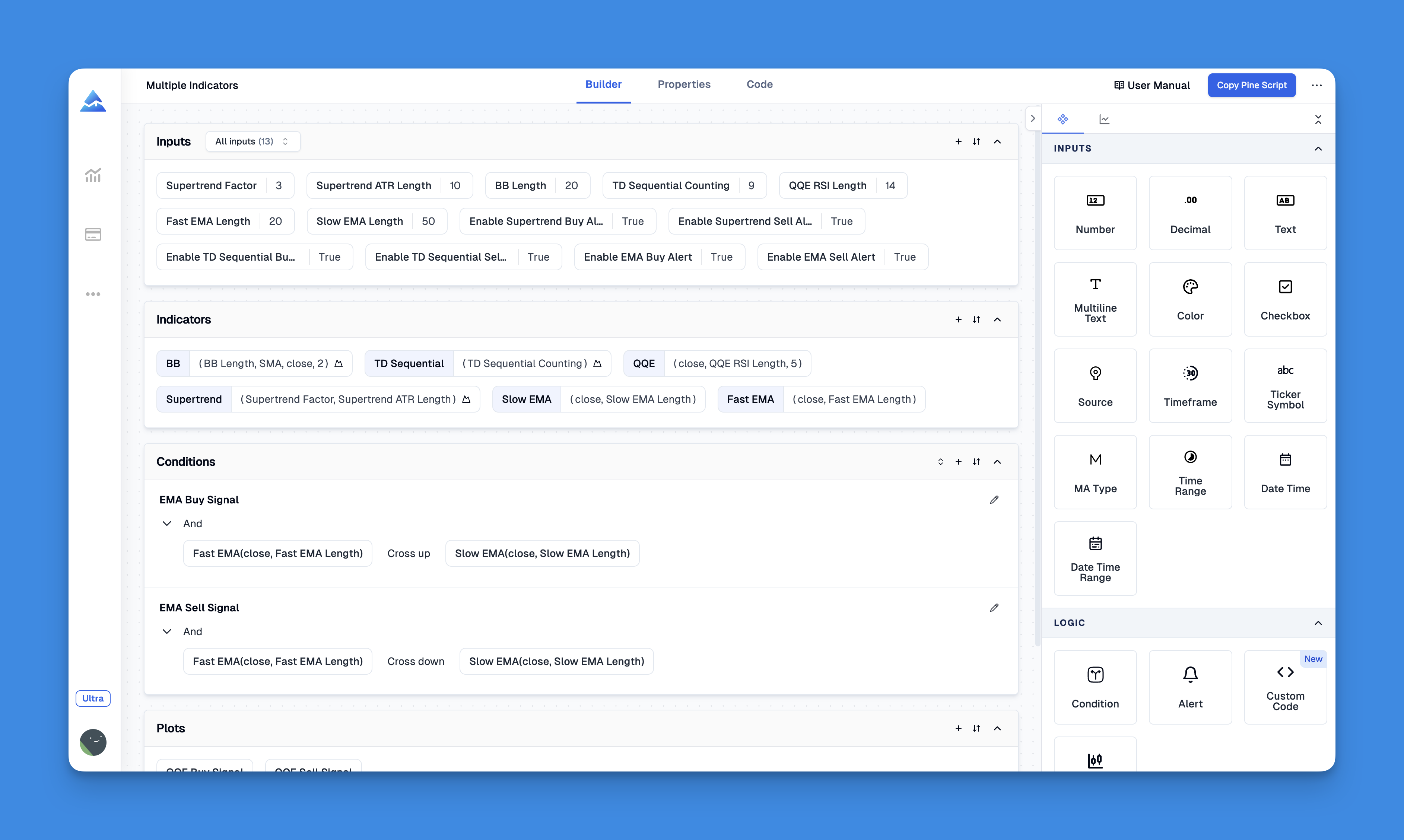
I use tools like Pineify to prototype strategies faster. Instead of typing every line of Pine Script manually, you can:
- Build strategies with visual drag-and-drop components
- Test different indicator combinations quickly
- Generate clean Pine Script code automatically
- Work around TradingView's indicator limits on free accounts
The visual approach lets me focus on strategy logic rather than syntax. Once I've validated a strategy in Pine Script, the conversion to MQL4 becomes a defined task instead of a guessing game. I prefer this workflow because I can iterate on ideas in minutes, not hours.
Explore Pineify's features to speed up your strategy development process.
What the Conversion Process Actually Looks Like
Let me be direct: converting Pine Script to MQL4 isn't something you automate. You can't upload a .pine file and download an .mq4. Every function, variable, and logic path needs to be rebuilt by hand. I haven't found a tool that changes this.
Full Rewrite Required
This isn't translation — it's reconstruction. Pine Script's Python-like syntax becomes MQL4's C++ structure. Indicator calculations, order management, data access — all of it needs to be reimplemented from scratch. When I converted a 200-line strategy for USD/JPY last year, it took about a week of focused work.
You Need to Know Both Languages
A successful conversion demands:
- Pine Script — understanding what your original strategy actually does
- MQL4 — knowing how to implement the same logic in the target platform
- Market mechanics — the logic behind entries, exits, and risk management
- Platform differences — how data indexing and bar timing vary between TradingView and MT4
Features Don't Always Map Cleanly
Some Pine Script features have no direct MQL4 equivalent:
request.security()accesses data differently than MT4's symbol functions- Drawing objects need completely different implementation approaches
- Alert systems must be rebuilt from scratch using MQL4's notification API
I'd estimate 20-30% of the conversion time goes to these mismatches alone.
Testing Is Half the Work
After the code is written, you still need to:
- Compare signal outputs bar by bar between platforms
- Run MT4 backtests and compare results to TradingView's
- Validate the strategy across different market conditions
- Check performance during high-volatility events
Proper backtesting and validation matters whether you're testing in Pine Script or MQL4.
Common Conversion Challenges
Language Structure Differences
- Syntax variations — MQL4 uses C++ style, Pine Script is closer to Python
- Function naming —
ta.sma()becomesiMA(), with different parameters - Variable declarations — MQL4 requires explicit types for everything
- Error handling — completely different approaches between the two languages
Platform-Specific Features
- Data access methods — Pine Script's
request.security()doesn't have a direct MQL4 equivalent - Time handling — bars, timestamps, and timeframes work differently
- Order management — MQL4's
OrderSend()is nothing like Pine Script'sstrategy.entry() - Performance — MQL4 requires more attention to loop efficiency and execution speed
Market Data Handling
I've seen calculation differences of up to 2% on the same indicator running the same historical data. The tick data models are different, and that shows up in edge cases.
DIY or Hire a Developer: Which Makes Sense for You
Your approach depends on your coding background, timeline, and budget. I've done both, and here's what I've learned.
Working With a Developer
When hiring a conversion specialist, look for:
- Proven work with both Pine Script and MQL4 — not just one
- Market knowledge — they need to understand trading logic, not just syntax
- Past conversions they can show with verifiable results
- Clear communication — if they can't explain the process, keep looking
Typical professional workflow:
- Code review — assess your Pine Script strategy's complexity
- Timeline estimate — based on actual function count and logic depth
- Iterative builds — convert in stages with testing after each
- Signal matching — confirm the MQL4 version matches Pine Script outputs
- Documentation — commented code and setup instructions
I went this route once for a multi-pair strategy I didn't have time to convert myself. Cost me around $800 and took three weeks. The result was solid, but I could have done it myself for the price of time.
Going DIY
If you're converting yourself, work through these steps:
- Know your strategy — understand every line of your Pine Script code before touching MQL4
- Learn the basics — focus on MQL4 syntax and common trading functions first
- Start small — convert a single indicator before attempting the full strategy
- Test as you go — validate each converted section against the original
- Use the community — the MQL4 forum on MetaQuotes saved me twice during my first conversion
Components That Need Extra Work
- Trailing stop implementations — these work completely differently between platforms
- Position sizing — MQL4 gives finer control but demands more precision
- Market data access — different APIs for historical and real-time data
- Alert systems — MQL4's notification methods are entirely different from Pine Script's
- Risk management — stop losses, take profits, and money management rules need careful porting
Alternatives Worth Considering
Before committing weeks to a conversion, check if these options solve your automation problem faster.
Bridge Services
PineConnector links TradingView alerts directly to MT4. You keep your Pine Script strategy and get automated execution without any MQL4 coding. I haven't tested it with every broker, but it works well for standard MT4 setups.
Target MQL5 Instead
MetaTrader 5's MQL5 offers better syntax, a larger standard library, and faster execution. If your broker supports MT5, converting to MQL5 might be a better long-term move than targeting MQL4.
Go Through Python
If you already know Python, converting Pine Script to Python first gives you access to frameworks like Backtrader and vectorbt. That opens up more testing and execution options, though it adds a layer of complexity.
What is a Pine Script to MQL4 converter?
It's the process — always manual or partially tool-assisted — of taking Pine Script code from TradingView and rebuilding it as MQL4 code for MetaTrader 4. No fully automated one-click converter exists because the languages have fundamentally different syntax and execution models. Conversion means rewriting the strategy logic in MQL4, not running it through a translator.
Can I automatically convert Pine Script to MQL4 without coding?
Not reliably. Pine Script and MQL4 differ in syntax, data access, and order management, so automatic tools produce broken code. A practical alternative is using a bridge service like PineConnector, which routes TradingView alerts to MT4 for execution without touching MQL4 at all.
What are the main syntax differences between Pine Script and MQL4?
Pine Script reads like Python; MQL4 follows C++ conventions. Function names are completely different (ta.sma() vs iMA()). MQL4 requires explicit variable types. Data access uses different APIs. Order management goes through MQL4's OrderSend() family instead of Pine Script's strategy functions. These aren't cosmetic differences — they change how you structure the entire program.
How long does it take to convert a Pine Script strategy to MQL4?
It depends on complexity. A simple single-indicator strategy might take an experienced developer a few days. A multi-condition strategy with custom risk management, trailing stops, and position sizing can take one to four weeks. Budget extra time for validation and backtesting to confirm signals match between platforms.
What are the limitations of Pine Script that make MQL4 conversion necessary?
Pine Script can't execute live trades — period. It has no direct broker API, can't manage orders autonomously, and doesn't support tick-level backtesting with spread modeling. MQL4 Expert Advisors fix all of these by connecting directly to an MT4 broker and running 24/7 with no manual intervention.
Is converting to MQL5 better than converting to MQL4?
For most new projects, yes. MQL5 has a modern object-oriented syntax, a larger standard library, faster execution, and is the primary language for newer MetaTrader 5 brokers. Go with MQL4 only if you specifically need MT4 compatibility or your broker doesn't support MT5.
How do I verify that my converted MQL4 strategy matches the original Pine Script logic?
Run both versions over the same historical data and compare entry and exit signals bar by bar. Check that indicator values at specific candles are identical. Compare MT4 Strategy Tester reports — trade counts, win rates, drawdown — against TradingView's backtest results. Any discrepancy usually points to data indexing differences or bar-close timing offsets between platforms.