Pine Script v6: What's New + Migration Guide (2026)


TradingView just released Pine Script v6, and honestly, this might be the most practical update they've made to their scripting language yet. After spending weeks testing every new feature, I can tell you the improvements are genuinely useful - especially if you've been frustrated with the limitations in older versions.
Let me share what actually matters in this update and why you should consider making the switch.
Pine Script v6 is the latest version of TradingView's scripting language, released in late 2025. It introduces dynamic requests by default, strict boolean logic, unlimited backtesting, and several quality-of-life improvements over v5.

What Makes Pine Script v6 Different?
Before diving into the technical stuff, let's be clear about what Pine Script is. It's TradingView's programming language that lets you build custom indicators and automated trading strategies right inside your browser. Unlike other trading platforms where you need separate software or complex setups, Pine Script runs directly on your charts.
I've been writing Pine Script since v3, and v6 is the first release where I didn't immediately find something to complain about. The team focused on solving real problems that traders and developers actually face.
What makes Pine Script useful:
- Real-time execution on any TradingView chart
- Access to extensive market data across multiple asset classes
- Built-in backtesting without external tools
- Active community sharing thousands of scripts
- No installation required - everything runs in your browser
Key Features in Pine Script v6
Here's where Pine Script v6 steps up. Instead of cosmetic updates, TradingView tackled the fundamental issues that made developers want to pull their hair out in previous versions.
Dynamic Requests: The Feature Everyone Asked For
This is probably the biggest improvement. In older versions, working with multiple symbols or timeframes required hacky workarounds. Pine Script v6 makes dynamic data requests as simple as they should have been from day one.
Want to analyze multiple stocks in a single script? Here's how easy it is now:
//@version=6
indicator("Dynamic Symbol Analysis", overlay=true)
var symbols = array.from("AAPL", "MSFT", "GOOGL", "TSLA")
for i = 0 to array.size(symbols) - 1
    symbol_name = array.get(symbols, i)
    daily_close = request.security(symbol_name, "1D", close)
    log.info(symbol_name + " daily close: " + str.tostring(daily_close))
That's it. No dynamic_requests=true parameter, no special configurations. It just works. This opens up possibilities for portfolio analysis, sector comparisons, and multi-asset strategies that were painful to implement before.
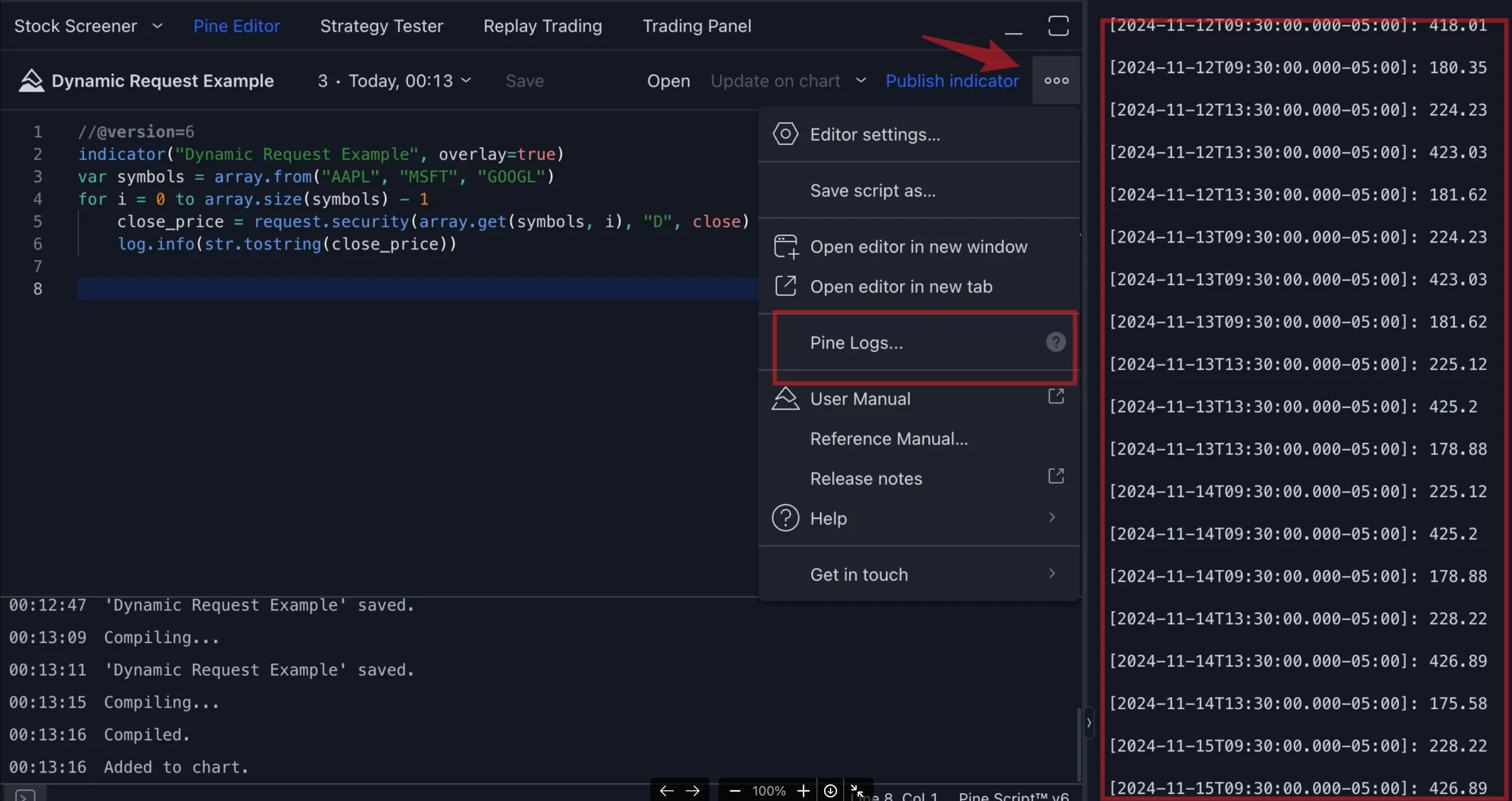
Boolean Logic That Actually Makes Sense
This might seem like a minor technical detail, but it solves a major headache. In older versions, boolean values could be na (not available), leading to confusing and unpredictable behavior in conditional statements.
Pine Script v6 enforces strict boolean logic - values are either true or false, never na. They also added short-circuit evaluation, which means:
if (condition1 and condition2)
    // If condition1 is false, condition2 won't even be evaluated
This makes scripts more efficient and eliminates a whole class of bugs that used to plague complex indicators.
Professional Text Formatting
Finally, you can make your chart annotations look professional. Text formatting options let you emphasize important information:
label.new(bar_index, high, "Strong Signal",
          text_formatting=text.format_bold,
          color=color.green)
Enhanced Array Functionality
Arrays got some much-needed improvements. Negative indexing means you can access elements from the end of an array without calculating positions:
price_history = array.new_float()
array.push(price_history, close)
// Get the most recent price (last element)
latest_price = array.get(price_history, -1)
// Get the second-to-last price
previous_price = array.get(price_history, -2)
This makes working with historical data much more intuitive, especially when dealing with advanced Pine Script array techniques and complex data structures.
Unlimited Strategy Backtesting
Remember hitting that annoying 9,000 trade limit during backtesting? Gone. Pine Script v6 automatically manages memory by trimming older trades, so your strategies can run through years of data without stopping.
This is huge for anyone doing serious strategy backtesting. I've personally been burned by that trade limit while testing a scalping strategy on ES futures - it hit 9,000 trades in about three months of historical data. With v6, that's no longer a concern.
If you're new to backtesting, you might want to check out this guide to automated backtesting strategies which explains the process in more detail.
Proper Division Mathematics
This fix might seem small, but it prevents countless bugs. Integer division now behaves like you'd expect in any modern programming language:
plot(5 / 2) // Now correctly shows 2.5 instead of 2
plot(7 / 3) // Shows 2.333... instead of 2
If you specifically need integer division, you can use math.floor() or wrap the result with int().
Upgrading Your Existing Scripts to v6
The good news is that migrating from previous versions to Pine Script v6 is surprisingly straightforward. TradingView built an automatic converter that handles most of the heavy lifting.
Automatic Conversion Process
The simplest approach is to use the built-in converter:
- Open your existing script in the Pine Editor
- Click the "More" dropdown menu
- Select "Convert code to v6"
- Review the converted code for any warnings or errors
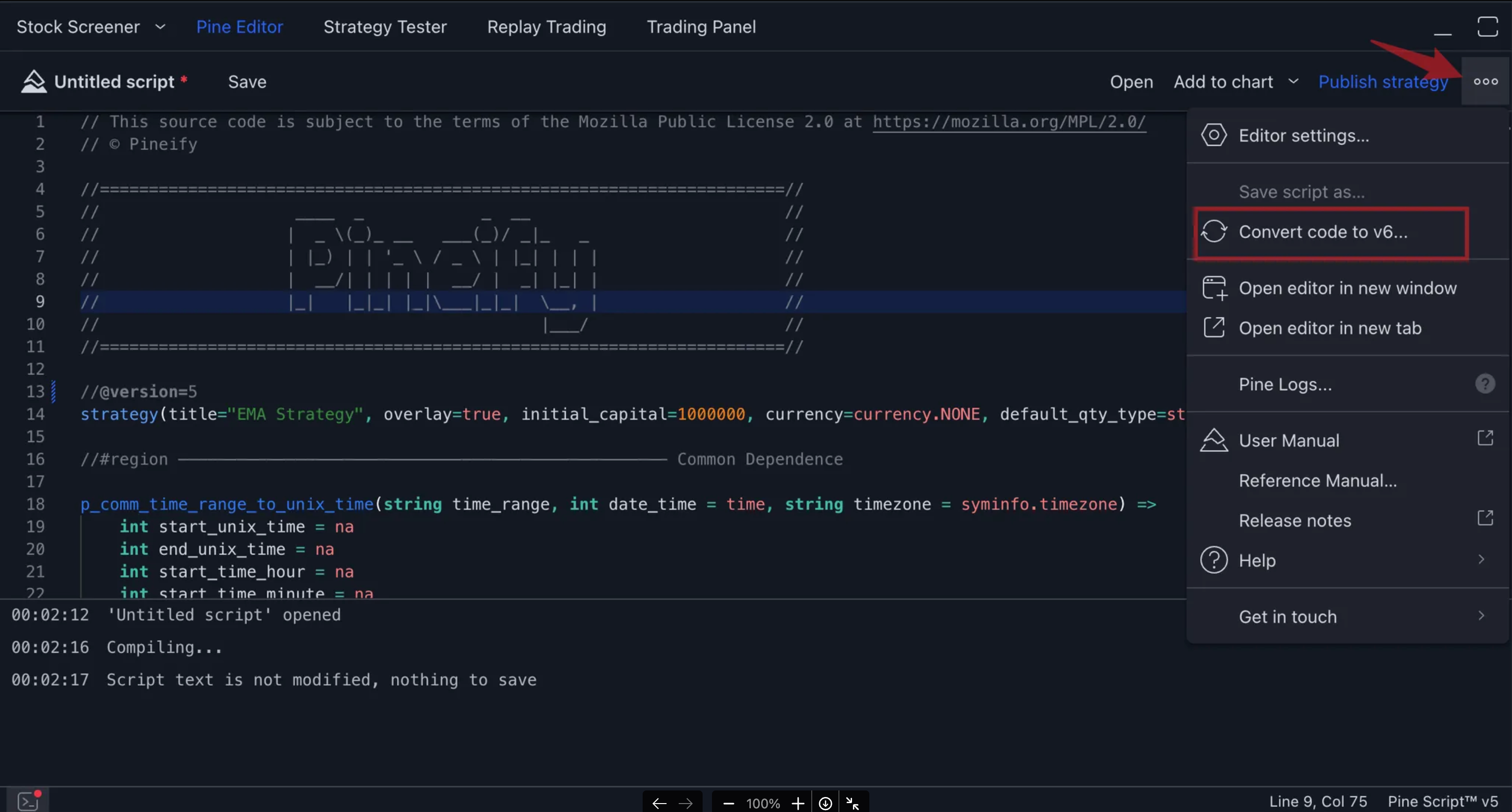
The converter successfully handles about 90% of scripts without any manual intervention. It automatically updates syntax, removes deprecated parameters, and modernizes function calls.
Manual Migration Considerations
For the remaining cases where manual adjustment is needed, here are the key areas to check:
Boolean Logic Updates: If your script explicitly checks for na in boolean contexts, you'll need to restructure that logic since booleans are now strictly true/false.
Dynamic Request Parameters: Remove any dynamic_requests=true parameters - they're no longer needed and will cause compilation errors.
Mathematical Operations: Scripts that relied on integer division behavior might need adjustment. For example, if you specifically needed 5/2 to equal 2, wrap it with int(5/2) or use math.floor(5/2).
Array Access: Take advantage of negative indexing to simplify array operations, but this is optional and won't break existing code.
The official Pine Script documentation includes detailed migration notes for edge cases, but most traders find the automatic converter handles their needs perfectly.
No-Code Approach to Pine Script v6
Not everyone wants to dive into programming syntax and debugging code. If you prefer focusing on trading logic rather than wrestling with programming details, visual tools can bridge that gap.
Visual Pine Script Development with Pineify
Pineify offers a drag-and-drop interface for creating Pine Script indicators and strategies. Instead of writing code line by line, you build your trading logic visually using predefined components and conditions.
What makes this approach particularly valuable for Pine Script v6 is that Pineify automatically generates code using the latest syntax and features, so you get all the v6 improvements without needing to understand the technical implementation.
That said, I prefer Pineify for quick strategy prototyping, but for truly custom work I still write the code myself. The visual builder covers most common patterns well, but I haven't tested it with very niche indicators yet. It's not a replacement for knowing the language if you're building something truly unusual.
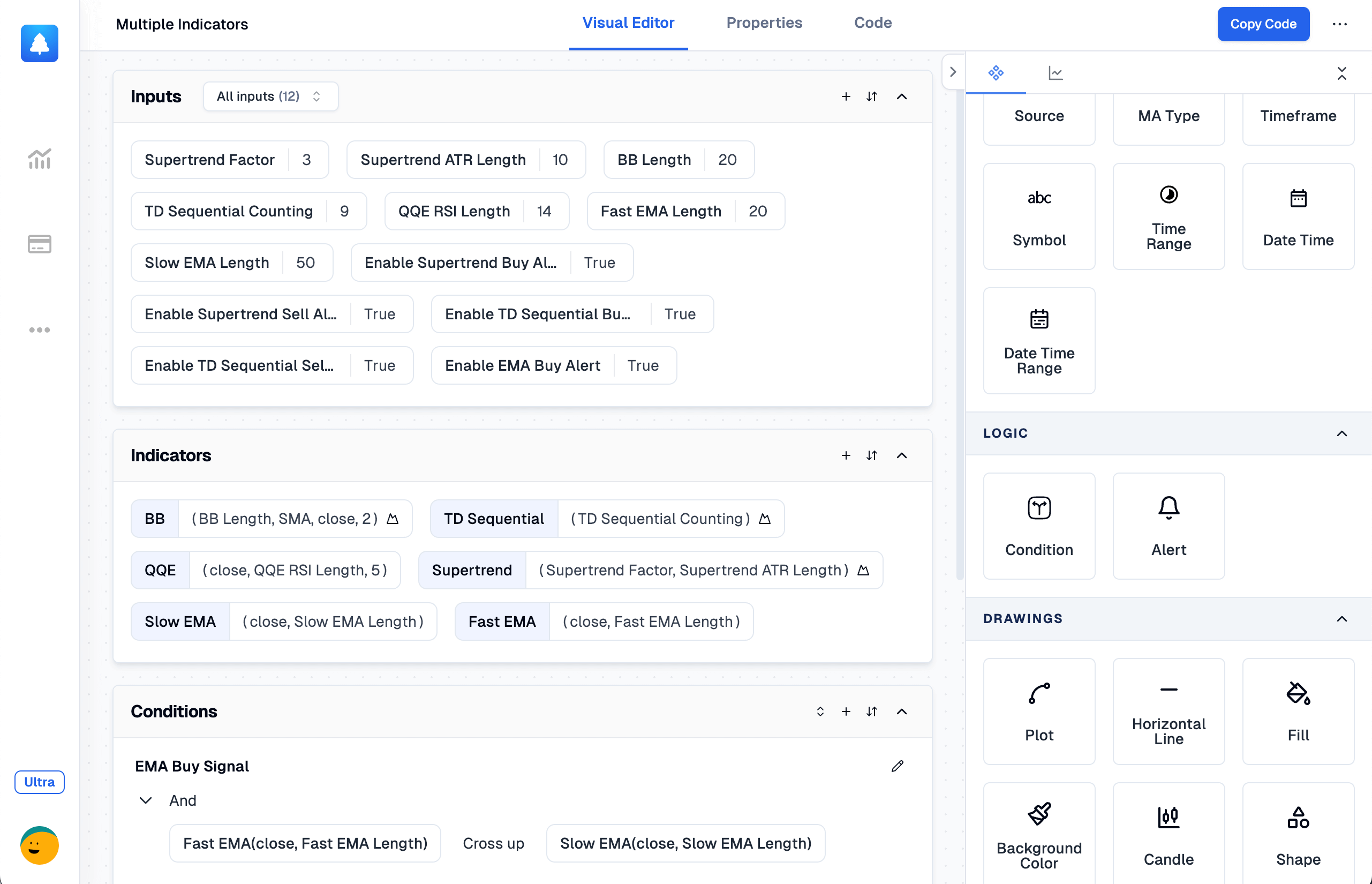
The Development Process
The workflow is designed to be intuitive for traders:
- Strategy Design: Use the visual interface to define your trading conditions using technical indicators, price levels, and market data
- Logic Assembly: Connect different components to create complex multi-condition strategies
- Parameter Customization: Adjust indicator settings, timeframes, and thresholds
- Code Generation: Pineify automatically creates optimized Pine Script v6 code
- TradingView Integration: Copy the generated code directly into TradingView's Pine Editor
This approach eliminates syntax errors, version compatibility issues, and the learning curve associated with programming. You focus on what you know best - trading strategy - while the tool handles the technical implementation.
For traders interested in learning Pine Script gradually, this also serves as a useful educational tool since you can examine the generated code to understand how your visual logic translates into actual Pine Script syntax.
Why Pine Script v6 Matters for Your Trading
The short answer is yes - Pine Script v6 is worth adopting, whether you're a seasoned developer or just starting with custom indicators. The improvements address real pain points that have frustrated the Pine Script community for years.
For Existing Pine Script Users
If you're already working with Pine Script, the upgrade solves problems you've definitely encountered. The dynamic request functionality alone eliminates those frustrating workarounds needed for multi-symbol analysis. Instead of being limited to fixed symbol lists or complex manual configurations, you can now build sophisticated portfolio analysis tools and cross-market strategies with clean, readable code.
The enhanced backtesting capabilities mean you can finally test long-term strategies without hitting arbitrary trade limits. This opens up possibilities for testing buy-and-hold approaches, dividend strategies, and other long-term methodologies that were previously impossible to validate properly.
For New Pine Script Developers
If you're just getting started, beginning with v6 is a no-brainer. You'll learn modern syntax from the beginning without picking up outdated patterns that you'd later need to unlearn. The cleaner boolean logic and improved mathematical operations mean fewer debugging sessions and more time focusing on trading strategy development.
Looking Forward
Pine Script v6 represents TradingView's commitment to providing professional-grade development tools. As the trading community continues to embrace algorithmic approaches, having a solid, modern scripting language becomes more important.
Whether you prefer hands-on coding or visual development tools like Pineify's no-code solution, Pine Script v6 provides the foundation for creating sophisticated trading tools.
The community is rapidly adopting v6, which means new tutorials, examples, and shared scripts will increasingly use v6 syntax. Starting with or upgrading to v6 now puts you in line with the direction the entire Pine Script ecosystem is moving.
For anyone serious about custom trading tools - whether that's debugging existing scripts or building entirely new strategies - Pine Script v6 provides the reliability and flexibility that modern algorithmic trading demands.
What is Pine Script v6 and how is it different from v5?
Pine Script v6 is TradingView's latest scripting language version, released in late 2025. The key differences from v5: dynamic requests work without the dynamic_requests=true parameter, booleans are strictly true or false (no na), integer division returns a float (5/2 gives you 2.5, not 2), arrays support negative indexing, and the 9,000-trade backtesting limit is gone.
How do I migrate an existing Pine Script v5 script to v6?
Open your script in the Pine Editor, click the More dropdown, and select Convert code to v6. TradingView's converter handles about 90% of scripts automatically. You'll need to manually check boolean na conditions, remove dynamic_requests=true parameters, and review any code that depends on integer division rounding down.
Does Pine Script v6 break backward compatibility with v5 scripts?
Yes, there are breaking changes. Scripts that check for boolean na values, use dynamic_requests=true, or rely on integer division returning whole numbers will need updates. The automatic converter handles most of these, but complex scripts with explicit na checks or integer math will need manual attention.
What does the removal of the 9,000-trade backtesting limit mean in practice?
In v5, if you were testing a strategy that generated frequent signals over long periods, the backtester stopped recording after 9,000 trades. That made it impossible to validate short-term strategies across multi-year datasets. In v6, TradingView trims older trades from memory automatically, so your backtests can run through unlimited historical data — essential for high-frequency or long-term strategy validation.
Can I use Pine Script v6 without writing code?
You can. Pineify provides a visual drag-and-drop builder that generates Pine Script v6 code for you. You define your conditions, indicators, and timeframes visually, and the tool outputs ready-to-use v6 syntax to paste into TradingView. It's designed for traders who want v6 features without learning Pine Script syntax.
Why did TradingView change how integer division works in v6?
In v5, dividing two integers gave you an integer back — 5/2 returned 2, which caused subtle bugs in price calculations and ratio logic. In v6, division always returns a float (5/2 = 2.5), matching how Python, JavaScript, and most modern languages handle it. If you specifically need integer division, use math.floor(5/2) or int(5/2).
Is it worth upgrading all existing scripts to Pine Script v6 now?
For most people, yes. The automatic converter makes migration low-effort, and you get cleaner dynamic requests, reliable boolean logic, and unlimited backtesting. The community is moving to v6 quickly, so new examples and shared scripts will use v6 syntax. Migrating now avoids compounding technical debt later.