Understanding Pine Script Built-ins Function Return Multiple Values

Pine Script, a domain-specific language used on the TradingView platform, is essential for traders and developers looking to create custom indicators and strategies. One of the most crucial aspects of Pine Script is understanding how functions work, particularly how they return values. This article delves into the mechanics of function returns in Pine Script, providing insights into both built-in and user-defined functions.
What is Pine Script?

Pine Script is a lightweight scripting language designed specifically for use on TradingView. It allows users to create custom technical indicators and strategies to analyze financial markets. With its easy-to-learn syntax, Pine Script enables users to automate trading strategies and visualize data in innovative ways.
Built-ins Functions in Pine Script
Functions in Pine Script are blocks of code designed to perform specific tasks. They help in organizing code, enhancing reusability, and improving readability. Functions can be built-in or user-defined, each serving different purposes within a script.
Built-in Functions
Pine Script comes with a rich library of built-in functions that perform various calculations and tasks. Some common examples include:
ta.sma(): Calculates the Simple Moving Average.ta.ema(): Calculates the Exponential Moving Average.ta.rsi(): Calculates the Relative Strength Index.
These functions are called by their names followed by the required arguments, making them easy to use for standard calculations.
User-Defined Functions
User-defined functions allow users to create custom calculations that are not covered by built-in functions. They are particularly useful for repetitive tasks or complex operations that need to be isolated from the main script.
Single-Line Functions
Single-line functions are ideal for simple operations. They follow this structure:
<function_name>(<parameter_list>) => <return_value>
For example:
f(x, y) => x + y
Multi-Line Functions
Multi-line functions are used for more complex operations and follow this structure:
<function_name>(<parameter_list>) =>
    <local_block>
The last statement in a multi-line function's body determines the return value.
How Functions Return Values
In Pine Script, the value returned by a function is crucial as it determines what data is passed back to the calling context.
Returning Multiple Values
While most functions return a single result, Pine Script allows returning multiple values using a tuple-like structure. This requires special syntax when calling such functions:
fun(x, y) =>
    a = x + y
    b = x - y
    [a, b]
To use these returned values:
[res0, res1] = fun(open, close)
plot(res0)
plot(res1)
Scope and Limitations
Understanding scope is vital when working with functions in Pine Script.
Local vs Global Scope
Variables declared inside a function belong to its local scope and cannot be accessed outside that function. Conversely, global variables can be accessed within any function but cannot be modified directly inside them.
Limitations
- No Recursion: Functions cannot call themselves.
- No Nested Functions: Functions cannot be defined within other functions.
- Global Scope Definition: All user-defined functions must be declared in the global scope.
Practical Example
Here’s an example of creating a custom indicator using user-defined functions:
// This source code is subject to the terms of the Mozilla Public License 2.0 at https://mozilla.org/MPL/2.0/
// © Pineify

//======================================================================//
//                    ____  _            _  __                          //
//                   |  _ \(_)_ __   ___(_)/ _|_   _                    //
//                   | |_) | | '_ \ / _ \ | |_| | | |                   //
//                   |  __/| | | | |  __/ |  _| |_| |                   //
//                   |_|   |_|_| |_|\___|_|_|  \__, |                   //
//                                             |___/                    //
//======================================================================//

//@version=6
indicator("[Pineify - Best Pine Script Generator] Custom Moving Average", overlay=true)

calc_moving_average(src, length) =>
    ta.sma(src, length)

plot(calc_moving_average(close, 14), color=color.blue)
This script defines a function calc_moving_average that calculates a simple moving average over a specified period and plots it on the chart.
Generating Pine Script Code with Pineify
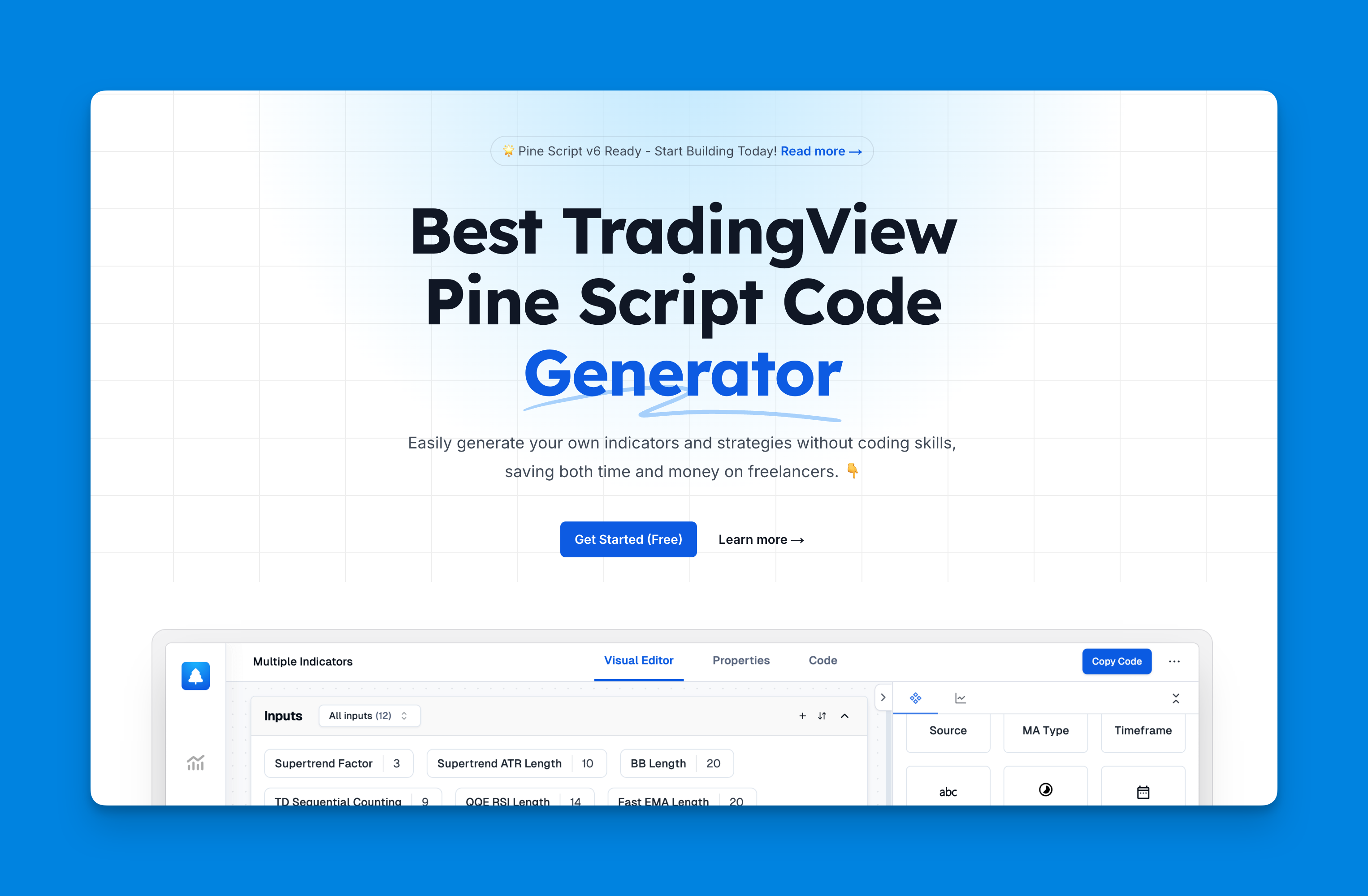
Pineify is a revolutionary tool designed to simplify the process of creating Pine Script code for traders who use the TradingView platform. It addresses the common challenge many traders face: a lack of programming knowledge. With Pineify, users can generate Pine Script code effortlessly, allowing them to focus on their trading strategies rather than coding complexities.
What is Pineify?
Pineify is a visualization tool that enables traders to create, manage, and optimize trading indicators and strategies without needing any programming skills. Its user-friendly interface allows traders to leverage their market insights to develop custom indicators and strategies. The generated code can be easily copied and pasted into TradingView to visualize the indicators or strategies directly on the charts.
Key Features
- No Coding Required: Create and customize scripts without any programming knowledge.
- Error-Free Scripts: Unlike AI-generated scripts, Pineify ensures error-free and reliable code.
- Time Efficiency: Generate scripts quickly, reducing the time needed compared to hiring a freelancer.
- Cost Savings: Access lifetime features at low costs compared to freelance services.
- Unlimited Indicators: Add any number of indicators using TradingView's free plan.
- Comprehensive Backtesting: Generate strategy scripts for thorough backtesting.
Pineify empowers traders by providing a robust platform for developing trading strategies without the need for coding expertise. This makes it an invaluable tool for both novice and experienced traders looking to enhance their trading capabilities on TradingView.
Conclusion
Understanding how functions return values in Pine Script is fundamental for anyone looking to develop custom indicators or strategies on TradingView. By leveraging both built-in and user-defined functions effectively, you can create powerful tools tailored to your trading needs.
reference:
- https://stackoverflow.com/questions/72957988/pine-script-function-return
- https://use.autoview.com/hc/en-us/articles/14109331588365-Lesson-4-Pinescript-Functions
- https://pinescriptstrategy.com/course/practical-pinescript/lessons/pp-2-10-functions/
- https://www.tradingview.com/pine-script-docs/v4/language/declaring-functions/
- https://www.tradingview.com/pine-script-docs/v4/language/functions-and-annotations/
- https://docs.bulltrading.io/bulltrading-designer/pinescript/pine-script-tm-v5-user-manual/user-defined-functions
- https://www.tradingview.com/pine-script-docs/language/user-defined-functions/