564 posts tagged with "TradingView"

Blog posts related to the TradingView

View All Tags

Bookmap TradingView: Order Flow Heatmaps for Real-Time Trading

· 19 min read
Pineify Team
Pine Script and AI trading workflow research team

Bookmap is a real-time order flow visualization platform that displays live market depth as a color-coded heatmap. TradingView is the charting tool for multi-asset analysis, strategy backtesting, and custom Pine Script indicators. My take: TradingView wins for planning, Bookmap wins for execution. You don't pick one—you pair them.

I've run this combo for over two years on ES futures, NQ, and NASDAQ stocks. The heatmap shows where limit orders accumulate; TradingView gives me the context and alerts. Not every trade works—I've had plenty of fakeouts—but the workflow is consistent, and consistency matters more than any single indicator.

Bookmap TradingView: The 2025 Guide to Order Flow, Heatmaps, and Charting Workflows

Notepad++ Pine Script Setup for TradingView Coding

· 10 min read
Pineify Team
Pine Script and AI trading workflow research team

TradingView's built-in editor gets the job done, but I hit its limits fast when building complex Pine Script strategies. That's why I switched to Notepad++ for offline development. Notepad++ Pine Script development means writing indicators and strategies with real syntax highlighting, local file backups, and a text editor that doesn't slow you down when your code passes 500 lines.

I've been writing Pine Script for over three years, and the TradingView editor still lacks basic features like multi-file projects or proper offline editing. In March 2025, I spent four hours debugging a strategy on a cross-country flight -- no internet, no editor syntax help. Notepad++ would've caught half those errors before I even hit compile.

BOP Strategy: Profitable Growth at the Bottom of the Pyramid

· 15 min read
Pineify Team
Pine Script and AI trading workflow research team

The Bottom of the Pyramid (BOP) strategy is a business approach that targets the roughly 4 billion people living on less than $8 per day as a viable consumer market. Most companies chase customers with disposable income. This one goes the other way.

For decades, businesses treated low-income communities as charity cases, not customers. C.K. Prahalad flipped that script with his 2004 book The Fortune at the Bottom of the Pyramid. His argument: people at the base of the economic pyramid are value-conscious buyers, and serving them well can build profitable, sustainable businesses. It's not about handouts. It's about designing products and services that actually fit their needs and budgets.

BOP Strategy: Growth at the Bottom of the Pyramid

Build Custom Backtrader Indicators for Automated Trading

· 16 min read
Pineify Team
Pine Script and AI trading workflow research team

Ever tried to build something with a toolkit and found it's missing that one perfect tool? If you're using Backtrader for backtesting trading strategies, you've hit that wall. The built-in indicators work fine for common setups, but your unique idea isn't in the box.

Custom Backtrader indicators are Python classes that extend bt.Indicator to calculate your own trading signals from market data. You define the math, inputs, and output — Backtrader handles the timing and synchronization. I've built over a dozen custom indicators this way for strategies I run on Apple (AAPL) and SPY data, and that flexibility is the main reason I stick with Backtrader.

Learning to build your own custom indicators turns a generic backtesting setup into one that matches your exact logic. You take a specific calculation you've been noodling on, or a combination of data points, and code it into something your strategy can act on.

I'll show you how these indicators work and how to build, test, and tune your own. You won't find a shortcut here — you'll write Python — but the payoff is tools that match your trading logic exactly. For a practical walkthrough of the full backtesting workflow, see Backtesting.py Guide: How to Backtest Trading Strategies in Python.

Build Custom Backtrader Indicators: Complete Guide to Advanced Trading Tools

Bull Bear Power Indicator: Setup, Divergences, and Trading Tips

· 10 min read
Pineify Team
Pine Script and AI trading workflow research team

The Bull Bear Power indicator is a momentum oscillator developed by Dr. Alexander Elder. It measures who controls price by comparing each bar's high and low to an exponential moving average. The formula is straightforward:

Bull Power = High - EMA(N) Bear Power = Low - EMA(N)

Where N is the lookback period (default 13). Positive Bull Power means buyers pushed the high above the average with real force. Negative Bear Power means sellers dragged the low below it.

Can You Trade Forex on TradingView? Yes — Here's How

· 15 min read
Pineify Team
Pine Script and AI trading workflow research team

Forex trading on TradingView is the practice of executing currency pair trades through TradingView's charting interface by linking a supported brokerage account. You connect your broker inside TradingView, then analyze charts, place orders, and manage open positions from one place — no app switching needed. I've used this setup since early 2024 with OANDA, and it handles everything from EUR/USD entries to adjusting stop-losses mid-session.

If your broker isn't on their list, or you're just getting started, Paper Trading lets you practice with fake money on live charts. The fills are simulated, so slippage won't match reality, but it runs on the same data you'd trade with real cash.

Can You Trade Forex on TradingView? A Complete Guide

Stripe Indicator Sellers vs Pineify: Safer TradingView Scripts

· 13 min read
Pineify Team
Pine Script and AI trading workflow research team

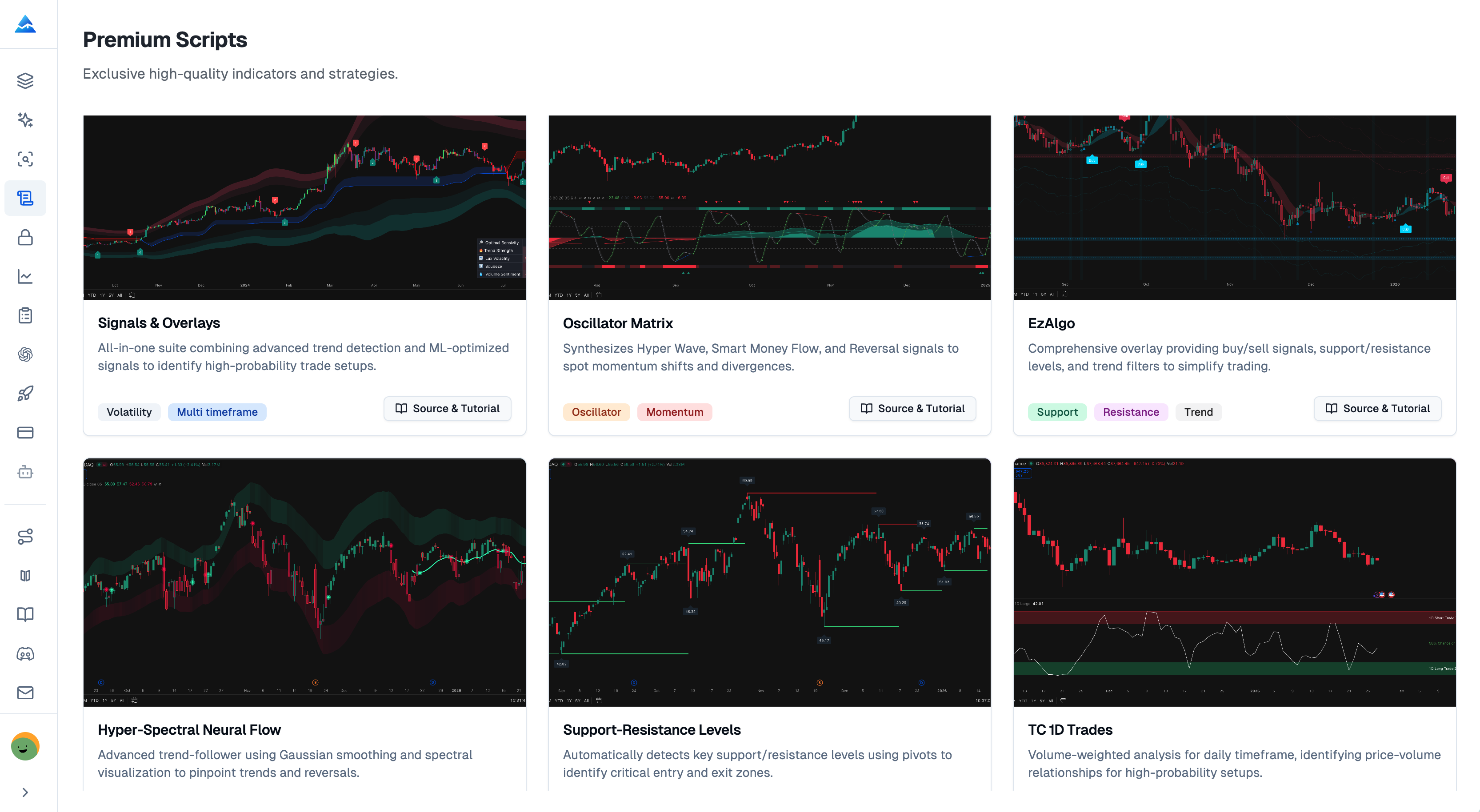
I spent about $600 on TradingView indicators from Stripe checkout pages before I called it quits. Three different sellers, all promising the moon. Two disappeared within six months, and the third one's "premium" script stopped working after a TradingView update in late 2025. A Stripe indicator seller is typically an individual running a small operation with no oversight, no source code access, and no guarantee you'll keep the tool you paid for. Pineify Premium Scripts is the opposite — a U.S.-registered platform that gives you full source code, one-time lifetime payments, and proper documentation. Between the two, Pineify is the safer choice by a wide margin.


Stripe Indicator Sellers vs Pineify: Secure TradingView Scripts Comparison

Quantstats vs Pineify: Trading Strategy Analysis Compared

· 12 min read
Pineify Team
Pine Script and AI trading workflow research team

Most backtest reports tell you your final profit and little else. Quantstats and Pineify's Backtest Deep Report both go further, but they serve different traders. Quantstats is a Python library that gives developers 30+ metrics from raw return data. Pineify's Deep Report is a browser-based tool that adds Monte Carlo simulation, MFE/MAE analysis, and Kelly Criterion without any code. I've run both on my own strategies, and here's the verdict: if you want maximum control and write Python, Quantstats is your tool. If you live in TradingView and want deeper analysis in less time, Pineify wins.


Quantstats vs. Pineify: Complete Comparison for Trading Strategy Analysis Tools

MQL5 AI: Build MetaTrader 5 Expert Advisors Without Coding

· 12 min read
Pineify Team
Pine Script and AI trading workflow research team

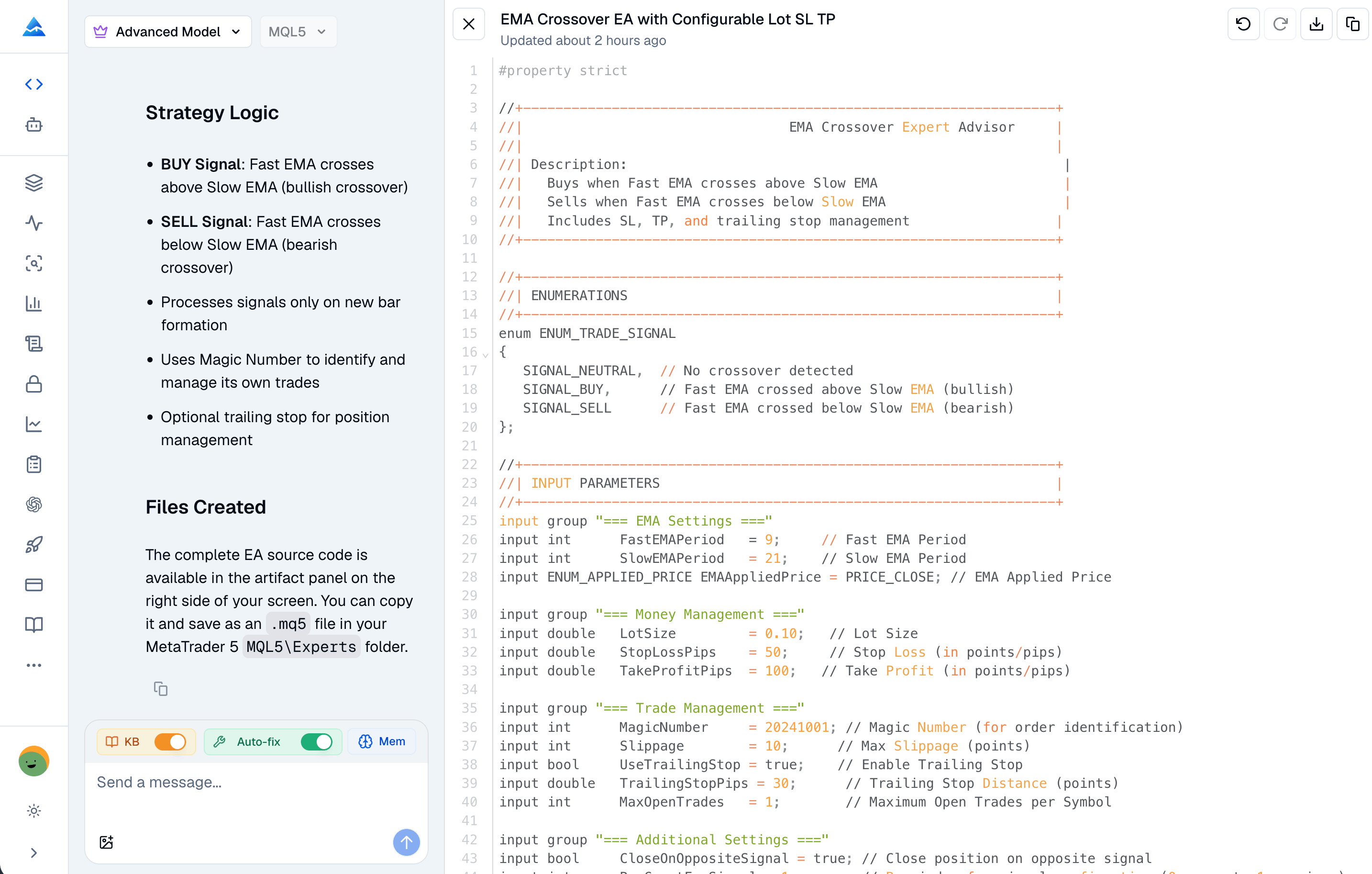
MQL5 AI is a specialized tool category that generates compilable MetaTrader 5 code from plain English strategy descriptions. If you've looked into algorithmic trading for MT5, you've probably seen these tools popping up. They handle MQL5 syntax, event handlers like OnInit() and OnTick(), buffer management, and MetaQuotes API rules — so you can build Expert Advisors, custom indicators, and scripts without being a coding expert. I've tested several options, and the difference between general chatbots and purpose-built MQL5 agents is huge.


MQL5 AI Guide: Build MetaTrader 5 Expert Advisors Without Coding