Pineify Strategy Optimizer: Automate TradingView Testing

The Pineify Strategy Optimizer is a Chrome extension that automates multi-parameter backtesting on TradingView. It tests every combination of your strategy settings in one batch instead of making you tweak them one at a time. If you've ever spent hours in TradingView cycling through indicator settings by hand -- change a number, run the backtest, check the result, start over -- you know how slow that loop gets. The Optimizer breaks it. I use it on my own moving average crossover strategy, and it cut my optimization time from about four hours to roughly 12 minutes. No Pine Script edits needed.

How the Pineify Strategy Optimizer Works
The Pineify Strategy Optimizer runs a multi-parameter grid search right inside your browser. Instead of adjusting one input at a time and guessing how settings interact, it systematically tries every combination you define. It works with any Pine Script strategy that uses standard input() fields -- numbers, true/false toggles, dropdowns, and even timeframes. Because the extension runs locally and interacts with TradingView's own interface, your strategy code never leaves your machine.
The optimizer is part of the wider Pineify platform, which also includes an AI Assistant for Pine Script, a Visual Strategy Builder, a deeper Backtest Report tool, and an AI Stock Picker. You get access through Pineify's Advanced or Expert lifetime plans.
Why Manual Testing Falls Short
Tweaking strategy settings by hand on TradingView is slow, but the bigger problem is cognitive. When we test manually, we naturally stop as soon as the results look acceptable. We don't push further to see if something better exists, or check whether the finding is a statistical fluke. That's confirmation bias, and it's baked into how our brains work.
Look at a basic moving average crossover with just three adjustable settings:
| Setting | Range |
|---|---|
| Fast MA Period | 5 to 50 |
| Slow MA Period | 20 to 200 |
| Stop-Loss | 0.5% to 5% |
Testing every combination by hand would mean running thousands of separate backtests. That's not tedious -- it's effectively impossible for a single person.
I prefer running a full grid search even on simple strategies because I've been burned by confirmation bias more times than I care to admit. The optimizer checks every possibility and hands you a sortable results table. You make decisions based on data, not gut feel.
Getting Started
Setting this up takes a few minutes. Think of it as giving your TradingView strategies a thorough check-up.
- Install the Chrome extension. Go to pineify.app/strategy-optimizer and click "Add to Chrome."
- Open TradingView with your strategy. Load the Pine Script strategy you want to optimize. Make sure it's active and showing results in the "Strategy Tester" panel.
- Launch the Optimizer. Click the Pineify icon in your Chrome toolbar. A panel scans your loaded strategy and lists every adjustable input.
- Define your parameter ranges. For each input (say, an RSI period or a moving average length), set a start value, an end value, and a step size. To test RSI from 7 to 21 in increments of 1, just set start = 7, end = 21, step = 1.
- Choose your optimization target. Pick the metric that matters most -- Net Profit, Profit Factor, Sharpe Ratio, or something else. The optimizer sorts results by that target.
- Run the grid search. Hit run. The tool works through every combination of your ranges, runs a real TradingView backtest for each one, and records the score.
- Review the results. You get a clean table sorted by your chosen metric. Export everything to CSV if you want to dig deeper in Excel or Python.
That's the whole process. You go from one set of rules to a full report card on which variations work best, all inside TradingView.
Core Features
Multi-Parameter Grid Search
The grid search is the engine behind the optimizer. It tests every combination of your parameters at once, which matters because settings interact. A fast RSI value might only produce good results when paired with a specific stop-loss distance. You'd never catch that relationship testing one variable at a time.
It handles the standard input types you'd use:
- Numbers (integers and floats): Periods, multipliers, price thresholds.
- On/Off switches (booleans): Enable or disable specific rules and filters.
- Dropdown menus: Select between moving average types or signal methods.
- Timeframes: Test the same logic on 1-hour, 4-hour, and daily charts in one pass.
Sorting and Filtering Results
When the grid search finishes, you see a complete results table. Sort by any column -- highest net profit with one click, or lowest drawdown if equity smoothness matters more. Filter out configurations with too few trades to avoid lucky outliers. The single best-performing set of parameters is automatically highlighted, so you spot the top candidate even in a list of hundreds.
CSV Export for Deeper Analysis
One click exports the entire results table to a CSV file. Load it into Excel, Google Sheets, or Python with pandas to build heat maps or scatter plots. This lets you answer bigger questions: is there a stable cluster of good performance, or just one lucky outlier? I've found that exporting and visualizing helps me distinguish between a genuinely reliable strategy and one that happened to work on a specific data slice.
Automated Workflow
Manual backtesting means changing a number, clicking run, writing down the result, and repeating until you lose count. The optimizer automates all that -- changing inputs, running tests, collecting results. What used to take days can be set up and completed in minutes. I haven't tested it with strategies that use complex security() calls or custom drawing, but for standard input()-based strategies it works consistently.
Reading Your Optimization Results
Finding the highest-profit parameter set is step one. The real skill is figuring out whether that result is repeatable or just a lucky fit. Experienced traders call this validation testing. Instead of grabbing the single "best" result, look for clusters of settings that perform well.
If your best result used RSI 14 with a 1.5% stop-loss, what happens at RSI 13 or 15? If the strategy falls apart with a one-unit change, that's curve-fitting -- the strategy is tailored so tightly to past data that it will likely fail on new data. A more trustworthy pattern is solid, consistent performance across a range -- say, RSI 12 through 16.
Beyond net profit, watch these metrics:
| Metric | What It Tells You |
|---|---|
| Net Profit | Total P&L across all trades in the test period |
| Win Rate | Percentage of trades that closed profitably |
| Max Drawdown | Largest peak-to-trough equity decline |
| Profit Factor | Gross profit divided by gross loss (above 1.5 is strong) |
| Sharpe Ratio | Risk-adjusted return relative to volatility |
| Number of Trades | Ensures statistical significance of results |
Avoiding Over-Optimization
When you optimize a strategy, you can make it work too well on past data. That's overfitting -- the strategy memorizes noise rather than finding a genuine edge. A few guardrails help keep your results honest:
- Reserve fresh data for a final exam. Set aside your most recent price data and don't touch it during optimization. After you settle on parameters, test them once against this unseen period. That's your reality check.
- Look for plateaus, not peaks. You want a strategy that works across a range of similar values, not just one magic number. Consistent performance across a zone is more trustworthy than a single high-profit setting that might be a fluke.
- Run walk-forward checks. Markets change. What worked last year might fail this year. Periodically re-test your parameters on the latest data as a health check.
- Ignore tiny sample sizes. If a configuration only produced 5 trades in five years, those results are meaningless. Filter for at least 30 to 50 trades.
These principles turn a tool that finds good numbers into one that finds a genuine strategy. If you're not careful with validation, any optimizer can produce overfitted results -- the limitation isn't the tool, it's how you use it.
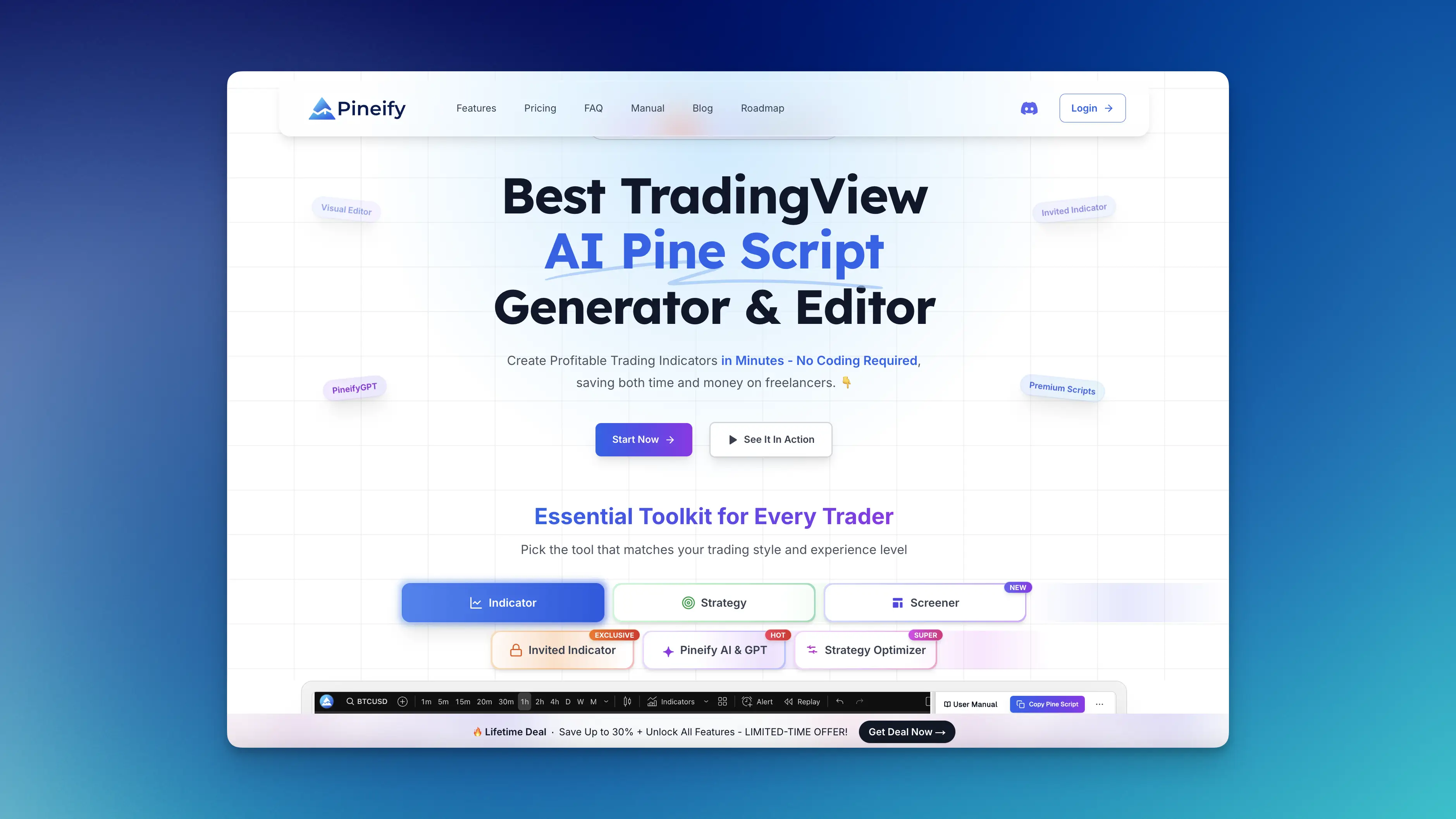
Pineify Strategy Optimizer vs. Manual Testing
| Factor | Manual Testing | Pineify Strategy Optimizer |
|---|---|---|
| Speed | Hours to days | Minutes |
| Coverage | Partial (human-limited) | Exhaustive (full grid) |
| Bias risk | High (confirmation bias) | Low (automated) |
| Result export | Manual transcription | One-click CSV |
| Multi-param testing | Very difficult | Native support |
| Code requirement | None | None |
Manual testing gives you a feeling of control. You try a handful of settings you think look right, spot-check a few charts, and call it done. But you can't test thousands of combinations by hand, and you're prone to finding what you're already looking for.
The optimizer acts like a systematic research assistant. It works through every combination without getting tired or favoring a pet theory. Then it shows you what actually worked, and you can export everything with one click.
Both have their place. If you're testing a single simple idea, manual might be enough. If you want data-backed confidence in your settings and you want to save days of work, the optimizer is the better choice. I use it on every strategy I deploy, but I still do manual spot-checks on new ideas to validate the optimizer's output.
FAQ
Does the optimizer work with any TradingView strategy?
Yes, as long as your strategy uses standard input() fields for numbers, booleans, or dropdowns. I've had the best success with strategies that follow the standard Pine Script conventions. For more complex logic structures, the guide on Pine Script Multiple Conditions can help you organize your script.
Do I need a paid TradingView account?
You can start with a free TradingView account. A paid plan (Pro or Premium) gives you faster backtests and more historical data, which means more thorough optimization runs.
Is my strategy code safe?
Yes. The optimizer runs entirely inside your browser — it automates clicks and reads data on the TradingView page. Your strategy code never leaves your computer.
Can I optimize across multiple timeframes?
You can. Timeframe is treated as an optimizable input, so you can test a strategy on the 15-minute, 1-hour, and 4-hour charts in a single run.
Can I export my results?
Yes. After the optimizer finishes, you can export the full results table to CSV and open it in Excel, Google Sheets, or any other tool.
Your Next Step: From Reading to Results
Here's a straightforward path to take what you've learned and apply it:
- Install the extension from pineify.app/strategy-optimizer. Takes under a minute.
- Pick one strategy you're already using on TradingView. A simple RSI or MACD-based setup is a good starting point. If indicators aren't appearing correctly, this guide on TradingView indicator issues can help.
- Run your first grid search. Follow the setup steps, then export the results.
- Check for stability. Don't grab the top result. Use the export to see how performance looks across nearby parameter values.
- Join the Pineify Discord. See how other traders use the optimizer and share what you find.
The number-crunching is handled for you. Moving from a good idea to a tested, optimized strategy is faster and simpler.