Pineify Market Insights: Align Flow, Prints, and Disclosures

Pineify Market Insights brings options activity, premium summaries, reported equity prints, and congressional disclosures into related views. The practical challenge is aligning what each record means and when it became available. Four views on one screen do not automatically provide four independent trading signals.
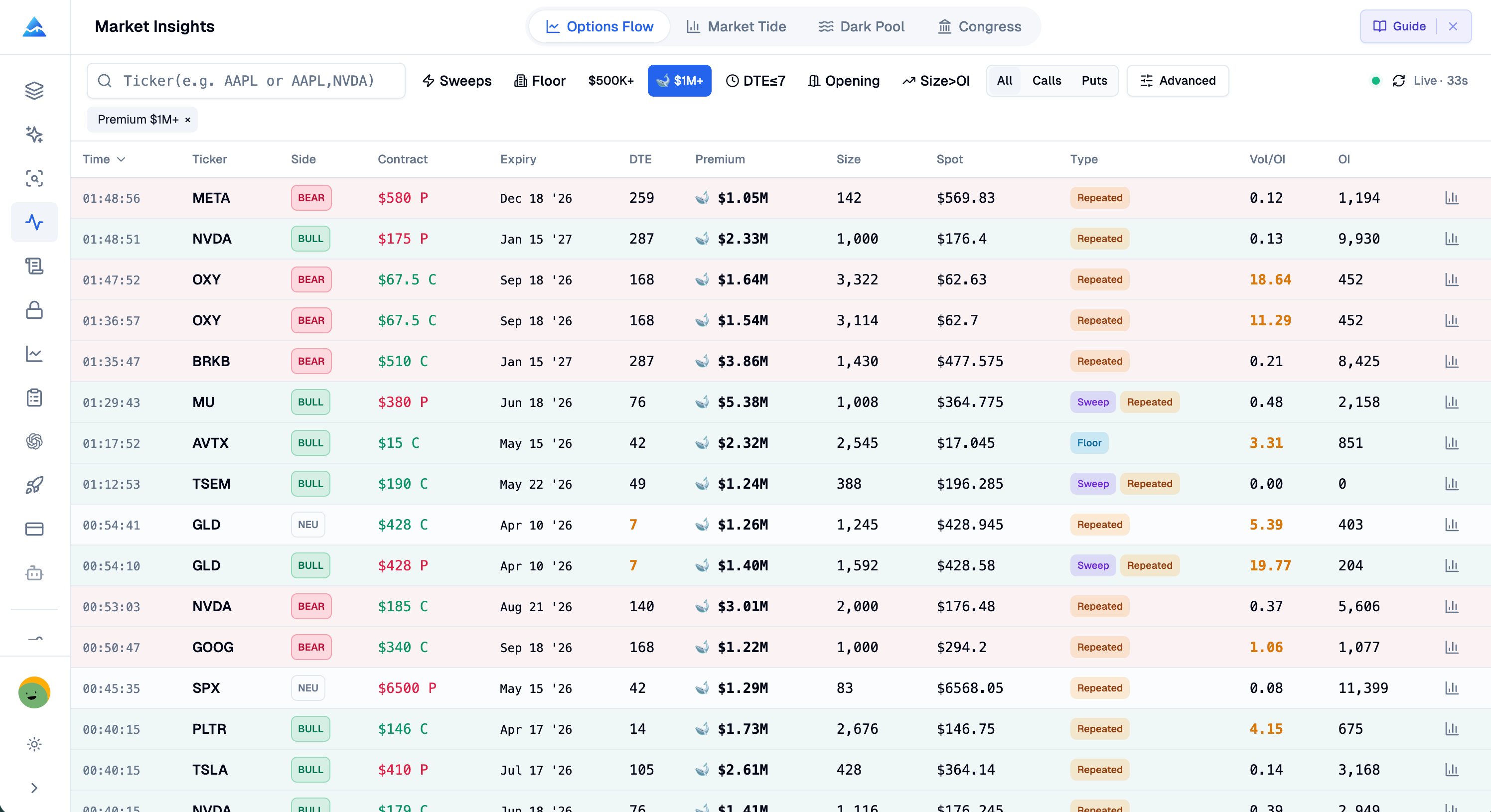
Choose the question before combining views
Start with a specific question, such as whether reported options activity in one stock changed during a selected session. Then use each view only for the information it actually contains.
| View | Observation available | Important boundary |
|---|---|---|
| Options Flow | Returned option alerts and contract fields | Trade-side labels do not reveal full positions |
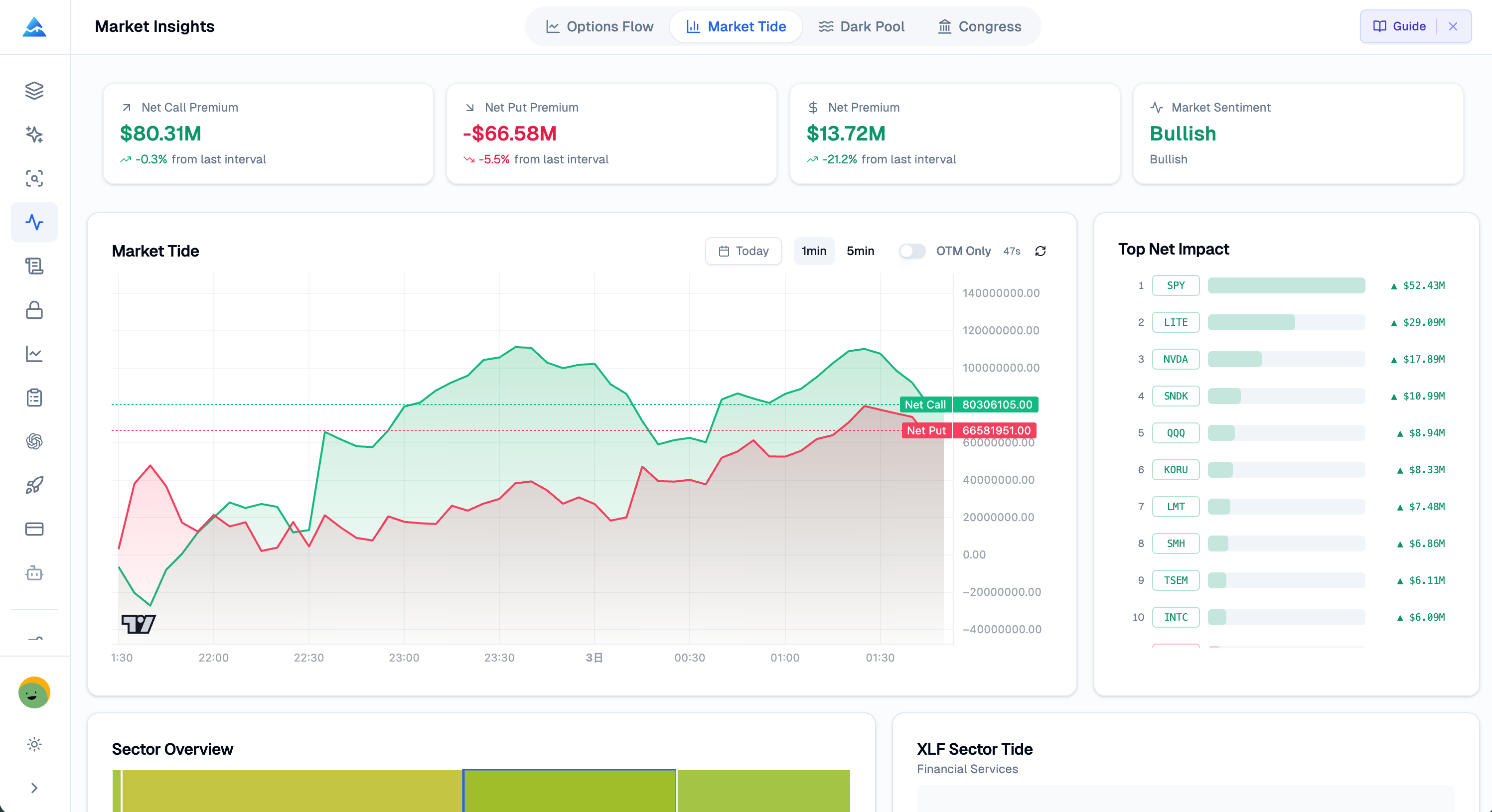
| Market Tide | Net call and put premium series and summaries | May overlap with individual flow observations |
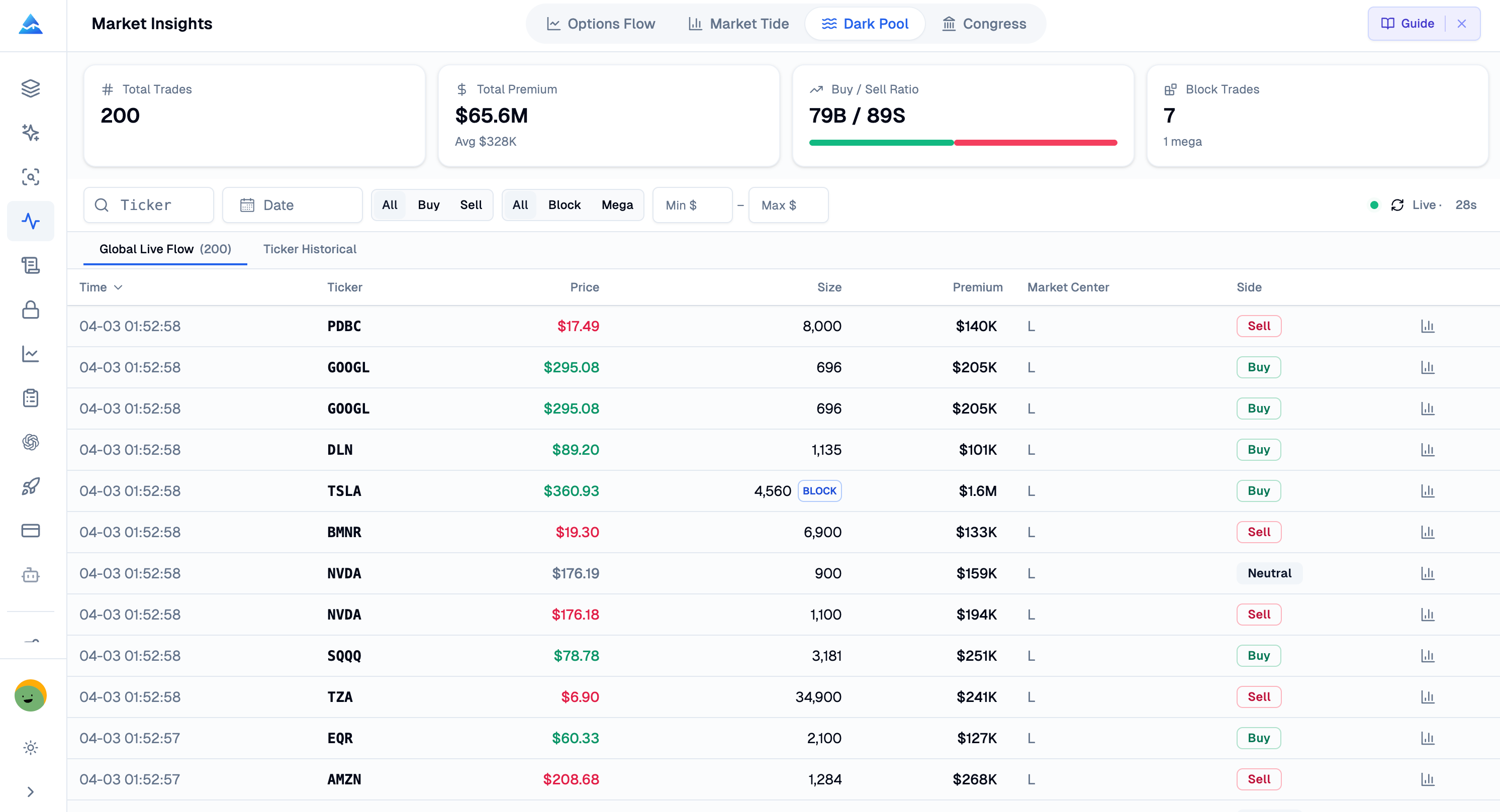
| Dark Pool | Provider-reported equity trades with prices and sizes | A print does not identify a beneficial owner |
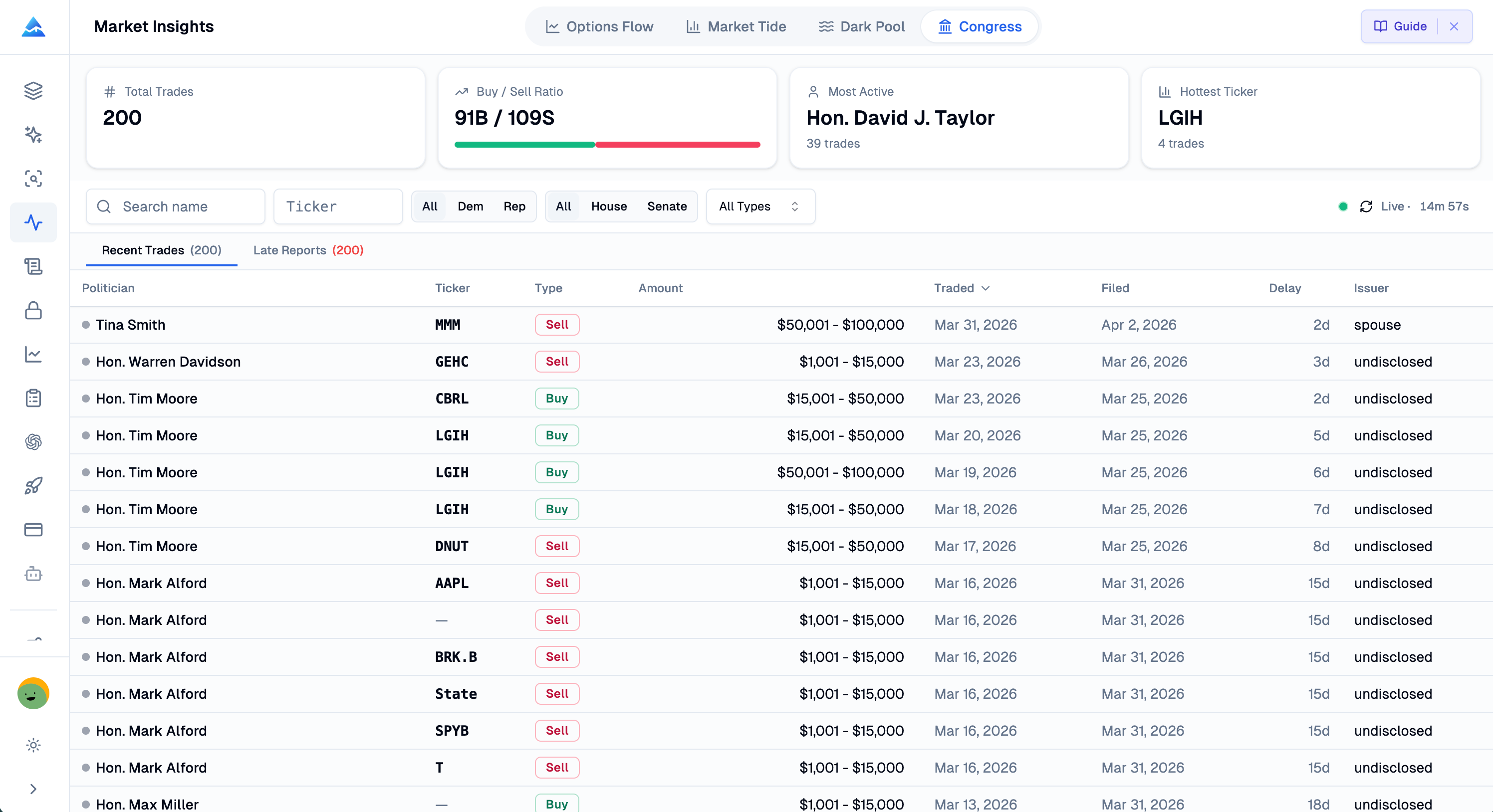
| Congress Trading | Aggregated disclosed transactions | Disclosure time differs from transaction time |
The app uses provider services and bounded requests. A displayed list is not evidence of complete market or filing coverage. Review account entitlement, active filters, returned records, and error states before interpreting an absence.
Keep three times in the research note
Record the event time, the time the information became available, and the time you inspected it. They answer different questions. A transaction that occurred weeks ago but was disclosed today cannot be used as if it were public on the transaction date.
For a hypothetical comparison, suppose an options alert arrives during today's session while a congressional purchase was executed three weeks earlier and disclosed today. Both may be relevant to research, but they are not simultaneous purchases or evidence that the parties coordinated.
The current Options Flow view polls every 60 seconds and Dark Pool every 30 seconds while active. Market Tide components use separate refresh intervals. Backend caching adds another timing layer. Refreshing a page does not guarantee a newly published event or remove a disclosure delay.
Read options classifications in context
The app's flow sentiment depends on call versus put type and the share of ask-side or bid-side premium. Ask-side dominance in calls and puts has opposite directional labels. A large print or sweep still may be part of a hedge, spread, or closing transaction.
Market Tide receives net call and net put premium and calculates a directional difference. These are not simply totals of all call and put spending. The provider's net-flow documentation explains how trade-side premium affects net series.
A matching flow alert and Market Tide move may reflect the same transactions. Do not count related aggregations as independent confirmation without checking their underlying coverage.
Separate an equity print from an ownership conclusion
Off-exchange activity includes ATS and non-ATS trading. FINRA explains these distinctions in Where Do Stocks Trade?. An off-exchange percentage is therefore not automatically a dark-pool percentage.
Pineify estimates trade side by comparing the execution price with the NBBO midpoint. Above midpoint is labeled buy, below midpoint sell, and exactly at midpoint neutral. This is a heuristic about the reported execution, not a record of institutional accumulation or a guarantee of support at that price.
Every completed trade has both a buyer and a seller. A large size alone does not tell you which party initiated a new long-term position or whether either party is an institution.
Use congressional disclosures as dated records
For covered House transactions, the House Ethics Committee's deadline explanation states the earlier of 30 days after awareness or 45 days after the transaction. This is not a fixed 45-day publication delay.
Pineify's displayed late flag uses a simpler difference of more than 45 days between transaction and filing dates. It should not be treated as a complete legal compliance determination. Aggregated records can also require checking against the original filing, including ownership, amount ranges, amendments, and transaction descriptions.
A disclosed purchase does not prove access to material nonpublic information, future outperformance, or a current holding. Avoid converting an amount range into a precise investment size. A list's most frequent ticker describes that returned dataset, not necessarily what all lawmakers are buying now.
Combine evidence in a review sheet
Write one row per observation rather than one row per bullish or bearish impression:
| Field | What to retain |
|---|---|
| Source and view | Provider, module, filters, and selected date |
| Availability | Event time, publication time when known, and retrieval time |
| Observation | The actual premium, price, size, or filing field |
| Interpretation | A hypothesis clearly separated from the observation |
| Alternative explanation | Hedge, closing trade, delayed filing, or incomplete sample |
| Follow-up | Original record or additional information needed |
If you later test a trading rule, use only information available before each simulated decision and include costs and execution assumptions. A collection of favorable anecdotes is not a backtest.
Access and next steps
The Market Insights page describes the product and leads to account access. Check current plan requirements and data terms in the app. Public promotional screenshots do not establish an anonymous live data feed or unlimited redistribution rights.
Related Pineify research and coding tools can help organize a question or implement a separately defined strategy. This article does not establish that dashboard data automatically becomes an executable Pine strategy, or that any resulting strategy will be profitable.
Are the four views independent signals?
Not necessarily. Options Flow and Market Tide can share underlying activity, while other views may describe events from different dates.
Does a missing record mean no trade occurred?
No. Filters, request limits, provider coverage, timing, and access or service errors can affect the returned records.
Does the Congress late flag establish a legal violation?
No. The app uses a date-difference rule. Check the original filing and applicable reporting requirements before drawing that conclusion.
Can I infer institutional buying from a dark-pool buy label?
The label is inferred from price relative to the quote midpoint. It does not identify the owner, position change, or investment motive.