Koyfin vs Pineify AI Agent: Which Investment Research Tool Wins?

Professional investment research tools split into two camps: dashboard-based analytics and conversational AI. Koyfin is a traditional financial analytics platform built for deep screening and portfolio management across multiple asset classes. Pineify's AI Finance Agent is a conversational research assistant that answers plain-English questions with live market data from professional-grade APIs. I've tested both extensively, and the verdict is clear: for most individual investors and active traders, Pineify's lifetime pricing and AI-driven answers deliver better value, but Koyfin remains the stronger choice if you need advisor-grade portfolio analytics and client reporting tools.
Koyfin has been around for eight years and now serves over 500,000 investors plus tens of thousands of financial advisors. It pulls together deep data, charts, and dashboards that rival expensive professional terminals at a much more accessible price. In the latest Kitces AdvisorTech study, Koyfin scored a 9/10 for satisfaction and value, topping the list for investment research tools.
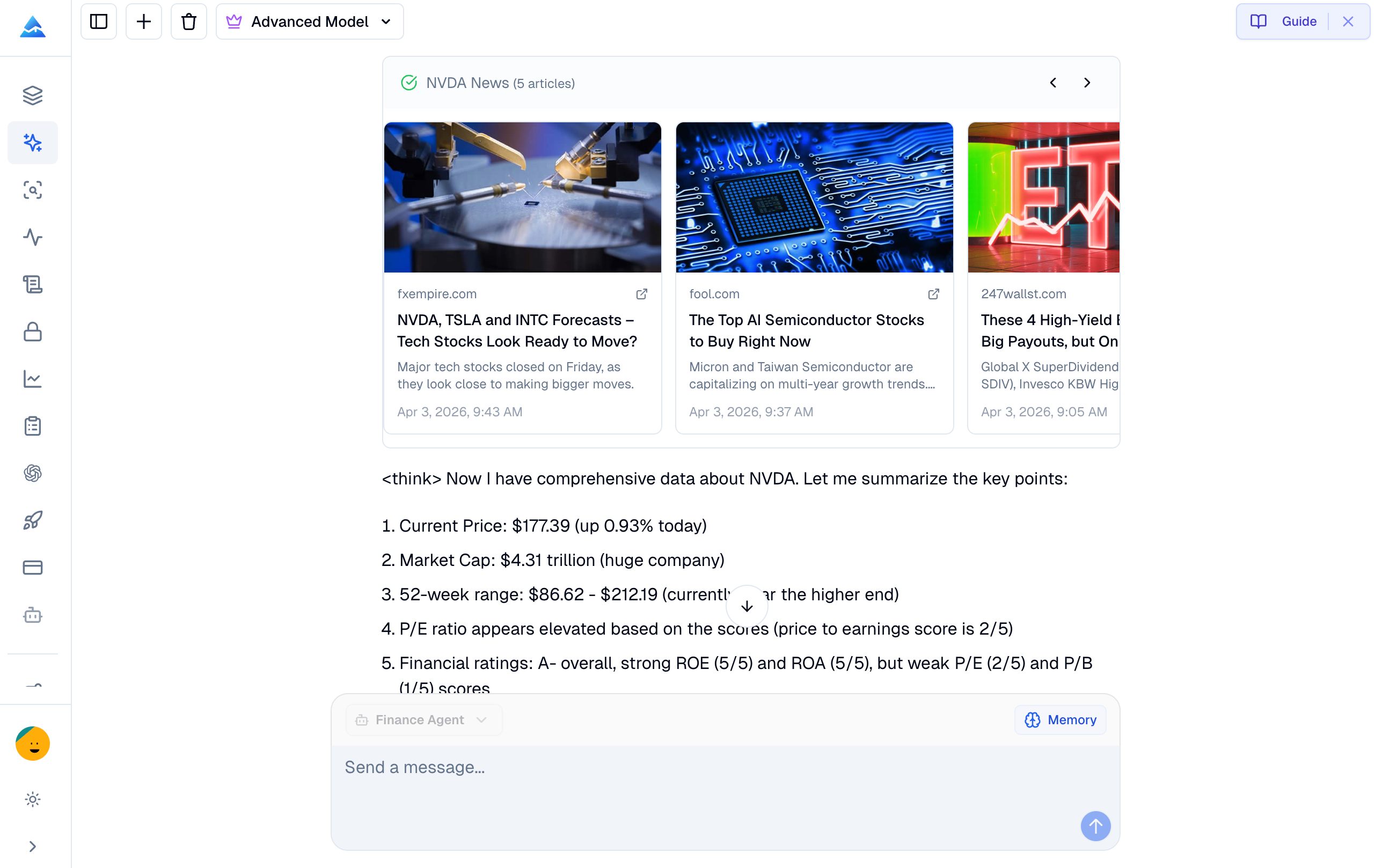
Pineify works differently. You skip the dashboards entirely. You type a question like "Should I buy NVDA right now?" or "Find undervalued tech stocks with strong cash flow," and the agent fetches real-time data from live financial APIs to synthesize an answer. It's not pulling from a static database — every response uses current market information.
The agent gives you a wide view of the market, covering:
| Asset Class | Coverage |
|---|---|
| Stocks | 11,000+ |
| Crypto & Forex Pairs | 400+ |
| Financial Data Tools | 90+ |
These tools include live income statements, balance sheets, analyst estimates, SEC filings, insider trading activity, economic reports, and options data. All accessible 24/7.
The key difference from a general AI chatbot like ChatGPT is the data source. Standard chatbots train on a static snapshot. Pineify's agent bypasses that by pulling verified, up-to-the-minute data directly from professional financial APIs whenever you ask. You get insights based on what's happening right now, not information that could be weeks or months old.
Picking the Right Tool: A Side-by-Side Look
Both platforms cover the same broad goal — better investment decisions — but the experience is completely different. Here's how they compare feature by feature.
| Feature | Koyfin | Pineify AI Finance Agent |
|---|---|---|
| Interface | Dashboard / traditional UI | Conversational AI chat |
| Real-time data | ✅ Yes | ✅ Yes |
| Stock coverage | Global (multi-asset) | 11,000+ stocks globally |
| Crypto/Forex | ✅ Yes | ✅ 400+ pairs |
| Screener | 5,900+ filter criteria | Natural language AI screener |
| AI capabilities | ❌ None | ✅ Core feature |
| Technical analysis | ✅ Advanced charting | ✅ RSI, MACD, SMA, EMA + more |
| Fundamental analysis | ✅ 10-year financials | ✅ Full financial statements |
| Analyst estimates | ✅ Yes | ✅ Yes |
| SEC filings / earnings | ✅ Earnings transcripts | ✅ 10-K, 10-Q, earnings calendar |
| Sentiment analysis | ❌ Limited | ✅ News + social media |
| Insider/Congress trades | ❌ Not featured | ✅ Yes |
| Options analysis | ❌ Not featured | ✅ Full Greeks + unusual activity |
| Portfolio analytics | ✅ Advanced | ❌ Not a core feature |
| Client proposals | ✅ Advisor-focused | ❌ Not available |
| Buy/sell recommendations | ❌ Data only | ✅ AI-generated with reasoning |
| Mobile apps | ✅ Yes | ✅ Web-based |
I prefer Pineify's agent when I need a quick, synthesized take on a company I'm tracking. Last week I asked it to compare NVDA and AMD — it pulled live P/E ratios, revenue growth, analyst opinions, and margin data side-by-side with explanations in about 30 seconds. Koyfin can get you to the same numbers, but you'll spend more time clicking through menus and setting up screens.
If you're a professional advisor who loves deep dashboards and portfolio analytics, Koyfin is incredibly powerful. If you'd rather ask questions and get answers — like "show me undervalued tech stocks with strong recent insider buying" — Pineify is the better fit. For traders building their full tech stack, understanding platform differences beyond just Koyfin versus Pineify helps — this Tradestation vs TradingView comparison covers another angle worth knowing.
Getting the Data You Need: How These Platforms Compare
When you're researching investments, two things matter: how much data you can access, and how deep you can go. Koyfin and Pineify take pretty different approaches here.
Koyfin's Strength: Screening and Breadth Koyfin is built for deep screening. With over 5,900 screening criteria at your fingertips, you can build incredibly detailed filters that target exactly what you're looking for. It casts a wide net covering:
- Stocks
- ETFs & Mutual Funds
- Bonds
- Currencies & Commodities
- Futures
- Cryptocurrencies
This is arguably the broadest asset coverage you'll find at this price level. For fundamental analysis, you get historical financial data going back 10 years, which is solid for long-term valuation models.
Pineify's Approach: Ask and You Shall Receive Pineify works differently. Instead of pre-building dashboards, its AI Finance Agent acts like a research assistant. You ask a question, and it dynamically finds the specific data needed to answer. This means you can pull up:
- Standard financials (income statements, balance sheets, cash flows, key ratios)
- Analyst forecasts and earnings calendars
- Macroeconomic data (GDP and CPI reports)
- Insider and Congressional trade disclosures — a dataset not natively available in Koyfin
For options traders, Pineify is particularly handy. It provides full options chains with live Greeks (Delta, Gamma, Theta, Vega), implied volatility, put/call ratios, max pain analysis, and flags unusual options activity on the fly.
| Feature | Koyfin | Pineify (AI Finance Agent) |
|---|---|---|
| Primary Data Method | Pre-built screening & dashboards | Dynamic, question-driven retrieval |
| Key Screening Power | 5,900+ pre-defined criteria | Conversational, natural language queries |
| Unique Data Highlights | Broad asset class coverage | Insider/Congressional trades, live options Greeks, unusual activity |
| Best For | Building systematic screens across many assets | Getting precise, complex answers quickly |
The AI Difference: Why It Matters for Your Research
This is where the two platforms feel completely different. Koyfin doesn't use AI. In 2026, that's something users notice. Once you're used to asking for data in plain English, going back to manually clicking through menus and building dashboards can feel like a step backward.
Pineify's Finance Agent is less like a search bar and more like a research partner. It actively gathers and connects information for you. Ask it to compare NVDA and AMD — it doesn't just give you a single number. It fetches live P/E ratios, revenue growth, analyst opinions, and margin data, puts them side-by-side, and highlights what it might mean. What could take hours of manual work happens in moments.
Beyond answering questions, Pineify also helps you discover new ideas. Its AI Stock Rankings refresh daily, sorting stocks into lists like growth opportunities, reliable dividends, and undervalued picks. I've been using the free AI stock picker tool to spot names I'd otherwise miss.
| Feature | Koyfin | Pineify |
|---|---|---|
| Core AI | Not available | Finance Agent (acts as a research partner) |
| Data Query | Manual navigation & dashboard setup | Natural language questions (e.g., "Compare NVDA vs AMD") |
| Insight Generation | User-built and interpreted | Synthesized and explained by AI |
| Stock Discovery | User-defined screens | AI-powered daily rankings (growth, value, dividends, etc.) |
Ease of use matters when you're evaluating a new tool. Here's how they stack up.
Getting Started with Koyfin
Compared to heavyweight terminals like Bloomberg, Koyfin is much more approachable. But getting full value still takes time. There's a learning curve as you get familiar with building screeners, using charting tools, and setting up portfolio analytics. If you put in the effort, the platform becomes powerful. But if you're a more casual user who won't tap into those advanced features often, the monthly cost can feel steep.
Getting Answers with Pineify
You don't need a financial background to use Pineify's AI Finance Agent, and there's essentially no learning curve. You just ask questions in plain English. That makes it just as easy for a beginner investor as it is for a seasoned analyst to get started. Instead of learning a complex dashboard, you have a conversation. Ask follow-ups naturally, and the agent builds context as you go.
Pricing Comparison
How you pay matters a lot. Koyfin uses a monthly or annual subscription. Pineify offers lifetime access for a single one-time payment. That's a major difference when you project costs over a few years.
Here's a straightforward look at their plans:
| Plan | Koyfin | Pineify |
|---|---|---|
| Free tier | ✅ Limited access | ✅ Try free |
| Entry paid plan | $39/mo (Plus) | $99 one-time (Plus) |
| Mid-tier plan | $79/mo (Pro) | $149 one-time (Advanced) |
| Finance Agent access | N/A | $259 one-time (Expert) |
| Advisor plans | $209–$299/mo | N/A |
| AI features | None | Included |
The math on lifetime value is hard to ignore. Pineify's top Expert plan costs a single $259 and includes everything — AI Finance Agent, stock tools, the works. Compare that to paying $79, $209, or even $299 every single month with Koyfin. The lifetime deal can save you thousands over time. It comes down to whether you prefer a smaller ongoing expense or one larger upfront investment.
If you're looking to optimize your full trading software budget, the Best TradingView Subscription guide covers another piece of the puzzle.
Who Gets the Most Out of Koyfin?
Koyfin is a specialized platform that clicks with certain finance pros.
- Financial Advisors juggling client portfolios. If you're tired of switching between tools to analyze holdings, build reports, and connect to custodian data, Koyfin pulls that entire workflow into one place.
- Fundamental Analysts who dig deep. If your process involves screening stocks using specific criteria and you value 10-plus years of financial statements, this is where Koyfin shines.
- Portfolio Managers who need a clear top-down view. The platform gives you a cohesive picture across managed households and benchmark comparisons.
- Institutional Researchers who prioritize substance over flash. If you're comfortable with traditional financial dashboards and care more about data breadth than the trendiest interface, Koyfin's approach feels familiar.
| User Profile | Core Need | How Koyfin Addresses It |
|---|---|---|
| Financial Advisor | Unified workflow for analysis, reporting, and custodian data | Integrates portfolio analytics, client proposal tools, and custodian connections |
| Fundamental Analyst | Deep historical financials and complex screening | 10-year financials and a screening tool with thousands of customizable criteria |
| Portfolio Manager | Household-level overview and performance attribution | Aggregate portfolio views, benchmark comparisons, risk/return attribution |
| Institutional Researcher | Data breadth and stability | complete data coverage in a professional-grade dashboard |
I haven't tested Koyfin's advisor proposal tools since I'm not a financial advisor, but I've read strong reviews from those who use them. My main hesitation is the monthly cost — at $79/mo or more for the useful tiers, it adds up fast if you're not using it daily.
Who Gets the Most Out of Pineify's AI Finance Agent?
Pineify is built for people who want actionable insights without needing a finance degree or a huge budget.
- Individual investors managing their own portfolios. You get access to the kind of deep data institutional investors use without the crazy cost or complexity.
- Active traders looking for an edge. It pulls together options flow analysis, real-time insider trade tracking, and market sentiment in one spot.
- Students and anyone learning the markets. You can ask questions conversationally and see how professional-grade analysis works.
- Professionals short on time. It delivers quick synthesized research and clear buy/sell/hold perspectives — I use it this way myself.
- Crypto and forex traders. You get analysis on hundreds of crypto and forex pairs alongside stock fundamentals.
I'd like to see Pineify add proper portfolio tracking — that's a real gap compared to Koyfin. For now, I use Pineify for research and idea generation, then track positions elsewhere. It's not a one-stop shop, but the research quality makes the trade-off worth it.
Frequently Asked Questions
Can Pineify AI Finance Agent actually replace Koyfin?
For most individual investors and active traders, yes, it handles the core job. You get access to most of the same market data, plus AI-powered summaries, options analysis, sentiment tracking, and insider trading info — things Koyfin doesn't focus on. Koyfin still wins for financial advisors who need deep portfolio analytics and client proposal tools.
Is the data on Koyfin more reliable than Pineify's?
Both pull from professional-grade financial data sources. Koyfin has been around longer, which gives some users comfort. Pineify fetches fresh live data every time you ask, so you're never working from old info. I always double-check critical data points before big moves regardless of the tool.
Does Pineify work for stocks outside the US?
Yes. It covers major global markets including the US, Europe, and Asia, plus emerging markets. You can look into over 11,000 stocks along with forex and cryptocurrencies.
With Pineify's one-time fee, is Koyfin's monthly subscription still worth it?
Depends on your needs. If you're a financial advisor using Koyfin's specialized multi-client tools, the monthly cost makes sense. For an individual doing their own research, Pineify's lifetime plan is far more cost-effective, especially with the added AI features.
Can I use both Koyfin and Pineify together?
Absolutely. That's actually a powerful combo. Use Koyfin's advanced screener to find potential investments and monitor your portfolio, then use Pineify's AI Agent to get a deep dive on earnings reports or options flow for specific stocks.
What types of assets does the Pineify AI Finance Agent cover?
Over 11,000 stocks globally, 400+ crypto and forex pairs, and 90+ financial data tools. This includes live income statements, balance sheets, analyst estimates, SEC filings, insider trading, economic reports, and options data.
Try Both Free Options
The best way to decide is to test them yourself — both have solid free tiers.
- Give Koyfin's free plan a look if your work involves deep analysis, screeners, or client reporting.
- Try Pineify's AI Finance Agent at pineify.app/finance-agent if you'd rather ask questions in plain English. It's designed for real-time insights without learning a complex platform. Pineify also offers a Visual Editor for building trading strategies without code, an AI Stock Picker with daily predictive scores, and a Pine Script Coding Agent that generates error-free TradingView indicators in minutes.
Spend 10 minutes poking around each one. See which interface feels more intuitive for the way you work. Still on the fence? Drop a comment below with your biggest research headache — filtering stocks, making sense of options chains, or keeping portfolio tracking organized — and the community can help suggest the best fit.