Finance AI Agent: Research Tools, Sources and Data Freshness

Pineify Finance Agent is a conversational interface to financial-data tools. It can gather inputs for research, but a retrieved value and an AI explanation are different forms of evidence. Check the source, timestamp, reporting period and calculation before relying on an answer.
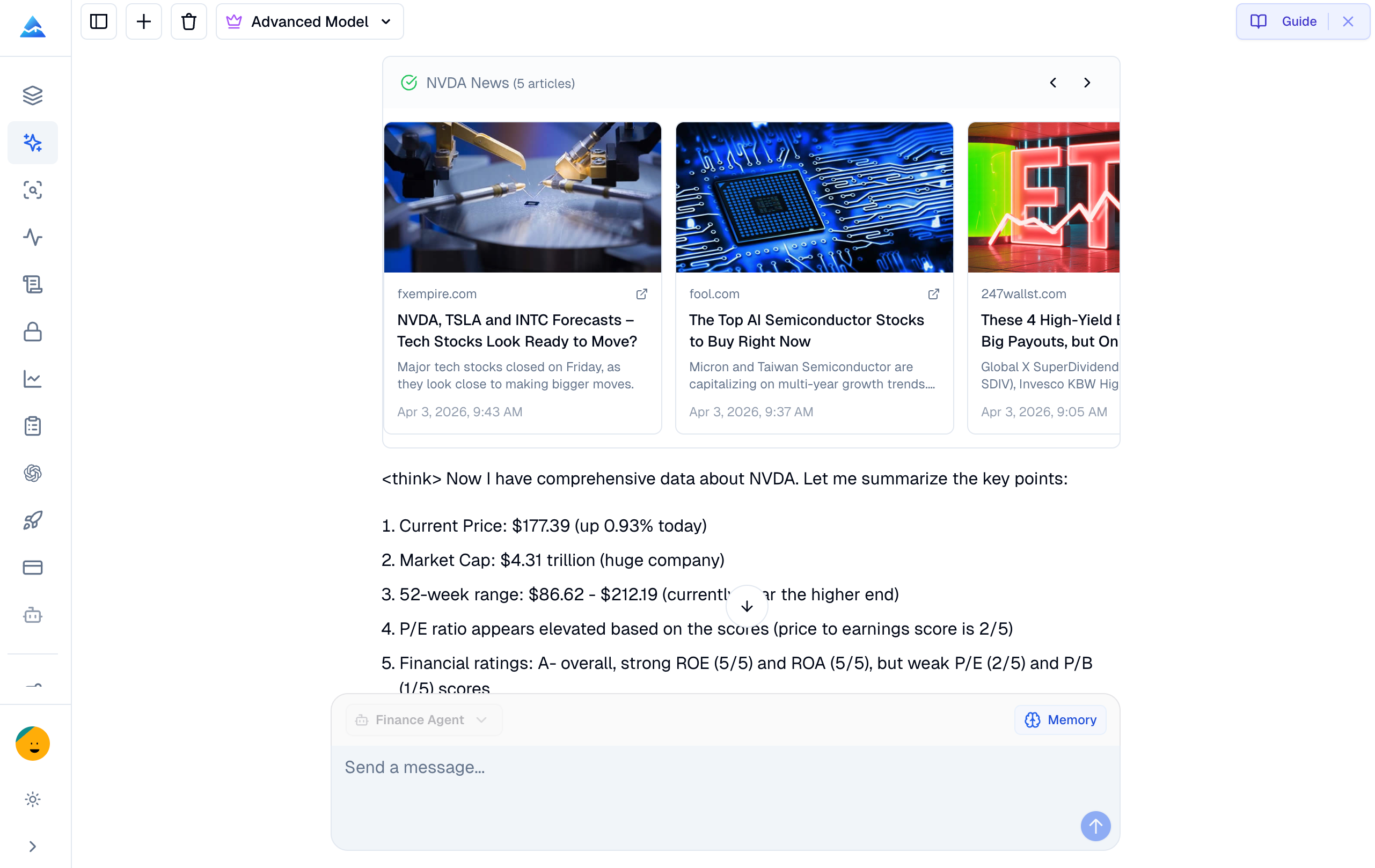
What a finance agent does
A request can lead to one or more tool calls, followed by an explanation of the returned data. Available tool families include quotes, company statements, ratios, analyst estimates, news, calendars and screening.
A tool-connected assistant can retrieve information beyond a model's training data. This is not exclusive to a specialized finance product: general assistants may also use search or connectors. Compare actual access and outputs rather than assuming a competitor has only a training cutoff.
No industry adoption statistic, hours-saved benchmark or personal trading experience is used to establish the product's value here. The useful test is whether a specific research question produces traceable inputs and a defensible answer.
Quotes, news and calendars

Ask for the symbol, exchange, quote timestamp and currency alongside the price. The quote tool returns provider data and a timestamp when available; an on-demand API response is not a guaranteed streaming exchange feed. Coverage and delay can differ across instruments and data products.
News has a publication time, while calendars describe scheduled or reported events. Neither becomes current merely because the assistant retrieved it now. Check whether an earnings event is confirmed or estimated and whether the displayed time matches your timezone.
A useful prompt is: "Show the latest available quote for AAPL, including exchange and timestamp. List recent company news separately with publication dates and original links. Flag missing fields." This is an example request, not a measured result.
Company financials and estimates
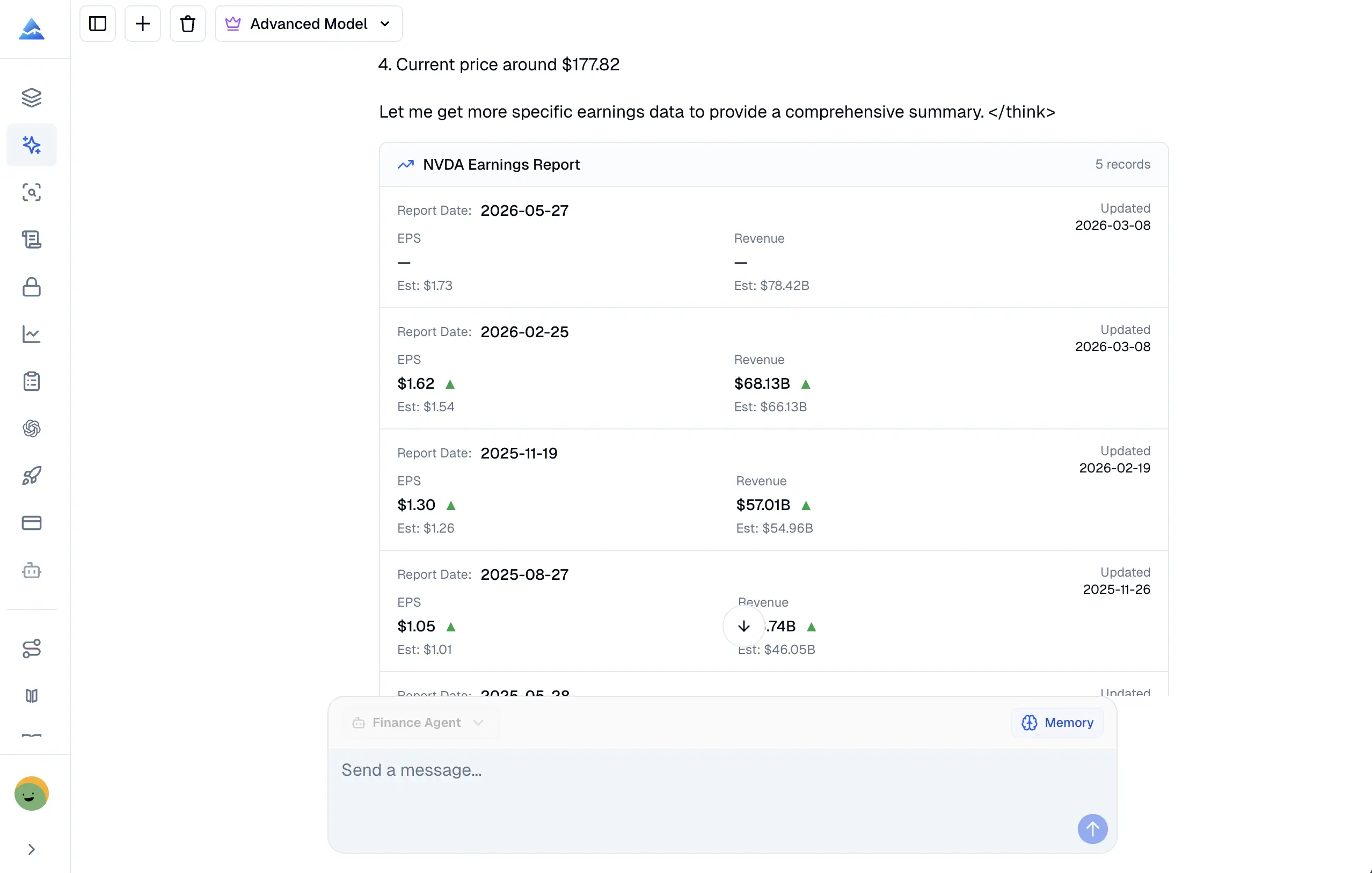
Financial tools include income statements, balance sheets, cash flow, ratios, growth data, analyst estimates and filing-related information. For a company comparison, keep these distinctions explicit:
| Field | Check before comparing |
|---|---|
| Revenue or earnings | Annual, quarterly or trailing period; currency and units |
| Growth | The two periods used and the denominator |
| Margin | The exact numerator and revenue basis |
| Analyst estimate | Forecast period, number of contributing estimates and update date if provided |
| Filing | Reporting period, filing date and whether an amendment exists |
| Ownership disclosure | Reporting date versus publication date; it is not a live position feed |
An estimate is not a reported result. A company's fiscal year may differ from the calendar year. Standardized provider fields can also differ from the issuer's presentation. Follow the filing link or verify material figures through SEC EDGAR or the company's investor-relations site.
For revenue growth, request the raw values before the percentage. For example, revenue rising from 100 to 120 in the same units implies 20% growth. That arithmetic example does not establish any company's actual growth rate.
Natural-language screening has tool boundaries
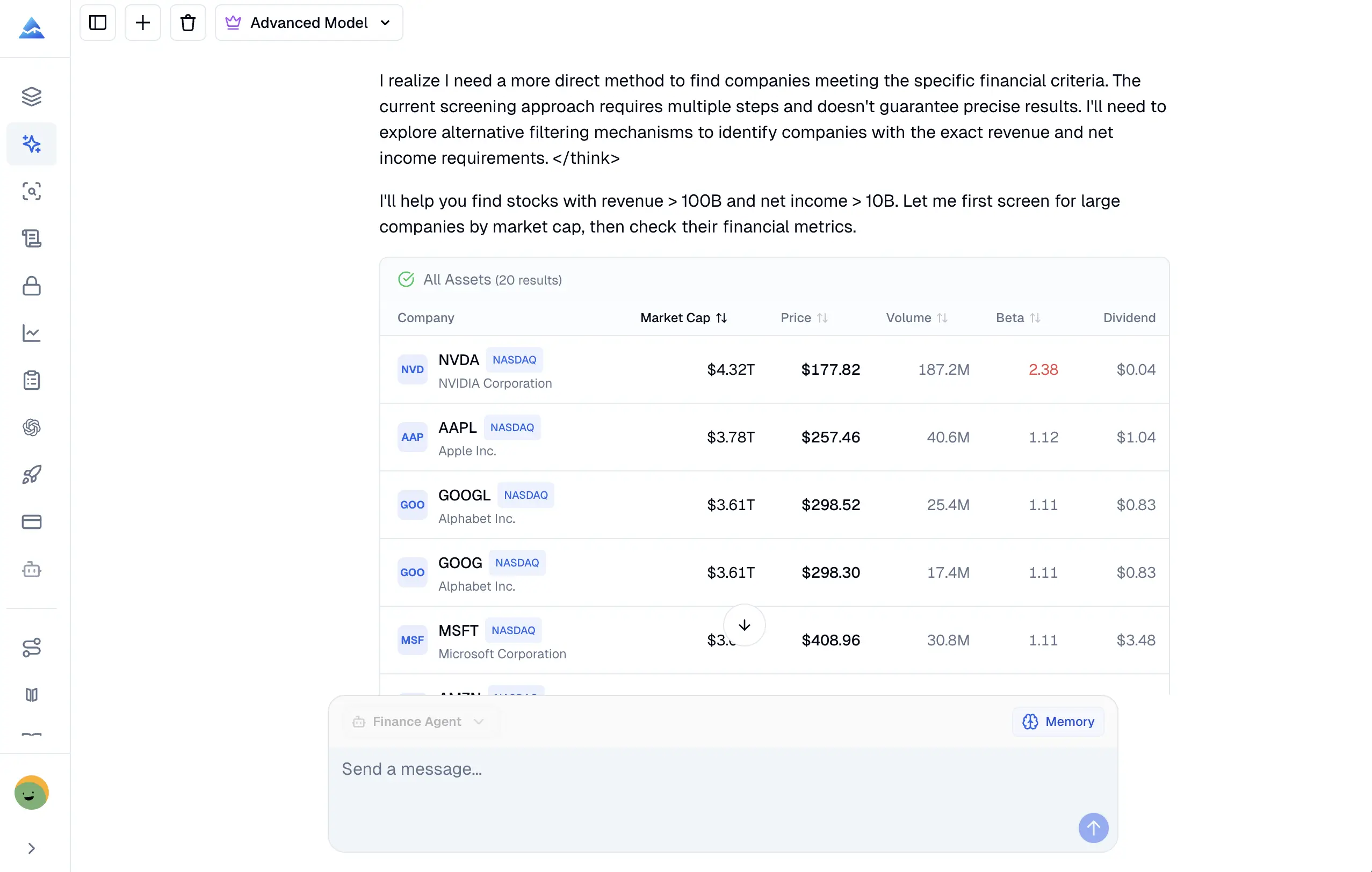
The registered asset screener supports fields such as market cap, sector, industry, country, exchange, price, volume, beta, dividend and asset type. A conversational request can be broader than a single tool's schema.
For example, "Find US technology stocks above $10 billion market cap, then compare their P/E, revenue growth and free cash flow" should be treated as a screening step followed by separate financial lookups where those criteria are not direct filters. Ask which criteria were actually applied, how many results were returned and which follow-up metrics were unavailable.
A capped result list is not proof that every qualifying stock was examined. "Strong moat" and "undervalued" also require a stated analytical framework; they are not objective labels supplied by a price filter.
AI stock-ranking tools are another input. The Stock Picker uses provider scores and snapshots; a score is not a verified probability of making money. Do not count an agent's restatement of the same provider score as independent confirmation.
Check original sources
Open material sources and distinguish the publication date from retrieval time. A sample of public discussions does not measure the sentiment of all investors or establish institutional positioning. Popularity, engagement and a bullish label are not evidence that a claim is true.
Confirm important leadership details with company filings or official biographies, especially when names are ambiguous or employment information may be outdated.
A research workflow with an audit trail
- Define the question and time horizon, including the exact companies or market.
- Request source fields and dates before asking for a conclusion.
- Separate reported facts, forecasts, calculations and interpretation in the output.
- Recalculate important ratios from the displayed inputs and resolve conflicting sources.
- Save the question, tool results and remaining uncertainties with the research note.
This workflow helps expose errors; it does not certify that the agent will find all of them automatically. There is no guaranteed 24-hour filing ingestion, daily estimate refresh or negligible data lag established here.
Access and related Pineify tools
Open Finance Agent from your Pineify workspace and check the current account access and credit balance. Current plans describe billing and entitlements; this article does not promise a fixed number of free queries or unlimited future services.
The Finance Agent supports research. Pine coding and visual configuration create scripts; TradingView evaluates Pine strategy backtests. The TradingView optimizer and imported backtest analysis serve separate purposes. Research, code generation, historical testing and broker execution should not be described as a single automatic deployment step.
Nor is broad feature overlap proof of Bloomberg Terminal equivalence. Compare the specific dataset, license, depth, analytics and execution requirements needed for the job.