The Market Facilitation Index, often written BW MFI, divides a bar's high–low range by its volume. Bill Williams used changes in this ratio together with changes in volume to classify market activity. The calculation does not identify institutional orders, determine price direction, or establish that a breakout will succeed.
Backtrader can combine a lower-timeframe execution feed with a higher-timeframe filter. The engineering problem is knowing which bar is available when, allowing indicators to warm up, and managing pending orders. Adding a weekly filter does not by itself demonstrate fewer false signals or better returns.
Funding-rate strategies seek to receive periodic payments on perpetual futures while managing the price exposure and costs of holding the position. A spot–perpetual hedge can reduce directional exposure, but it does not create guaranteed income: funding can reverse, the basis can move, and one leg can be liquidated while the other remains open.
Multi-timeframe candle analysis places higher-timeframe price information beside or over a lower-timeframe chart. On TradingView, you can use a built-in range overlay, a community candle script, or separate charts. The essential distinction is whether the higher-timeframe candle is still forming or has closed; treating an unfinished candle as final can change both signals and backtests.
Average True Range (ATR) measures recent price-range volatility, including gaps. It can supply a consistent unit for stop distances, position sizing, and volatility filters. It does not predict direction or guarantee that a stop will survive ordinary price fluctuations. An ATR strategy still needs explicit entry, exit, sizing, and execution rules.
A Donchian breakout strategy compares price with a range established by earlier bars. Its central implementation requirement is to exclude the signal bar from the breakout threshold. A close cannot exceed the highest high of a window that includes that same close's bar.
Ichimoku combines range midpoints and displaced plots to describe price structure. The cloud drawn ahead of price uses information already available; its forward position is not a forecast. A usable trading strategy must add explicit signal timing, exits and position sizing.
Kaufman's Adaptive Moving Average (KAMA) changes its smoothing weight with the efficiency of a price path. A steady move and a large back-and-forth move can have very different efficiency ratios even when both are volatile. KAMA therefore does not simply speed up whenever volatility rises.
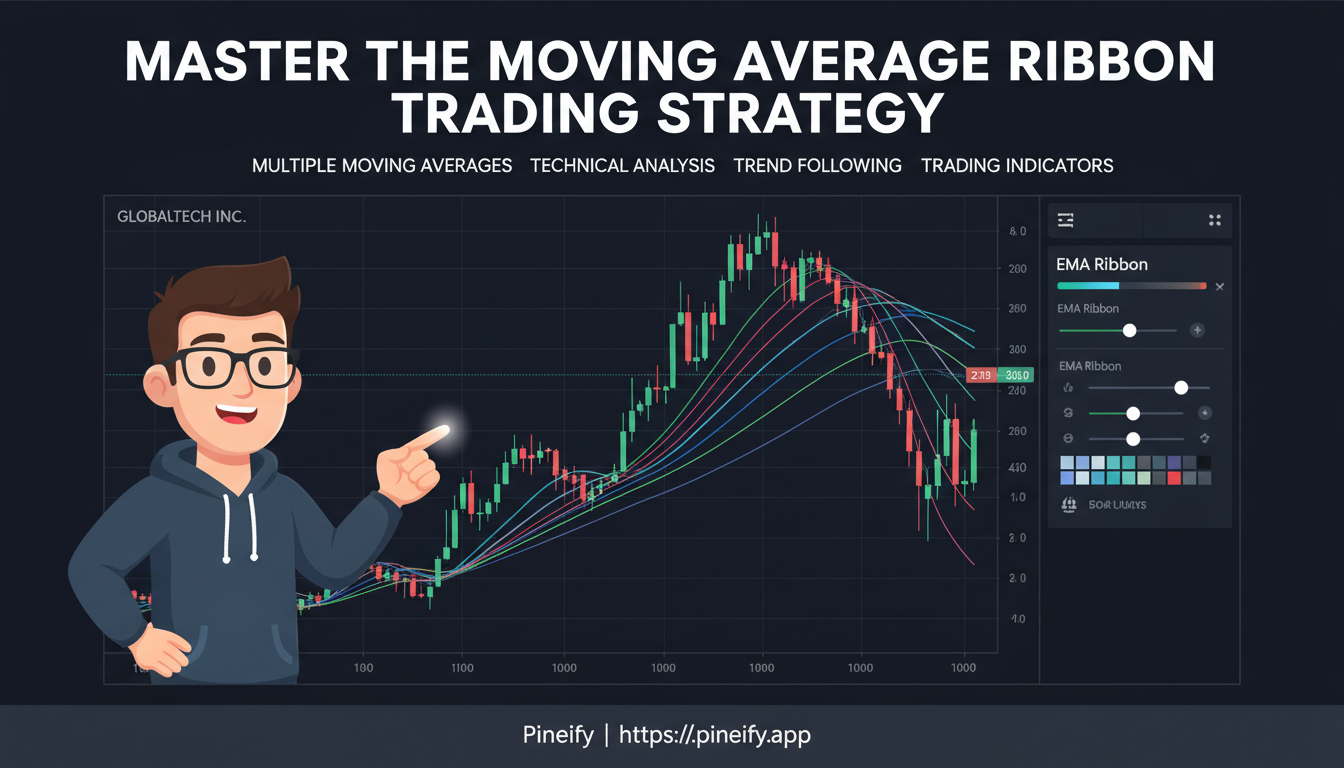
A moving average ribbon plots several lookback lengths on the same chart. It makes their ordering, slopes and separation visible. Different lengths on a five-minute chart remain five-minute calculations; they are not separate timeframes or independent evidence of a profitable trend.
An EMA strategy built with Pineify is a set of rules you configure and generate as Pine Script. There is no single three-EMA system or verified return implied by that name. Begin with an explicit crossover rule, then check the generated strategy's calculations and trades in TradingView.