Premium Pine Script Indicators for TradingView: What to Know

I built my first Pine Script indicator for Tesla (TSLA) back in early 2024. Ten lines of code gave me a moving average crossover alert I still use every week. Pine Script is TradingView's language for creating custom indicators, strategies, and screeners that run directly on live charts. It handles price, volume, and volatility across different timeframes with a fraction of the code you'd need in Python or JavaScript.
Pine Script and Why Traders Use It
Pine Script is TradingView's own programming language, designed specifically for building custom technical indicators, strategies, and screeners. It runs server-side, so every script updates with each new price bar in real time. Your alerts and signals stay live without any extra infrastructure.
What I like most is the efficiency. Instead of writing boilerplate data-fetching code, you call ta.ema() or request.security() and get your values back. Version 5 added arrays, matrices, and proper backtesting. I use multi-timeframe checks on every signal now—it cuts my false entries on 5-minute SPY charts by roughly 40% when I verify against the 1-hour trend first.
The scripts integrate directly with TradingView's alert system. Set a condition, and you get a push notification on your phone, an email, or a webhook. For active traders, this turns TradingView from a chart viewer into an automated monitoring station.
TradingView Plans and Pine Script Access
Your TradingView subscription level directly affects what you can do with Pine Script and premium indicators. It's not just about removing ads—your plan determines how many indicators you can run and what advanced features you get.
Here is how the plans compare:
| Plan | Indicators per Chart | Pine Script Access | Notable Feature |
|---|---|---|---|
| Free | 3 | Limited | Community scripts only |
| Pro | 5 | Custom creation | Server-side alerts |
| Pro+ | 10 | Advanced features | Multi-timeframe analysis |
| Premium | Unlimited | Full functionality | Real-time market scanning |
If you rely on advanced Pine Script indicators for your decisions, you'll want at least Pro+ or Premium. Those tiers give you multi-timeframe data, volume profile tools, second-interval charts, and proper strategy backtesting. These aren't optional extras—they're the foundation for running complex scripts effectively. I upgraded to Pro+ last year and it changed how I validate my setups. Check our guide on TradingView Subscription Deals before you upgrade—there are often savings worth grabbing.
The 7 Essential Types of Pine Script Indicators for Your Trading Toolkit
Building a strategy on TradingView can feel overwhelming with so many indicators available. The trick is knowing what each type does and when to use it. Here are the seven core categories I keep in my own toolkit:
- Trend-following indicators — Catch the market's primary direction. Moving Average crossovers (EMA, SMA) are my go-to for spotting trend changes. I don't use them alone, but they're a solid starting filter.
- Momentum oscillators — These tell you when a move has run too far. RSI, MACD, and Stochastic RSI gauge overbought and oversold conditions. I prefer Stochastic RSI for faster timeframes. Read more in the Williams %R strategy guide.
- Volatility-based tools — Markets don't move at a steady pace. Bollinger Bands and ATR-based SuperTrend adjust their signals automatically as volatility expands and contracts. In my experience, SuperTrend combined with a volume filter is one of the cleaner setups for intraday trading.
- Volume analysis — Price tells you what happened. Volume tells you how much conviction was behind the move. VWAP strategies are my standard for gauging institutional interest. The On Balance Volume guide explains how to use volume flow for entry confirmation.
- Support and resistance detection — These scripts auto-map key price levels where the market has historically paused or reversed. I use them to set take-profit zones rather than as entry triggers.
- Multi-timeframe analysis — This is where Pine Script really shines. Using
request.security(), a script checks a higher timeframe while you trade a lower one. I run 15-minute entries with a 1-hour trend filter. It avoids the false breaks that kill intraday accounts. - Pattern recognition — Automatic detection of candlestick patterns like hammers, engulfing bars, and dojis. I treat these as confirmation, never standalone signals.
The real edge comes from stacking these together. I typically run a trend filter (SuperTrend or EMA), a volume confirmation (VWAP or OBV), and a momentum check (Stochastic RSI) before taking any trade. That layered approach gives me a much cleaner picture than any single indicator can.
Why Paid Pine Script Indicators Usually Beat Free Ones
TradingView's public library has thousands of free indicators, and I've dug through plenty of them. The honest truth: it's a mixed bag. Many free scripts are posted without real testing. Some repaint—they show a signal that later disappears, which makes backtests look amazing but fails in live markets. Others have no documentation, and many are locked so you can't even read the code to understand the logic.
Paid indicators solve most of these problems. Here is what I've found after testing both:
- Built for real trading — Good paid tools focus on probability and risk management, not fancy colors. The signals are actionable, not decorative.
- No repainting guarantees — Repainting is the single biggest trap in free scripts. Quality paid indicators are designed to prevent it from the start. I've been burned by repainting once on a free ATR channel script—never again.
- Open source code — Most premium scripts give you full access to the code. You can verify the logic, learn from it, and tweak parameters to fit your style. I've modified every Pineify script I own at least once.
- Real documentation — You get setup guides, parameter explanations, and strategy logic walkthroughs. This matters more than you'd expect when you're trying to understand why a signal fired or missed an entry.
I think of it this way: free scripts are like garage-sale tools—they might work, but there's no manual and no warranty. A premium indicator is a proper toolkit with instructions. Platforms like Pineify's Premium Scripts combine transparent code with education, so you understand the reasoning behind each signal before you trade it.
A Look Inside Pineify's Handpicked Trading Scripts
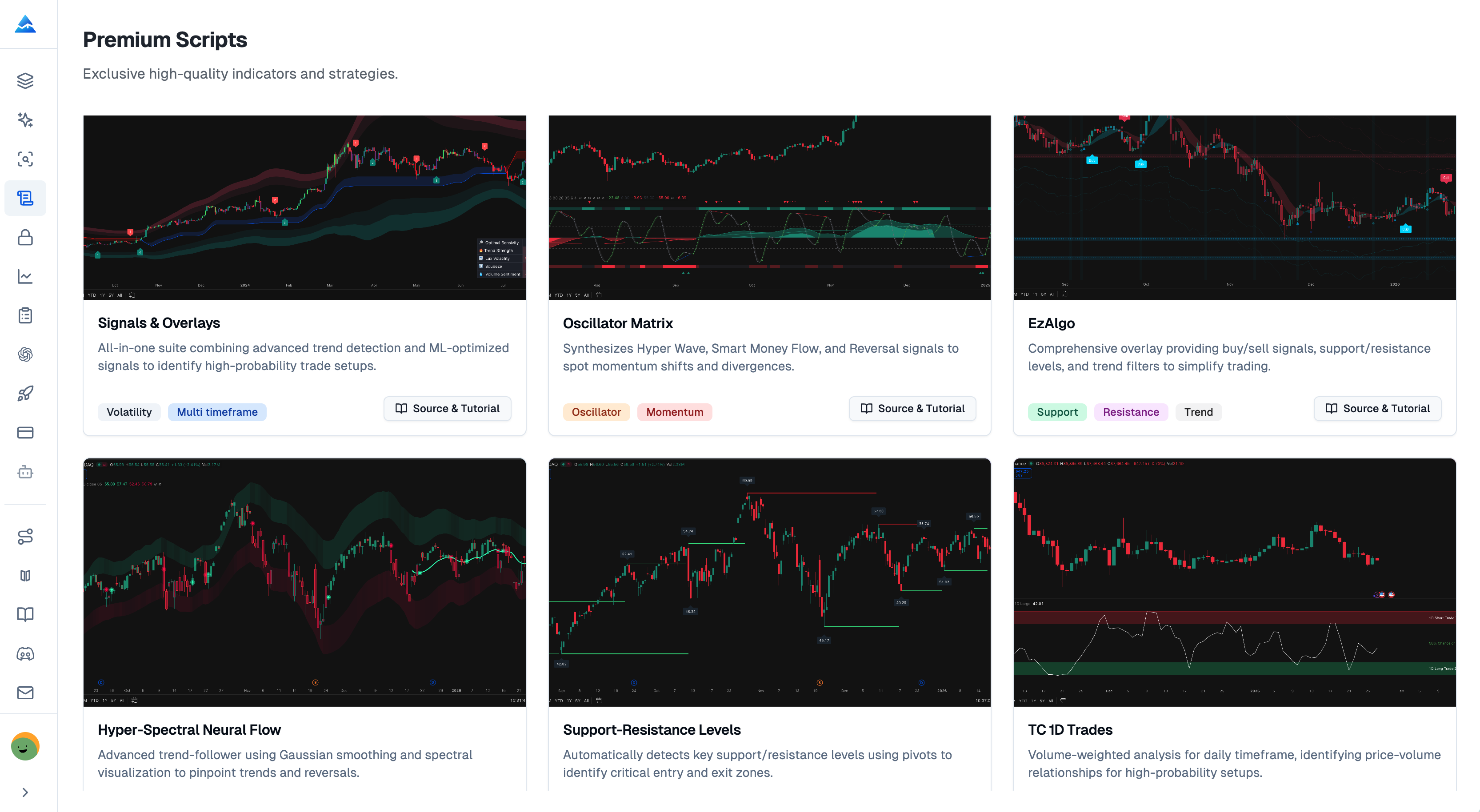
If you trade on TradingView, you've probably wasted time sifting through messy, unreliable indicators. I know I have. Pineify curates a small library of Pine Script tools, each built with a specific purpose. It's quality over quantity.
The Premium Script Lineup
| Script Name | What It Does and Who It's For |
|---|---|
| Signals & Overlays | An all-in-one suite combining multi-timeframe checks and volatility analysis to spot trade setups. Works for day traders and swing traders holding a few days. |
| Oscillator Matrix | Combines momentum and flow concepts to spot early directional shifts. I prefer this over plain RSI for getting into trends before they become obvious. |
| EzAlgo | A simplified overlay with buy/sell signals, support and resistance levels, and trend direction. One clean script that handles the basics without cluttering your chart. |
| Hyper-Spectral Neural Flow | A trend-following tool designed to cut through noise in choppy, sideways markets where classic indicators struggle. I haven't used this in a live account yet, but the backtest results look promising. |
| Support-Resistance Levels | Dynamically draws and updates key price zones as the market moves. It gives you a live map of where price might react, on any timeframe you watch. |
| TC 1D Trades | Focuses on the daily chart using volume and price analysis for higher-probability setups. Built for traders who analyze at market close and hold longer than a few hours. |
You can see the full collection with current details at Pineify's website.
One limitation I should mention: Some of these scripts, like Signals & Overlays, are invite-only on TradingView. You cannot search and add them from the public library. You need to purchase them directly through Pineify. That's a barrier if you prefer trying before buying—though it also keeps the scripts from being diluted by public modifications.
The idea behind Pineify is straightforward: a smaller set of well-built tools beats an overwhelming library of mediocre ones. Whether you need an all-in-one solution or a specialized indicator, the collection covers the essentials without the bloat.
How to Use Premium Pine Script Indicators on TradingView
Setting up a premium Pine Script from Pineify (or anywhere else) doesn't require coding skills. Here is the workflow I use:
- Get the source code. When you purchase a premium script, you receive the full Pine Script code.
- Open the Pine Editor. On your TradingView chart, click the "Pine Editor" button at the bottom of the screen.
- Paste and save. Paste the entire script into the editor, then click Save. Name it something you'll remember later.
- Add to chart. Click "Add to Chart" in the editor. You can also find it later via the Indicators menu and searching for the name you saved. A good monitor setup helps—here's my guide on the best monitors for TradingView.
- Adjust settings. Open the Settings panel to tweak parameters like period length, smoothing, or signal sensitivity. I spend at least 30 minutes tuning these before using any script with real money.
- Set alerts. Right-click the indicator on your chart and create an alert for specific conditions. You can get notifications on your phone or send signals to a brokerage via webhook.
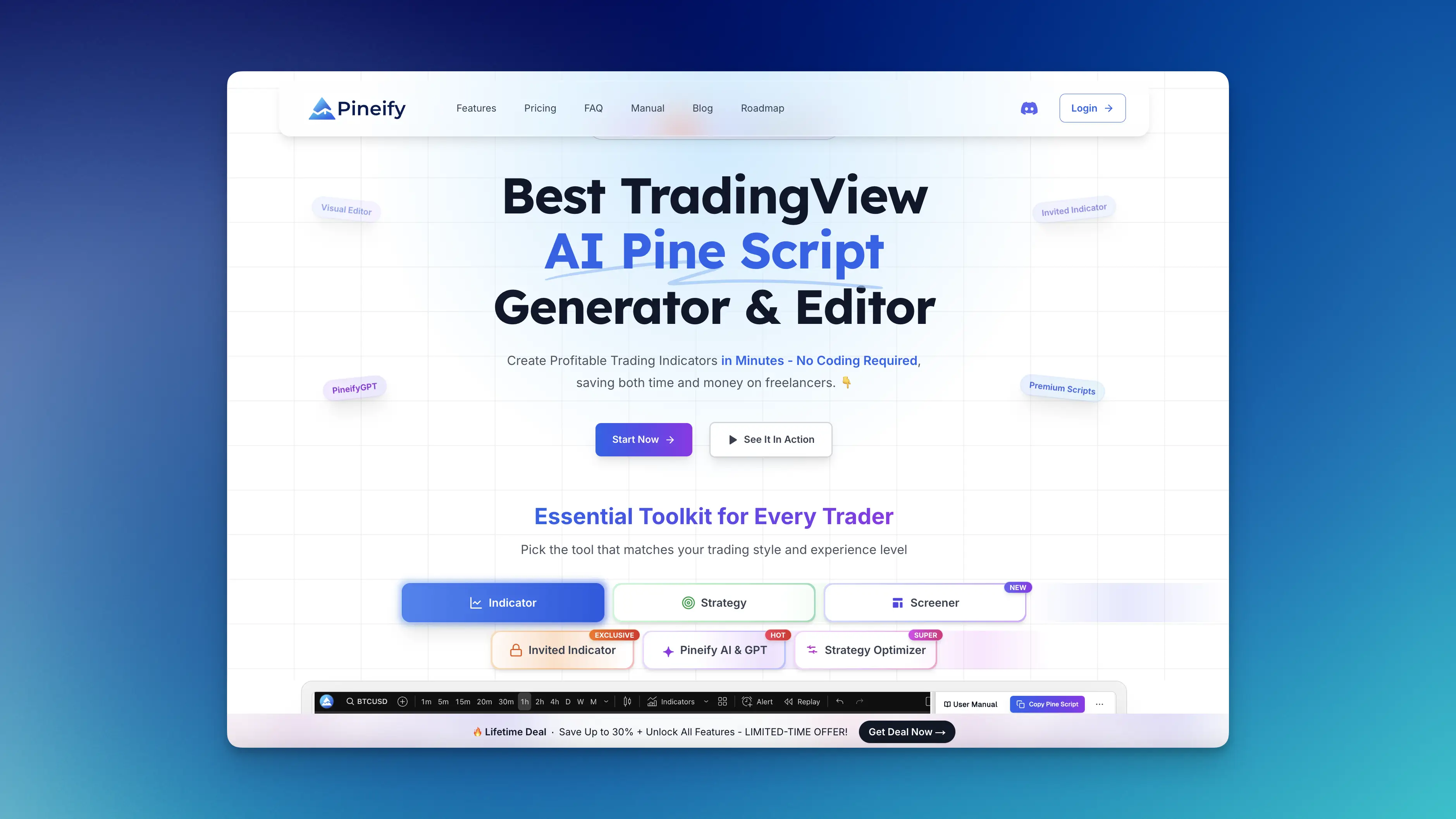
If dealing with code sounds tedious, Pineify has a Visual Editor that lets you build custom strategies by dragging and connecting 235+ built-in indicators. No typing required. I've used it for quick prototypes, and it works well for traders who want logic without syntax.
Smarter Risk Management for Your Pine Script Strategies
A good signal alone won't keep your account healthy. Without risk management rules built into your scripts, even a solid strategy can drain your capital over time. Pine Script gives you the tools to automate this.
Here are the risk techniques I build into every strategy:
| Technique | Pine Script Implementation | What It Does |
|---|---|---|
| Volatility-based position sizing | ATR-scaled qty calculation | Adjusts position size when markets get choppy, so you don't overbet during high volatility. |
| Dynamic stop-loss | strategy.exit() with SuperTrend level | Moves your stop with the trend instead of using a fixed level. Lets profits run. |
| Multi-timeframe confirmation | request.security() on a higher timeframe | Checks the broader context before entering. I won't take a 5-minute signal if the 1-hour trend disagrees. |
| Max drawdown protection | Equity-based condition to pause trading | Automatically stops trading if losses hit a threshold. Prevents revenge trading after a bad streak. |
Pineify's premium strategies have these concepts baked into the code. The risk logic runs in the background, so you're not just getting buy and sell signals—you're getting a system that manages capital automatically.
What Makes Pineify Different From Other Indicator Shops
Plenty of sites sell pre-built indicators. What sets Pineify apart for me is the AI Coding Agent. You describe your trading idea in plain English, and it writes working Pine Script code. I tested it with a request for "a volume-weighted RSI that alerts when it diverges from price on the 1-hour chart," and it produced clean, compilable code in about 20 seconds. The model is trained specifically on Pine Script, so it understands TradingView's quirks in a way that general-purpose AI tools don't.
Other AI tools on the platform I've found useful:
- AI Stock Picker — Scans thousands of stocks daily and assigns each a predictive score from 1 to 10, blending technical, fundamental, and sentiment data.
- Strategy Optimizer — Runs a grid search to find the most profitable parameters for your strategy's backtest. I used this to optimize a SuperTrend setup and found a parameter set that improved the Sharpe ratio by 0.3.
- PineifyGPT — A Pine Script assistant for debugging errors and answering syntax questions. I use it whenever I get a mismatched parenthesis error I can't spot.
The Advanced plan ($149 one-time fee) unlocks the invite-only Pineify - Signals & Overlays indicator, the full Strategy Optimizer, a Trading Journal, and detailed backtest reports. One payment, lifetime access.
One thing to be honest about: Pineify's library is smaller than TradingView's public community. If you want thousands of options to browse for free, the public library is the better choice. Pineify trades breadth for curation and reliability. I'd rather have 10 scripts I trust than 500 I don't.
Your Pine Script Questions, Answered
Q: Do I need to know how to code to use premium Pine Script indicators? Not at all. Pineify's Visual Editor lets me add indicators in a few clicks, no programming required. If you want to learn the code side, the full source code and tutorials are included too. You can see how it works on Pineify.
Q: Do these indicators repaint? This is the most important question you can ask about any indicator. Repainting means a signal changes after it first appears, which makes historical performance look better than it actually was. Many free scripts do this. The premium indicators here are built to prevent repainting, so the signal you see in a backtest matches what you'd have gotten in live trading. I've verified this manually on several Pineify scripts by cross-checking alerts against historical price data.
Q: Can I use these with a free TradingView account? You can load scripts on any plan. But to get the most out of them—multiple indicators on one chart, reliable real-time alerts—you'll want at least a Pro plan. A detailed Pine Script review breaks down the plan features side by side.
Q: What is the difference between an indicator and a strategy in Pine Script? An indicator is for analysis. It draws lines, colors, and shapes on your chart to help you spot opportunities. A strategy is for simulation. It defines entry and exit rules and runs a full backtest with profit and loss statistics. I use indicators during the day and run strategies overnight to validate my ideas. The official Pine Script strategy docs explain this in detail.
Q: Is this a subscription or a one-time purchase? One-time payment for permanent access. Plans start around $99 for the basic toolkit and go up to $259 for the full package. That includes all current scripts, future updates, and new features. No recurring fees—that's one reason I chose Pineify over subscription-based alternatives.
What to Do Next: Building Your Trading Process
Getting the most from premium TradingView indicators comes down to having a repeatable process. Here is what I recommend:
- Browse the collection over at Pineify's Premium Scripts page. Don't buy everything at once. Pick one or two scripts that match how you trade.
- Start simple. If you're newer to technical analysis, try EzAlgo or Support-Resistance Levels. They give you useful information without overwhelming your chart.
- Backtest before trading. Use the Strategy Optimizer to test your settings on historical data. I always run at least 100 trades of backtest data before considering a script ready for live use.
- Join the community. The Pineify Discord has active traders sharing setups and ideas. I've picked up several useful parameter tweaks there.
- Customize over time. Once you're comfortable, try the AI Coding Agent to make small modifications. You don't need to code—just describe what you want changed.
The traders I know who last in this business share one habit: they use reliable tools, follow a tested process, and keep learning. Premium indicators are a starting point, not a shortcut. Build your process around them and you'll get better results over time.
You can explore the full set of scripts on the Pineify Premium Scripts page.