Knowing when the trend has actually flipped—instead of chasing noise—is one of the hardest parts of trend trading. HalfTrend (HT) is one indicator to evaluate for that purpose. It draws a single trend line that switches between support and resistance, plus an ATR-based channel around it, and it marks Buy and Sell only when the internal trend state changes. That keeps signals clear and avoids the clutter of many overlapping lines.
In the Pineify implementation, price comparisons and moving averages over the amplitude lookback determine trend transitions. ATR determines channel width and arrow offsets; it is not the trend-switch threshold. When the trend flips from down to up, you get a Buy signal and the line turns into support (often shown in blue); when it flips from up to down, you get a Sell signal and the line acts as resistance (often shown in red). The ATR High and ATR Low bands form a ribbon that shows the channel around the trend line. Compare amplitude values on the same symbol and period before choosing one. The examples below describe possible rules, not tested performance.
TradeStation strategy testing and Pineify Backtest Deep Dive operate at different stages. TradeStation can execute EasyLanguage strategy rules in its testing environment. Pineify's deep report analyzes an existing trade dataset. A report with more charts does not independently validate the execution model that produced those trades.
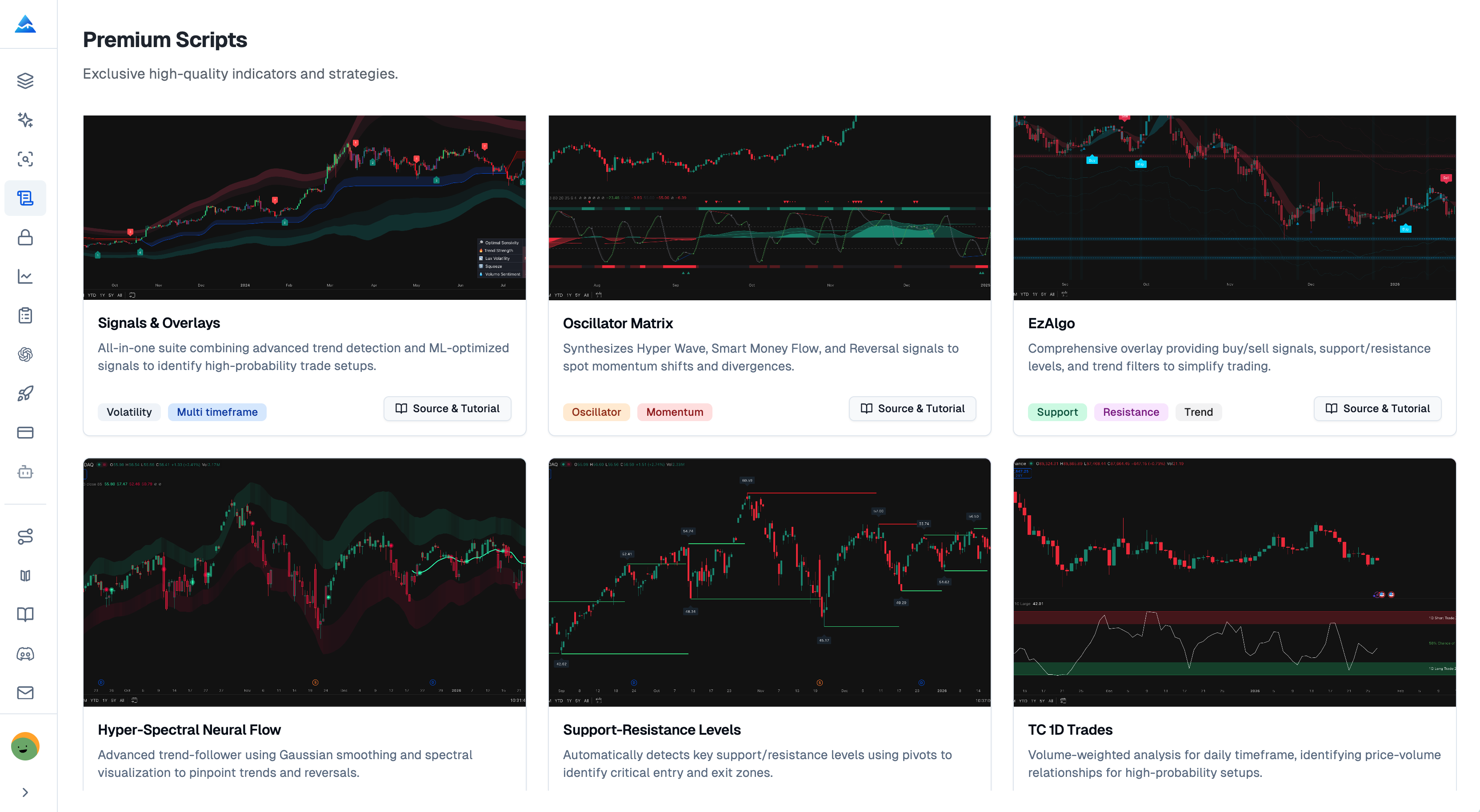
An indicator purchase can provide permission to run a script, access to its source, or a collection of educational material. Those are different deliverables. Before comparing marketplaces, identify the exact script and the rights included in the offer. A paid label does not establish better signals, and a free publication can include inspectable source code and detailed documentation.
This guide is published by Pineify. It compares evaluation criteria and documented access paths, not independently measured trading performance.
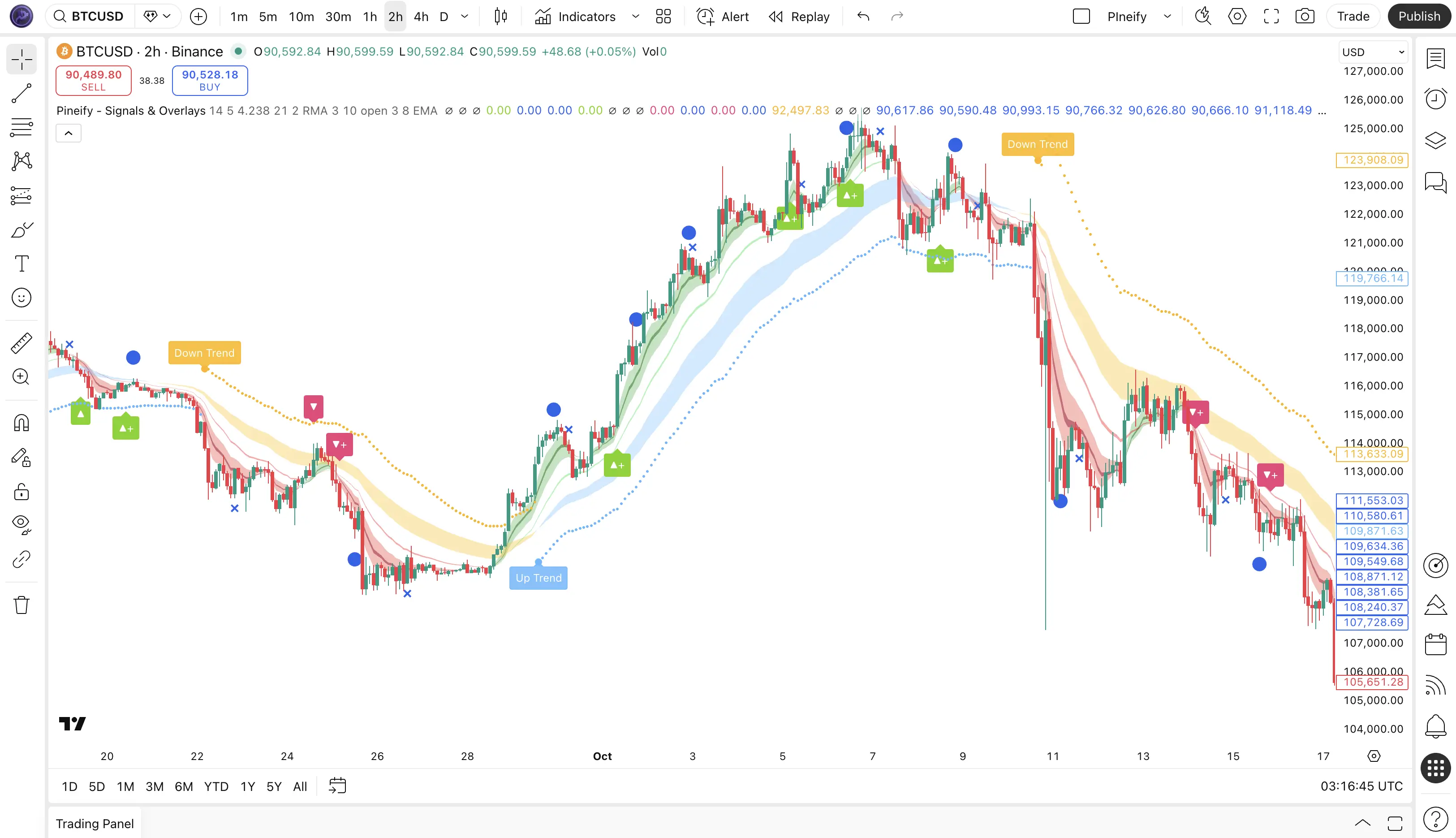
Smart money concepts and Pineify Signals and Overlays need separate checks. Smart Money Concepts (SMC) is a collection of price-action labels and trading hypotheses, including order blocks, structure breaks, liquidity sweeps, and fair value gaps. Those labels can organize a chart, but ordinary candles do not reveal the identity or intention of the traders behind a move. Pineify Signals & Overlays is a separate invite-only indicator; its access model does not establish that it detects institutional orders or delivers a particular win rate.
How much does TradingView cost? It depends on the plan, billing cycle, account classification, taxes and optional services. Compare the total charge at checkout rather than treating a monthly equivalent on an annual offer as a monthly subscription.
Kodify alternatives in Pineify start from three different needs: learning Pine Script, generating custom code, or obtaining an existing script. Those needs call for different evidence. A tutorial, an AI-generated draft and a paid indicator are not interchangeable guarantees of a usable trading strategy.
What are the best AI options trading platforms? This guide does not rank them by returns. It compares Options AI, VantagePoint, Tickeron, Trade Ideas, and Pineify using official documentation for chain research, stock signals, strategy ideas, and execution workflows. A stock forecast is not an option recommendation, and an alert product is not necessarily an options broker.
MT5 trend indicators are the studies MetaTrader 5 groups under Trend. They do not all measure direction. Moving averages summarize price, ADX measures directional strength, and Standard Deviation measures dispersion. Start with the quantity you need to measure rather than treating every item as an entry signal.
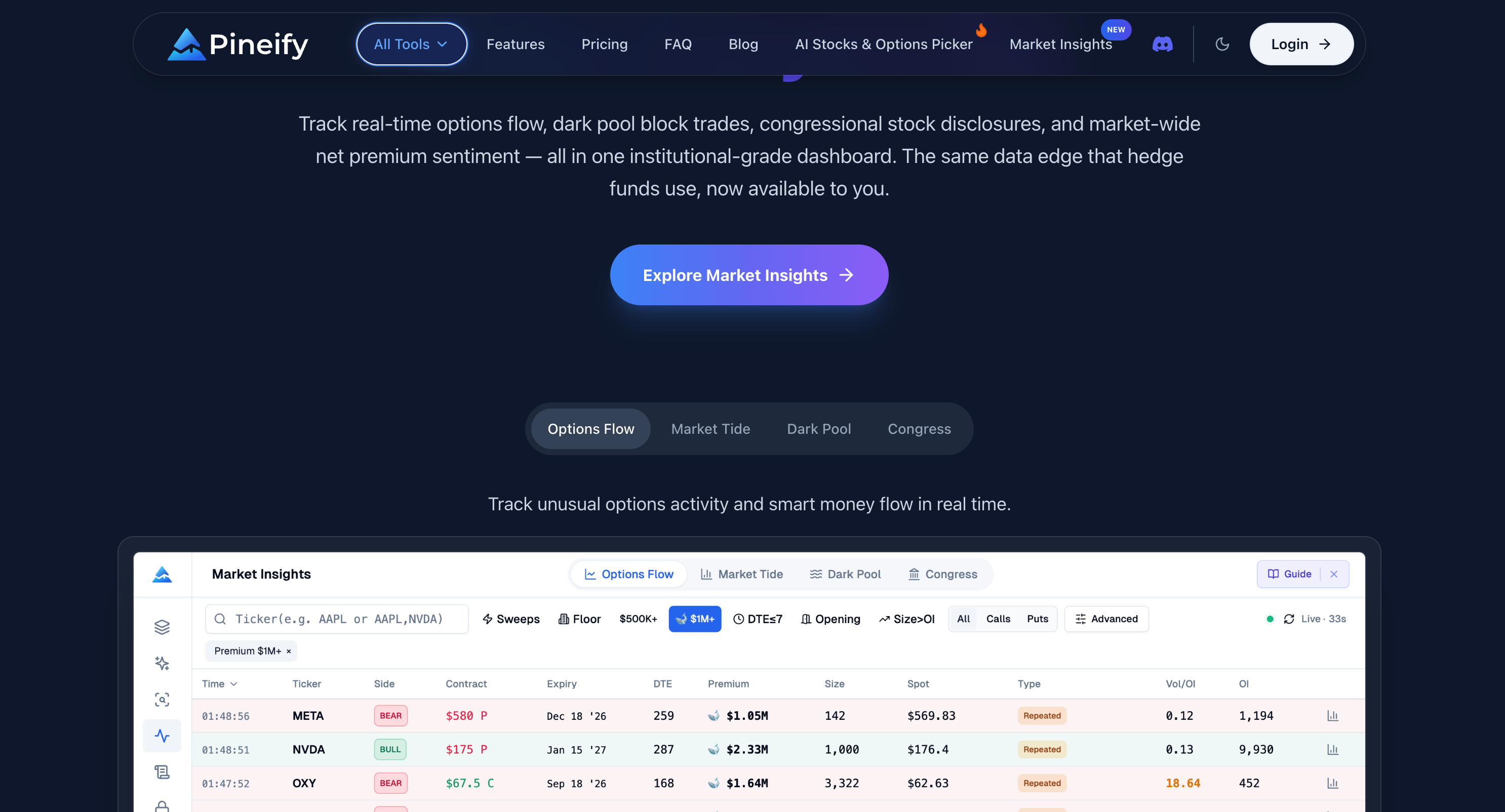
Options flow is a record of option executions, often filtered by size, premium, or unusual volume. It can help identify contracts worth investigating. A trade print alone does not reveal the trader's identity, whether the position is opening or closing, or the risk of the rest of that trader's portfolio.
Which AI finance agent is best? None fits every workflow. Pineify, Fiscal.ai, Magnifi, Prospero.ai, and Intellectia AI differ by research task, data traceability, plan limits, and account permissions. This comparison uses documented product functions and buyer checks. It does not report controlled performance tests or rank returns.