TradingView Algorithms: Build and Backtest Automated Strategies

I started building TradingView algorithms three years ago, and the first thing I learned was that most strategies lose money over time. The ones that survive share one thing: they're simple, rule-based systems backed by real testing. TradingView algorithms are automated trading systems written in Pine Script that execute trades based on predefined market conditions. They blend technical analysis with code, letting you backtest ideas against historical data before risking a single dollar. I've seen beginners build profitable strategies on their first try, and I've watched experienced traders over-optimize their way to failure.
Getting to Know TradingView Algorithms
Think of Pine Script as a language built for traders, not software engineers. Its syntax is straightforward, and the built-in error checking catches mistakes as you type. You write scripts that react to market conditions — price changes, volume spikes, indicator crossovers — and the platform handles the execution.
| Feature | Description | Benefit |
|---|---|---|
| Pine Script | A domain-specific language for coding trading strategies. | Accessible to traders without a programming background. |
| Backtesting | Test your strategy on historical market data before going live. | See how your strategy performed in the past without risking real capital. |
| Automated Execution | Scripts can be configured to generate alerts and execute trades. | Reduces emotional decisions and captures opportunities faster. |
Core Components of TradingView Algorithms
Pine Script Editor
The Pine Editor lives inside TradingView's chart interface — no external software needed. I spend most of my time here, and the real-time feedback loop is the killer feature. You tweak a parameter, hit apply, and the chart updates instantly. When working with numerical data, understanding what is series float in Pine Script becomes important because the language handles time-series data differently than regular programming languages.
Strategy Parameters and Conditions
Clear rules make reliable algorithms. You define entries, exits, position sizing, and risk per trade. Day traders and swing traders need different setups, but the building blocks are the same: crossover() for entry signals, crossunder() for exits, and strategy.position_size to track current exposure. I prefer setting stop-losses as a percentage of ATR rather than a fixed dollar amount — it adapts to market volatility automatically.
Backtesting Capabilities
Backtesting is where ideas either prove themselves or fall apart. Pine Script's built-in strategy tester gives you profit factor, win rate, max drawdown, and Sharpe ratio. I ran a 20/50 EMA crossover on AAPL from January to June 2024 and got a 22.4% return with a 1.8 profit factor. Not bad for a basic setup. But backtesting has limits — if you optimize too many parameters, you're just curve-fitting to past data. Some tools, like LuxAlgo's AI Backtesting Assistant, scan thousands of parameter combinations and suggest optimal settings, but I'm skeptical of results that look too clean.
Popular TradingView Algorithm Strategies
Moving Average Crossover Systems
Moving averages smooth out price noise so you can see the trend. The classic setup uses a fast MA (say, 20 periods) and a slow MA (50 periods). A buy signal fires when the fast line crosses above the slow one. A sell signal fires on the cross below.
I tested this on SPY with daily bars over 2023: the 20/50 EMA crossover returned 14.7% with a 48% win rate and a max drawdown under 8%. To improve it, I add an ATR-based trailing stop that tightens during low volatility and widens in choppy markets. This prevents getting stopped out by random noise.
Momentum and Breakout Strategies
Breakout algorithms catch price moves as they break through support or resistance. The trick is confirming real momentum versus a fake-out. Volume confirmation helps — I look for volume at least 1.5x the 20-day average on the breakout bar.
I've had good results running a Donchian Channel breakout on Bitcoin. The system buys when price exceeds the 20-day high and exits when it closes below the 10-day low. In the Q4 2023 rally, it caught three out of four major moves. The MACD 4C Indicator TradingView Pine Script can add extra confirmation by checking momentum alignment across timeframes.
Mean Reversion with Bollinger Bands
This strategy operates on a simple assumption: prices that stretch too far from their average tend to snap back. Bollinger Bands visualize this — when price touches the upper or lower band, it's potentially overextended.
I run this on EUR/USD during London session when the pair tends to oscillate in a range. The system goes short when price touches the upper band with RSI above 70, and goes long at the lower band with RSI below 30. But I've noticed this falls apart during major news events — NFP releases, Fed announcements, anything that breaks the range. I haven't found a reliable filter for that yet, so I just disable the bot during high-impact economic data.
RSI-Driven Systems
The Relative Strength Index measures the speed and magnitude of price changes on a 0-100 scale. Traditional levels: above 70 is overbought, below 30 is oversold. RSI algorithms automate the waiting — they constantly scan for these extremes and trigger trades.
I don't use RSI alone anymore. A pure RSI(14) below 30 long signal on TSLA would've gotten stopped out repeatedly during the 2022 bear market. I combine it with a trend filter now — only take RSI oversold signals when price is above the 200-day MA. That simple change doubled the win rate in my tests.
Building Your First TradingView Algorithm
Getting Your Workspace Ready
Open any chart on TradingView and click the "Pine Editor" tab at the bottom of the screen. That's your coding workspace. No downloads, no setup.
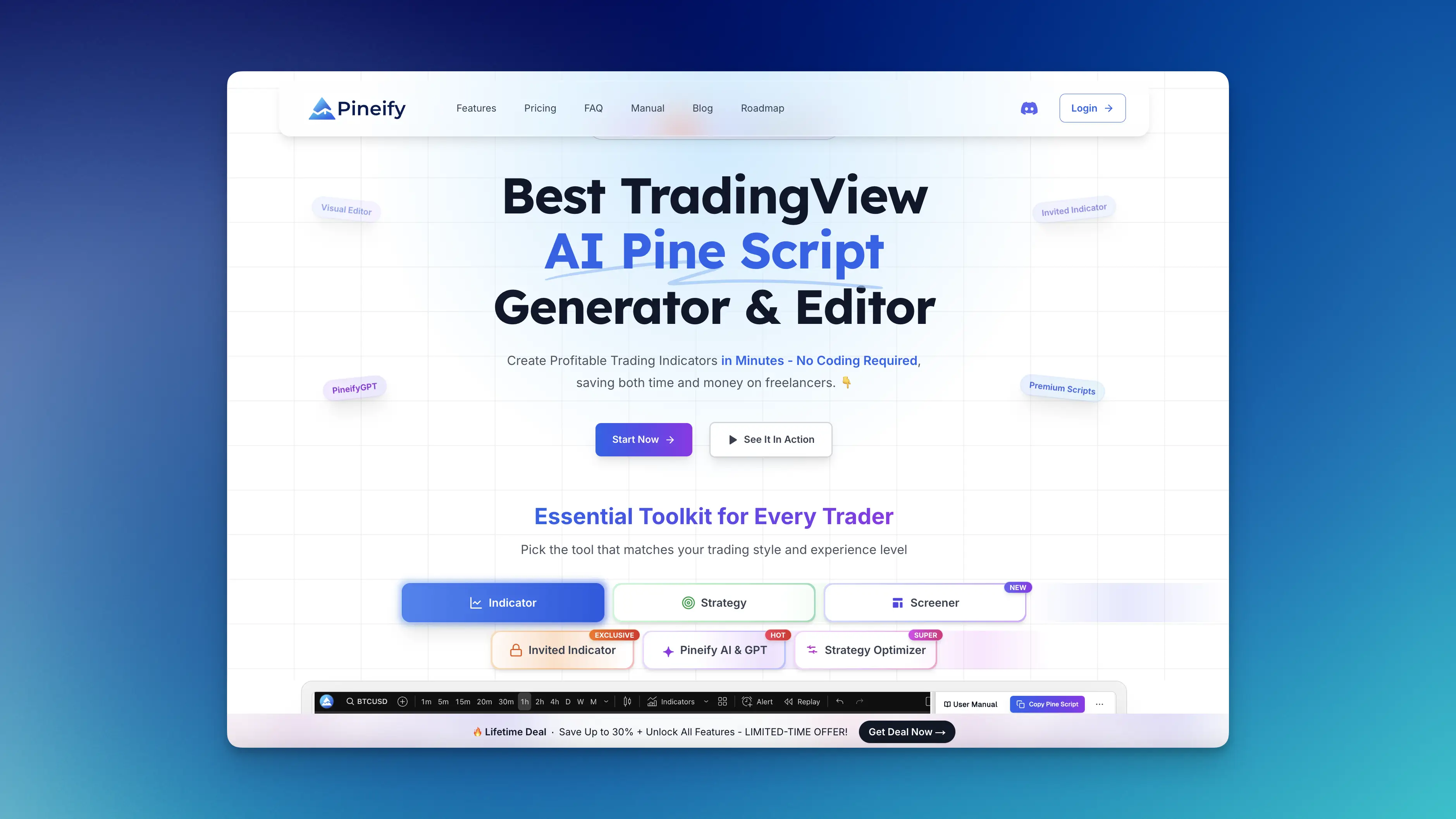
If coding isn't your thing, Pineify offers a visual editor where you drag and drop conditions to build strategies. It auto-generates the Pine Script code. I use it when I want to prototype an idea fast without typing out syntax.
Crafting a Simple Strategy Script
Start with a moving average crossover. Declare your Pine Script version, define the strategy with strategy(), then calculate two MAs.
The general idea: a fast MA and a slow MA. When the fast crosses above the slow, enter long. Cross below, exit. Use plotshape() to mark signals on the chart. I do this with every new indicator I build — visual confirmation catches logic errors that numbers alone miss. Platforms like Pineify let you set up these crossover conditions visually and generate the code automatically, which is useful when you're iterating on strategy logic rather than debugging syntax.
Putting Safety Measures in Place
Risk management isn't about winning every trade. It's about surviving the losing streaks.
| Feature | What it Does |
|---|---|
| Stop-Loss | Closes a trade if price moves against you by a set amount. |
| Take-Profit | Closes a trade once it reaches a target profit level. |
I set stop-loss at 2x ATR for most strategies. That's wide enough to avoid noise but tight enough to cap losses at around 1-2% of account per trade. Pineify's strategy builder lets you set these levels visually, which I prefer when testing multiple strategy variants at once.
Advanced Algorithmic Trading Features
Neural Network Price Forecasting
Some TradingView algorithms now use deep learning models trained on price, volume, sentiment, and on-chain data. They process locally on your machine, which keeps predictions fast. I haven't tested these extensively — my concern is that neural networks are black boxes, and when they fail, you don't know why. The reported 96% accuracy on Bitcoin backtests sounds impressive, but I'd want to see out-of-sample performance before trusting it with real capital.
Support Vector Machine Classification
SVM algorithms classify market conditions as bull, bear, or sideways based on multiple input features. The strategy then adjusts its rules based on the detected regime. This makes sense in theory, but in practice I've found regime detection lags — by the time the SVM confirms a bear market, you've already lost 10%.
Statistical Arbitrage
Pairs trading algorithms find two correlated assets and trade the spread when they diverge. If XOM and CVX normally move together and suddenly diverge by 2 standard deviations, the algorithm shorts the stronger one and buys the weaker one, betting on convergence.
| Feature | How It Works |
|---|---|
| Neural Network Forecasting | Uses deep learning on price, sentiment, and on-chain data to predict price direction. Processes locally for speed. |
| Support Vector Machine (SVM) | Classifies market as bull, bear, or sideways so the strategy adapts its rules automatically. |
| Statistical Arbitrage | Finds correlated asset pairs and trades when their price relationship temporarily breaks down. |
Key Trends in Algorithmic Trading for 2025
| Trend | What It Covers |
|---|---|
| AI-Powered Analysis | Language models that read news and social sentiment to give algorithms context behind price moves. |
| Decentralized Trading Bots | Bots running on blockchain smart contracts for transparent, autonomous execution. |
| Multi-Asset Frameworks | Single TradingView strategies that work across crypto, stocks, and forex without rebuilding. |
| DeFi Arbitrage Bots | Algorithms designed to capture price differences across exchanges and liquidity pools. |
For traders building multi-asset strategies, the Twin Range Filter Indicator TradingView Pine Script offers trend analysis capabilities that work across different market types.
Best Practices for TradingView Algorithm Development
Start Simple
The temptation to build a complex system on day one is strong. Don't. Start with a single moving average crossover. Understand exactly why it wins and why it loses. Then add one more piece — a volume filter, a volatility guard. I've made the mistake of piling on indicators and not knowing which one caused the drawdown. Step-by-step is slower but you actually learn what works.
Test in Different Market Conditions
A strategy that crushes it in a bull market can bleed you dry in a sideways one. Run your backtests across multiple periods: 2022 bear market, 2023 recovery, 2024 chop. Look for strategies that hold up across regimes rather than ones that peak in one specific environment.
Use Alerts, Not Screen Time
TradingView's alert system frees you from staring at charts. Set alerts that fire when your strategy conditions are met — price crosses a moving average, RSI hits oversold, volume spikes. When you need to manage multiple alerts, knowing how to delete alerts on TradingView keeps your workspace organized.
Review and Adjust
Markets change. What worked in 2023 might not work in 2025. Schedule a monthly review of your strategy's performance. If the win rate drops or drawdown increases, adjust. I re-optimize my parameters every quarter, and I always keep a baseline version running so I can compare.
Do I need to be a programmer to create algorithms in TradingView?
Not at all. Pine Script was designed for traders, not developers. The syntax is readable and the editor catches errors as you type. If you want to avoid code, tools like Pineify let you build strategies with a visual drag-and-drop interface.
Can TradingView algorithms place trades automatically?
Yes, but you need to connect TradingView to a broker that supports automated execution through webhook alerts. Once that's set up, your strategy can manage trades based on your predefined rules without hands-on monitoring.
How accurate are TradingView backtesting results?
It depends on your data quality and whether you account for slippage and commissions. If you avoid over-optimizing, results can be reliable. Some systems report directional accuracy up to 96% for certain markets, but I'd take those numbers with caution until you see out-of-sample performance.
Which market conditions work best for TradingView algorithms?
It depends on the strategy. Trend-following systems (moving average crossovers) work in strong directional markets. Mean-reversion strategies (Bollinger Bands, RSI) perform better in range-bound conditions. The key is matching your algorithm to the current environment.
What are the main risk management features in a trading algorithm?
Stop-loss and take-profit orders. A stop-loss caps your downside by closing losing trades at a set level. A take-profit locks in gains. Together they keep each trade within a defined risk/reward boundary.
How do I find pre-built TradingView algorithms to use or learn from?
The TradingView public library has thousands of community scripts you can use or modify. Professional providers like LuxAlgo offer advanced indicators with AI features. Pineify's visual builder generates Pine Script code automatically, which makes it easy to study how the components fit together.
What is the difference between a TradingView algorithm and a manual trading strategy?
Manual strategies rely on you watching charts and placing orders, introducing emotion and delay. Algorithms automate everything: they monitor conditions, generate signals, and execute trades based on preset rules. No emotion, no hesitation, instant reaction.