Track Dark Pool Trades and Institutional Activity

Dark pools are private trading venues where institutions buy and sell massive blocks of stock away from public exchanges like NYSE or NASDAQ. These off-exchange transactions account for nearly 40% of all U.S. stock market volume, yet most individual traders never see that activity. If you've wondered where the big money moves, it's often here.
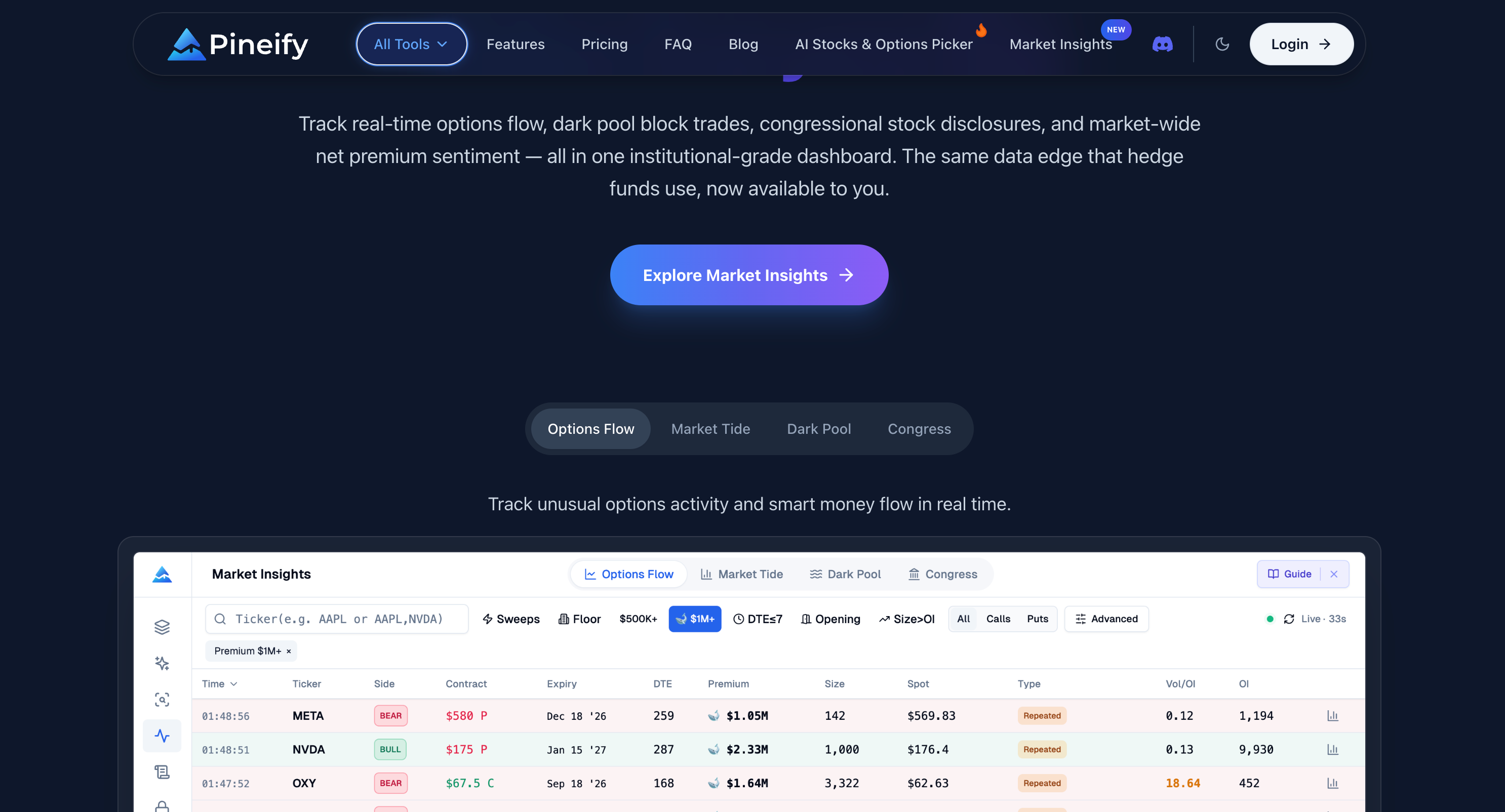
Pineify Market Insights (pineify.app/market-insights) surfaces these hidden institutional trades alongside options flow and congressional signals. I've spent years trading with and without this type of data, and the visibility it gives you is night and day.
What Are Dark Pools and Why Do They Matter?
Picture a pension fund that needs to sell 2 million shares of a single company. If that order hit the NYSE directly, the market would see it immediately and the stock price would drop before the trade finished. Dark pools let institutions execute these large orders discreetly.
Trades in dark pools leave a trail, but you need the right tools to spot it. With 40% of U.S. equity volume flowing through dark pools, anyone watching only exchange data is missing nearly half the picture.
Dark pool data services aggregate this off-exchange information. They give you a window into the large, influential transactions happening behind the scenes.
Professional Trading Data Without the Hefty Price Tag
Jumping between separate data subscriptions gets expensive. Options flow from one service, dark pool prints from another, congress trading from a third — it adds up fast.
Pineify Market Insights combines four data types that professional desks watch into a single dashboard. Real-time updates while the market is open, no jumping between tabs. You can see it here: pineify.
| Module | What It Tracks | Why It Matters |
|---|---|---|
| Options Flow | Every large options trade in real time | Spot unusual activity and smart money positioning |
| Market Tide | Net call vs. put premium across the market | Gauge overall bullish/bearish sentiment |
| Dark Pool | Off-exchange institutional block trades | Find hidden support/resistance levels |
| Congress Trading | Stock trades by U.S. lawmakers | Detect political timing signals |
You'll find a deeper walkthrough here: pineify.
Understanding the Dark Pool Module
What We Show You, the Moment It Happens
Every off-exchange trade in a dark pool gets captured and displayed in real time. You'll see the timestamp, ticker, price, share count, and our best estimate of whether it was a buy or a sell.
Trades are sorted into three categories by size:
- Standard — A typical institutional trade.
- Block — 10,000 shares or more.
- Mega Block — Position-sized moves that signal major institutional intent.
Figuring Out the "Buy" or "Sell"
Dark pools don't publish a public bid/ask spread the way exchanges do. To determine direction, we compare the execution price to the National Best Bid and Offer (NBBO) at that exact millisecond.
Here's the logic:
- A trade at or above the midpoint between the best public bid and ask is classified as a buy.
- A trade below that midpoint is classified as a sell.
This is the standard method used across the industry. It's reliable but not perfect — no dark pool tool can guarantee direction with 100% accuracy.
Seeing Where the Big Money Piles Up
Beyond individual trades, we map where hidden volume clusters. Heavy trading at a specific price creates a "volume node," and stocks tend to react when they return to that level. I've found this is similar to what you see with the Best Support and Resistance Indicator in TradingView, except the data comes from off-exchange prints instead of public charts.
Two key metrics on the map:
- Point of Control (POC): The single price level with the highest dark pool volume — where institutions did the most business.
- Value Area: The price range containing 70% of all dark pool volume — essentially a fair-value box around where big players are active.
How to Use Dark Pool Data in Your Trading
Here's how I actually put this data to work:
- Support at volume nodes. When a stock drops back to a price with heavy prior dark pool buying, that level often holds. Institutions tend to defend their positions. I saw this play out with NVDA in late January — the stock bounced twice off a volume node around $485 before reversing.
- Watch mega blocks. A single buy order over $50 million in a mid-cap stock is worth paying attention to. It signals conviction.
- Spot quiet accumulation. When dark pool buy volume consistently beats sell volume at a certain price over several days, institutions are building a position. I've caught moves on MRNA and PLTR this way before they broke out.
- Cross-check with options flow. Heavy dark pool buying plus unusual call activity on the same ticker is a strong confirmation signal. I prefer seeing two independent sources agree before I take a position.
A Clearer Way to Research Stocks
The real value isn't any single module — it's how they fit together. I use them in this order:
- Check the Market Tide. Is the overall market leaning bullish or bearish? This sets the context.
- Scan unusual options flow. Which stocks are seeing activity that doesn't fit the normal pattern?
- Look at dark pool data. Where are institutions quietly positioning themselves?
- Review congress trading. Are lawmakers making moves in relevant sectors?
| Module | What It Answers |
|---|---|
| Market Tide | Is the overall market sentiment bullish or bearish? |
| Options Flow | Which specific stocks are seeing unusual smart money activity? |
| Dark Pool | Where are institutions building positions, and at what price levels? |
| Congress Trading | What are lawmakers with access to non-public information doing? |
Most platforms charge separately for each type of data. Here's how the costs compare:
| Feature | Pineify Market Insights | Unusual Whales | FlowAlgo | Quiver Quantitative |
|---|---|---|---|---|
| Options Flow | ✅ Real-time | ✅ Real-time | ✅ Real-time | ❌ |
| Dark Pool | ✅ Full analysis | ✅ Basic | ❌ | ❌ |
| Congress Trading | ✅ Full tracker | ✅ Basic | ❌ | ✅ Congress only |
| Market Tide / Net Premium | ✅ Sector-level | ❌ | ❌ | ❌ |
| Unified Dashboard | ✅ All-in-one | Partial | Single focus | Single focus |
| Additional Tools | AI Agent, Pine Script, Backtester | Limited | None | None |
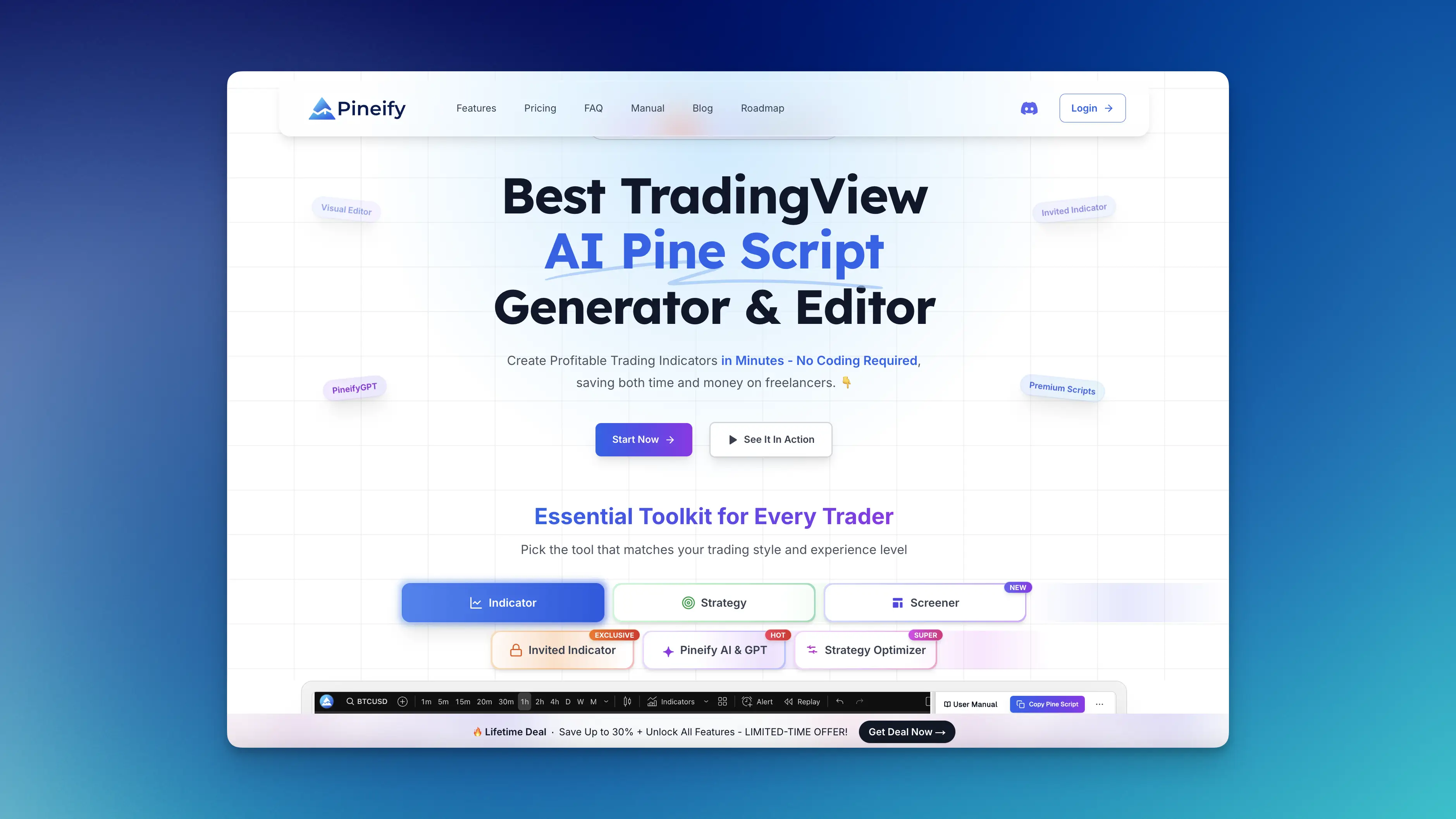
The main difference: Pineify bundles options flow, dark pool, congress trading, and market tide into one subscription. You also get the AI finance assistant, Pine Script helper, strategy optimizer, and trading journal. I don't bother with Quiver Quantitative anymore now that congress data is included here.
Who Is Pineify Market Insights For?
Pineify works differently depending on your trading style:
- Day Traders: Spot sudden options activity and dark pool prints in real time. Check Market Tide before your first trade of the day.
- Swing Traders: Track sector shifts with Market Tide. Look for stocks showing steady dark pool accumulation over days.
- Options Traders: See where the big premium is flowing — which strikes and expirations institutions are hitting.
- Long-Term Investors: Track quiet accumulation and congress trading for a sense of what informed players are doing over months.
- Quant Traders: Use structured flow data as inputs for backtesting and automated signals.
| Trading Style | Primary Use Case | Key Pineify Features |
|---|---|---|
| Day Trader | Intraday setups & confirmation | Real-time options flow, live dark pool prints, Market Tide |
| Swing Trader | Multi-day positioning & timing | Market Tide sectors, dark pool accumulation, unusual options activity |
| Options Trader | Structuring positions | Institutional premium analysis, strike/expiration heatmaps |
| Long-Term Investor | Identifying insider conviction | Congressional trading reports, long-term dark pool trends |
| Quant Trader | Strategy backtesting & signals | Structured flow data, volume profiles, net premium exports |
One thing to be honest about: if you already subscribe to Unusual Whales, the switch only makes sense if you'll actually use the bundled extras — AI Agent, Pine Script tools, the trading journal. If you only need options flow, Unusual Whales still does a fine job.
Q&A: Common Questions About Dark Pool Trading
Q: Is dark pool data available in real time? Yes. Pineify's Dark Pool module captures every trade as it happens. It uses smart polling that pauses when you switch tabs and resumes when you return, so the stream stays live.
Q: How reliable is the buy/sell direction on dark pool trades? Dark pools don't show bids and asks, so direction is inferred, not guaranteed. Pineify uses the NBBO midpoint method — the standard approach professional platforms trust. Trades above the midpoint are marked as buys; below as sells. No tool offers 100% accuracy here.
Q: Do dark pools only cover stocks? For the most part, yes. Dark pools are mainly for U.S. stocks. Futures markets like S&P 500 /ES handle large trades through CME ClearPort instead. Pineify's Dark Pool module focuses on U.S. equities.
Q: How is this different from something like Bookmap? Bookmap analyzes public exchange order flow. It can hint at dark pool activity through sudden liquidity changes. Pineify shows the actual reported dark pool trades — price, size, estimated direction. It's a different data source entirely. You can read more about order flow charting in our Bookmap TradingView guide.
Q: How accurate is the congressional trading data? The data comes from official STOCK Act disclosures. Pineify pulls filings from the U.S. House and Senate databases and flags any trades reported after the 45-day window.
Getting Started
Go to pineify.app/market-insights and start the free trial. This kind of data is especially valuable if you're trading with a proprietary firm — many provide and rely on these signals, as covered in our guide on Prop Firms That Use TradingView.
Try filtering the Dark Pool module for "Mega Block" trades to see the highest-conviction institutional activity. Then check Options Flow for the same ticker — when both show the same direction, the signal is stronger than either alone.
Make Market Tide your morning routine. A quick glance at the net premium trend and sector heatmap tells you whether your planned trades align with the broader institutional mood. Set Congress Trading alerts for defense and energy stocks — a late-filing politician trade in those sectors often signals something worth investigating.
Dark pool and institutional data used to be a Wall Street exclusive. With the right tools, that's no longer true. You can start here: pineify.app/market-insights.