Pine Script AI Coding Agent vs Pine Script GPT: I've Tested Both
Pine Script AI Coding Agent vs Pine Script GPT comparison: I tested both, and the Pineify AI Coding Agent wins for first-try compilation. GPT tools work, but you'll debug more.

Blog posts related to the TradingView
View All TagsPine Script AI Coding Agent vs Pine Script GPT comparison: I tested both, and the Pineify AI Coding Agent wins for first-try compilation. GPT tools work, but you'll debug more.

You know that feeling when you're watching a chart and you sense momentum is about to shift, but you're not quite sure when to pull the trigger? I've been there too many times to count.
The EMA Wave indicator is a momentum oscillator that translates price action into three colored waves. Each wave represents a different speed of market movement, which gives you a layered view of momentum instead of a single line. I've been using it for about six months now, and it changed how I spot entries.

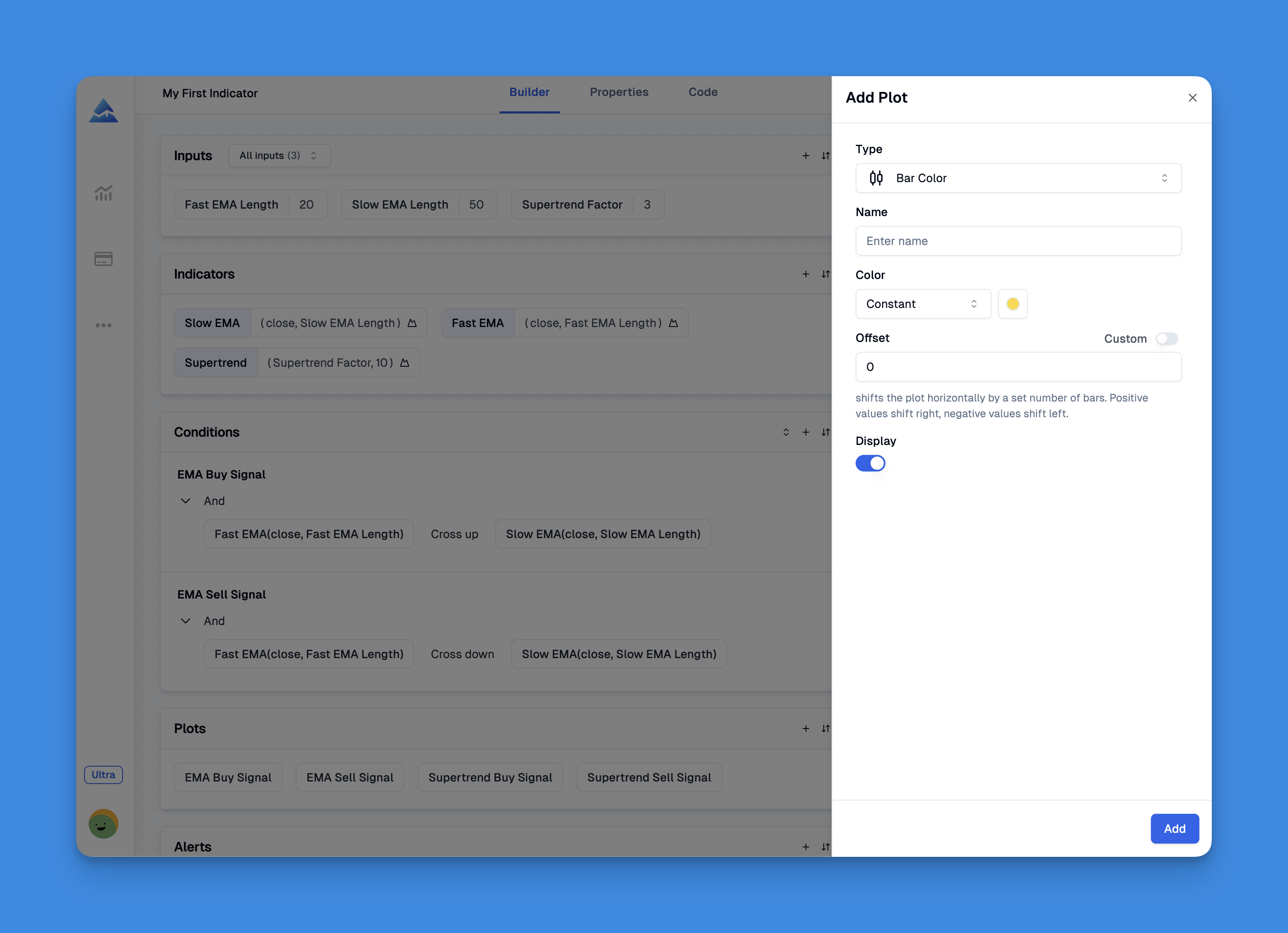
Pine Script bar coloring is a technique that changes the color of individual price bars on TradingView based on any market condition you define. Instead of reading each candle one by one, you get instant visual signals that tell you when momentum shifts, volume spikes, or trends change direction.
I've been using barcolor() for about three years now, mostly on AAPL 1-hour and TSLA daily charts. Before I set it up, I'd stare at a screen full of green and red candles, feeling like I was hunting for needles in a haystack. The colors do that filtering for me now.

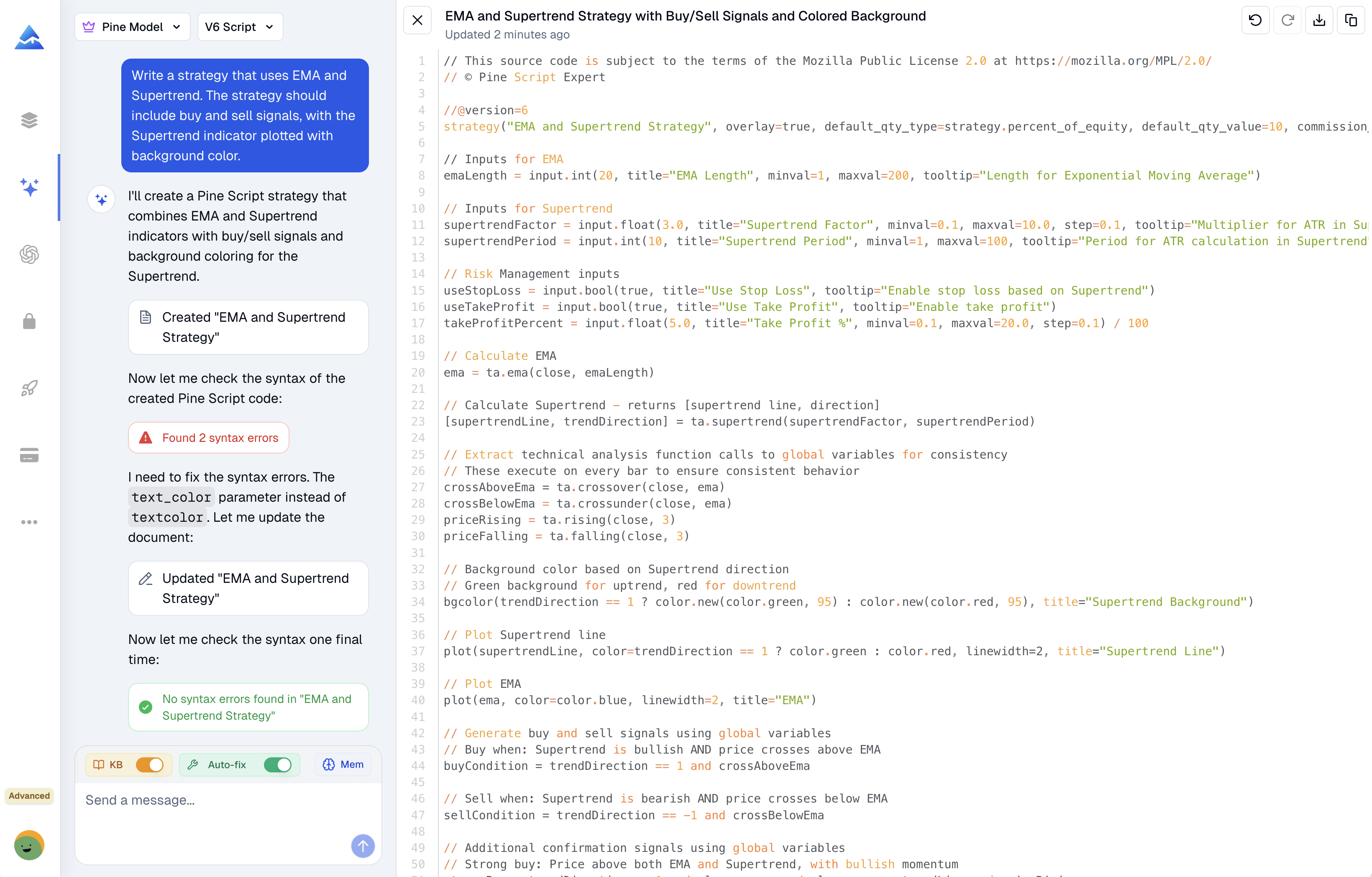
Creating a profitable TradingView strategy used to mean choosing between two painful options: hiring a developer or spending months learning Pine Script. A Pine Script AI Coding Agent is a specialized assistant trained specifically on TradingView's platform rules and Pine Script syntax. It takes a plain English description of your trading idea and produces working Pine Script code, ready to paste into TradingView's editor.

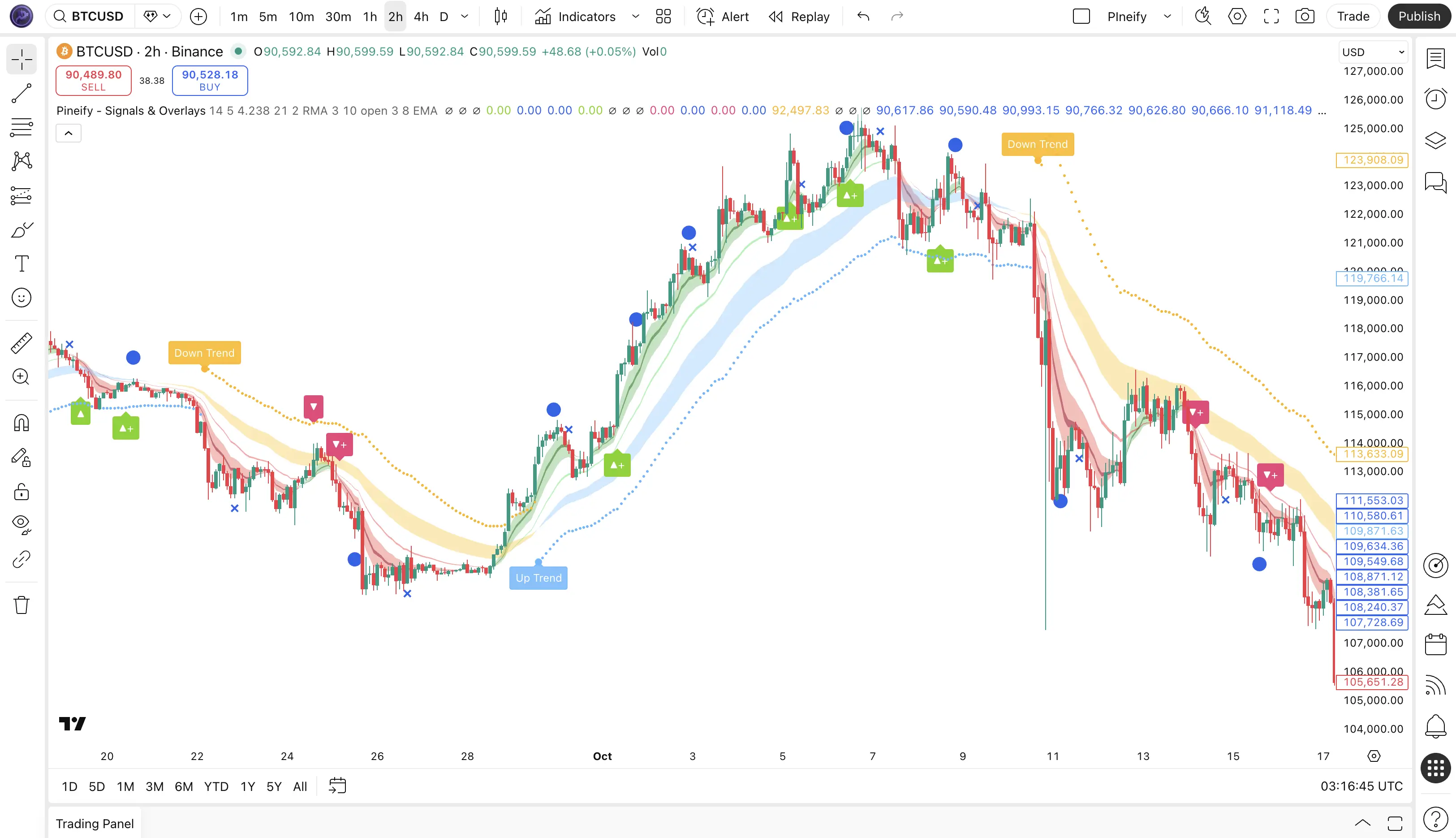
Pineify® - Signals & Overlays™ is an invite-only TradingView indicator that applies Dow Theory trend analysis, ATR-based stop loss levels, and non-repainting buy/sell signals directly on your price chart. If you're searching for a solid Market Cipher alternative that doesn't cost a fortune but still delivers professional-level signals, I can tell you what I've found using it. I've been running this on AAPL and MSFT daily charts for the past three months, and the colored cloud picked the right trend direction 9 out of 11 times. Not bad for an overlay that takes two minutes to set up.

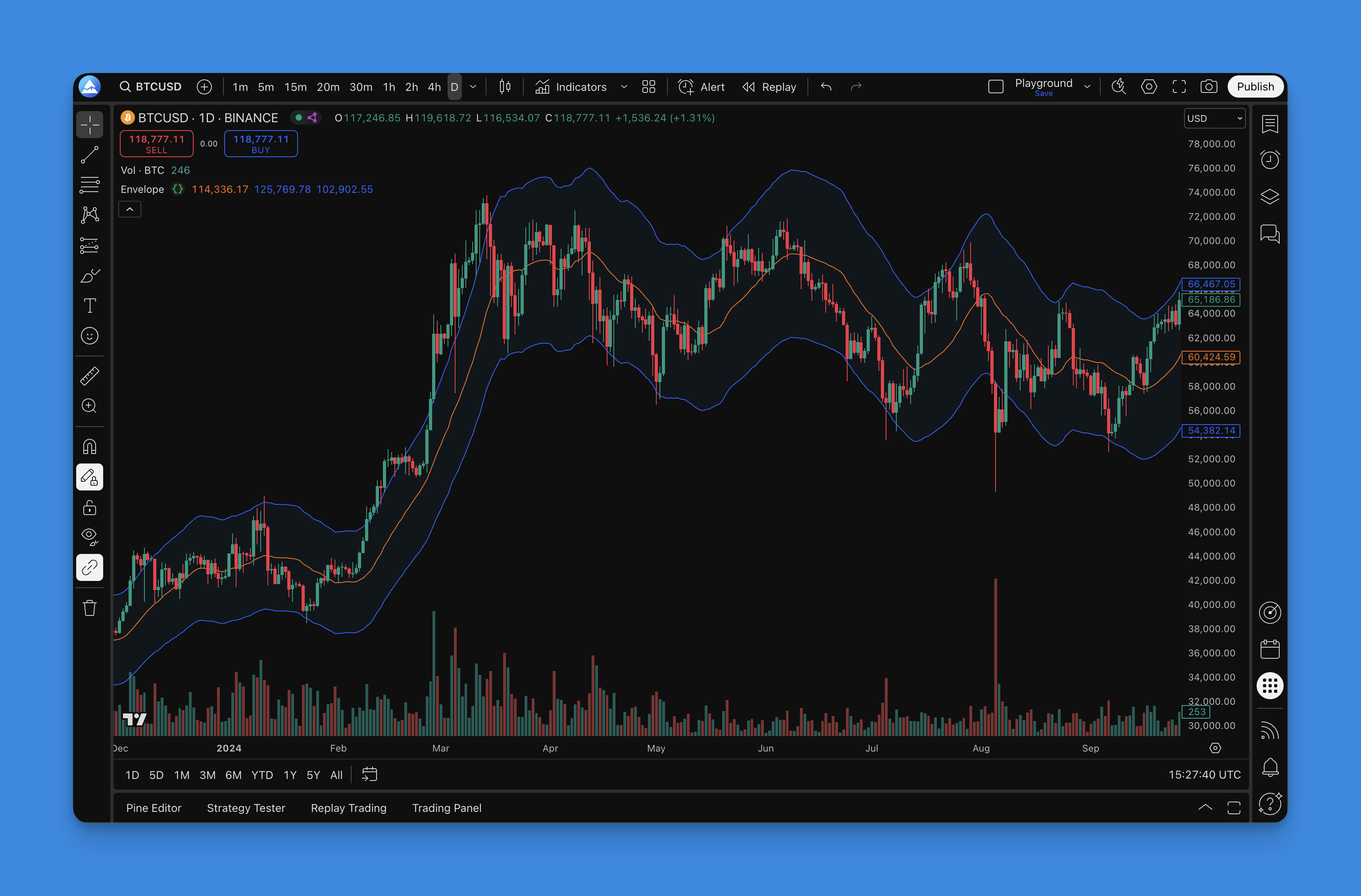
The Envelope indicator is a technical analysis tool that plots two percentage-based bands above and below a moving average, creating a price channel that shows potential overbought and oversold zones. It's one of the simplest ways to spot mean reversion opportunities without diving into complex math.
I remember the first time I put this on AAPL on the daily chart — the 2.5% band caught a pullback in March 2025 that a plain moving average would never have signaled. That's when the Envelope clicked for me.
Here's how it works: take any moving average (SMA, EMA, whatever you prefer), add a fixed percentage above and below, and you get three lines — center, upper band, lower band. If AAPL is at $200 and the 20-day SMA is $190, a 5% envelope puts the upper band at $199.50 and the lower band at $180.50. Price touches the upper band, and you know it's stretched relative to its recent average.
What sets the Envelope apart from Bollinger Bands? Bollinger Bands use standard deviation, so the channel widens and narrows with volatility. Envelope bands stay a fixed percentage away from the moving average at all times. I've found this predictability makes it easier to set consistent entry and exit rules — you're not chasing a moving target.
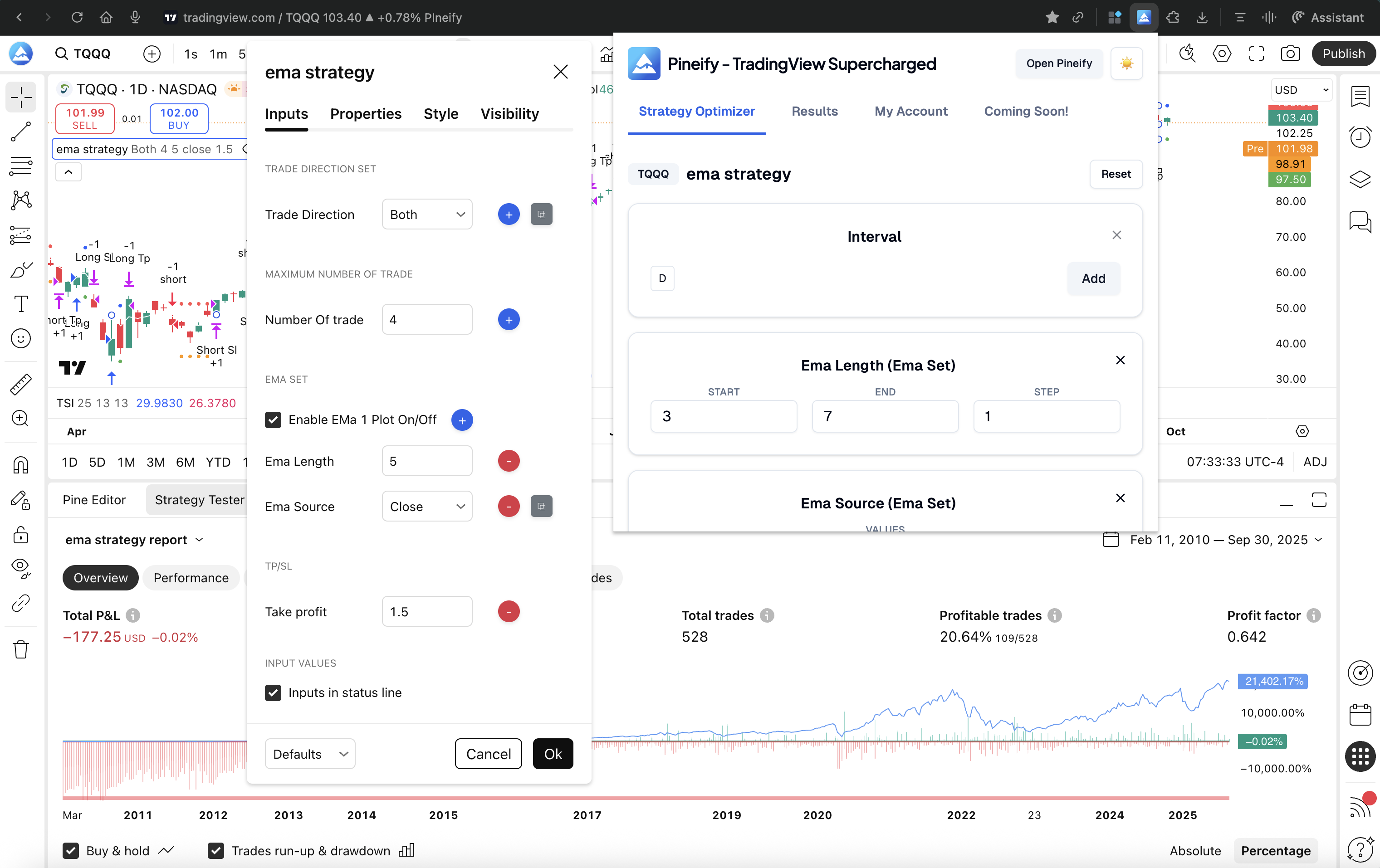
If you've ever found yourself manually adjusting numbers in your TradingView strategy, hitting refresh, waiting, and jotting down results—only to repeat it all again—you know exactly how tedious traditional backtesting can feel. It's a slow, repetitive grind. A strategy optimizer is a tool that automates the search for your best parameter settings, running every combination you define so you don't have to stand guard. The Pineify Strategy Optimizer is a Chrome extension built around that exact idea. I've used it on several of my own strategies, including a mean-reversion system I run on EURUSD, and the time savings are real.

I've been trading on MetaTrader 5 for years, and one tool I keep coming back to is the MT5 volatility index indicator. An MT5 volatility index indicator is a technical tool that measures market movement intensity using candle size, standard deviation, and price pressure analysis — it doesn't guess direction, it just tracks activity. It's like a speedometer for the market: quiet means low volatility, building steam means medium, and crazy means high. MetaTrader 5 doesn't ship with a built-in VIX-style tool, so most of us install custom indicators from the MQL5 Marketplace or community forums. I've used these on forex pairs like EUR/USD, global indices, synthetic pairs like Volatility 75 (V75), and even BTC/USD. Understanding volatility helps you spot breakout zones, avoid choppy sideways grinding, and know when to tighten or widen your stops.
eSignal is a professional-grade market data platform built for institutions and active traders who need exchange-direct feeds. TradingView is a browser-based charting and community platform that's become the default choice for retail traders. Here's my take after years of using both: unless you're running ultra-high-frequency strategies on eight-figure accounts, TradingView delivers 90% of the capability at roughly 10% of the price.

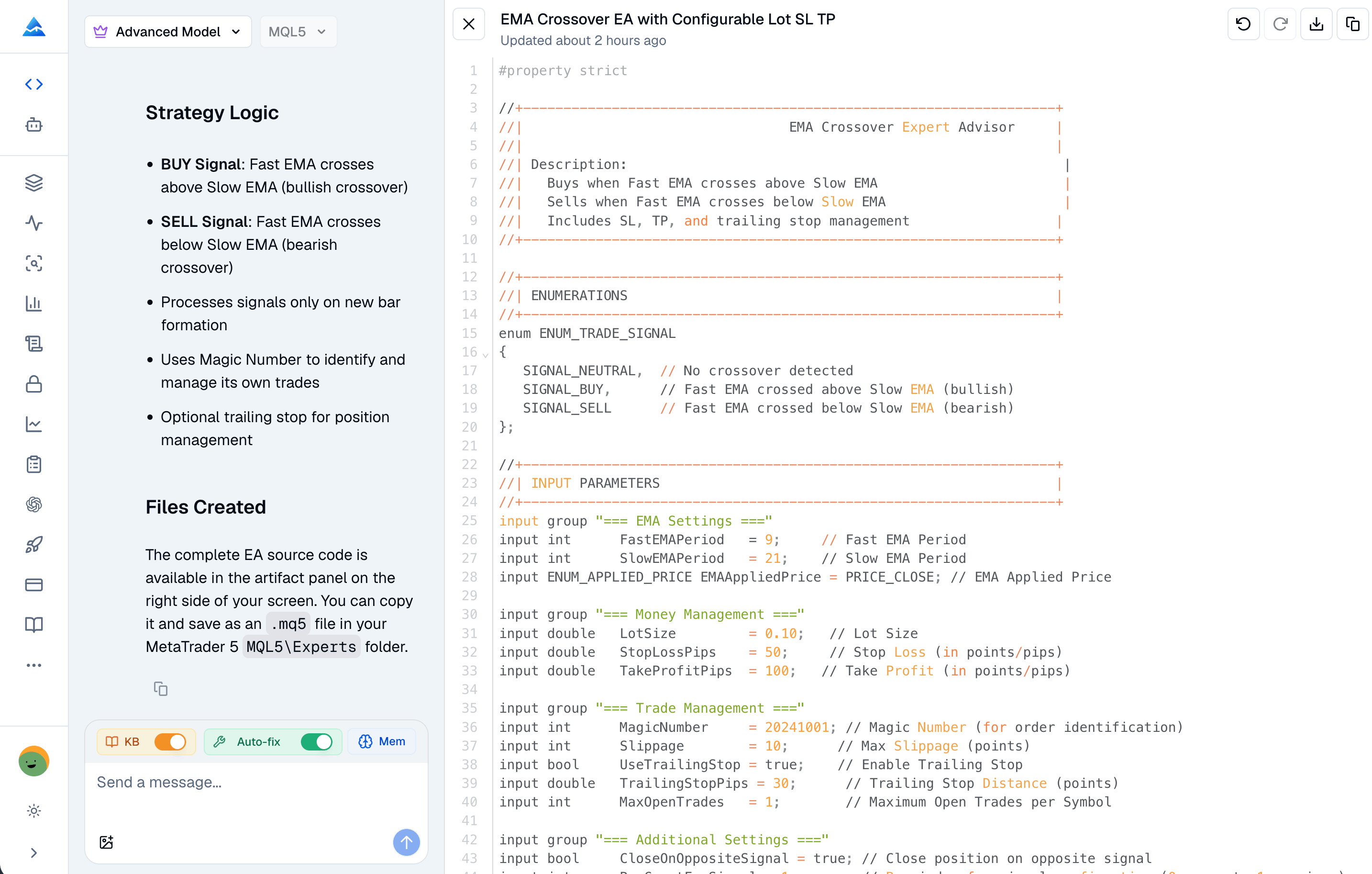
Post a job on Upwork, wait a week for a quote, pay hundreds of dollars to a freelance MQL4 programmer. That workflow is officially obsolete. A purpose-driven MQL5 coding agent is an AI tool trained specifically on MetaTrader 5's API, indicator patterns, and compilation rules — not a general language model that happens to know some MQL5. It generates, validates, and fixes code until it compiles cleanly. I've used this approach to build an RSI-based EA for EURUSD that ran on the first compile. No back-and-forth with a developer, no surprise revision costs.