ChartPrime publishes TradingView indicators and sells access to indicator toolkits and related services. Its public indicator library and paid plans are different things: a useful public script is not proof that a paid package will improve a trading strategy. This guide explains several documented tools, the access workflow, and a practical way to evaluate whether the features fit your needs.
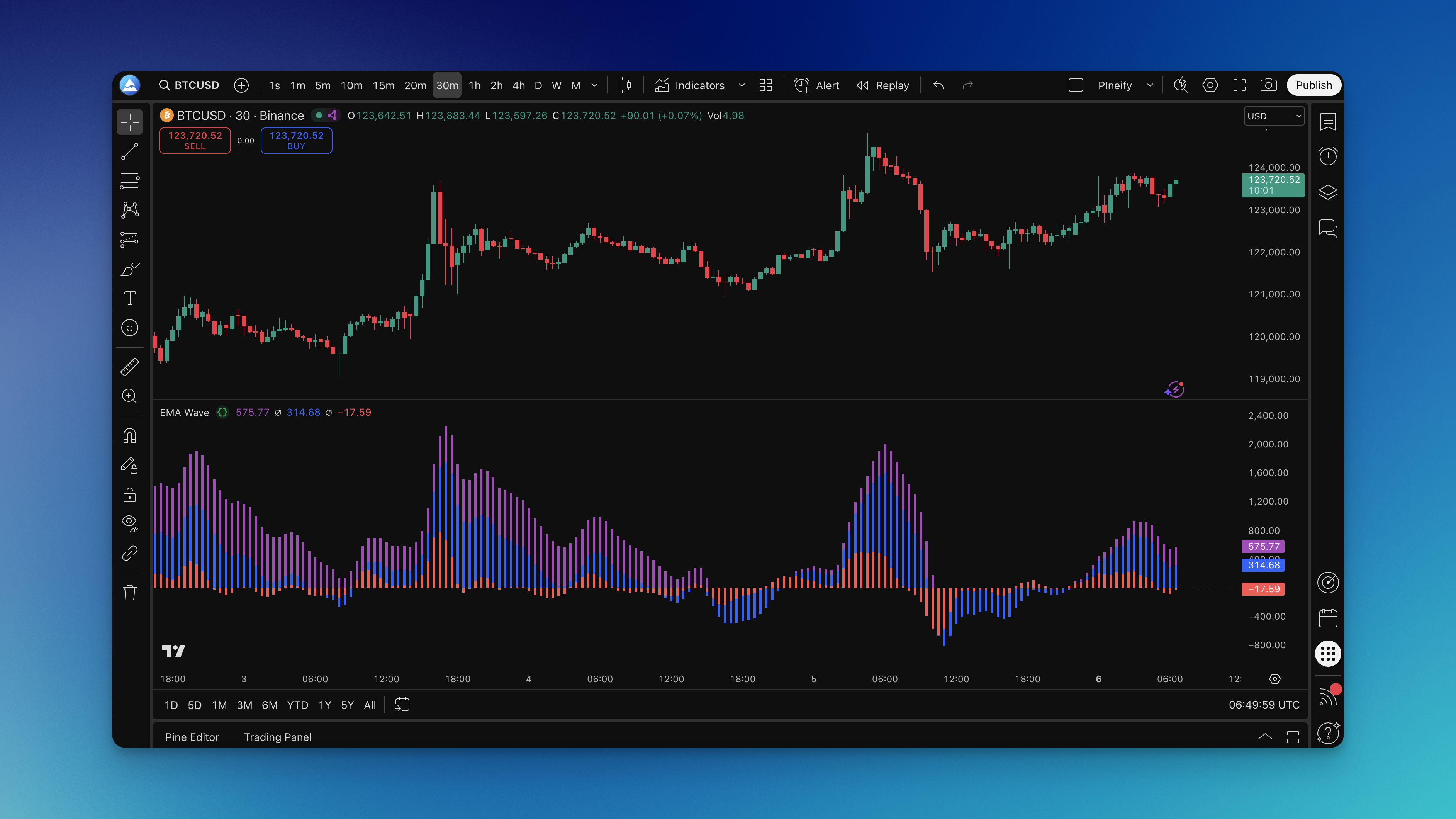
EMA Wave plots three smoothed differences between a price source and exponential moving averages. It helps you inspect how price sits relative to averages with different lookback lengths. It does not establish that a reversal is coming or that a trade will be profitable.
This guide describes the implementation available in Pineify. If you use another script called EMA Wave, check its source, inputs and version before applying these settings. The name alone does not guarantee matching calculations.
VuManChu Cipher B + Divergences is a free, open-source TradingView indicator that readers can evaluate as an alternative oscillator workflow. It is not authorized free access to the proprietary Market Cipher suite, and similar colors or dots do not establish identical calculations, signal timing, or trading results.
Pine Script v4 is a legacy language version that still appears in published indicators and older projects. TradingView announced it on June 25, 2019. Reading v4 accurately means distinguishing its APIs from later versions: study() and input() belong in v4 code, while the indicator() declaration and specialized input functions are part of the v5 migration.