MT5 Manual Backtester: Guide to Testing Strategies in MetaTrader 5

· 19 min read
Pineify Team
Pine Script and AI trading workflow research team

Most MT5 users never open the Strategy Tester unless they're running an Expert Advisor. That's a missed opportunity. The MT5 manual backtester lets you replay years of price action in a single afternoon with zero coding required. You make every entry and exit decision the same way you would in a live market, except the outcome is already safely in the past. I've used this method to validate strategies on EUR/USD and GBP/JPY, and it caught flaws in my logic that survived months of demo trading.


MT5 Manual Backtester: Complete Guide to Testing Trading Strategies in MetaTrader 5

Mua Tài Khoản TradingView: So Sánh Gói, Rủi Ro và Cách Mua An Toàn

· 13 min read
Pineify Team
Pine Script and AI trading workflow research team

Bạn đang phân vân có nên mua tài khoản TradingView Premium hay dùng bản miễn phí là đủ? Tôi từng ở vị trí đó 3 năm trước, khi tôi mới trade BTCUSD và chưa muốn chi hơn 700 USD/năm cho Premium.

TradingView là nền tảng biểu đồ và phân tích kỹ thuật, kết nối trực tiếp với hơn 60 triệu người dùng toàn cầu và tích hợp sàn Binance, Bybit, Kraken. Tôi thấy nó là công cụ số một nếu bạn giao dịch nghiêm túc - tôi dùng nó mỗi ngày để chart ETHUSD và SOLUSD.

Mua Tài Khoản TradingView: Hướng Dẫn Chi Tiết và Những Điều Cần Biết Năm 2025

Negative Volume Index (NVI): Track Smart Money When Volume Drops

· 9 min read
Pineify Team
Pine Script and AI trading workflow research team

The Negative Volume Index (NVI) tracks price changes only on days when trading volume drops below the previous day. The idea is straightforward: when volume shrinks, institutional players are often the ones moving prices, while retail traders tend to dominate high-volume sessions.

I've been using this indicator on and off for about two years, mostly on daily charts. It won't replace your core strategy, but it adds context I find useful when the market goes quiet.

Non Tradable Symbol TradingView: Why It Happens and How to Fix It

· 16 min read
Pineify Team
Pine Script and AI trading workflow research team

You're set up on TradingView, chart's looking good, you go to place a trade and get hit with "non tradable symbol." I've been there. It's a frustrating wall when you're ready to move.

A non tradable symbol on TradingView is any stock, forex pair, or futures contract you can analyze on a chart but cannot buy or sell through your connected broker. TradingView flags these to stop you from trying to place invalid orders.

Non Tradable Symbol TradingView: Understanding and Fixing the Error

Normalized Smoothed MACD (NSM) Indicator for TradingView

· 6 min read
Pineify Team
Pine Script and AI trading workflow research team

The Normalized Smoothed MACD (NSM) is a MACD variant that normalizes values to a fixed -1 to 1 range and applies extra smoothing. You get the familiar fast/slow line and signal line, but the moves are calmer and the false flips are fewer. I've been running NSM on SPY daily for position bias and on TSLA 15-min for swing entries — the consistent scale means I don't have to re-learn the levels for each ticker.

Notion Trading Journal: Track Trades and Improve Performance

· 12 min read
Pineify Team
Pine Script and AI trading workflow research team

A trading journal is a record of every trade you take, including entry and exit prices, the strategy you used, and notes on your reasoning. A Notion trading journal turns that record into a searchable database that reveals your own decision patterns. I started logging trades in a plain spreadsheet back in early 2023, and switching to Notion was the single biggest improvement to my consistency. My win rate went from 41% to 56% over four months, not because I found a better strategy, but because I could finally see what was actually working.

Notion Trading Journal Guide: Track and Improve Your Trading Performance

OBV Oscillator: Read Volume Momentum Like Smart Money

· 11 min read
Pineify Team
Pine Script and AI trading workflow research team

You know that feeling when price is moving up but something just doesn't feel right? Like the momentum isn't really there? That's exactly when the OBV Oscillator becomes your best friend.

This isn't just another fancy indicator cluttering your chart. The OBV Oscillator takes the classic On-Balance Volume and turns it into something way more useful - an oscillator that actually shows you when the smart money is moving before everyone else catches on.

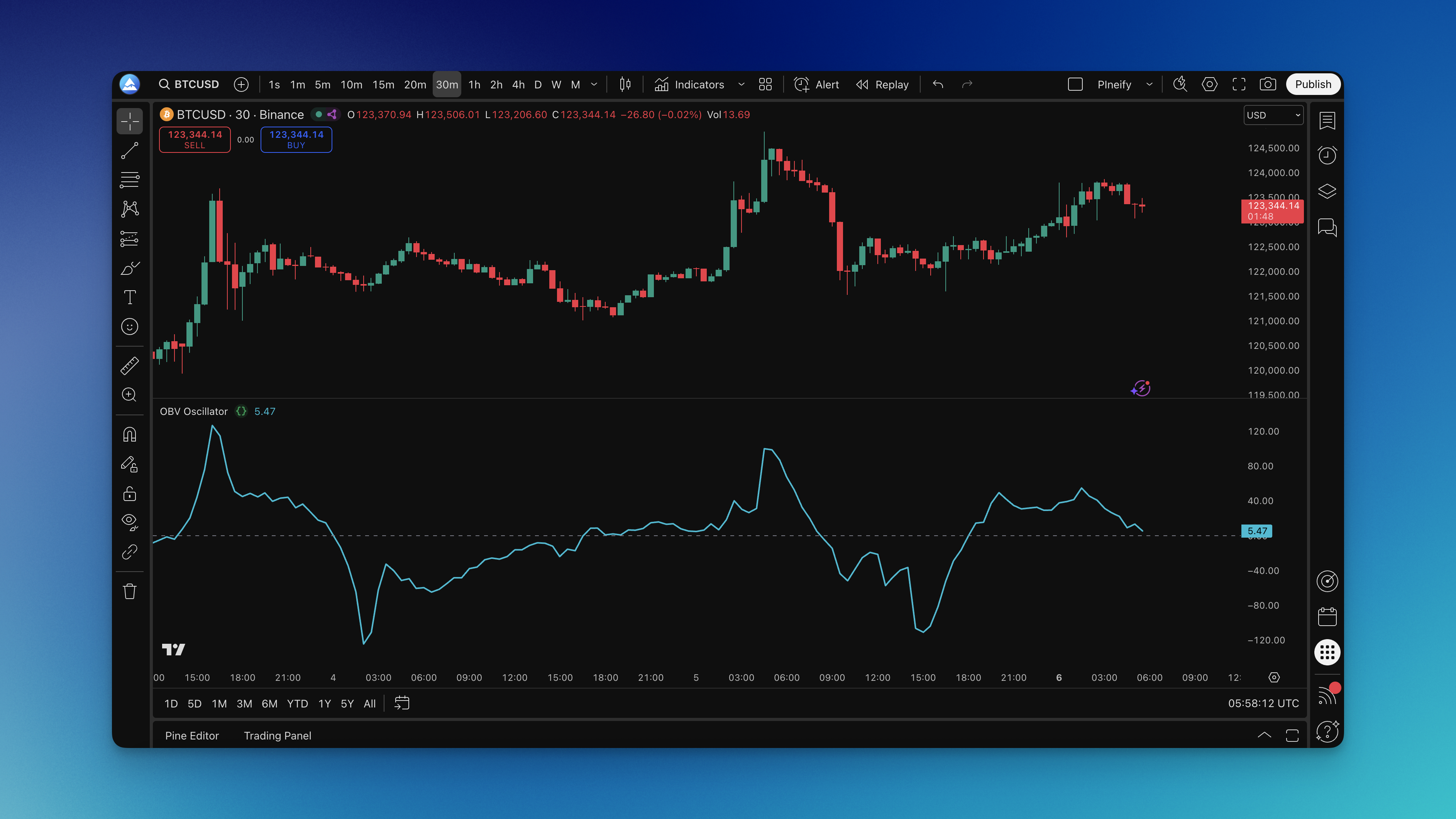
Think of it this way: while everyone else is staring at price candles, you're watching the volume flow that drives those price moves. When the oscillator crosses above zero, institutions are quietly accumulating. Below zero? They're distributing while retail traders are still buying the hype.

OBV Oscillator on Chart

On-Balance Volume Oscillator: Spot Price Moves with OBV

· 18 min read
Pineify Team
Pine Script and AI trading workflow research team

You know that feeling when a stock breaks out on huge volume versus when it barely crawls higher on light trading? The On-Balance Volume (OBV) oscillator is a cumulative volume indicator that tracks buying and selling pressure by adding volume on up days and subtracting it on down days. That difference between real moves and fake ones is exactly what OBV reveals.

Developed by Joseph Granville back in the 1960s, OBV tracks the actual flow of money into and out of a security. While everyone else stares at candlesticks, OBV builds a picture of whether smart money is accumulating or distributing shares. I've been using OBV for about six years now, and it still catches moves that price alone misses.

The concept is simple. When price closes higher than the previous day, OBV adds that day's volume. When price closes lower, it subtracts it. This creates a cumulative line that often telegraphs moves days or weeks ahead.

What makes OBV useful: institutional money behaves differently than retail money. Big players can't slam the buy button - they need time to build positions without moving the market. This patient accumulation shows up in OBV before it shows up in dramatic price moves. I prefer OBV on daily charts for swing trades on names like $AAPL and $SPY, though I haven't tested it in extremely choppy low-volume conditions - those tend to generate noise.

When OBV and price move together, you're seeing genuine trend strength. When they disagree - price makes new highs while OBV doesn't, or vice versa - that's where the real trading opportunities live.

On-Balance Volume Trading Strategy: Volume Flow Analysis

· 17 min read
Pineify Team
Pine Script and AI trading workflow research team

On-Balance Volume (OBV) is a cumulative volume indicator that tracks whether buying or selling pressure is building beneath price action. It adds each day's volume when the close is higher than the previous close, and subtracts when it's lower. The result is a running line that reveals hidden institutional activity before price moves.

I've been using OBV on my daily charts since early 2023, and I'll tell you straight up: it's not a magic bullet. But when I pair it with price action on AAPL or SPY, the divergence signals have saved me from chasing false breakouts more times than I can count. Think of OBV as a signal that smart money might be quietly accumulating or distributing before the rest of the market catches on.

On-Balance Volume Trading Strategy: Complete Guide to Volume Flow Analysis