Paul Tudor Jones is associated with global macro investing, but a public article cannot reconstruct his portfolio from a moving-average rule and a fixed risk percentage. Tudor's own description of the firm includes discretionary and quantitative macro, equity strategies, and trading across rates, currencies, commodities, and equities. That is broader than a single mechanical system.
The practical distinction is between documented statements, interpretations of those statements, and rules you choose to test. A 200-day moving average or a 1% risk budget can be studied without claiming that it reproduces Jones' trades or returns.
What a Primary Source Shows About His Macro Reasoning
In the Economic Club of New York's June 9, 2020 interview transcript, page 17, Jones discusses fiscal dominance, debt, and the possibility that inflation would become difficult to contain. He distinguishes that longer-horizon concern from near-term disinflationary pressure and does not give a precise near-term deadline.
This supports a narrower lesson than “Jones never predicts”: he forms conditional economic views and considers time horizons. It does not establish a particular Nasdaq futures entry, a stop percentage, or an audited trade outcome. An interview about inflation is evidence of the expressed thesis, not a complete portfolio statement.
Likewise, the firm's official overview identifies Jones as its founder and describes multiple investment approaches. It does not verify the claim that a $1 million account became a particular personal net worth solely through three trading rules. Personal wealth, fund assets, and an investor's compounded account return are different quantities.
Build a Macro Thesis Without Rewriting History
A research note needs a mechanism and a condition that could prove it wrong. “Inflation will rise” is incomplete: rising inflation can coincide with stronger growth, a policy response, changes in real yields, or deteriorating margins. Those paths need not produce the same asset returns.
Use a short decision record:
| Field | What to record |
|---|
| Observation | The specific release or policy change and its publication time |
| Mechanism | How it could affect the selected market |
| Alternative | Another explanation consistent with the observation |
| Horizon | When the proposed effect might become observable |
| Invalidation | The evidence or market behavior that would contradict the thesis |
| Exposure | Instrument, direction, leverage, and overlapping positions |
This is a proposed research workflow, not Jones' disclosed daily checklist. There is no source here for a rule that exactly three macro factors must align before he enters.
Historical macro tests also need the data available at the time. The St. Louis Fed's ALFRED supplies historical release vintages. Using today's revised economic series in an old decision can introduce information the trader did not have. Record release time as well as observation date; a monthly statistic is not available at the start of the month it measures.
Treat the 200-Day Average as a Separate Test
A 200-day simple moving average averages the selected daily price over 200 observations. A close above it is a price condition; it is not proof that the economy has improved, that institutions are buying, or that future returns will be positive.
To evaluate a long/cash variant, specify all of the following:
- The instrument and whether prices account for splits and distributions.
- The rule for a completed daily close above or below the average.
- The order time, such as the next session's open, rather than assuming an already observed close was tradable.
- The treatment of cash returns, fees, spread, slippage, and taxes where relevant.
- Whether a new cross is required or the condition can trigger after a flat period.
- The development period, later validation period, and comparison benchmark.
A long/short variant is a different experiment, with borrow or futures-specific costs and different exposure. Adding RSI, MACD, or volume filters creates further variants. Label them as your research choices; this page does not establish that Jones applies an unbreakable 200-day rule to every position or uses those filters in the stated combination.
What a 1% Risk Budget Actually Means
A risk percentage is a planning assumption. For a simple unlevered share position:
Planned quantity = risk budget ÷ estimated loss per share
Suppose, purely for illustration, equity is $10,000 and the selected budget is 1%, or $100. An intended entry at $50 and stop at $48 imply $2 per share before costs. That gives 50 shares before allowing for fees and adverse execution. If the effective loss allowance is $2.20 per share, rounding down gives 45 shares and $99 of modeled loss.
The realized loss can exceed the budget. A gap through the stop, unavailable liquidity, or a rejected order changes the outcome. Futures require the contract multiplier; foreign-currency instruments require conversion; options require attention to nonlinear price changes. A fixed percentage does not make all instruments equivalent.
Several positions can also share one risk driver. Five separately budgeted trades linked to the same interest-rate shock can lose together. Review portfolio exposure and drawdown constraints rather than assuming a per-trade fraction controls the whole account.
No trade log is supplied here to verify that Jones always risks exactly 1%, and no demo-account outcome is presented as evidence that the rule guarantees protection.
Reward-to-Risk Is an Assumption, Not a Win Probability
A proposed 5:1 payoff means the targeted gain is five times the planned loss. It says nothing by itself about the likelihood of reaching either level or the average realized payoff.
For a simplified two-outcome illustration with every winner exactly +5R and every loser exactly −1R, expected return before costs is 5p − (1 − p) = 6p − 1, where p is the winning probability. Breakeven is therefore about 16.7%, before costs. A 30% win rate would be profitable under those assumptions, but it is not the mathematical minimum.
Real trades can exit early, gap beyond a stop, or incur different costs. Use the observed average winner and loser when assessing completed results. A distant target does not create positive expectancy merely because the displayed reward-to-risk ratio is large.
How to Evaluate a Claimed Jones Backtest
A test of a simple moving-average filter is not a backtest of a discretionary manager's entire process. Before accepting a return comparison, require the rules, data source, dates, cash and dividend treatment, costs, position sizing, and exported trades.
A claimed 2000–2023 test also does not span forty years. A drawdown avoided on a selected chart is not proof that every major drawdown was detected in advance. Inspect false exits, delayed reentries, and the results outside the period used to choose the rule.
An attributable trade record or reproducible backtest is required before presenting a return comparison as evidence.
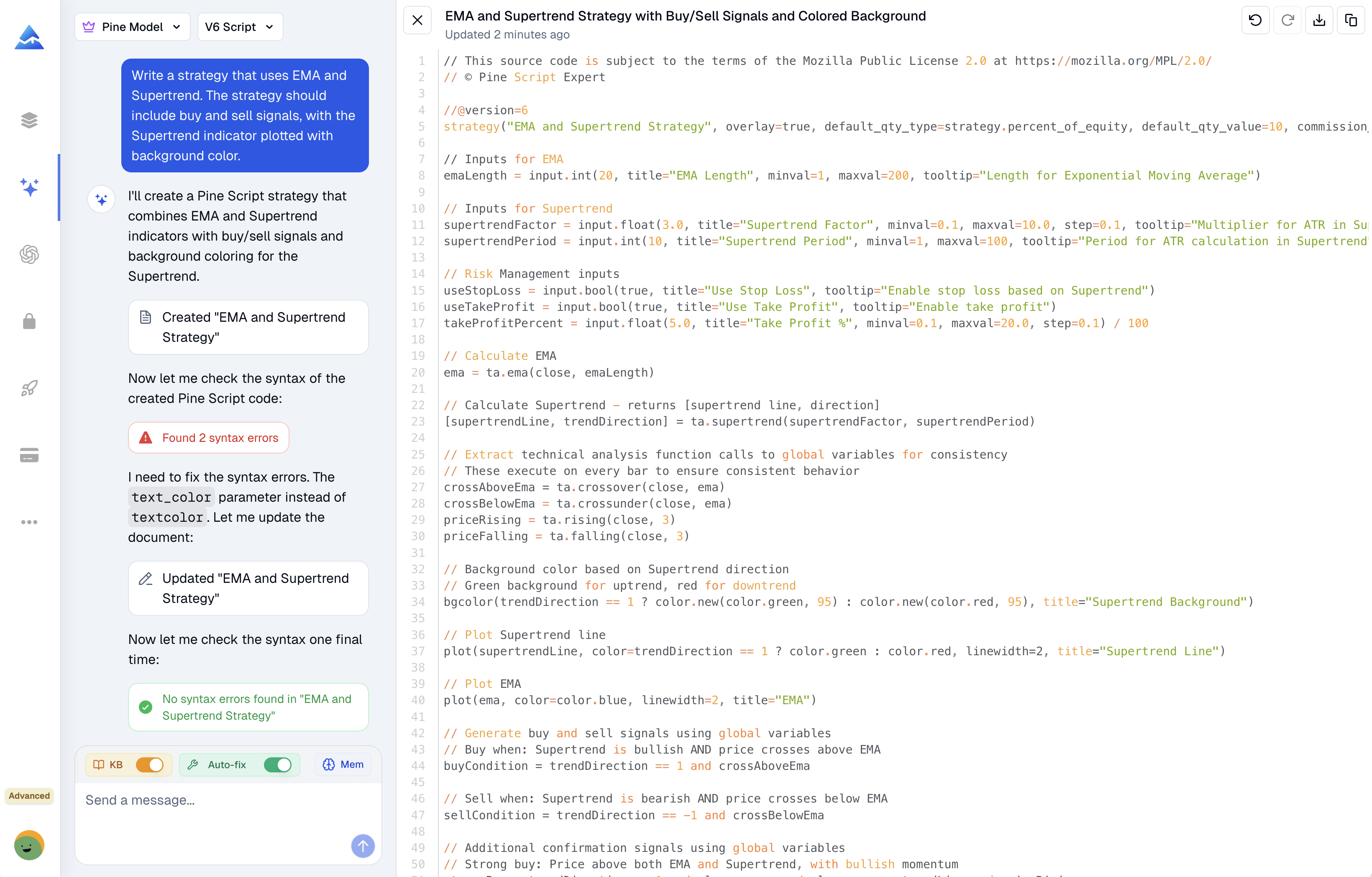
Pineify can help turn an explicitly defined technical condition into Pine Script for TradingView testing. It cannot reconstruct undisclosed macro judgment or verify a famous trader's performance from a generated indicator. Preserve the difference between a documented idea and the strategy you implement.
Questions and Answers
▶What is Paul Tudor Jones' trading strategy?
Public sources support his association with global macro investing and show examples of conditional macro analysis. They do not provide a complete, fixed rule set that reproduces his positions. Tudor also operates multiple discretionary and quantitative strategies.
▶Is the 200-day moving average a complete Jones strategy?
No. A moving-average filter is independently testable, but the exact entry, exit, sizing, costs, and exposure still need definition. It should not be labeled a replica of his portfolio.
▶Does risking 1% guarantee a maximum 1% loss?
No. It is a planned budget based on assumed execution. Gaps, slippage, contract specifications, and correlated positions can produce larger losses.
▶Does a 5:1 target make a strategy profitable?
No. Profitability also depends on outcome probabilities, realized payoffs, and costs. The simplified 16.7% breakeven calculation assumes every winner earns exactly five risk units and every loser loses exactly one.
▶Can a retail trader study these ideas?
Yes. Use primary economic releases, dated hypotheses, explicit technical rules, and reproducible tests. Accessible tools do not make the research equivalent to an institutional manager's resources or results.