On-Balance Volume Trading Strategy: Volume Flow Analysis

On-Balance Volume (OBV) is a cumulative volume indicator that tracks whether buying or selling pressure is building beneath price action. It adds each day's volume when the close is higher than the previous close, and subtracts when it's lower. The result is a running line that reveals hidden institutional activity before price moves.
I've been using OBV on my daily charts since early 2023, and I'll tell you straight up: it's not a magic bullet. But when I pair it with price action on AAPL or SPY, the divergence signals have saved me from chasing false breakouts more times than I can count. Think of OBV as a signal that smart money might be quietly accumulating or distributing before the rest of the market catches on.
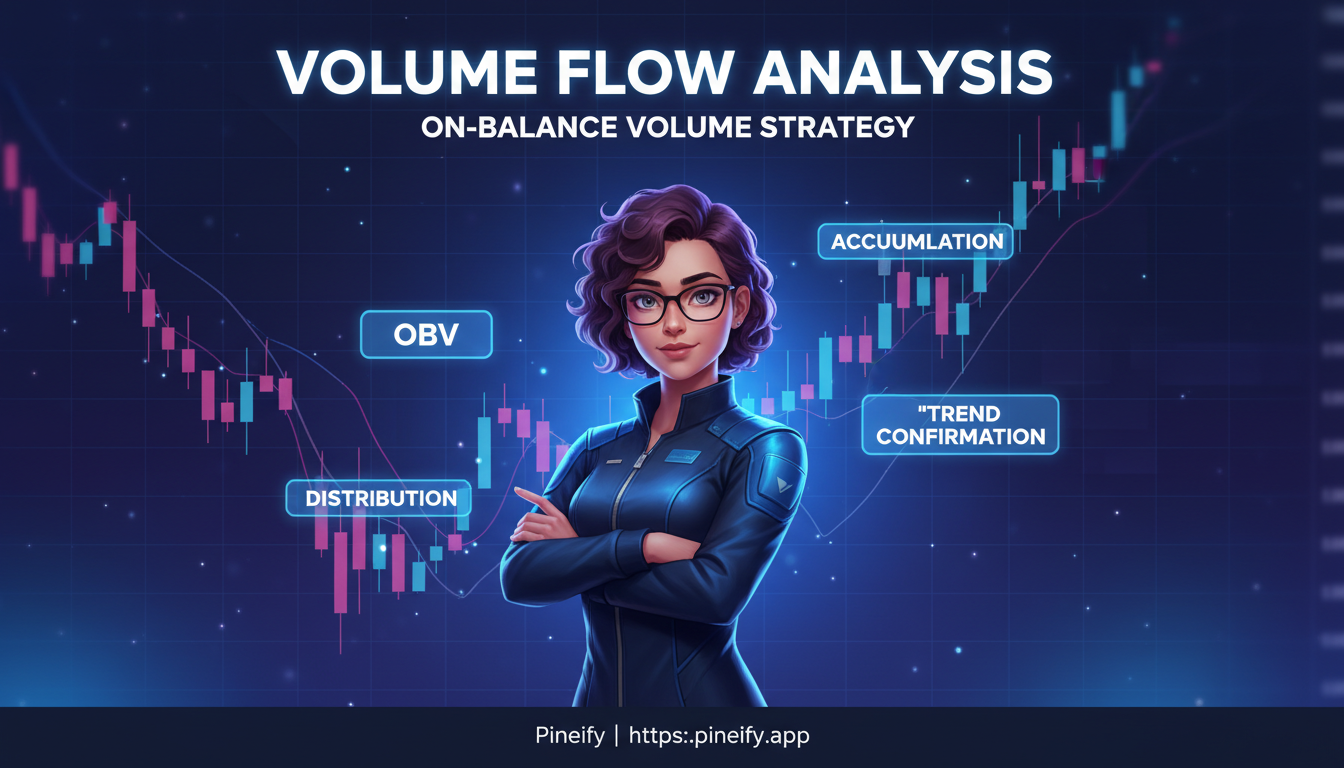
What is the On-Balance Volume (OBV) Indicator?
OBV is a running total—a cumulative line on your chart. It works like this:
- If today's closing price is higher than yesterday's close, all of today's volume counts as "up volume" and gets added to the OBV line.
- If today's closing price is lower than yesterday's close, all of today's volume counts as "down volume" and gets subtracted.
It's essentially a scoreboard keeping track of whether volume is supporting up days or down days over time. When the OBV line rises, accumulated buying pressure is building. When it falls, selling pressure is building.
The real value comes from comparing the OBV line's trend to the price's trend. If the price moves sideways or dips slightly, but the OBV line steadily climbs, that can signal accumulation—a price rise may follow. It helps you ask: "Is the volume confirming this price move, or is it telling a different story?"
How to Figure Out On-Balance Volume
Calculating OBV is straightforward once you get the hang of it. It's a running total that adds or subtracts each day's trading volume based on whether the price went up or down. You start with a beginning number, then follow a few rules day by day.
Here's how it works:
- If the closing price today is higher than yesterday's close: Add today's full trading volume to the previous OBV.
- If the closing price today is lower than yesterday's close: Subtract today's volume from the previous OBV.
- If the price closes exactly the same: OBV doesn't change. You carry over yesterday's number.
Let's walk through a quick example.
Say a stock closes at $110 with 15,000 shares traded. If your OBV was at 10,000 the day before, you'd add because the price went up. 10,000 + 15,000 = 25,000. That's your new OBV.
The next day, the stock drops to $105 on 12,000 shares traded. Since the price fell, subtract that day's volume. Take 25,000 and subtract 12,000. Your OBV drops to 13,000.
You keep doing this every day. Over time, all these additions and subtractions create a cumulative line—a running tally of volume flow. Traders plot this line under their price chart to look for clues and confirm trends. That simple connection between price movement and volume makes OBV so useful.
How to Read the Market with On-Balance Volume (OBV)
Is the Trend for Real? Using OBV to Check
The simplest way to use OBV is to see if a price trend has real backing. Think of it like checking if a crowd is genuinely moving in one direction.
If the price is going up and the OBV line is also rising, that's a good sign. The rising prices have support from increasing buying activity (accumulation). I haven't found a more reliable way to gauge whether a trend has legs—when volume confirms direction, the move tends to continue.
On the flip side, if the price is falling and OBV is dropping too, it confirms the downtrend. Selling (distribution) is broad and the decline could keep going. When price and OBV agree, you get much more confidence in the market's direction.
Spotting Reversals Early: The Power of Divergence
Sometimes the price tells one story, but volume tells another. This disagreement—a divergence—can be a powerful early signal that a trend is running out of steam.
Bullish Divergence (A Hidden Opportunity)
This happens when the price hits a new lower low, but OBV makes a higher low. The price is dropping, but selling volume is decreasing, and smart buyers are quietly stepping in. The downtrend is weakening and a move up could be next.
I caught one of these on TSLA in October 2023. The stock was grinding lower, but OBV had already turned up. Two weeks later, TSLA ripped 18% higher. Not every divergence works that cleanly, but when the timeframe lines up, it's worth paying attention.
Bearish Divergence (A Warning Sign)
This occurs when the price makes a new higher high, but OBV makes a lower high. The price is climbing with less and less buying enthusiasm. The market is getting tired. This often happens before a top forms and the price reverses down.
Making Sure Breakouts Are Legit
One of the most frustrating things is acting on a breakout, only to see it reverse immediately—a false breakout. OBV can help filter these out.
When price breaks above a key resistance level, check the OBV. If OBV is also rising strongly during the breakout, it's a green light. The move has volume support and is more likely to be real.
Same logic for breakdowns. If price breaks below support and OBV is falling, the breakdown is confirmed. This volume agreement helps avoid getting caught in a false move that snaps back.
Popular OBV Trading Strategies
OBV Trendline Strategy
Draw trendlines right on the OBV indicator. It gives clear signals for entries and exits. If the OBV line is consistently making higher highs and higher lows (an upward trend), buying is outpacing selling. That's a good spot to consider a long position. If OBV is trending down, selling pressure is building—time to exit a long or look for a short.
Another trick: watch for key levels—support and resistance—on the OBV line itself. When price breaks one of these, it can act as a solid entry signal.
OBV Moving Average Strategy
Adding a moving average to your OBV line helps cut through noise. It's like having a smoother version of the indicator for confirmation. Here's the rule: when OBV crosses above its moving average, it's a bullish sign that momentum is picking up. When it drops below, it's a bearish signal that momentum is fading.
I prefer using a 20-period EMA on the OBV line. It smooths out the daily noise without being so slow that I miss the turn. That said, I've tested shorter periods like 10 and they trigger too many false signals for my style.
This approach works well in choppy markets because it helps you spot genuine trend changes without getting tricked by every little blip on the chart.
Finding the Right Timeframe for Your OBV Strategy
OBV doesn't work the same on every chart. The timeframe you choose changes the story it tells.
| Timeframe | Focus | Best Application |
|---|---|---|
| Short-Term (Day Trading) | Steepness of OBV line, volume spikes | Monitor minute-to-minute changes during high-volume sessions |
| Medium-Term (Swing Trading) | Sustained shifts in OBV | Analyze daily and weekly charts for trend changes |
| Long-Term (Investing) | Overall direction, divergence patterns | Use weekly or monthly charts for broader market trends |
For stock traders, OBV gives its clearest signals when lots of shares change hands. That's usually during the market's busiest times: the opening bell (9:30-10:30 AM ET) and the final hour before close (3:00-4:00 PM ET). Volume is highest then, making OBV's movements more meaningful. For day traders, getting accurate data is critical—check out How to Get Live Data on TradingView to make sure your signals are timely.
If you trade forex, volume centers around major market overlaps. The best window for OBV analysis is when London and New York are both active (8:00 AM to 12:00 PM ET). The surge in trading activity during this overlap creates the strong volume flow that OBV is built to measure.
What to Watch Out For With the OBV Strategy
OBV is a handy tool, but it's not perfect. Like any single metric, it has blind spots. I've learned these the hard way over the years.
| Limitation | Why It Happens | The Practical Effect |
|---|---|---|
| Low-Liquidity Markets | In thinly traded stocks or assets, even a small trade causes a big percentage change in volume. | OBV jumps around based on insignificant activity, creating false signals that don't reflect real buying or selling pressure. |
| Sudden Price Gaps | After earnings news or big events, a stock can open much higher or lower than the previous close. | OBV only looks at the closing price. A huge intraday move on massive volume might barely register if the price closes near where it opened. |
| Artificial Volume Spikes | High-frequency traders and algorithms place and cancel orders rapidly, inflating volume numbers. | These fake volume spikes temporarily push OBV up or down, making it look like a trend is starting when it's really market noise. |
Think of it this way: OBV listens for the steady hum of genuine interest. In a quiet room (a low-liquidity stock), a single cough sounds deafening. During a sudden shout (a price gap), it misses context. And sometimes there's just static in the system (artificial volume).
Never rely on OBV alone. Always check the price and use other information to see if OBV's story makes sense. It's a great teammate, but it shouldn't be the only player on the field.
Getting More From OBV: Pairing It With Other Tools
OBV works best when you combine it with other technical indicators. Check out TradingView Top 10 Indicators: Essential Tools for Technical Analysis Success for ideas on what pairs well with volume analysis.
Using OBV by itself can lead you astray. But when its message is backed up by another tool, your confidence grows significantly.
Powerful Combinations in Practice
Pair OBV with momentum indicators like RSI or MACD. This confirms whether a move has real strength.
If OBV shows a bullish divergence (price makes a lower low, OBV makes a higher low) AND the RSI is in oversold territory, that's a much stronger hint that a bounce might be coming than either signal alone.
It also works with classic chart patterns. When the story on the chart matches the story in the volume, pay attention.
Imagine a double bottom pattern forming. If OBV is trending upward and not making new lows with the price, buyers are quietly accumulating during the dips. This alignment increases the odds that the pattern will play out. I haven't seen many double bottoms fail when OBV was already trending up through the entire formation.
Finally, never skip a simple price action check. Before acting on an OBV signal, see if the price respects a key support level or if a bullish candlestick pattern is forming where you'd want to enter. This last look is your final reality check.
Practical Steps to Get Started
You've got the basics down. Time to test them.
Start simple: pull up your charting platform and add OBV. Watch how it moves alongside the price of an asset you know. Look back at old charts and spot places where OBV and price diverged. Did the price eventually turn?
I keep a simple log in a Google Sheet. I note the date, the asset, whether I see a divergence, and what happened afterward. After a few months, patterns start to emerge—you'll notice which timeframes produce the cleanest signals for your style.
Draw trendlines on both the price chart and the OBV line at the same time. This helps you see how closely they track each other—and when they drift apart.
Before using real money, try paper trading. Switch between timeframes—daily to 4-hour to 1-hour—and see how the strategy feels. No rush.
Blend OBV with other tools you already trust, like a moving average or RSI. Build an approach that fits how you trade and how much risk you're comfortable with. To deepen your understanding of how to code custom indicators, check out Understanding Pine Script's request.security Function.
This process of testing, logging, and refining is how traders build their edge. If you want to turn OBV observations into a custom TradingView indicator without coding from scratch, there are practical solutions.
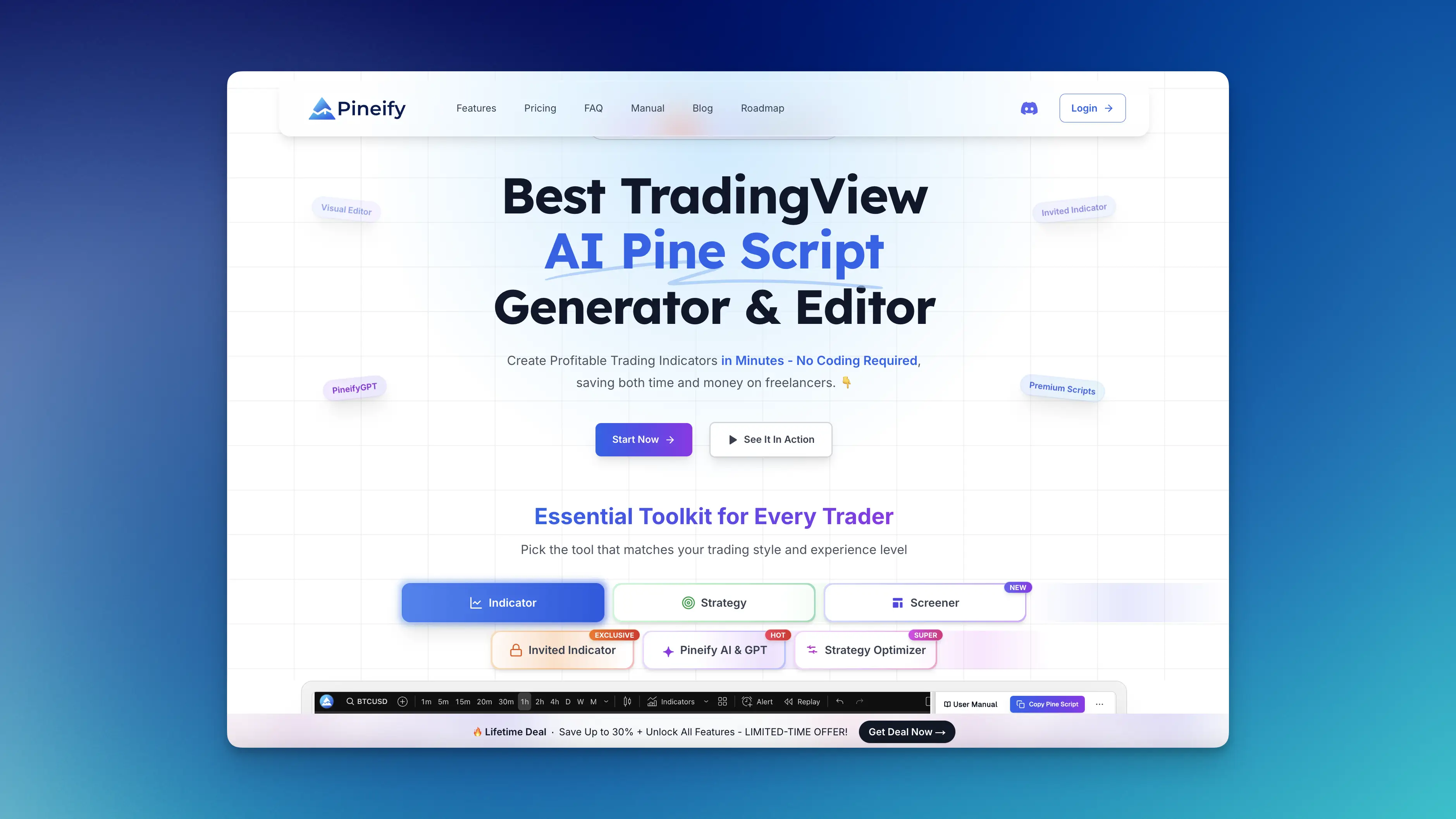
Platforms like Pineify let you visually combine OBV with other indicators, set complex entry and exit rules, and even backtest your composite strategy—all through a drag-and-drop editor. It's a way to move from manual charting to a coded tool that works on your charts 24/7, saving you the time of hiring a developer.
Like any skill, getting good with OBV takes practice. It's a powerful way to gauge what the market might be thinking, but it works best when you use it consistently, manage your risk, and learn to tell when volume is showing a real shift—not just random noise.
What is On-Balance Volume (OBV) and how does it work?
On-Balance Volume is a cumulative indicator that adds volume on up days and subtracts on down days. The resulting line shows whether buying or selling pressure is building beneath price action. I've found it most useful for spotting when volume contradicts what price is doing—that's where the real trading opportunities hide.
How do I use OBV divergence to find trade setups?
Watch for disagreements between price and OBV. Bullish divergence happens when price makes a lower low but OBV makes a higher low—selling pressure is drying up. Bearish divergence happens when price makes a higher high but OBV makes a lower high—buying enthusiasm is fading. Stick to daily or weekly charts where the pattern has developed over several weeks for the most reliable signals.
What are the best timeframes for OBV trading?
OBV works across all timeframes but gives clearest signals where volume is meaningful. Day traders should focus on 5-minute to 1-hour charts during high-volume sessions. Swing traders get the best results from daily charts. Long-term investors should use weekly or monthly charts to spot major accumulation and distribution cycles.
How does OBV confirm a breakout?
When price breaks above resistance, check if OBV is also rising. If it is, the breakout has volume backing and is more likely to sustain. If OBV is flat or falling during a breakout, the move may be false. I've had this filter save me from bad entries on NVDA and AMD more than a few times.
What indicators work best alongside OBV?
OBV combines well with RSI for momentum confirmation—a bullish OBV divergence plus oversold RSI is a strong buy signal. Pairing OBV with MACD helps confirm trend shifts. Classic chart patterns like double bottoms become more reliable when OBV is trending up during the pattern formation. I personally use OBV with a 14-period RSI and a 50-period moving average as my baseline setup.
What are the main limitations of the OBV indicator?
OBV has three key weaknesses: it struggles in low-liquidity markets where small trades create outsized moves; it can miss context around price gaps from earnings or major news; and artificial volume from algorithmic trading can create misleading spikes. I've seen all three trip up traders who relied on OBV alone. Always confirm with price action and at least one other indicator.
Does OBV work for forex and crypto trading?
OBV is most reliable for stocks and futures where volume data is precise. In forex, volume figures represent tick count rather than actual transaction size, so OBV readings need extra caution. For crypto, exchange-specific volume varies widely. My advice: stick to major exchanges with high liquidity if you're using OBV on crypto.