Order Flow on TradingView: DOM, Delta, Footprint, Volume Profile

Order flow is the live sequence of buy and sell transactions that drives every price move on your chart. On TradingView, you watch this through the DOM, Time & Sales, footprint charts, and cumulative delta. I started focusing on these tools in early 2023, trading ES futures, and within a few weeks I could see absorption patterns I had missed for years. Not every setup works. Some signals are just noise. The trick is knowing which is which.
What is order flow?
Order flow tracks every trade as it happens, showing you the mechanics behind each price move. Instead of relying on lagging indicators, you watch the live interaction between buyers and sellers through several tools:
- Executed Trades: The actual transactions happening right now.
- Queued Liquidity: The standing orders waiting to be filled.
- Buy vs. Sell Pressure: The real-time battle between bids and asks.
The main order flow tools on TradingView are:
| Tool | What It Shows You |
|---|---|
| Depth of Market (DOM) | The live list of all buy and sell orders waiting at different price levels. |
| Time & Sales | A real-time ledger of every single trade, showing the price, volume, and whether it was a buy or sell. |
| Footprint/Cluster Charts | A chart that breaks down each candle to show the individual buy and sell transactions that formed it. |
| Cumulative Delta | A running total of the difference between aggressive buys and sells, showing if one side is dominating. |
| Volume Profile | A visualization of how much trading activity occurred at specific price levels over a chosen time period. |
Is TradingView good for order flow?
Yes. TradingView bundles the essential tools—market depth, Time & Sales, volume profiles—into one platform. You don't need to juggle separate software. For most traders, that's enough to build a structured approach to order flow.
The catch: footprint charts aren't built in. You'll need community scripts for that. And data quality varies by market. Futures and crypto give you the richest data; some stocks require separate subscriptions.
Core Tools: A Practical Breakdown
Each order flow tool gives you a different view of the auction process. Here is what each one does, where it shines, and what to watch for.
| Tool | What it shows | Best use case | Key caution |
|---|---|---|---|
| DOM (Market Depth) | Resting liquidity across prices | Identify magnets, absorption, and likely pause zones | Liquidity can spoof or vanish fast |
| Time & Sales | Executed trades and pace | Confirm aggression, track sweeps | Can be noisy without context |
| Volume Profile | Traded volume distribution, POC/VA levels | Find value, LVNs, rotation targets | Not a timing tool by itself |
| Footprint/Clusters | Bid/ask volume at price, imbalances | Read absorption/exhaustion at levels | Depends on script quality/settings |
| Delta/CVD | Net aggression and its trend | Spot divergence and flips | Divergence can persist in trends |
DOM (Depth of Market): Shows you the buy and sell orders waiting at different prices. I use it to spot where big liquidity sits—price often stalls or reverses there. Just know that large orders can disappear instantly. I've watched a 200-contract bid at 4500.25 on ES completely vanish within seconds.
Time & Sales: The raw tape of every executed trade. When big orders keep hitting the ask aggressively, that's a strong directional signal. On its own the tape is just noise. You need chart context to make sense of it.
Volume Profile: One of the most useful tools for understanding where the market has found value. It shows which price levels saw the most activity (the Point of Control) and which were thin (Low Volume Nodes). The value area often acts as a magnet for price. Its main weakness: it tells you where something might happen, but rarely when.
Footprint Charts: Splits each candle open to show bid vs. ask volume at every price level. You can spot exhaustion in real time—heavy buying that can't push price higher. The quality of what you see depends heavily on the specific script. I've tested three different footprint indicators on NQ and got noticeably different readings from each. For a deeper walkthrough, check out Pine Script Volume Footprints.
Delta / Cumulative Delta (CVD): The net difference between aggressive buyers and sellers. CVD divergence is my favorite signal: price makes a new high, but delta stays flat or drops. That divergence warned me before a reversal on BTC on November 14 last year. But in a strong trend, divergence can persist much longer than you expect.
Setting Up Your Order Flow Toolkit in TradingView
Getting your charts configured with order flow tools is straightforward once you know the steps.
A quick note: The exact button names and menu locations change over time. The concepts stay the same.
1) Start with the DOM and Time & Sales
This is the foundation.
- Open a supported chart: Futures and major crypto pairs give you the best data. Some stocks need a separate data subscription. I trade mostly ES and BTC, and both deliver clean order book data on standard plans.
- Find the Depth of Market (DOM): Look under "More" or a side panel labeled "Depth of Market." This shows live buy and sell orders at various price levels.
- Open Time & Sales: This is the tape—every trade as it prints. Watch the speed and size, especially at support and resistance levels.
2) Use Volume Profile the Smart Way
Volume Profile shows where trading happened, not just how much.
- Session Volume Profile: The built-in indicator. Shows the value area, Point of Control (POC), and value area high/low for the current session.
- Fixed Range Profile: Draw a box around a specific move (a consolidation zone, a breakout). The profile calculates volume for just that area.
- Compare days: Look at today's profile next to yesterday's. Is today a balance day or an expansion day? I check this every morning before the US open.
3) Add VWAP
The Volume Weighted Average Price is a classic mean-reversion tool. The standard VWAP works well for intraday mean reversion. I prefer anchoring VWAP to the session open for day trades and to a major breakout candle for swing trades. For more detail, see our anchored VWAP guide.
4) Set Up Delta and Footprints
- Search the TradingView indicators menu for "delta," "cumulative delta," or "bid ask." Pick scripts with good ratings and clear documentation.
- Footprint charts show buying and selling volume at each price level within a bar. You can see imbalances and the POC for individual candles.
- Keep it clean: Two or three order flow tools per chart is enough. More than that and you're just watching noise.
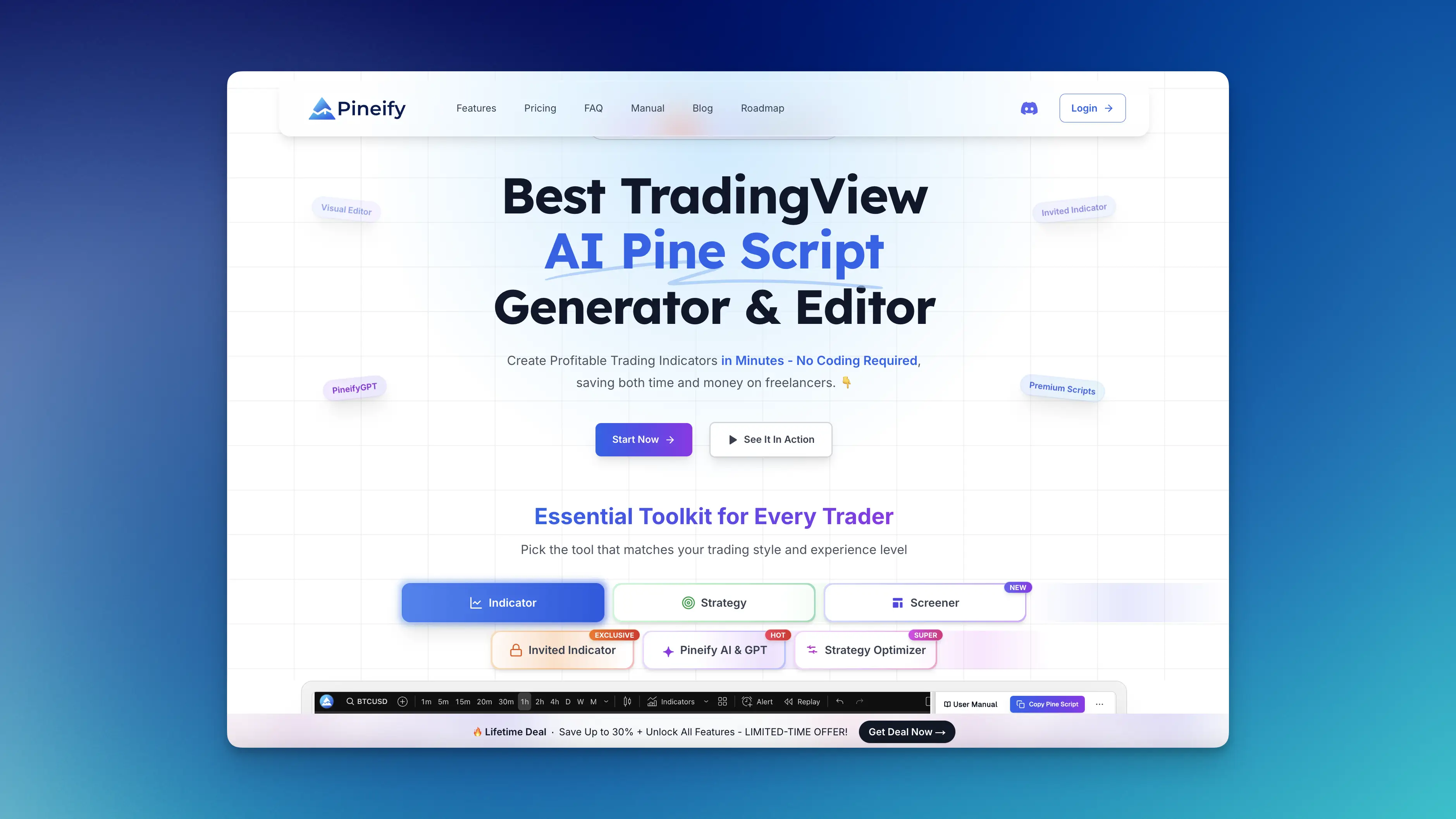
If custom order flow indicators appeal to you but coding Pine Script isn't your thing, Pineify's visual editor lets you build complex indicators and strategies without writing code. You combine conditions, set alerts, and backtest your ideas. I've used it to build a CVD-based divergence scanner. That said, it won't replace manual footprint reading for precision entries—you still need to watch the tape yourself. It works best as a complement, not a replacement.
5) Build Your Workspace
Here is a layout I've found effective:
| Pane/Location | Recommended Tool(s) | Why It Works |
|---|---|---|
| Left Chart | 1–5 minute candlesticks with Volume Profile and VWAP | Main price action view, contextualized by volume levels and trend. |
| Right Chart | Footprint/Cluster chart or a separate Delta/CVD pane | Micro-view of trading activity within each bar. |
| Side Panel | Depth of Market (DOM) and Time & Sales | Real-time pulse on incoming orders and live execution. |
Set alerts for when price tests the POC, tags VWAP, or when you see a sudden delta burst. That way you don't need to stare at the screen all day. If you're automating execution, you might also connect MetaTrader to TradingView.
How to Read Order Flow on TradingView: Key Signals
Reading order flow means watching the real-time conversation between buyers and sellers. On TradingView, the footprint chart makes this visible. Here is what I look for:
- Imbalances: One price level where selling volume (asks) completely overwhelms buying (bids), or vice versa. Several stacked imbalances in a row tell you the trend has strength.
- Absorption: Price hits a level repeatedly but can't break through, even with heavy trading. A large player is passively soaking up orders. When price finally reclaims that level, expect a reversal.
- Exhaustion: Price pushes to a new high or low, but the final push has thin volume. Price snaps back almost immediately. I've seen this pattern on NQ dozens of times near session highs.
- Sweeps and Stops: Price tests a prior high or low, triggers a flush of trades (stops being hit), then reverses hard. That failed breakout is a strong reversal signal.
- Delta/CVD Divergence: Price makes a new high but buying pressure (delta) is weaker than the prior swing. On December 5, I watched BTC print a higher high while CVD printed a lower high. Price dropped 3% in the next hour.
- Profile Edges and LVNs: Value Area High/Low (VAH/VAL) from Volume Profile. Sharp rejections here, or fast moves through Low Volume Nodes (LVNs), set up high-probability reversal or breakout entries.
A Simple, Repeatable Trading Playbook
These setups are starting points. Test them, adjust them, find what fits your market and style. I've found that ES and NQ respond differently to the same playbook—ES tends to respect VWAP more, while NQ shows cleaner footprint imbalances. For more on building and testing strategies, check out How to Create a Strategy in TradingView.
| Playbook Setup | Context | Trigger | Entry | Exit |
|---|---|---|---|---|
| 1. VWAP Reversion | Sideways market, balanced inside day. | Price pushes away from VWAP to the day's range edge; delta shows signs of slowing. | Trade back toward VWAP. Tight stop past the push's high or low. | Take partial profit at VWAP, rest at opposite range edge. |
| 2. POC Test & Hold | Clear trend or building new value area. | Price pulls back to the POC; buyers or sellers defend it. | Enter in trend direction as POC holds. | Profit at recent high/low. Exit if POC breaks decisively. |
| 3. Breakout Continuation | Tight, multi-test range. | Price breaks out with speed and stacked imbalances. | Small pullback to breakout level or nearby low-volume area. | Partial profit after a move equal to prior range height, then trail. |
| 4. Liquidity Sweep Reversal | Approaching prior day high or low. | Price pushes beyond that level, sucks in orders, then reverses as delta flips. | Enter when price reclaims the original level. Stop beyond the fake-out extreme. | First profit at mid-range or VWAP. |
| 5. Fading the Extreme | Long, extended move in one direction. | New high or low with weaker delta—the move is running out of steam. | Fade on a confirming sign: weak candle or slowing momentum. | Profit at first support/resistance. Exit if fresh aggressive orders appear against you. |
Managing Risk in Order Flow Trading
You need a clear plan for getting out when things turn. Here is how I think about risk and execution.
Define risk by more than price. Don't just say "I'll get out if it drops to 4500." Watch the tape. Is momentum stalling? Is buying pressure drying up? If the market's aggression flips against you, exit based on that behavior change, not a fixed number.
Use hard stops and bracket orders. Always set a hard stop-loss. If your platform supports OCO (One-Cancels-the-Other) or bracket orders, use them. They set your profit target and stop at the same time, removing emotion. I've held losing trades too long because I didn't have a bracket set. That mistake cost me about 15 points on ES in one afternoon.
Adjust size for conditions. Trade smaller when the market is thin—low liquidity, ahead of major news. Thin books mean wider slippage and sudden price swings.
Watch slippage and fills. The difference between your intended price and actual fill grows in fast markets. The DOM can vanish right after a news catalyst. Track this to understand the true cost of trading in volatile moments.
Journal the specifics. After every trade, write down what order flow signal triggered the entry, where absorption appeared, and how the tape felt—fast, slow, urgent. This turns every trade into a learning experience.
Limitations and Workarounds
No order flow tool is perfect. Here is what I've learned to watch for.
- Data coverage varies. Futures and crypto give you rich data. Some stocks need extra subscriptions, and the quality is inconsistent. Check what your plan includes before relying on a signal.
- Latency smooths fast moves. If you try to catch every micro-movement, you'll get frustrated. Focus on the bigger decision zones—price levels where meaningful volume is happening.
- Script quality differs. Community-built footprint and delta scripts calculate things differently. Pick one well-documented script and stick with it. Jumping between scripts creates more confusion than insight. I haven't tested footprint scripts on forex pairs, so I can't vouch for those.
- Mobile is for monitoring, not execution. You can check charts on your phone, but DOM-based entries need a desktop. Screen size makes precise footprint reading impractical.
Common Mistakes to Avoid
I've made all of these. Save yourself the tuition.
- Trading every imbalance. Context matters. An imbalance in a choppy, sideways market is noise. The same imbalance at a key high or low is a signal. Learn the difference.
- Ignoring the liquidity picture. You see a perfect setup on the chart, but the DOM is thin. That's a red flag. Thin books mean bad fills and fake moves.
- Tweaking settings constantly. Pick your footprint colors and thresholds, then leave them alone for a month. If you change settings every day, you'll never recognize the real patterns.
- Using order flow in isolation. Order flow confirms other signals. Does your setup line up with a key level, a volume profile LVN, or VWAP? When multiple things agree, your odds improve.
- Doubling down when wrong. You jump in on what looks like absorption, but price keeps dropping. The tape is telling you that you're wrong. Don't average down. Exit. I ignored this rule twice last year and paid for it both times.
FAQs: Order flow TradingView
Does TradingView have footprint charts?
Not as a built-in feature, no. But community-made indicators give you the same functionality. Some well-rated scripts show bid/ask volume, imbalances, and the Point of Control for each bar. Pick one, learn it well, then branch out if you need to.
Do I need a paid plan for order flow on TradingView?
Depends on what you need. The free plan limits how many indicators you can use and how much volume profile data you can access. To use multiple scripts, see live market depth on certain exchanges, or get more historical data, you'll likely need a higher-tier plan or a separate data subscription.
Which markets are best for order flow on TradingView?
CME futures (ES, NQ) and major crypto pairs. They have deep, transparent order books and an active tape. Stocks can work, but data quality and market depth access are inconsistent. I trade mostly ES and BTC and get clean data on both.
Is cumulative delta better than a footprint chart?
They do different things. Footprint charts show fine detail for pinpointing entries and exits within a single bar. Cumulative delta shows the bigger picture—who is in control overall—and excels at spotting divergence between price and momentum. I use both.
Can order flow analysis work on higher timeframes?
The scalping signals are best on intraday charts. But volume profile value areas and POC levels give you useful context on weekly and monthly timeframes too. I use weekly volume profile to plan my swing trades on NQ.
How do I backtest order flow signals?
TradingView Replay mode is your best bet. Go back in time, watch the tape move, and mark where your signals appeared. Pair that with screenshot journaling to track what works over time. Full automated backtesting is harder here since order flow signals are subjective by nature.
What is CVD divergence and why does it matter?
CVD divergence happens when price makes a new high or low but the net buying or selling pressure is weaker than the previous swing. It tells you fewer traders are driving this move aggressively, so the trend may be about to reverse. I caught a 4% BTC drop in December using this signal alone.
Can I use order flow on mobile TradingView?
You can monitor charts and positions on mobile. But for active trading with the DOM or footprint charts, screen size makes it impractical. I only check my phone for alerts. All my entries happen on a desktop.