TradingView Layout Guide: Set Up Your Workspace for Better Trading

A TradingView layout is the arrangement of charts, panels, and tools inside a single browser tab. It defines how you see the market. Get this right and your trading changes. Instead of hunting through tabs and losing focus, a clean layout puts the signals you need front and center.

Setting Up TradingView Layouts
TradingView layouts are your command center. You can arrange charts almost any way you want in one tab. You are not stuck with one chart. Pick a starting point:
- One Big Chart: For deep focus on a single asset.
- Side-by-Side: Compare two markets or a stock with an index.
- Stacked or Grid Views: Monitor multiple timeframes or different assets at once.
The real efficiency booster for active traders is the multi-chart mode (paid plans). It lets you watch up to eight charts live in the same workspace. I have used this for over a year to watch BTC on the 1-minute, 5-minute, and 1-hour charts at the same time, and it saves me from switching tabs constantly. It works for:
- Watching a stock, its sector ETF, and the overall market index together.
- Keeping an eye on a watchlist of potential trades without switching windows.
- Tracking ES futures on multiple timeframes in one view.
Trading Layouts That Work for Your Style
There is no perfect layout. The goal is a workspace that fits how you trade. Here is what I have found works for different styles.
Day Trading Setups
If you are in and out of trades within the same day, speed and context matter most. I prefer a 2x2 grid with ES futures on a 5-minute chart as the main view. A daily chart in the corner keeps me honest about the broader trend. A momentum panel in the third slot confirms moves before I enter.
A typical day trading screen includes:
- Your Main Workspace: A short timeframe chart (5 or 15 minutes) with your entry and exit indicators.
- The Reality Check: A daily chart tucked in a corner to remind you of the major trend.
- The Momentum Gauge: Volume flow or RSI to confirm moves.
- Your Quick-Switch List: A watchlist of the symbols you are focused on that day.
Day traders who want precise entries can read this guide on the best indicator for entry and exit TradingView.
Swing Trading Setups
Swing traders hold for days or weeks. Your layout should match that patience. You do not need live data for every tick. You need clear signals on higher timeframes.
Simplicity wins here. I have been swing trading NVDA on the daily chart since last year, and I keep almost no indicators on screen. Just a 50-day EMA and volume. That is enough.
What makes a swing trading layout work:
- One Big Chart: Daily or 4-hour timeframe. See price history and key levels clearly.
- A Quiet Interface: Remove distractions. Turn off unnecessary alerts.
- Organized Tabs: Use saved chart templates across different assets. Switch from gold to a tech stock with the same clean setup.
- Focus on Key Levels: Highlight major support and resistance only.
Scalping Setups
Scalping catches tiny moves within minutes. Speed is everything. I tried scalping AAPL on a 1-minute chart with four panels and it was too much. I switched to one large chart with all indicators overlaid directly. Way better.
A scalper's layout is built for:
- Speed Above All: A single large chart on the fastest timeframe you trade (1-minute, 3-minute).
- All-in-One Overlays: Moving averages, order book depth, and volume profile on the main chart.
- A Tiny Context Window: A small secondary chart on a higher timeframe (5 or 15 minutes) to avoid getting trapped in a counter-trend move.
- Minimalist Design: If it does not help with a split-second decision, remove it.
Building Your Layout: A Practical Guide
Picking Your Chart Type
Your chart type is the lens you see the market through. Each option gives a different perspective.
| Chart Type | Best For | Key Benefits |
|---|---|---|
| Candlestick | Price action analysis | Shows open, high, low, close with visual patterns |
| Bar Chart | Traditional technical analysis | Clear price information without visual clutter |
| Line Chart | Trend identification | Simplified view focusing on closing prices |
| Area Chart | Volume visualization | Highlights volume-weighted price movement |
Organizing Your Indicators
Adding every indicator you know is tempting. Do not do it. Cluttered charts create confusion. Mix a few tools that answer different questions, like one for trend and another for momentum.
Here is how to keep it tidy:
- Stick to 3-5 indicators per chart. More creates noise.
- Use the Style tab to change colors and line thickness. This helps you tell indicators apart at a glance.
- Keep oscillators like RSI or MACD in their own panes below the main chart.
- Save your indicator combination as a template. Apply it to any chart with one click.
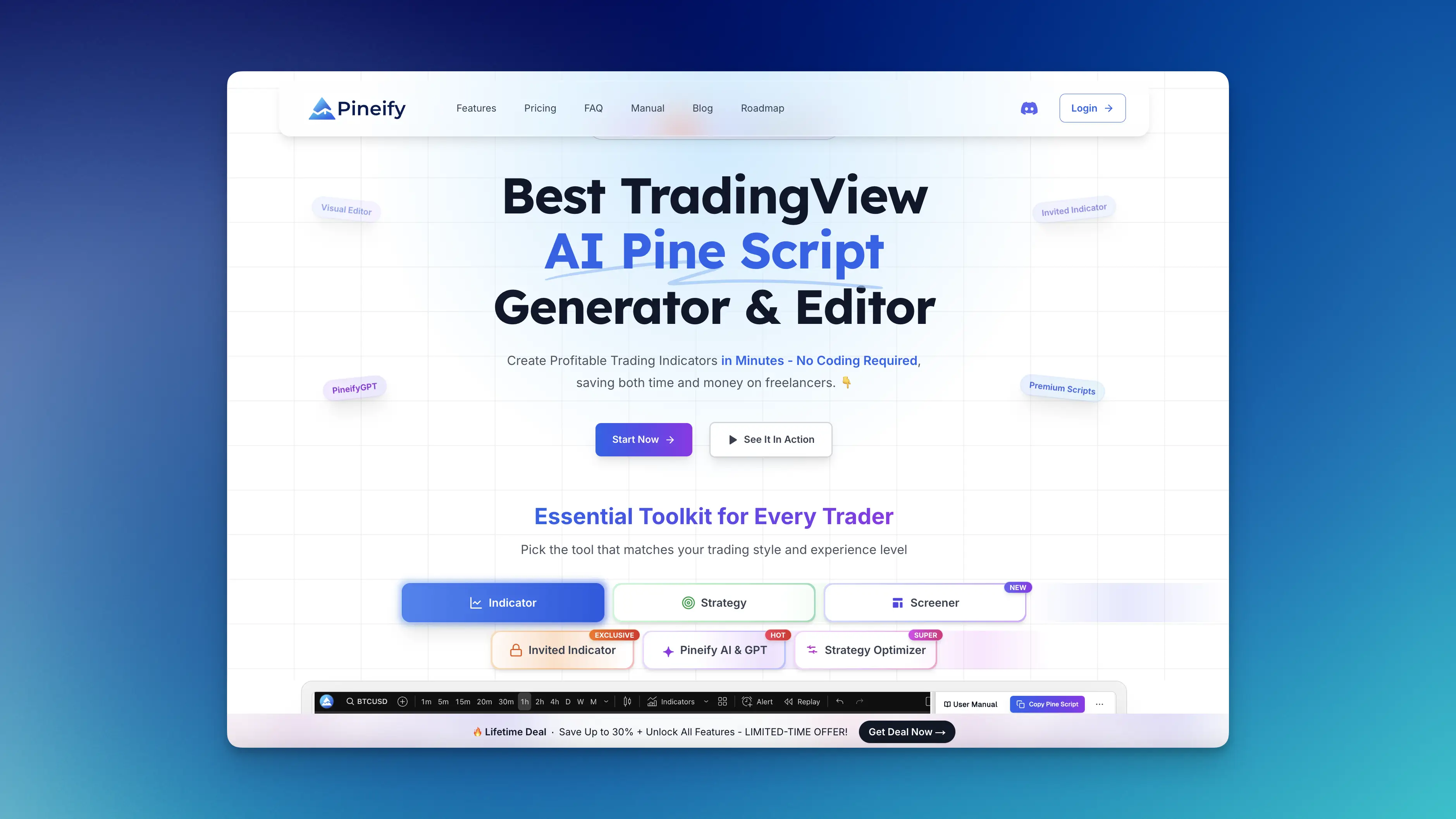
Building custom indicators can be time-consuming. I have used tools like Pineify to visually combine and test different indicator setups without coding. It helped me quickly find a combination of 4 indicators that worked for my ES scalping strategy, saving hours of manual Pine Script editing.
Multi-Timeframe Analysis
This is the secret to a powerful layout. Instead of flipping between charts, bring the bigger picture into your short-term view.
You can plot hourly price action while showing daily moving averages and major support levels on the same screen. This gives you immediate context. I do this with SPY: a 15-minute chart for entries with daily EMAs overlaid. It keeps me from trading against the weekly trend.
Multi-timeframe analysis often needs custom Pine Script. With Pineify's tools, you can build scripts that pull data from higher timeframes and plot them on your current chart without writing code from scratch.
Getting Creative with Your Layout
Making Each Chart Your Own
You can customize each chart in a multi-layout setup separately. Click any chart to change its type, add indicators, switch timeframes, or set how many bars to show.
TradingView's flexible layouts let you drag and resize charts freely. Want your main chart bigger and the others smaller? Go for it. Create a workspace that matches how you actually think and trade.
Keeping Charts in Sync
Symbol syncing saves time when you compare related assets. Enable it, and changing the ticker on one chart updates all synced charts in your layout. I use this to compare AAPL and MSFT or BTC and ETH without updating each chart manually.
Setting Up Colors for Comfort
Hours on screens are part of the job. Good colors reduce eye strain and make price action pop.
What I do:
- Pick clear, high-contrast colors so green and red candles are instantly distinguishable.
- Use a dark background for late-night analysis sessions.
- Tweak border colors and wick styles to see price details clearly.
- Use opacity settings when layering indicators so the chart stays readable.
Getting the Most from Your Layouts
How to Save and Name Your Layouts
Saving a layout locks in your entire setup. Without it, you rebuild from scratch every time. When your charts are arranged:
- Find the name in the top menu bar (probably "Unnamed") with a dropdown arrow.
- Click the arrow and choose "Rename." A clear name like "ES-Mini Day Trade" or "BTC Weekly Analysis" makes it easy to find later.
- Hit "Save layout" or press Ctrl+S (Cmd+S on Mac). If you skip this step and close the tab, those changes are lost.
Having a few layouts ready saves mental energy. Common ones:
- The Scanner: A clean layout for browsing charts to find ideas.
- The Active Trade Station: Your trading panels, order book, and focused chart.
- The Big-Picture Review: Longer timeframes (daily or weekly) to review how the session played out.
- Your Strategy Template: Charts pre-loaded with all the indicators your strategy needs. Validate before risking capital using the strategy tester TradingView ultimate backtesting guide.
Organizing Your Setups
Build a small library of layouts that serve different purposes.
| Layout Purpose | What's In It |
|---|---|
| Main Trading Dashboard | Your core watchlist, open positions, and primary charts. |
| Quick-Scan Research | Minimalist charts for speed-reviewing sectors. |
| Strength vs. Weakness | Separate layouts for strong and weak sectors. |
| Style-Specific | One for scalping (fast timeframes), one for swing trading (slower timeframes). |
Autosave and Experimenting
Autosave quietly saves changes to your current layout. Keep it on for your main layouts so everyday tweaks are saved automatically.
Pro tip: Turn Autosave off when you want to experiment. Otherwise you might overwrite a proven template. Create a copy of the layout first. Play with ideas on the copy and save it under a different name. Keep your original safe.
If your charts are not updating in real time, feed latency could be the issue. Read about how delayed is TradingView data to understand delay on different subscription tiers.
Setting Up for Any Screen
Single Monitor
One monitor means simplicity. Use a single clean chart as your workspace. Save your preferred indicator setup as a template and apply it to each trading pair. Each pair gets its own tab. When you switch from Bitcoin to Ethereum, everything looks the same. I have not tested this approach on an ultrawide monitor, so your mileage may vary with wider aspect ratios.
Multiple Monitors
Two or more screens let you dedicate each to a task. TradingView works across multiple displays and ultrawide monitors.
| Monitor | Best Use For |
|---|---|
| Primary Screen | Your main trading charts and order placement. |
| Secondary Screen | Watchlists, scanners, and research charts. |
| Additional Screens | Market overview tools, news feeds, or education. |
Start with your main chart on one screen and a watchlist on another. Add more as you get comfortable.
Avoiding Common Layout Mistakes
When Your Screen Feels Overwhelming
We have all been there. Too many indicators, too many panels. A cluttered workspace slows you down.
How to stay clean:
- Group similar things. Use tabs or collapsible sections to organize tools.
- Set filters. If your news feed or scanner is noisy, filter it.
- Focus on essentials. Be ruthless. If you are not using it for the current trade, hide it.
- Do a monthly cleanup. Ask yourself: "Do I actually use this?" If not, remove it.
The Power of Consistency
Consistency matters when you compare charts side by side. Imagine two weather reports where one uses Celsius and the other uses Fahrenheit. Confusing.
For your charts:
- Use the same timeframe across related charts.
- Show the same amount of historical data.
- Use the same chart type for each purpose.
Your eyes scan across charts and make true comparisons. No mental friction.
Quick Reference Checklist
| Step | Action | Tip |
|---|---|---|
| 1 | Open TradingView and pick a starting style. | Start with fewer panels. Add more later. |
| 2 | Save your first draft with a descriptive name. | Use version names (v1, v2) to track progress. |
| 3 | Explore shared layouts from the community. | Look for users who trade a similar style. |
| 4 | Remove unused widgets after a few sessions. | If you have not looked at it in 3 days, delete it. |
| 5 | Note changes in your decision speed. | The goal is less hesitation and more clarity. |
The best layout is the one you stop thinking about. It gets out of the way and shows you the market. Open TradingView now and make your first change.
What is a TradingView layout and how is it different from a tab?
A TradingView layout is how you arrange charts, panels, and tools inside one browser tab. A tab is like a desk. You can have multiple tabs open, and each tab has its own layout. For example, one tab might hold a 4-chart crypto layout and another tab holds a 2-chart forex setup.
How do I set up a multi-chart layout?
Click the layout selector icon in the top toolbar and pick a multi-chart template. You can choose a 2x2 grid, a 3-chart split, or other options. Multi-chart mode supports up to eight charts and needs a paid TradingView subscription. Each chart in the layout can use its own symbol, timeframe, and indicators.
Which layout works best for day trading versus swing trading?
Day traders usually do well with a 2x2 grid that shows a short timeframe (5 or 15 min) chart next to a daily chart for context. Swing traders can get away with a single large daily or 4-hour chart. Day trading needs real-time context across multiple timeframes. Swing trading values clarity over speed.
Can I save multiple layouts and switch between them?
Yes. TradingView lets you save unlimited named layouts, even on free accounts. Use the layout dropdown at the top, click Rename, give it a name, and save with Ctrl+S. Switch between layouts instantly without rebuilding your charts.
How does symbol syncing work across charts?
When symbol sync is on, changing the ticker on one chart updates all synced charts in the same tab. This is useful for comparing correlated assets like a stock and its sector ETF, or BTC and ETH, without updating each chart manually.
What are the limits of layouts on a free account?
Free accounts get one chart per tab. Multi-chart mode is not available. Saved layouts on free accounts are single-chart only. Paid plans (Pro, Pro+, Premium) open multi-chart mode with up to 8 charts per tab.
How do I apply one chart's settings to all charts at once?
Open the Properties window on any chart. Click the "Apply to All" button. It copies the current chart's color scheme, chart type, or background theme to every other chart in the same tab. No need to adjust each chart individually.