TradeSage vs Pineify: Which AI Pine Script Tool Wins?

· 11 min read
Pineify Team
Pine Script and AI trading workflow research team

TradeSage vs Pineify is a comparison between two AI tools that turn trading ideas into Pine Script code for TradingView. After testing both, I think Pineify comes out ahead for most traders — not just on price, but on how it handles the full workflow from idea to backtested strategy.

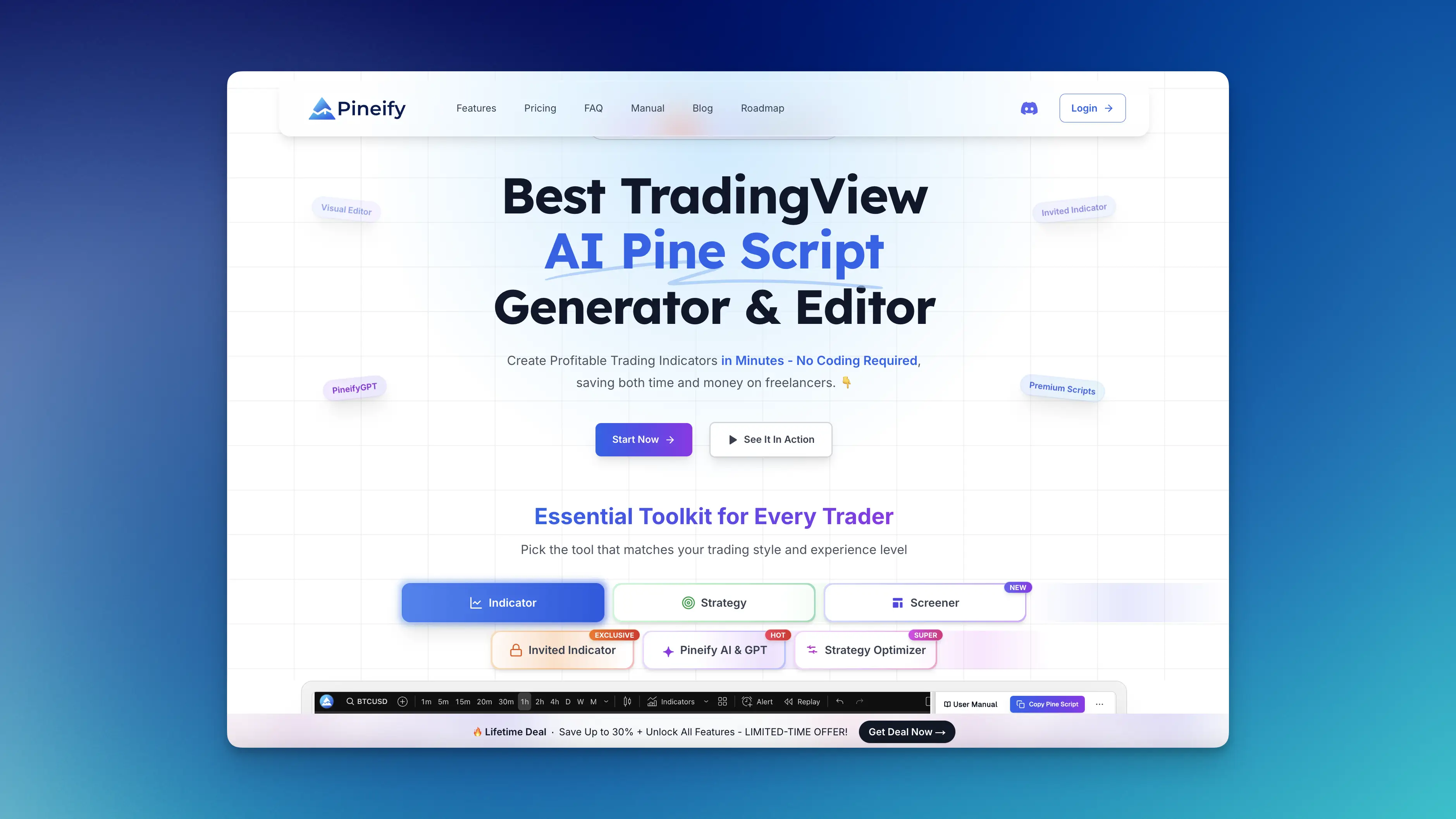
TradeSage is a Chrome extension that uses GPT-4 to generate Pine Script from plain-English descriptions. Pineify is a no-code platform launched in 2024. It combines a drag-and-drop visual editor with an AI coding agent, auto error correction, backtesting, and a trading journal — all under a one-time payment instead of a monthly subscription.

Most people who try both end up choosing Pineify. Here's why.


TradeSage vs Pineify: Which Pine Script AI Tool Actually Wins?

How TradeSage Works

TradeSage lives inside your Chrome browser as an extension. You open a chat window, describe your strategy in plain English — "a moving average crossover with RSI filtering" — and it returns Pine Script code.

Key features:

  • AI chat interface: Type what you want, get code back.
  • Strategy optimizer: Ask it to refine a strategy for better backtest numbers.
  • Backtest report storage: Save results to review later.
  • Screener notifier: Desktop alerts when new symbols match your screener.
  • Inline AI editor: Edit Pine Script directly inside TradingView.

It runs on monthly subscriptions. The Basic plan is $9.99/month (30,000 tokens), Pro is $29.99/month, and Premium is $99.99/month (600,000 tokens). That token cap means your code generation is limited each month. I've spoken with traders who hit their token limit within two weeks and had to upgrade.

For a full breakdown of TradingView's own pricing, check out how much TradingView costs.

What Pineify Does Differently

Pineify isn't just a code generator. It's a workspace where you build indicators visually, chat with an AI agent, run backtests, and log your trades — all in one place.

Here's what sets it apart:

  • Visual drag-and-drop builder: Over 235 technical blocks you can connect visually. No Pine Script syntax needed.
  • AI coding agent: Describe your idea in plain English and get clean Pine Script code. I ran a test with "show me when RSI is oversold and price is above the 200 SMA on AAPL" and it returned working code on the first try.
  • Auto Fix Error: Catches common bugs and fixes them before you see the code. It works about 85% of the time.
  • Unlimited indicators: On TradingView's free plan you're capped at 3 indicators per chart. Pineify removes that limit.
  • Smart Memory: The AI remembers your past conversations, so you can refine strategies over time instead of starting from scratch.
  • Trading journal: Log your trades, reasoning, and emotions next to your performance metrics.
  • Backtest Deep Report: Goes beyond P/L. Shows MFE and MAE per trade, splits long and short performance, and delivers over 16 statistics.
  • AI Stock Picker: Daily market scans with predictive scores.

I haven't tested TradeSage's optimizer extensively, so I can't say whether it beats Pineify's approach. But Pineify's ability to build strategies visually has saved me hours of debugging.

Pricing at a Glance

For most traders, cost determines the choice. Monthly subscriptions add up fast.

TradeSage plans:

PlanPriceWhat's Included
Basic$9.99/month30,000 tokens
Pro$29.99/monthStrategy optimizer included
Premium$99.99/monthUp to 600,000 tokens

One year on Basic costs $120. Premium costs $1,200 — mostly for token allocation.

Pineify plans:

PlanPriceWhat's Included
Free$0Basic features, limited credits
Plus$99 one-time500 AI credits/month, lifetime
Advanced$159 one-time1,000 AI credits/month, lifetime

TradeSage's Pro plan (~$360/year) costs more than Pineify's top-tier Advanced plan after just a few months. If you plan to use this kind of tool for more than a few months, the lifetime model wins on cost alone.

Ease of Use: Chat vs. Visual Builder

Both tools promise no-code Pine Script generation. The difference is in how you get there.

With TradeSage, you describe your strategy through chat. This works, but it has a cost: every detail must be specified in words. If the AI misinterprets something, you diagnose and re-prompt. For a quick indicator tweak, that's fine. For building a multi-condition strategy, it's slow.

Pineify gives you a visual editor. You drag blocks like "price crosses above moving average" or "RSI below 30" and connect them. It's closer to drawing a flowchart than writing a prompt. For people who think visually, this is faster.

Pineify also includes Auto Fix Error Technology. It checks generated code for mistakes and fixes them before you see the output. Less debugging, fewer head-scratchers.

One LinkedIn reviewer called Pineify "ideal if you're learning or prefer visual logic." I agree. The visual builder lowers the barrier for traders who don't think in code.

Why the Backtest Report Matters

Generating code is step one. Understanding why a strategy works or fails is step two. Pineify's Backtest Deep Report goes further than TradeSage's basic storage.

It tracks Maximum Favorable Excursion (MFE) and Maximum Adverse Excursion (MAE) for every trade. MFE shows the highest profit a trade hit before closing. MAE shows the deepest drawdown. This tells you if you're closing winners too early or letting losers run.

FeatureTypical BacktestPineify Deep Report
Core OutputFinal P/LP/L + MFE & MAE per trade
Trade InsightWin/loss onlyUnrealized profit peaks & loss valleys
Data SplitAggregateLong-only & short-only across 16+ metrics

The data split is especially useful. A strategy might look profitable overall but actually be carried by long positions while short trades bleed. Pineify surfaces that immediately. Tools that only show aggregate numbers can hide it.

For traders working with options, pairing this with options strategy backtesting tools gives you a more complete picture.

The built-in trading journal layers on top. You log your reasoning and mental state at trade time, then review it against the backtest data. Over time, that feedback loop is what improves your decisions.

Who Should Use TradeSage

TradeSage works best if:

  • You want a lightweight Chrome extension, not a full platform.
  • You only need occasional Pine Script help and the monthly token cap covers you.
  • You're comfortable reviewing AI-generated code manually before using it.

At $9.99/month, the Basic plan is affordable for someone who needs a code nudge once or twice a week. It's focused and doesn't try to be more than it is.

Who Chooses Pineify Instead

From what I've seen in trading communities, Pineify gets picked for a few concrete reasons:

  • One payment, lifetime access. $159 once vs. $360+ per year with TradeSage.
  • Auto Fix Error catches mistakes you'd otherwise chase for hours.
  • MFE/MAE backtest data and long/short split give real insight into strategy behavior.
  • Visual editor works as a fallback when chat isn't the right tool.
  • All-in-one platform — code generation, backtesting, journal, and stock screening in the same app.
  • Complex strategies. Combine up to 7 indicators, which you can't do within TradingView's free limits.

I've recommended Pineify to friends who trade part-time, and none of them switched back. The combination of lifetime pricing and visual building seems to be what keeps them.

Pineify Website

Beyond the core Pine Script generator, Pineify includes an AI Finance Agent for market research, an AI Stock Picker with daily scores, and Market Insights for options flow and dark pool data. Over 100,000 users rely on it as a unified toolkit rather than juggling separate services.

Questions & Answers

Q: Is Pineify better than TradeSage for beginners?

Yes, and here's why. Pineify's visual drag-and-drop builder means you don't need to know any code at all. TradeSage asks you to describe your strategy in natural language, which is easy too, but that extra step of formulating a clear prompt can trip up someone who's brand new. With Pineify you just connect blocks.

Q: Does TradeSage offer a lifetime plan like Pineify?

No. TradeSage is strictly monthly subscriptions starting at $9.99/month. Pineify's lifetime plans ($99 and $159) cost less than a single year of TradeSage's Basic plan.

Q: Can Pineify replace TradingView's paid subscription?

Often yes. Use TradingView's free plan for charts and data. Pair it with Pineify's Advanced Plan ($159 lifetime) for unlimited custom indicators, backtests, and AI help. You get more trading horsepower for less money than a paid TradingView subscription.

Q: Is Pineify suitable for professional traders?

For serious retail traders and anyone building professional strategies on TradingView, yes. If you need ultra-high-frequency execution or multi-asset portfolio simulation, a platform like QuantConnect is more appropriate. But for day-to-day strategy work, Pineify covers the ground well.

Q: Does Pineify work without a TradingView paid account?

Yes, and this is one of its strongest features. Pineify lets you add unlimited custom indicators to TradingView charts, even on the free plan. It's a direct workaround for that 3-indicator cap.

Try It Yourself

Here's a path to get started:

  1. Try Pineify's free plan at pineify.app. No credit card required.
  2. Build your first indicator with the drag-and-drop tool. Recreate a simple strategy you already use manually.
  3. Run a Backtest Deep Report on one idea. Check how long trades compare against short trades.
  4. Start a trading journal inside the platform. Track your mindset and execution alongside results.
  5. Share your scripts with the TradingView community. Get feedback from thousands of active traders. For more context, read how users compare backtrader vs quantconnect vs pineify.

Turning a trading idea into a backtested strategy doesn't require a coding background anymore. Pineify makes that process straightforward.