Pineify Finance Agent: Checking Market Data Before Stock Research

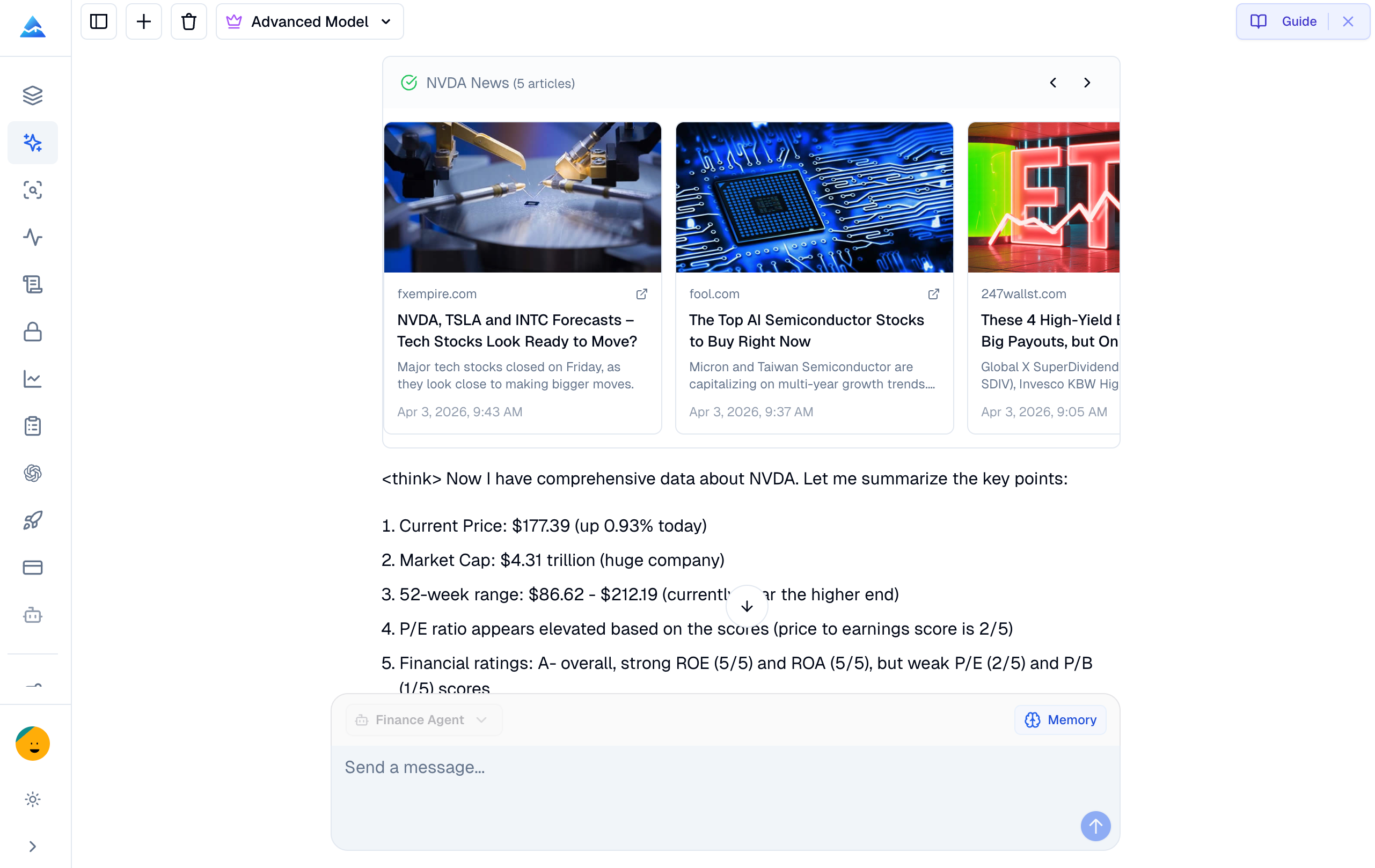
Pineify's Finance Agent can retrieve quotes, financial statements, estimates, news, and other research data through connected tools. A useful answer must distinguish when a request ran from when its underlying data was observed or reported. Fetching a result now does not make every number real-time.
Four dates that should not be mixed
A stock research note can combine several clocks. Keep them visible rather than giving the whole note a single "live" label.
| Data | Date or time to retain | What it means |
|---|---|---|
| Quote | Provider timestamp, timezone, and trading session | When the displayed price was observed; it may be delayed or from a previous session |
| Financial statement | Fiscal period end and filing date | The business period measured and when it became public |
| Analyst estimate | Forecast period and estimate update date, where available | A projection for a future period, not a reported result |
| News or public post | Publication time and event date | When a claim was published versus when the event happened |
For example, a hypothetical note written on a Monday morning could contain Friday's closing price and financial results published weeks earlier. Both may be the latest available observations without being measurements of Monday's business performance.
Ask a question that makes the evidence visible
A starting prompt can be:
For the company I name, retrieve the latest available quote and most recent reported financials. Show the quote timestamp and session, fiscal periods, units, currencies, source links, and missing fields. Separate reported facts from estimates and your interpretation. Do not fill missing data with guesses.
Follow up on any field whose provenance is unclear. A source link should support the particular number or claim, not merely point to a finance homepage. Check important reported figures against the company's investor-relations report or its SEC EDGAR filing.
The agent can summarize retrieved information, but source retrieval is not a guarantee of correct interpretation. Check whether figures are annual, quarterly, or trailing twelve months before calculating growth or comparing peers.
What the connected tools can do
Pineify has tools for company profiles, statements, ratios, estimates, earnings transcripts, quotes, calendars, news, and supported asset screening. It also exposes web, X, and Reddit searches. Results depend on provider coverage and account access; an empty response needs investigation rather than an invented substitute.
The basic stock screener accepts attributes including sector, exchange, market capitalization, price, volume, and beta. A request such as "healthcare companies with strong margins and low debt" needs explicit definitions and may require financial queries after the initial candidate screen. Ask for the applied filters, returned count, and any criteria that could not be evaluated.
For options, specify the underlying, expiration, and contract type. Snapshots may provide quotes, Greeks, implied volatility, and open interest, but fields can be absent and returned lists can be limited. Do not assume the first list is every listed contract or that all timestamps match.
Build a research note in separate passes
First, gather the facts. Request the reported statements and relevant market observations. Retain periods, units, source locations, and limitations.
Second, reconcile differences. If two sources disagree, check timing, currency, adjustment conventions, and whether one uses an estimate. Leave unresolved differences visible.
Third, analyze the business question. Ask what explains a margin change or cash-flow movement, then distinguish evidence from a proposed explanation. A numerical trend alone does not establish its cause.
Fourth, challenge the conclusion. Request the strongest contrary evidence and the next observable fact that could change the assessment. A buy/hold/sell label is less useful than an explicit thesis with uncertainty and a time horizon.
Social posts can suggest questions to investigate. They do not constitute a complete survey of investors, and more positive posts do not establish future returns.
Keep research and strategy testing distinct
The Finance Agent handles research. Pineify's Coding Agent can help express a defined trading rule as source code, while the Visual Editor configures supported blocks. A narrative explanation about a company does not automatically become a testable strategy.
TradingView strategy testing requires explicit rules, suitable historical data, fill assumptions, and trading costs. Pineify's Strategy Optimizer explores supported input combinations in the TradingView workflow; selecting the best historical result can overfit. Neither operation validates a market-data claim in a research note.
Access and comparison questions
Check current pricing and feature access before purchasing. AI credits, model allowances, and Finance Agent availability are plan-dependent. Historical price tables should not be treated as today's offer.
General AI assistants may also have search or data connections. Compare the actual sources, fields, timestamps, limits, and reproducibility of each tool you use. An interface label alone does not establish freshness or accuracy.
Can the agent cover any public company? Coverage varies by market, provider, and data category. Verify the specific symbol and fields you need.
Does a successful query prove that a number is current? No. Inspect the data timestamp and reporting period as well as the retrieval time.
Can an answer be used without checking its sources? Material claims should be checked against the underlying report or data record. Missing or conflicting evidence should remain explicit in the research note.