Pineify Finance AI Agent: Agentic AI for Finance and Accounting

Agentic AI for finance uses a model to plan a task, call available tools, and assemble an output for review. The useful question is which tools, data, permissions, and checks are actually present. An assistant that retrieves financial statements is not automatically an accounting ledger, tax engine, or autonomous trading system.
Pineify Finance Agent supports market research through connected financial-data tools and conversational analysis. This article separates that current workflow from possible accounting applications that would require additional integrations and controls.
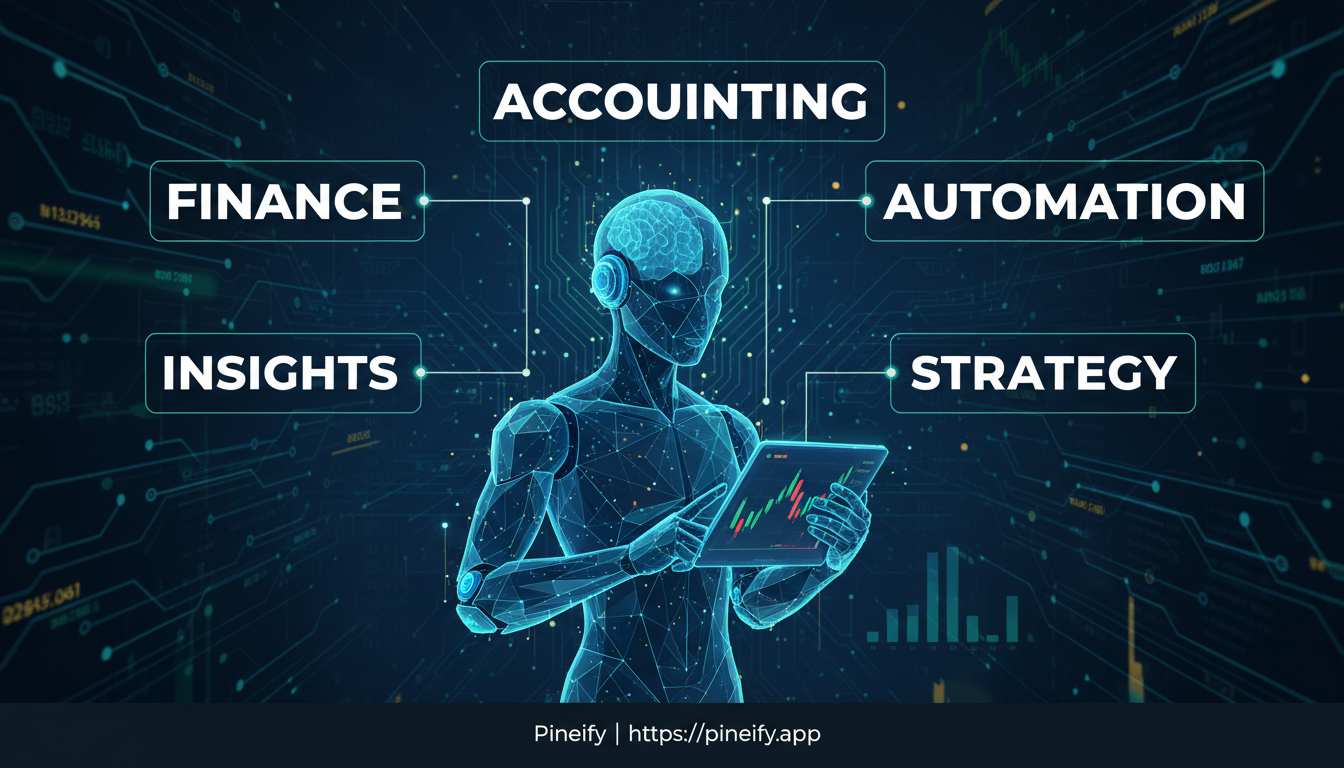
What Is Agentic AI in Finance?
A multi-step request might retrieve a company's financial statements, compare reported periods, calculate a ratio, and explain a change. Each step has a distinct failure mode: an incorrect ticker, mismatched units, an unavailable data field, a calculation error, or a conclusion stronger than the evidence.
Tool use does not mean a model learns continuously, catches every error, or operates without supervision. A successful data response also does not prove that the data is current enough for the decision. Ask for the reporting period, retrieval time, and source alongside the result.
Why Finance Teams Evaluate It
Research often involves repeated extraction, comparison, and summarization. AI may help prepare a draft, but a time-saving claim needs a measured baseline, task definition, error rate, and review cost. This article supplies no controlled productivity study or personal portfolio experiment.
Start with a bounded task such as comparing two reporting periods. Measure whether the output includes the right company, currency, units, dates, reconciled totals, and source references. Count correction time as part of the workflow rather than measuring generation speed alone.
What Pineify Finance Agent Can Support
The current tool registry includes company profiles, financial statements, ratios, analyst estimates, earnings material, market data, news, options-related data, and selected public-disclosure research. Availability and freshness depend on the tool, provider, instrument, and account access.
Journal tools can retrieve journal context and assist with supported record creation. That does not establish an automatic broker feed. Likewise, a research answer about a strategy is not proof that a historical simulation was run. For a backtest conclusion, require the actual strategy, dataset, dates, assumptions, and report.
Conversation memory can retain configured context, but it should not be treated as a verified live portfolio or authoritative accounting record. Reconfirm holdings, currencies, dates, and restrictions when they matter.
Applications for Different Finance Roles
Traders and Portfolio Researchers
Ask a specific question, such as comparing revenue growth with cash-flow changes over stated periods. Separate provider facts from calculations and interpretation. Options flow or public ownership filings can add context, but neither reveals every investor's intent nor establishes a trade to execute.
Use broker records for positions, fills, buying power, and account status. Research output does not place or supervise broker orders by itself.
CFOs and Finance Teams
An analyst can use AI to outline a scenario, explain a variance, or draft questions for management. A useful scenario identifies assumptions, units, time period, and sensitivity. It should not quietly replace missing actuals with model guesses.
A corporate workflow requires access controls, documented source systems, reconciliation, and an approval path. The current market-research toolset does not establish an autonomous month-end close or invoice-posting integration.
Accountants and CPA Firms
| Proposed application | What a reviewable output needs | Additional integration or control |
|---|---|---|
| Invoice extraction | Source document, extracted fields, uncertainty flags | Approved document handling and ledger mapping |
| Reconciliation assistance | Matched and unmatched items with traceable identifiers | Complete bank/ledger data and reviewer sign-off |
| Tax research | Jurisdiction, tax year, primary authority | Qualified review and a verified tax calculation system |
| Audit preparation | Evidence references and reproducible selections | Audit methodology, permissions, and retained workpapers |
| Forecasting draft | Assumptions, units, formulas, scenarios | Reconciliation to approved actuals and management review |
This table describes evaluation requirements. It is not a list of accounting functions that Pineify currently automates, and it contains no claimed reduction in errors or completion time.
Comparing an Agent with Existing Software
Traditional finance software can already automate scheduled and rule-based work. An AI agent adds natural-language interpretation and tool selection, which introduces flexibility and additional uncertainty. A ledger's deterministic controls and an assistant's explanation serve different purposes.
Compare systems on data coverage, permission scope, reproducibility, exception handling, review effort, and total cost. A natural-language interface is not a reason to discard the authoritative ledger or broker record.
Oversight and Financial Data
Use a small, permitted dataset first. Define the allowed operations and require review before any externally consequential action. Treat a generated explanation as a claim to check against the underlying records.
Pineify's privacy policy describes sharing with service providers and other stated circumstances. This page does not promise that financial information never leaves the platform, is never processed by third parties, or is deleted immediately. Check the policy and your organization's requirements before supplying confidential material.
Frequently Asked Questions
What is agentic AI for finance and accounting?
Does Pineify automatically close books or prepare tax returns?
Can it automatically import every trade?
Are all tasks completed with live data?
What does access cost?
How should confidential information be handled?
Getting Started
Choose one question and a known source record. Ask the agent to identify its source, separate observations from assumptions, and show the calculation. Compare the result with that record before expanding the scope. Use the current plan information to check access rather than relying on historical prices or promotional claims.