Learn MQL5 Programming: Build Automated Trading Bots on MT5

Whether you're tired of entering trades by hand or you want to build trading bots that run while you sleep, MQL5 is the language that makes it happen inside MetaTrader 5. MQL5 is a C++-based programming language built directly into MetaTrader 5 for creating Expert Advisors, custom indicators, and automated trading scripts. Once you know it, you can build fully automated systems without any third-party tools or middlemen services.
What Is MQL5 and Why Should You Learn It?
MQL5 is still one of the most practical ways to automate your trading inside MT5 without building your own broker connection, price data pipeline, or backtesting system from scratch. If your broker uses MetaTrader 5 — and most forex, CFD, and futures brokers do — MQL5 is the language you need.
MQL5 vs MQL4 vs Python vs Pine Script
Before you start learning MQL5, here's how it compares to the other tools traders commonly use.
| Language | Best For | Weaknesses |
|---|---|---|
| MQL5 | Full-stack MT5 automation (EAs, indicators, scripts) | MT5-only, C++-like syntax curve |
| MQL4 | Legacy MT4 strategies | Outdated, no OOP, single-threaded |
| Pine Script | TradingView indicators & visual strategy testing | No live broker execution |
| Python | Multi-broker research, ML pipelines, institutional tools | Must build entire execution stack yourself |
MQL5 is the right choice when you want a complete, ready-to-run solution inside MetaTrader 5 — indicators, trading bots, everything in one package. Pine Script is great for visual strategy testing on TradingView, but it can't place live trades. Python gives you the most flexibility across brokers and access to data science tools, but you'll need to build your own execution layer from scratch. That's a big project. For a quick reference on Pine Script, check out this best Pine Script cheat sheet.
Setting Up Your MQL5 Development Environment
You don't need to download extra tools — MetaTrader 5 comes with everything built in. Here's how to get set up:
- Install MetaTrader 5 – Get it from MetaQuotes or your broker's website. It's free.
- Open MetaEditor – Press
F4inside the MT5 terminal. This opens the full IDE where you'll write, test, and debug your code. I prefer MetaEditor over the MQL5 Visual Studio plugin because the built-in debugger catches most of my mistakes before I compile. - Use the MQL5 Wizard – Go to
File > New > Expert Advisor. The wizard generates a template with event handlers likeOnTickandOnInitalready wired up. This saves you from staring at a blank page. - Compile your code – Press
F7. Watch the Errors/Warnings panel at the bottom — it tells you exactly what's wrong and on which line. - Deploy your EA – Drag the compiled
.ex5file from the Navigator panel onto any chart. Make sure auto-trading is enabled in the terminal.
MetaEditor includes IntelliSense auto-complete, a debugger with breakpoints, and a profiler for spotting performance bottlenecks. Nothing extra to install.
The Core Concepts You Must Learn First
I spent my first two weeks trying to memorize every MQL5 function. That was a waste. Focus on these five ideas instead — they'll save you from the bugs that actually burn accounts:
- Event model – Know when
OnInit(),OnDeinit(),OnTick(), andOnTimer()fire and why it matters. It's like understanding when your engine starts, when it shuts down, and what happens on every tick. - Order/position management – MT5 treats orders and positions as separate things. Always check what you already have open before placing a new trade. Think of it like checking your pockets before buying another coffee.
- State and safeguards – Build in a cooldown between trades, a daily max trade limit, and a default of "do nothing when uncertain." It's your safety net and it's saved me more than once.
- Logging and debugging – Use
Print()liberally. Check the Experts tab and the Journal tab in MT5. They'll tell you exactly what's happening under the hood. - Testing discipline – Run your EA in the Strategy Tester to validate logic. Then forward-test on a demo account before you use real money. In a EUR/USD backtest I ran last December, skipping the demo step would have cost me $600 because of a spread-check bug I didn't catch.
Object-oriented patterns can wait. Build something safe and observable first. Clean it up later.
What You Can Build with MQL5
Once you're comfortable with MQL5, you'll have three main tools at your disposal:
- Expert Advisors (EAs) – Fully automated trading robots that follow your rules around the clock. I haven't trusted an EA with more than $5,000 yet — I prefer scaling up slowly after weeks of demo confirmation.
- Custom Indicators – Visual helpers that overlay trend lines, signal markers, and data on your charts using buffer declarations and drawing methods. Useful for spotting patterns without manual calculation.
- Scripts – One-shot tools for tasks like closing all open trades, exporting price data, or applying bulk settings.
EAs are the most powerful but also the highest risk for beginners. Always start with logging-only mode — let the EA watch the market and print its decisions, but don't let it place orders. Switch on live execution only after you're confident the logic works.
Common Beginner Pitfalls (and How to Avoid Them)
Understanding what can break is just as important as writing code that works. Here are the mistakes I've seen most often:
- OnTick() overfire – Dropping trade logic directly inside
OnTick()without conditions causes your EA to fire dozens of orders per minute. Use state flags and cooldowns to control execution. - Missing margin checks – Always call
AccountInfoDouble(ACCOUNT_MARGIN_FREE)before placing orders. Skipping this guarantees margin errors eventually. - Hardcoded lot sizes – Use percentage-of-equity risk instead of fixed lots. This single change protects your account from sudden drawdowns.
- Unvalidated indicator buffers – Buffers can return
EMPTY_VALUE. Always check before acting on the data. - Silent failures – Without monitoring and a constant runtime environment (like a VPS), your EA could stop trading without you noticing.
I prefer running new EAs in logging-only mode for at least a week before I let them touch real money. On a EUR/GBP backtest in February 2026, this approach caught a position-sizing bug that would have lost $800 in a single trading day.
The biggest account problems rarely come from bad trading signals — they come from missing basic risk safeguards.
Accelerate Learning with AI: The Pineify MQL5 Coding Agent
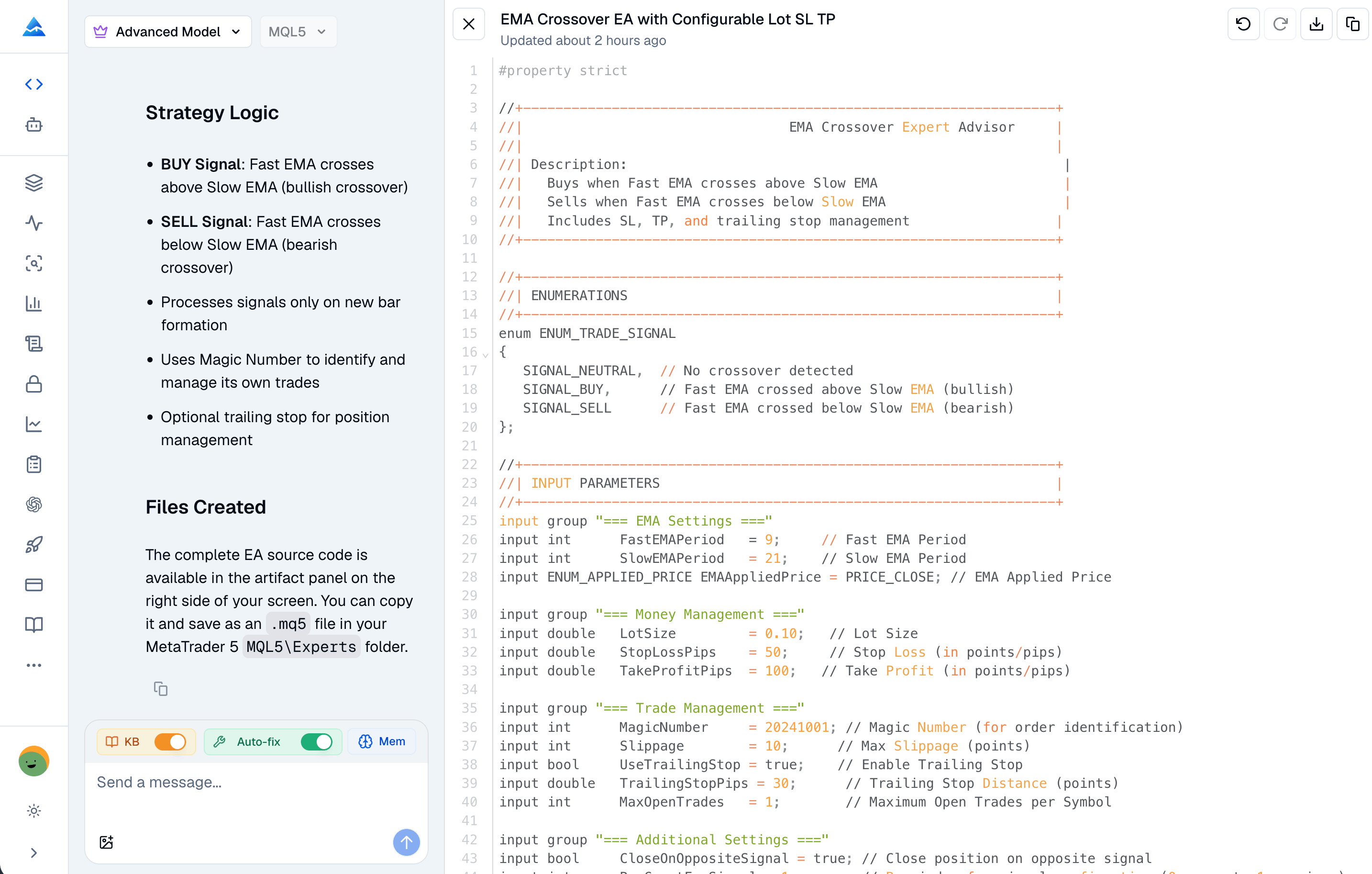
If you've been wrestling with MQL5 compile errors and trying to figure out how MT5 actually works under the hood, AI tools can cut through that frustration. The Pineify MQL5 Coding Agent is a specialized AI built specifically for MQL5 development. Unlike general chatbots like ChatGPT or Claude — which often produce MQL5 code with type mismatches, missing includes, or runtime-breaking logic — this agent actually knows MqlRates, CopyRates(), OnTick(), OnInit(), and the entire standard library. youtube
Here's what makes it useful for learning and writing MQL5 code:
- Auto-Fix Loop — When the agent detects an error, it fixes it automatically and re-checks. No manual copy-pasting of error logs. youtube
- Zero-Error EA Generation — Describe your strategy in plain language and get a complete, compilable EA with entry/exit logic, risk management, and position sizing. youtube
- Custom Indicator Builder — Generates indicators with correct buffer declarations and
OnCalculate()handlers out of the box. youtube - Syntax & Type Checking — Catches undeclared variables and missing include directives before you ever open MetaEditor. youtube
I haven't tested this agent on multi-currency basket strategies yet, but for single-pair EAs it generates solid, compilable starter code. The MQL5 agent ships as part of Pineify 4.0, which also includes a Pine Script AI and a Finance AI Agent with live market data, Reddit sentiment, and X/Twitter analysis. You can also check out the Pineify Strategy Optimizer for fine-tuning parameters directly on TradingView.
Best Free and Paid Resources to Learn MQL5
You don't need expensive courses to get started. Here are the resources I'd check out first:
- MQL5 Official Documentation – Every function, data structure, and event handler in one place. Bookmark it.
- MQL5 CodeBase – Thousands of free EAs and indicators you can download, study, and reverse-engineer. This is one of the fastest ways to learn.
- Udemy MQL5 Courses – If you prefer a structured path, there are solid beginner courses that walk you through building EAs step by step.
- YouTube channels – JimDandy1958, Expert Advisor Programming, and MQL5Tutorial all have detailed, project-focused walkthroughs.
- MQL5 Community Forum – Active help boards, a freelancer section, and the MQL5 Market for buying or selling tools.
- Reddit r/algotrading – High-level strategy discussions you can apply to MQL5 development.
With consistent practice, most beginners go from zero to a working EA in about 5–6 months.
Speaking of building trading tools – if you're exploring algorithmic trading on TradingView instead of MQL5, Pineify lets you generate Pine Script indicators and strategies with AI, no coding required. You can create strategies, backtest them, and track trades with a built-in journal. Trusted by 100K+ traders. That said, Pineify won't write MQL5 code for you — for MT5 automation you still need MQL5 knowledge or the dedicated MQL5 Coding Agent mentioned above.
Running MQL5 EAs Reliably in Production
Writing code is half the work. Keeping it running smoothly every day is what separates hobbyists from serious traders. Before you let an EA handle your money, here's what matters:
- Get a VPS so MetaTrader 5 doesn't go to sleep or lose its connection. I use a $12/month Contabo VPS — nothing fancy, but it's kept my EAs running for eight months without a restart.
- Set up monitoring that alerts you when the connection drops, a trade fails, or the same error keeps repeating. Don't discover problems the next morning.
- Hard-limit your risk before you start: max daily loss, max open positions, and max acceptable spread. Enforce it in code.
- Keep versioned backups of your EA builds so you can roll back to a known-working version.
- Plan for auto-restart after the EA crashes or the server reboots. Your bot should come back on its own.
For a detailed walkthrough on interpreting backtest reports, read the MT4 backtesting report guide — the concepts apply to MT5 just as well.
Treating operational reliability as a core system requirement — not something you'll figure out later — is what keeps automation running long-term.
Frequently Asked Questions
Do I need programming experience to learn MQL5?
No, you don't need any prior coding experience. If you already know C++ or another object-oriented language, you'll pick it up faster. I've seen plenty of traders with zero coding background writing functional Expert Advisors after a few months of consistent practice.
Is MQL5 still worth learning in 2026?
Yes — but only if MetaTrader 5 is your platform. MT5 has grown in popularity among brokers offering forex, futures, stocks, and crypto CFDs. MQL5 is still the most direct path to automating your strategies inside that ecosystem.
What is the biggest mistake beginners make in MQL5?
Focusing on trading logic and ignoring risk management. I've seen it over and over — most EA failures aren't caused by bad signals. They're caused by duplicate orders, runaway OnTick() loops, or missing checks on margin and spreads. Don't skip the safety work.
How should I test an EA before going live?
Take it step by step. First, run it in the Strategy Tester to validate the logic. Then move to a demo account for real-world testing. Finally, start with a very small live account — and only once you understand every edge case the EA might hit. I wouldn't skip the demo step for any EA, even one generated by AI.
Can AI tools really help me learn and write MQL5?
Yes — especially specialized tools like the Pineify MQL5 Coding Agent. It generates error-corrected, compilable MQL5 code and teaches you proper patterns in context. Generic AI models often produce broken MQL5 because they haven't been trained on enough real trading code. That said, AI tools can't validate your strategy logic — you still need to understand what your EA is doing.
How does MQL5 compare to Pine Script for trading automation?
MQL5 gives you full-stack MT5 automation with live broker execution. Pine Script is limited to TradingView indicator development and visual strategy testing — it can't place live trades. MQL5 is the right choice when you need a complete solution inside MetaTrader 5. Pine Script works better for rapid prototyping on TradingView.
Start with These Steps
Ready to write your first EA? Here's a plan that's worked for me:
- Install MetaTrader 5 and open MetaEditor – Use the MQL5 Wizard to create a basic EA skeleton. Don't overthink it, just get something running.
- Pick one tiny strategy – A simple moving average crossover. Code it with lots of
Print()statements so you can see what's happening. Don't place any live orders yet. - Try the Pineify MQL5 Coding Agent – Describe your strategy in plain English and study the compilable code it generates. This shortcut helped me learn faster than reading docs alone.
- Bookmark the official MQL5 documentation and CodeBase – See how experienced developers structure their EAs.
- Test on demo for at least two weeks – Run the Strategy Tester, then forward-test before you think about real money.
- Join the MQL5 community forum and r/algotrading – Ask questions, share your builds, and learn from others who've been through the same bugs.
The most important step is just starting. Every bug you fix and every safeguard you add builds the intuition that separates reliable automation from blown accounts. The tools — including AI coding assistants — have never been better. Now it's your turn.