Best Pivot Indicator TradingView for Support and Resistance Levels

Pivot indicators are price-action tools that mark likely support and resistance levels based on historical highs and lows. Finding the right one on TradingView can sharpen your trading approach. These tools hand you clear zones for entry, exit, and stop-loss placement, helping you spot reversals before they happen.

Understanding Pivot Indicators
Think of pivot indicators as a map of the market's memory. They highlight price points where the action has turned around before -- places where buyers or sellers stepped in and changed the trend.
Other tools draw lines based on formulas, but pivot points show where the real tug-of-war happened. These levels become psychological markers. Price has a habit of pausing or reacting when it returns to them. That's what makes them useful for anticipating the next shift in momentum.
Instead of digging through old charts and drawing lines by hand, a good pivot indicator plots key levels directly onto your chart. You can use it to judge trade placement, set a stop-loss, or spot when price is breaking through a key barrier. It works whether you're watching markets by the minute, the hour, or the day. For momentum-based confirmation, I've found pairing pivots with the SMI Ergodic Oscillator Indicator for TradingView helps reduce false signals.
Top Pivot Point Tools on TradingView
Spotting where a trend might pause or reverse is core to trading. Here are the most useful pivot indicators and how traders actually use them.
Pivot Points High Low Indicator
This scans for actual price swings. It marks a "pivot high" when a price peak has lower highs on both sides, and a "pivot low" when a trough has higher lows left and right. The formula: a bar at index i is a pivot high if high[i] > high[i-n] through high[i+n], where n is the lookback.
The power is in the parameters. You tell it how many bars to look at on each side. A popular setup is 20 bars. This "20-20" setting filters noise and focuses on major levels. I've tested this on AAPL daily charts and it catches the big reversal zones while ignoring intraday wiggles.
Standard Pivot Points
The classic method floor traders have used for ages. Calculated from the previous day's high, low, and close: P = (High + Low + Close) / 3. Then S1 = 2*P - High and R1 = 2*P - Low, plus second levels for wider ranges.
It gives a balanced view of where the market might find friction. I prefer this on ES futures -- the S1 and R1 levels act like magnets during the first hour of trading.
Woodie's Pivot Points
Woodie's doubles the weight of the closing price: P = (High + Low + 2*Close) / 4. This makes the levels more sensitive to where the market finished.
That can signal turns a bit earlier. But I haven't found them reliable during choppy, sideways markets -- the sensitivity produces too many false signals on GBP/USD pairs.
Camarilla Pivot Points
Camarilla calculates eight levels based on the previous day's range: R1 = Close + Range * 1.1/12, S1 = Close - Range * 1.1/12, and so on through R4/S4.
These are my go-to for day trading SPY. Price often reverses near the third level. Word of caution: in a strong trend, price can blast right through. They work best in ranging or moderately trending conditions.
Fibonacci Pivot Points
This applies ratios like 0.382, 0.618, and 1.0 to the pivot range. Resistance levels: R1 = P + (0.382 * (High - Low)), R2 = P + (0.618 * (High - Low)), R3 = P + (1.0 * (High - Low)). Support mirrors the same structure.
I've found these align well with retracements in crypto. BTC/USD respects the 0.618 level more often than I'd expect from random chance. To learn more about implementing custom calculations, check out What Language is Pine Script?.
| Indicator | Best For | A Quick Note |
|---|---|---|
| Pivot Points High Low | Spotting major swing points on any timeframe. | Filters noise, shows clean levels. |
| Standard Pivot Points | A reliable daily map for support and resistance. | The benchmark most methods are compared to. |
| Woodie's Pivot Points | Earlier shifts when closing price matters. | Can be noisy in sideways markets. |
| Camarilla Pivot Points | Intraday trading and quick scalps. | Inner levels fail during strong trends. |
| Fibonacci Pivot Points | Instruments that respect Fibonacci levels. | Adds mathematical probability to your map. |
The key isn't finding one "best" indicator -- it's understanding what each one tells you. When different methods agree on a price level, that's a stronger signal.
How to Use Pivot Indicators on TradingView
Pivot points are landmarks on a price chart. Setting them up on TradingView is simple, and a few tweaks make them work better for your style.
Adding the Indicator
Look at the top of your chart window for "Indicators" or "Fx." Click it, type the name of the pivot tool. For "Pivot Points High Low," choose the one built by TradingView itself. Click and it pops onto your chart.
Key Settings
After it's added, click the gear icon.
-
Find Important Swings: Go to the Inputs tab. Look for "Left Bars" and "Right Bars" (sometimes "Pivot High" and "Pivot Low"). These control how many bars the indicator scans to find a significant high or low. A useful tip: increasing these to 20 filters out noise, marking only major pivots. You'll get clearer levels to watch.
-
Style Tab: Change colors and thickness for clarity. On a light background, I set Pivot High markers to dark blue and Pivot Low markers to gray. Instant contrast at a glance.
Standard Pivot Points Settings
If you're using the classic "Pivot Points" indicator, adjust:
- Timeframe for calculations (daily, weekly, monthly).
- Calculation method (Classic, Fibonacci, Woodie's).
Match these to your trading period. Day traders on the 1-hour chart need different settings than swing traders on daily.
By taking a few minutes to adjust, you transform a generic tool into one that shows the information you need. Once you're comfortable, you might want to automate your analysis. Our guide on How to Automate a TradingView Indicator can show you how.
Build a Custom Pivot Indicator Without Code
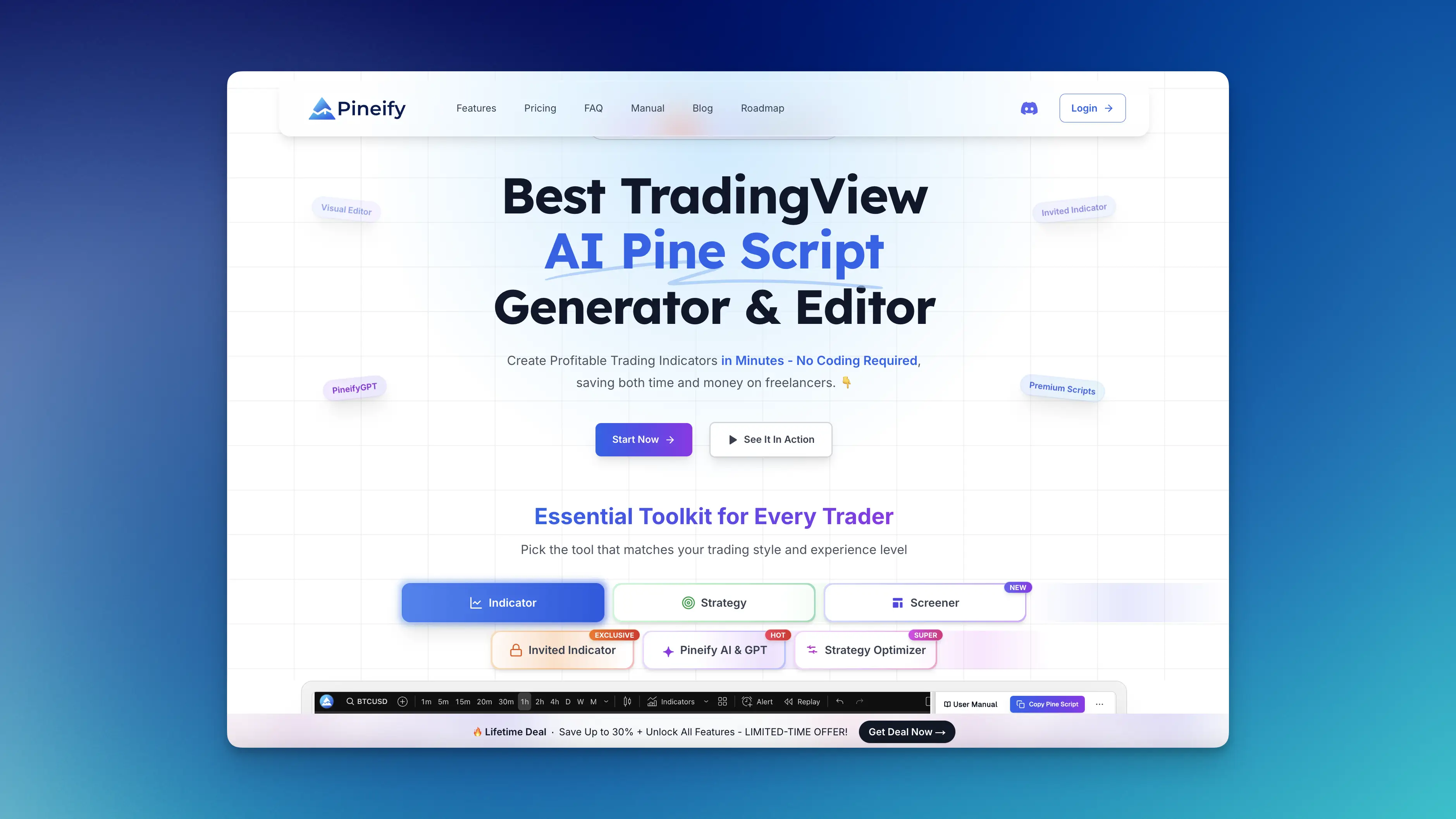
Manual tweaking is powerful, but imagine building a custom indicator that combines pivot points with other tools -- without writing code. Pineify lets you visually combine conditions, set alerts, and backtest logic, turning your trading idea into a working TradingView script in minutes.
Trading Smarter with Pivot Points
Cluster Analysis
The real magic happens when several pivot levels line up at roughly the same price. That's a cluster.
A cluster is stronger support or resistance because price has reversed there multiple times. Traders pay more attention to it. I've seen TSLA reverse at a triple-pivot cluster on the weekly chart four separate times in 2025 -- each bounce was textbook.
Draw a horizontal zone connecting these clustered points. When price approaches, you know a pause or reversal is more likely.
Riding the Breakout
When price pushes through a strong cluster zone, a new trend often starts. A break above resistance signals bullish momentum; below support suggests bearish.
Enter as price closes decisively beyond the cluster. Place a stop-loss just on the other side. The first hour of the trading day often offers clean breakout setups as the market digests new information.
Playing the Bounce
The classic "buy low, sell high" approach. Wait for price to touch a pivot zone and bounce.
Patience is key -- wait for confirmation (like a bullish candle pattern at support) before entering. Your stop goes just beyond the pivot level. This works any time the market is ranging or hitting clear levels.
Combining Tools for Confidence
Pivot points give you a map, but pairing them with other tools improves timing.
- Pivot Points: Spot key zones (especially clusters).
- MACD: Check for momentum shifts or divergences.
- Volume: High volume on a bounce or breakout adds credibility.
I don't use more than three indicators on one chart. Pivots plus MACD plus volume is enough to make grounded decisions without clutter.
Frequently Asked Questions
What is the most accurate pivot indicator on TradingView?
The Pivot Points High Low indicator with "20-20" settings is a solid choice for most traders. It filters noise and only marks the important highs and lows. For day trading, Camarilla pivots give faster signals. For swing trading, Standard or Fibonacci pivots tend to line up better with broader moves.
How do I choose which type of pivot point to use?
It depends on your style. Standard pivots are a reliable all-rounder. Woodie's pivots emphasize the closing price. Camarilla pivots create tight levels for day trading. Fibonacci pivots blend pivot theory with ratios for precise entries. Try each on your charts and see which clicks.
Can I use pivot indicators on any market or timeframe?
Yes. They work on forex, stocks, crypto, and commodities across all timeframes, from 1-minute charts to weekly charts. The key is adjusting settings to match your timeframe. What works for a 5-minute chart will be too sensitive for a daily chart.
What are the best settings for the Pivot Points High Low indicator?
The "20-20" setup is a great starting point. A high point is marked if there are 20 lower candles on each side, and a low point if there are 20 higher candles on each side. This removes noise and highlights major turning points.
Do I need other indicators with pivot points?
You can use pivots alone, but combining them improves results. Use pivot points as your map for support and resistance. Add momentum indicators like MACD, volume analysis, or price action patterns to confirm moves before entering.
To formalize your pivot-based rules into an automated strategy, the guide on How to Write a Strategy in Pine Script is a good next step.