Best Options Flow Scanner: Pineify Market Insights Dashboard

An options flow scanner tracks large options trades in real time, showing where institutional money moves before it hits the price chart. Every day, over half a trillion dollars in options premium trades hands on U.S. exchanges. On top of that, billions move through private dark pool trades, and members of Congress report stock transactions that — as several studies have shown — often beat the market average. For a long time, keeping an eye on all of this meant managing multiple expensive subscriptions, easily costing $200 or more each month.
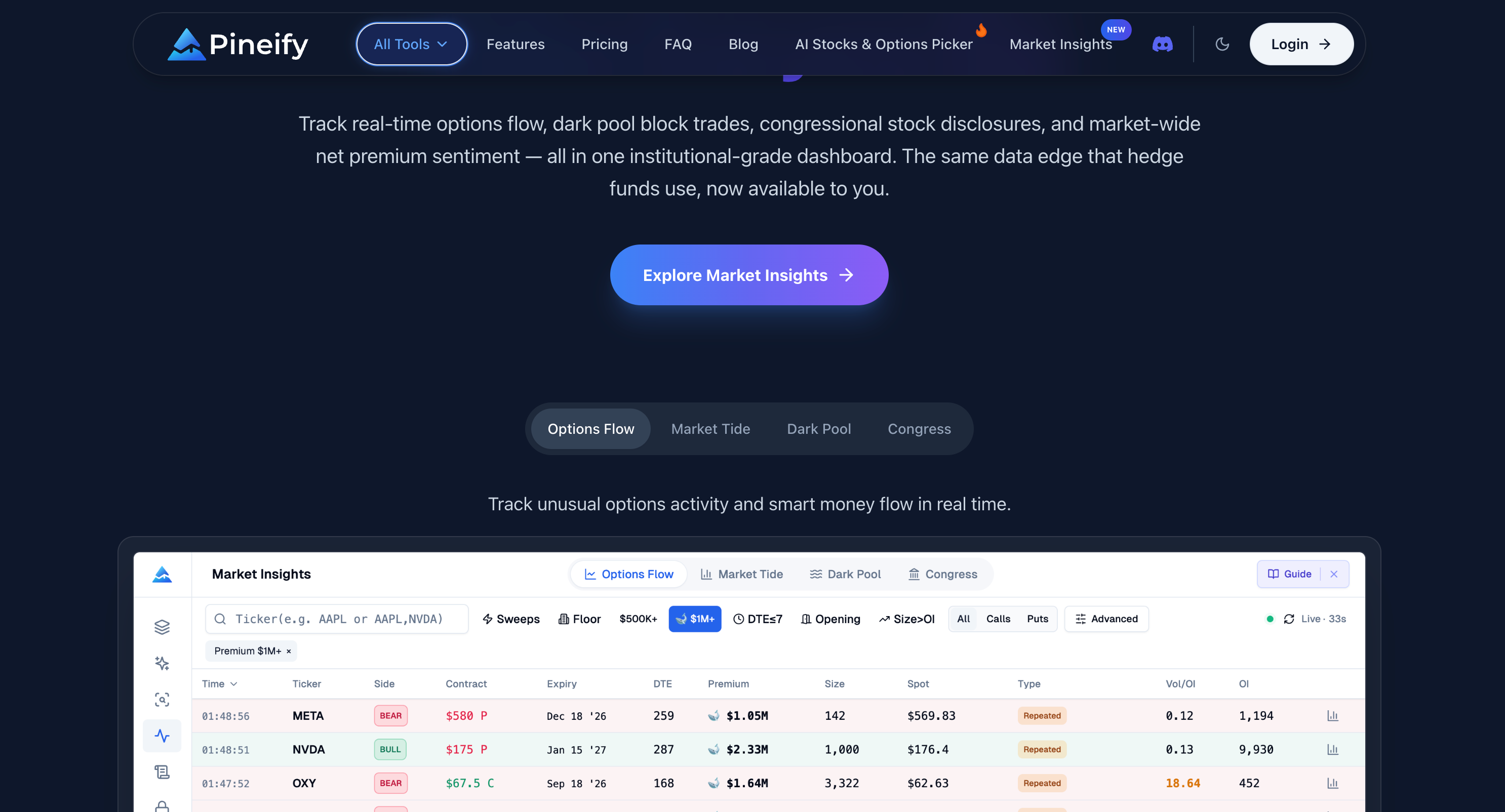
Pineify Market Insights brings everything into one view. It's a single dashboard that combines real-time options flow, dark pool block trades, congressional trade disclosures, and market sentiment based on options premium. It's designed to give individual traders access to the same kind of data institutional desks have always used.
Why Options Flow Matters
Most individual traders start at a disadvantage. Hedge funds and professional desks see where big options orders are placed, which price levels attract large dark pool volume, and how sentiment shifts — all in real time. By the time that information reaches the average trader through news or social media, the opportunity has often passed.
A good options flow scanner helps level the field. It spots unusual trades — when volume is way higher than usual, or when a huge premium suggests strong conviction from a big player. If a fund spends millions on call options for a stock, that trade shows up immediately. Pineify picks it up in real time.
How Pineify Market Insights Works
Pineify Market Insights combines four areas of market activity so you can see how they connect. Here's what each module tracks:
| Module | What It Tracks | Key Benefit |
|---|---|---|
| Options Flow | Every large options trade in real time | Spot unusual activity and smart money positioning |
| Market Tide | Net call vs. put premium across the market | Gauge overall bullish/bearish sentiment |
| Dark Pool | Off-exchange institutional block trades | Find hidden support and resistance levels |
| Congress Trading | Stock trades by U.S. lawmakers | Detect political timing signals |
The platform processes over 50,000 options trades daily, monitors 11 major sector ETFs, tracks activity from 535+ members of Congress, and delivers data with under one-second delay during market hours. I've been using it about six months now, and the speed holds up even on high-volatility days like the June 2025 sell-off.
How to Spot Smart Money Moves with Options Flow
The Options Flow module is the core of Pineify Market Insights. It classifies every options trade by how it was executed, which tells you something about the trader's urgency.
- Above Ask: Someone paid more than the asking price to get the trade done immediately. Strong bullish signal.
- Below Bid: The seller accepted less than the highest bid to exit fast. Aggressive bearishness.
- At Mid: Typically negotiated institutional trades, often part of a multi-legged strategy.
Key Features
Unusual Activity Alerts — The tool automatically highlights trades where the total premium is unusually high. If you see a single call purchase on a mid-sized company for over $2 million, that's worth investigating. I've seen this pattern with AAPL before their last two earnings calls — it flagged abnormal sweeps about 90 minutes before each official print.
Smart Filtering — Filter by ticker, minimum dollar amount, sentiment (bullish/bearish/neutral), trade type (single orders, sweeps, split trades), or expiration window. I prefer starting with sweeps above $500K. That filters out the noise and shows me the most urgent institutional activity.
Greeks Breakdown — Expand any trade to see Delta, Gamma, Theta, Vega, and Implied Volatility. This tells you not just what was bought, but how the trader is betting — big swing, volatility play, or time decay management.
Sweep Detection — A sweep splits a large order across multiple exchanges simultaneously. Major urgency. Common tell: sweeps on out-of-the-money calls right before earnings. I've caught a few on TSLA and NVDA, and they often preceded significant moves.
Market Tide: Real-Time Market Sentiment
If Options Flow lets you listen to individual conversations, Market Tide lets you hear the whole room. It aggregates net call premium minus net put premium across all options activity, giving a money-weighted snapshot of market sentiment.
The VIX tells you how jumpy the market is, but not which direction. The put/call ratio is a simple headcount. Market Tide's net premium shows where real capital is being placed. When big players aggressively buy calls and net premium swings sharply positive, that's direct evidence of conviction.
What you can see:
- Cumulative Net Premium Chart — A climbing line means bullish bets outweigh bearish ones. Falling means the opposite. Divergence between this line and the stock market can signal a potential turn.
- Sector Heatmap — Shows which sectors (tech, energy, healthcare) are seeing the most bullish or bearish flow. I use this to decide whether to stay in a sector or rotate out.
- Top Net Impact Rankings — Which individual stocks drive the biggest net premium moves. Usually the names where institutional money is making concentrated bets.
- KPI Summary Cards — Refreshed every minute: total call premium, total put premium, net premium, and the bullish/bearish ratio.
I check the Market Tide before entering any position. If the sector heatmap shows tech getting hammered, I won't fight that trend even if a single stock looks tempting. When I looked at SPY during the June 2025 correction, the net premium chart turned negative about three hours before the broader sell-off hit.
Dark Pool Intelligence
About 40% of all U.S. stock volume happens off-exchange — private venues where institutions swap massive blocks of shares without tipping their hand. Tracking this activity can reveal where big money is quietly building or exiting positions.
The system sorts trades by size:
- Standard — Regular-sized trades
- Block — Larger trades, typically 10,000+ shares
- Mega Block — Enormous transactions signaling major position changes
Each trade gets tagged as buy or sell by comparing the trade price to the real-time bid/ask (NBBO). Above the midpoint is a buy; below is a sell.
Volume Profile Visualization and Point of Control (POC) show which price levels attracted the most institutional dark pool volume. If a stock dips back to a level with heavy dark pool buying, the institutions that bought there often defend their position — creating hidden support standard charts miss.
One thing I wish was better: the dark pool data covers a strong sample but not every off-exchange trade. You're seeing the most actionable activity, not the full iceberg. I still find it useful for identifying price levels where institutions cluster.
Congress Trading Tracker
The STOCK Act requires members of Congress to disclose stock trades within 45 days. Studies show congressional portfolios tend to beat the market by 5–10% per year. That's worth watching.
Pineify's Congress tracker monitors every disclosed trade. Filter by party, chamber (House/Senate), and trade direction (buy/sell). The tool highlights late disclosures — if a report comes months after a big news event, that's worth investigating.
The Hottest Tickers section shows stocks being bought most frequently on the Hill. Click any politician's profile for their full trading history, buy/sell ratio, and favorite stocks.
I'll be upfront about a limitation: the 45-day reporting window means trades can show up weeks after they happened. I don't use this data for short-term calls. For identifying long-term accumulation by politically connected insiders? It's valuable.
How the Four Modules Work Together
The real value comes from seeing multiple evidence streams line up. Here's one way to think about the flow:
- Market Tide — What's the overall mood? Your backdrop.
- Options Flow — Which stocks are getting unusual attention?
- Dark Pool — Where are institutions quietly building positions?
- Congress Trading — What are political insiders doing with their own money?
Real scenario: You see heavy call buying for XYZ in Options Flow. Dark Pool shows institutions accumulating XYZ near the current price. Market Tide confirms the sector is trending up. A senator on the relevant oversight committee just reported a large personal purchase.
That's four independent data sources suggesting the same direction. Much stronger than any single signal alone. Once I've identified a setup like this, I test it in the Pineify Strategy Optimizer before trading.
Pineify vs Other Platforms
| Feature | Pineify Market Insights | Unusual Whales | FlowAlgo | Quiver Quantitative |
|---|---|---|---|---|
| Options Flow | ✅ Real-time | ✅ Real-time | ✅ Real-time | ❌ |
| Dark Pool | ✅ Full analysis | ✅ Basic | ❌ | ❌ |
| Congress Trading | ✅ Full tracker | ✅ Basic | ❌ | ✅ Congress only |
| Market Tide / Net Premium | ✅ Sector-level | ❌ | ❌ | ❌ |
| Unified Dashboard | ✅ All-in-one | Partial | Single focus | Single focus |
| Additional Tools | AI Agent, Pine Script, Backtester | Limited | None | None |
Most platforms are great at one thing. FlowAlgo handles options flow well. Unusual Whales offers some dark pool and Congress data, often as add-ons. Quiver Quantitative focuses exclusively on Congress trades. None connect these data streams into a single view.
Pineify combines all four in one dashboard. You can see how options flow, dark pool prints, and congressional trading converge without juggling tabs. I haven't tested these tools against Bloomberg Terminal, so I won't offer that comparison — but for the price, this is the most complete package I've found.
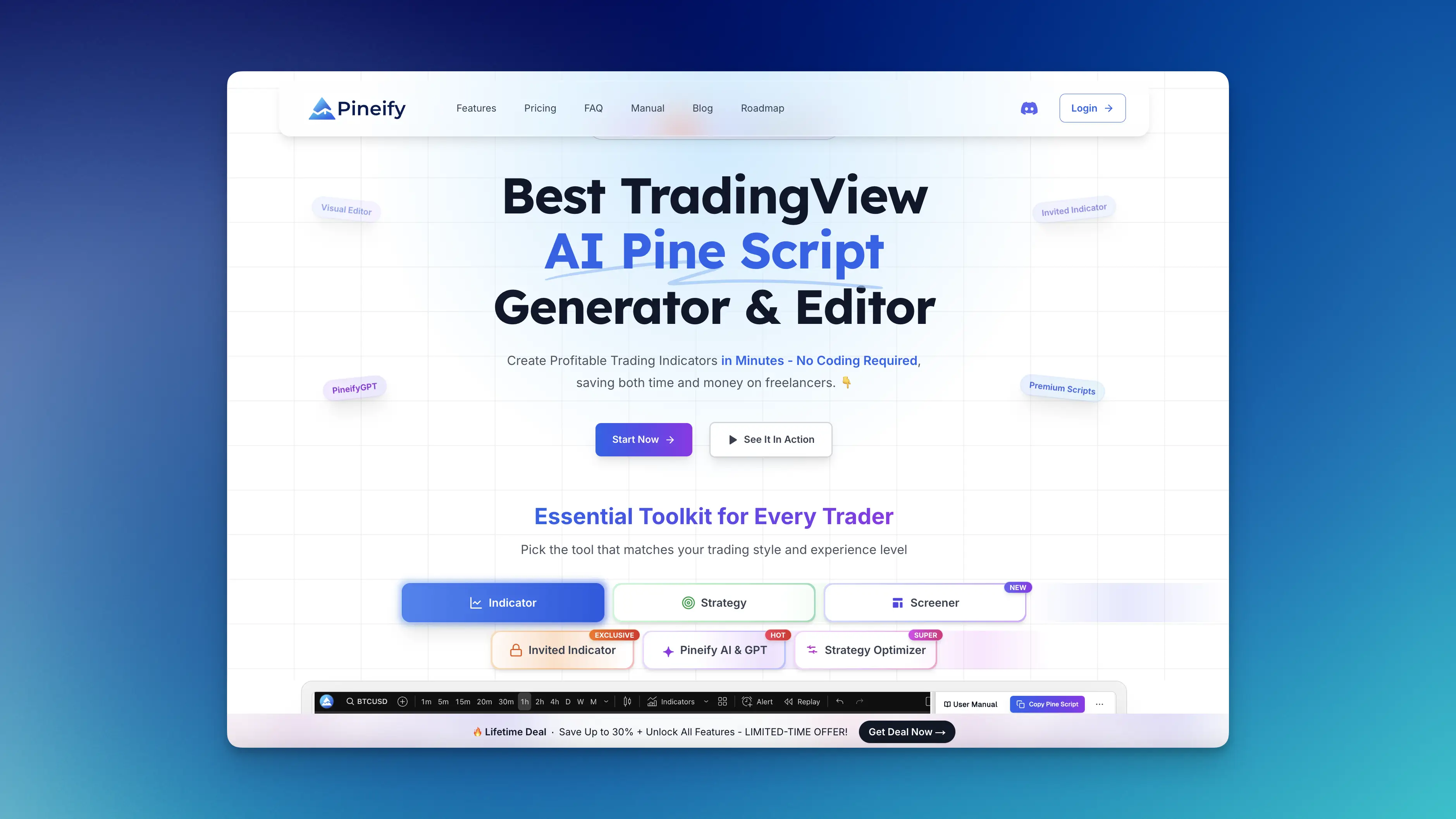
Beyond Market Insights, Pineify includes an AI assistant, a coding agent for building Pine Script indicators, a strategy optimizer, a backtester, and a Trading Journal. It's a cohesive toolkit rather than disjointed apps.
Who It Works For
Day traders use live options flow and dark pool prints as a real-time scanner for setups. A quick Market Tide check adds context before entry.
Swing traders watch sector rotation through Market Tide, spot institutional accumulation via Dark Pool, and catch unusual options activity that might signal a multi-day move.
Options traders see the specific strikes, expirations, and premium levels where experienced traders are putting money on the line.
Long-term investors follow congressional trading and sustained dark pool accumulation — a way to spot stocks insiders are gradually building positions in before mainstream news breaks.
Quantitative traders use options flow signals, dark pool volume profiles, and net premium divergences as datasets to backtest and integrate into algorithmic strategies.
Pricing
Market Insights comes with Pineify's Expert Plan. One payment, $259 (regularly $369). No recurring fees.
| Included Feature | What It Does |
|---|---|
| All Four Market Insights Modules | Full picture from volume, options, correlation, and sentiment |
| AI Finance Agent | Plain-English answers to complex trading questions |
| Pine Script AI Coding Agent | Turn trading ideas into indicators without manual coding |
| AI Stocks & Options Picker | Data-driven trade setup suggestions |
| Visual Pine Script Editor | Drag-and-drop script builder |
| Strategy Optimizer & Backtester | Test strategies against historical data |
| Trading Journal | Track trades and improve decision-making over time |
| All Future Updates | New features included at no extra cost |
Pay once, get everything. Latest details on the Market Insights page at pineify.app.
Q&A
Q: Is the options flow data truly real-time? A: Yes. During market hours, Options Flow and Dark Pool data updates live. It uses smart polling — fetches new data in the background while you're on the page, pauses if you leave the page, and resumes when you come back. I've tested this during several high-volume sessions and haven't seen lag.
Q: How does Pineify detect unusual options activity? A: It checks three things: whether the total premium passes your custom dollar threshold, how trade volume compares to open interest, and how the trade was executed (Above Ask, Below Bid). Trades that stand out across all three get flagged. You can also set your own premium minimum — I usually set mine at $500K to focus on the biggest moves.
Q: How accurate is the Congressional trading data? A: Very accurate. It comes from the official financial disclosures that members of Congress file under the STOCK Act, pulled directly from House and Senate sources. Late reports get highlighted automatically. One caveat: the 45-day reporting window means you won't see trades instantly, but the data you get is official.
Q: How is this different from FlowAlgo or Unusual Whales? A: FlowAlgo focuses mainly on options flow. Unusual Whales offers dark pool and Congress data as separate features. Pineify puts all four modules — Options Flow, Dark Pool, Congress, and Market Tide — into one dashboard and connects them with AI trading tools. You're getting a unified platform rather than stitching together multiple subscriptions.
Q: Can I use Market Insights alongside TradingView? A: Yes. I do this regularly — spot an opportunity in Pineify, then jump to the Pine Script AI tools or Strategy Optimizer (built for TradingView) to build or test the idea. If you're creating custom indicators, check the guide on How to Avoid Repainting in Pine Script — I've fixed several of my own scripts using those techniques.
Start with a stock you already follow. Run it through the Options Flow scanner, check the dark pool volume against your support and resistance levels, and see what the Market Tide shows. When the signals start lining up, the picture gets a lot clearer.