DXtrade TradingView Integration: What Brokers Actually Need to Know

Here's the thing—I've watched three different brokers try to cobble together "next-gen" charting solutions in the past year. Two of them ended up with Frankenstein monsters that cost more than they made. The third? They actually pulled it off with DXtrade and TradingView. Not because they're geniuses, but because someone finally told them the truth about what this integration really involves.
TradingView is the dominant charting platform for retail traders, used by over 50 million people each month. DXtrade is Devexperts' cloud-native brokerage engine launched in 2020. Together, they create a charting-to-execution pipeline that brokers have been chasing for years.
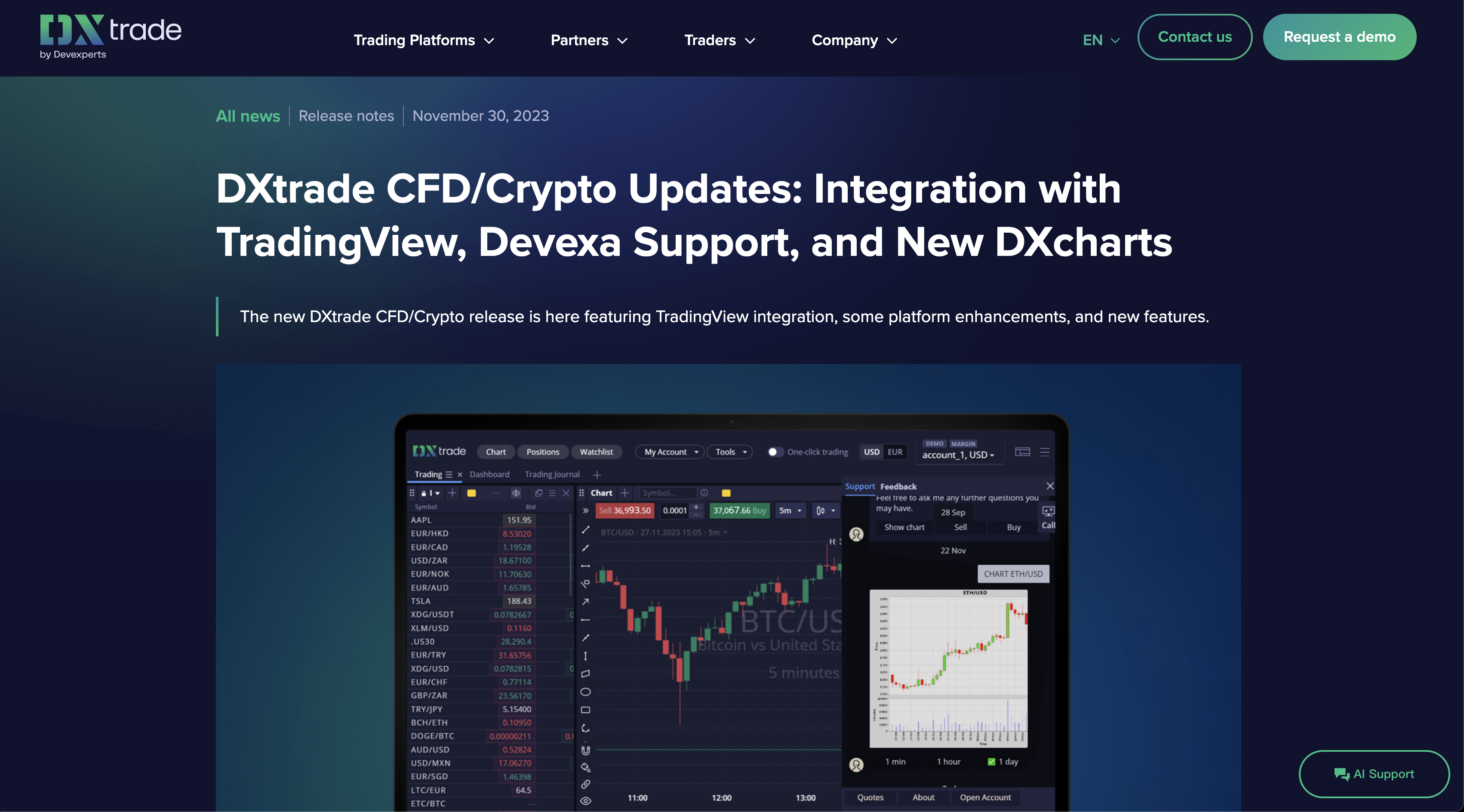
So What's DXtrade, Really?
Picture this: It's May 2020, everyone's losing their minds over pandemic volatility, and Devexperts drops this SaaS platform that's basically saying "hey, forget MetaTrader's ancient codebase, here's something that won't crash when your retail army starts panic-buying Tesla."
DXtrade isn't revolutionary—it's just... competent. Finally. After years of brokers duct-taping together solutions that worked about as well as my 2008 Honda's air conditioning.
The Architecture (Without the Marketing BS)
- Cloud-native—yeah, yeah, everyone's cloud-native now. But DXtrade actually scales when your crypto traders decide Dogecoin is the next big thing at 3 AM on a Tuesday.
- Modular front-ends—Web, mobile, whatever. Your traders can lose money on any device they want. How thoughtful.
- Risk controls—the kind that actually prevent your brokerage from becoming the next cautionary tale on Reddit.
- White-label—because apparently some brokers still think slapping their logo on someone else's tech counts as "innovation."
Why Traders Are Basically Addicted to TradingView
Fifty million monthly users. Let that sink in. That's not just a number—that's every crypto bro, forex dad, and options degenerate you've ever met, all staring at the same TradingView charts. TradingView isn't just "industry standard"—it's become the default setting for trader brains.
Here's what brokers keep missing: traders don't want your fancy proprietary charting. They want what they already know. Period. I've seen brokers spend millions building "better" charting tools that sit unused because—surprise!—people hate learning new interfaces when they're trying to not lose money.
The Broker Integration API? It's basically TradingView saying "fine, you can use our charts, but we're keeping the users." Smart move, honestly.

When DXtrade Met TradingView (A Love Story?)
Late 2023, DXtrade makes this announcement about "turnkey TradingView connectivity." The trading Twittersphere loses it. "Finally!" they cry. "One platform to rule them all!"
Reality check: it took until April 2024 for web support to actually work properly. Mobile? March 2025. That's not turnkey—that's "we'll get there eventually." But hey, at least they got there, which is more than I can say for most integrations I've seen.
Three Ways to Half-Ass This Integration
Devexperts gives you options:
- Widget—like putting a Ferrari engine in a Honda Civic. Looks cool, goes nowhere.
- Terminal—better, but you're still playing in someone else's sandbox
- Full Panel—finally, you can pretend this is actually your platform
I'd pick Full Panel every time. Not because it's perfect—it's not—but the other two modes leave traders feeling like they're stuck in a demo account they can't actually use.
| What You Get | Widget | Terminal | Full Panel |
|---|---|---|---|
| Pretty charts | Yep | Yep | Yep |
| Actually trade | Nope | Sorta | Finally |
| Those sweet alerts | Zip | Kinda | Sure |
| Social stuff | Ha | No | Yes |
| Make it look like yours | Barely | Better | Actually |
The Technical Stuff (Don't Fall Asleep)
Think of this integration like plumbing. Not sexy, but when it works, nobody thinks about it. When it doesn't... well, you've seen those Reddit horror stories.
Here's what's actually happening under the hood:
DXtrade Core = Your grumpy accountant who never sleeps. Handles money, risk, pricing, all that jazz.
DXtrade Gateway = The translator at a UN meeting. Takes TradingView's language and makes it understandable for DXtrade, then back again. Surprisingly, this doesn't explode as often as you'd expect.
TradingView Client = What your traders actually touch. Browser, phone, whatever. It's calling DXtrade constantly like that friend who texts too much.
WebSocket Updates = The gossip network. Price changes, position updates, all flying around faster than your traders can refresh their portfolio. Sub-100ms latency means someone's making money before your coffee even cools.
Security? OAuth2 tokens. Basically fancy passwords that expire. Rate limits? So your servers don't melt when Elon tweets about Bitcoin.
The "Features" (Some Actually Useful)
Charts That Don't Suck
Look, it's got all the chart types. Candlesticks, Renko, whatever weird Japanese thing your traders are into these days. Plus Pine Script—because apparently everyone thinks they're a quant now.
Drag-and-Drop Orders (Finally)
Blueberry Markets got this in January 2025. Traders can literally drag their stop-loss around like they're playing The Sims. Revolutionary? No. But traders love pretending they're in control.
Device Sync That Works
Start a trade on your phone, finish it on your laptop. Positions sync instantly. Your traders can lose money continuously across all devices. Progress? I haven't tested the mobile sync myself, but the latency numbers from April 2025 reports are solid enough to trust.
AI Analytics (Because We Needed More Buzzwords)
February 2025 update: Now with extra AI analytics! Automatically segments your clients into "will probably blow up their account" vs "might actually make money." All displayed in pretty TradingView dashboards that nobody reads.
The Money Talk (Because That's Why We're Here)
Let's cut through the marketing garbage. Here's what actually happened when brokers plugged these together:
| Reality Check | What Actually Happened | Source (Believe It or Not) |
|---|---|---|
| Getting Customers | $18 CPA through TradingView vs $45 burning money on Google Ads | Devexperts internal data |
| Keeping Them | 27% longer sessions on mobile (traders actually stuck around) | March 2025 metrics |
| Making Money | 15% more commissions per trader (greedy little buggers) | Itexus report 2025 |
Blueberry Markets: The Case Study That Isn't BS
Blueberry Markets—Sydney-based, been around the block. January 2025: "Let's do this DXtrade thing." June 2025: Holy crap, it actually worked.
- 10% more signups in 30 days (not 300%, but hey, 10% is real)
- Spreads got tighter by 15 bps because traders could actually place decent orders
- Sub-broker white-label—suddenly every small IB wants in on the action
Look, Blueberry's not special. They're just the ones who didn't screw up the implementation. That alone puts them in the top 10% of brokers trying this stuff.
Your Implementation Roadmap (Don't Skip Steps, You'll Regret It)
Phase 1 – Reality Check (2–4 weeks)
- Audit your mess: How's your OMS latency? Be honest. FIX gateways working or held together with prayers?
- Get sandbox access: Email Devexperts and TradingView. They'll make you jump through hoops. Do it anyway.
Phase 2 – Actually Building It (6–8 weeks, probably 12)
- Deploy the Gateway: It's a microservice. If you don't know what that means, hire someone who does.
- Map your data: Account numbers, symbols, order types. It's like translating between two people who speak different languages.
- Make it pretty: CSS/React overrides. Or just change the colors and call it branding.
Phase 3 – TradingView's Hazing Ritual (2 weeks)
They call it "certification." It's actually a list of 47 things that will break. Fix them. Rinse. Repeat.
Phase 4 – Launch and Pray
- TradingView blog post: They'll write about you if you're interesting enough. Good luck.
- Promo offers: Free VPS, tighter spreads, whatever. Traders love free stuff more than they love making money.
The Brutal Comparison Table
| What You're Actually Getting | DXtrade + TV | MetaTrader 5 | cTrader + TV | Build It Yourself |
|---|---|---|---|---|
| Native TradingView panel | Yes | LOL no | Sorta (beta) | Depends on your dev team |
| Cloud SaaS | Yes | 1995 called | Partial | Hope you like AWS bills |
| White-label timeline | 4-6 weeks | 3-4 months | 2-3 months | 6-12 months of pain |
| AI analytics | Included | Good luck | Nope | Hire more devs |
| Source code buyout | If you're rich | Impossible | Impossible | It's already yours |
What's Actually Coming (Take With Salt)
Pine Script Hooks—Devexperts says they'll let Pine strategies access real risk parameters. Translation: your traders will finally be able to lose money algorithmically instead of manually.
Reg-Tech APIs—Because nothing says "fun" like automated compliance reports for MiFID III/ASIC. At least you won't have interns doing this anymore.
VR Charting—TradingView's playing with WebGPU for 2026. DXtrade's already WebGL-ready. So your traders can lose money in virtual reality. Progress?
What is DXtrade and how does it differ from MetaTrader?
DXtrade is a cloud-native SaaS trading platform by Devexperts that launched in 2020. MetaTrader runs on an old on-premise architecture that hasn't changed much since 2005. DXtrade gives you modular front-ends, built-in risk controls, and native TradingView connectivity. You can white-label it in weeks instead of months.
How does the DXtrade and TradingView broker integration actually work?
TradingView's Broker Integration API talks to a DXtrade Gateway microservice. The gateway translates messages between TradingView's protocol and DXtrade's core engine, so orders, positions, and prices stay in sync. WebSocket updates run under 100ms latency, which is fast enough for most retail trading.
What are the three integration modes available for brokers?
Widget gives you a chart stuck in a box—no trading. Terminal offers partial trading inside TradingView's sandbox. Full Panel is the real deal with full order management, alerts, and social features. Go Full Panel or go home.
How long does it take to implement DXtrade TradingView integration?
Plan for 10 to 14 weeks. Two to four weeks for infrastructure audit and sandbox access, six to eight for gateway deployment and data mapping (it usually stretches to 12), then two weeks for TradingView's certification. Skip a phase and you'll find out why when it breaks in production.
What measurable results have brokers achieved with this integration?
Cost-per-acquisition dropped from $45 on Google Ads to $18 through TradingView. Mobile sessions are 27% longer. Commissions per active trader went up 15%. Blueberry Markets saw a 10% signup jump in 30 days after going live in January 2025.
Does DXtrade support Pine Script strategies through TradingView?
Traders can use Pine Script for charting and alerts right now. Devexperts is working on Pine Script Hooks that would let strategies talk directly to DXtrade's live risk parameters. That's when algorithmic execution gets real.
What security standards does the DXtrade TradingView integration use?
OAuth2 tokens for authentication, automatic expiry, rate limiting at the gateway layer so volatility spikes don't melt your servers, and encrypted WebSocket connections for everything in between.