AI for Options Trading: Smarter Strategies & Real-Time Edge

Options trading demands precision—right strike, right expiration, right volatility read. Professionals spend years building that intuition. AI for options trading is the practice of using machine learning models and real-time data analysis to surface patterns no human could spot alone, from volatility shifts to unusual options flow. It doesn't replace judgment, but it sharpens it.
Trade covered calls, iron condors, or 0DTE SPX options? AI helps with real decisions, not just faster execution. I've found that matters most when the market moves faster than you can think.
What AI Actually Does for Options
AI for options trading runs on machine learning models, natural language processing, and statistical algorithms that process data in real time. Unlike a stock screener with fixed filters, AI systems learn from market behavior and adjust their signals as conditions change.
The practical benefits include:
- Forecasting volatility — spotting when implied volatility will diverge from realized volatility before events like earnings or macro news
- Analyzing options flow — detecting unusual activity and where institutional money is positioning
- Reading sentiment — scanning earnings transcripts, headlines, and social media for market mood
- Suggesting strategies — matching current market conditions to the options strategy with the best statistical edge
- Automating trades — placing multi-leg orders instantly without emotional interference
- Backtesting — running thousands of historical simulations before you risk real capital
AI won't replace your trading judgment. It strengthens it by showing signals you'd never catch on your own, and by sticking to your rules with cold execution.
Speed, Discipline, Data: The Real Benefits
Speed and Execution Precision
Options are time-sensitive. A five-second delay on a 0DTE trade can flip a winner to a loser. AI-powered bots execute spreads, straddles, and iron condors at optimal prices the moment conditions are met—faster than any human can react. To refine your technical triggers, check out our guide on the best MACD settings for short-term trading.
Eliminating Emotional Bias
Fear and greed destroy options P&L faster than bad analysis. AI feels neither. It follows rules without second-guessing, so there's no FOMO chasing an overpriced breakout, no panic-exiting a position that's temporarily underwater. I've blown up accounts by ignoring this—letting fear close a position that would've recovered in two hours. AI doesn't make that mistake.
Institutional-Grade Data Access
Dark pool data, options flow, insider disclosures, congressional trading records—these were hedge fund territory until recently. Modern AI platforms aggregate all of it into unified dashboards. I prefer running Pineify's options flow tracker alongside my broker's data because the two sources together catch more than either alone.
Continuous Market Monitoring
Options positions get hit by overnight news, pre-market earnings, and 8:30 AM macro data. AI monitoring tools never sleep. They track global markets, scan unusual options activity, and alert you to changes around the clock. I keep one running even when I'm not actively trading—it's caught three CPI-related volatility spikes this year alone.
How Machine Learning Powers Options Strategy
Machine learning models train on years of data—price moves, volatility patterns, Greeks, economic signals. The model figures out which patterns tend to precede big moves. For example, a jump in implied volatility combined with bullish options activity and strong earnings revisions often signals a stock about to run.
This predictive analysis helps in practical ways:
- Spot volatility spikes early — so you know when buying a straddle or strangle might pay off
- Find mispriced options — when the market's implied move doesn't match historical reality
- Keep your Greeks in check — adjusting delta, theta, and vega across your portfolio in real time
- Catch earnings trades — when unusual call or put buying suggests smart money is positioning before a report
Reinforcement learning goes further. AI agents run through thousands of fake market scenarios, learn from mistakes, and improve strategy selection over time. I've run RL models on SPY data and watched them adapt to volatility regime changes faster than any manual rebalance I could manage. For a deeper dive into predictive techniques, see our linear regression strategy guide.
Pineify Finance Agent: An AI Research Tool for Options
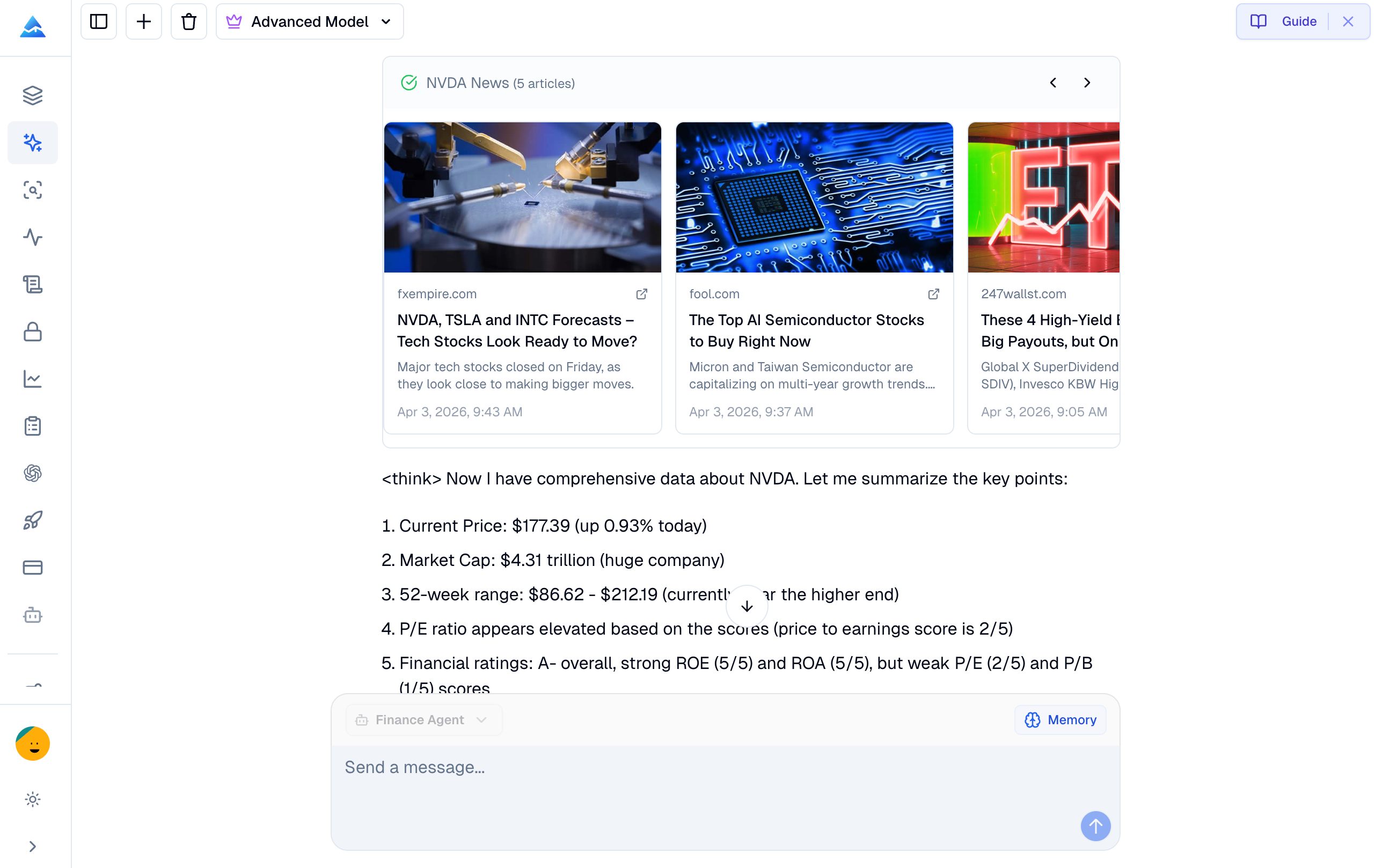
If you trade options regularly, you know how much data exists and how little of it comes in time. Most tools give stale snapshots or numbers without context. Pineify Finance Agent solves that differently.
It isn't a chatbot reciting textbook definitions. It's an AI research partner that fetches live data as the market moves—stock quotes, financial statements, analyst estimates, earnings filings, economic indicators, and critically, real-time options chains and flow. You get what's happening now, not what happened ten minutes ago.
What Pineify Finance Agent Covers
| Data Category | What Pineify Analyzes |
|---|---|
| Options Intelligence | Real-time options chains, flow, unusual activity, Greeks |
| Market Sentiment | Live X/Twitter sentiment, Reddit discussions, news NLP |
| Institutional Activity | Dark pool trades, insider disclosures, Congress trades, institutional holdings |
| Fundamental Data | Financial statements, key ratios, analyst estimates, EPS revisions |
| Technical Analysis | Price action, trend analysis, uploaded chart screenshots |
| Alternative Data | FDA calendars, forex/crypto rates, ETF data, macroeconomic indicators |
The real value is how Pineify connects everything. Instead of staring at numbers, the AI interprets price action, options flow, institutional moves, and sentiment together—then gives a buy, sell, or hold take with plain-English reasoning. For an options trader, that means asking whether a weird call sweep in NVDA at a specific strike is institutional buying or a hedge. You get an answer in seconds, not hours.
The platform also offers a free Options Flow Summary tracker that watches for unusual options activity across major stocks. Filter by premium, volume, sentiment, and strategy type. Pair that with the Options Strategy Comparison Tool (compare P&L, risk/reward, Greeks, and probability of profit side by side) and you've got a workflow that used to cost thousands in Bloomberg terminals.
I won't pretend Pineify replaces deep expertise in options mechanics. You still need to understand Greeks, expiration dynamics, and basic strategy construction before the AI can help you apply them. But for the research heavy lifting—scanning thousands of contracts, cross-referencing data sources, flagging what matters—it does work that would take a team of analysts.
You can check it out here: Pineify Finance Agent and the other free tools like the Options Flow Summary and trading journal.
AI Options Trading Strategies That Actually Work
Using AI for options trading gives you an edge—but only paired with a solid plan. Here are strategies where AI tools deliver real results.
1. Catching Unusual Options Flow
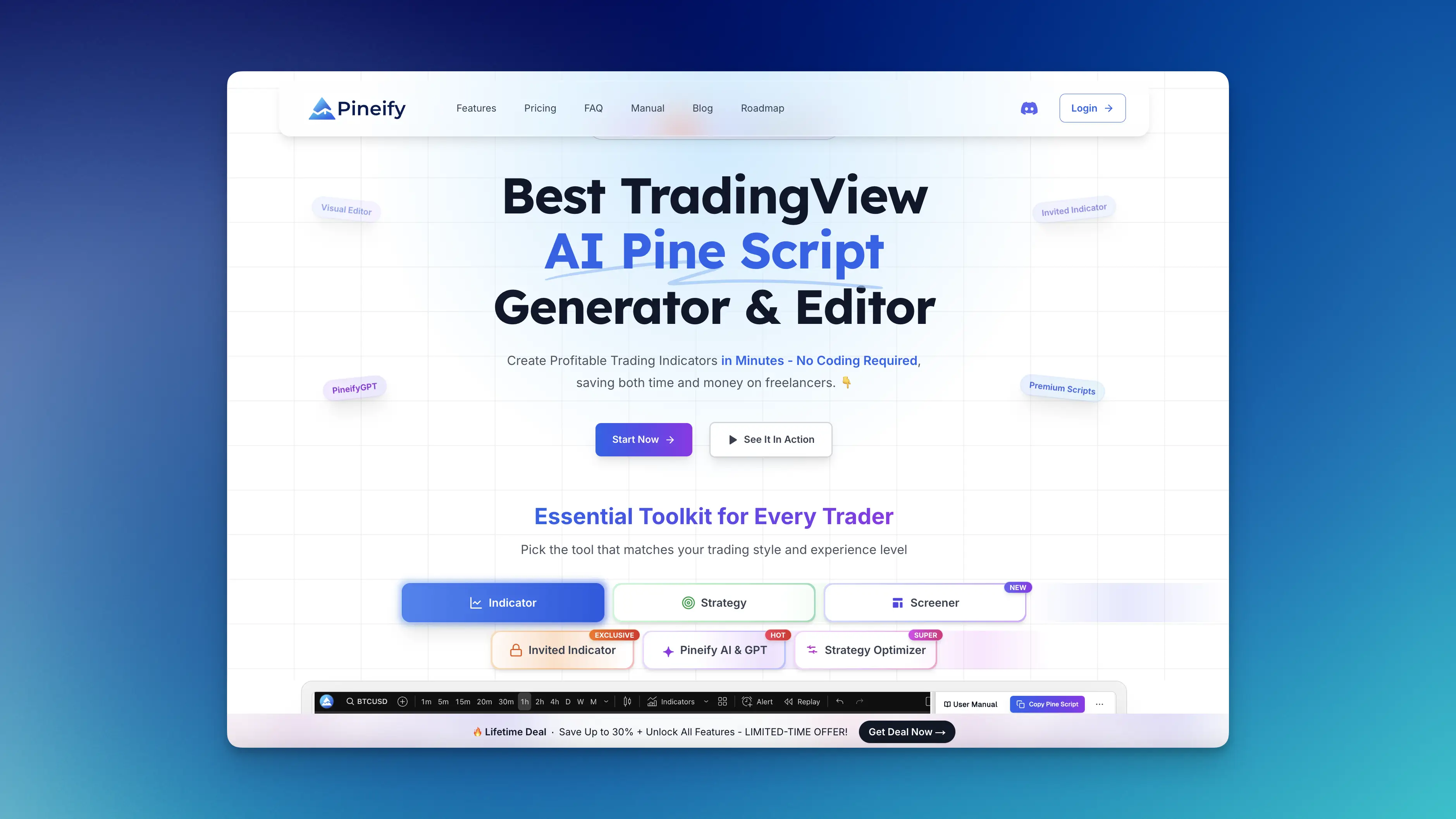
A stock suddenly gets ten times its normal call or put volume. That's usually a sign someone with deep knowledge expects a big move. AI scanners like Pineify spot these unusual flows in real time and tell you whether the action looks bullish, bearish, or just noise. With Pineify's Market Insights dashboard, you get real-time options flow, dark pool block trades, and net premium sentiment all in one interface.
2. Playing the Volatility Mismatch
AI compares a stock's implied volatility to its historical volatility across thousands of tickers at once. When the gap is wide—IV way higher than HV—it's often a good time to sell premium with iron condors or credit spreads. The AI flags these setups the moment they appear. If you use ATR-based position sizing in your Pine Script strategies, our ATR Pips indicator guide covers the implementation details.
3. Earnings Plays with a Smart AI Assistant
Before an earnings report, the options market guesses the size of the move. Pineify's Finance Agent crunches analyst estimate changes, unusual options flow, and even social media chatter to tell you if that expected move seems too big or too small. That's gold for deciding between a straddle or a strangle. I used this approach for AAPL's January earnings and caught an IV crush that netted 18% on a short strangle.
4. 0DTE Scalping Without the Panic
Zero-days-to-expiration trades on SPX or SPY are all about speed. Split seconds matter. AI bots fire off defined-risk spreads the instant technical triggers are hit—no hesitation, no second-guessing, no emotional meltdowns.
5. Delta-Neutral Hedging on Autopilot
Keeping your portfolio market-neutral used to require a quant desk. Now AI tracks your total delta and adjusts hedges in real time as the market moves. It's like having a risk manager that never sleeps.
Risks to Understand Before You Automate
AI is powerful but not perfect. Here are the real pitfalls:
- Overfitting risk — a model trained too heavily on past data can fail when the market behaves in new ways. I've overfitted a backtest once and watched it implode in live trading. That taught me to never trust any strategy without at least 100 trades of live data.
- Latency and slippage — even AI systems can't escape the realities of execution in fast-moving, low-liquidity options markets. Orders don't always fill at the price you expect.
- Over-reliance — treating AI signals as guaranteed winners instead of probabilistic guesses is the fastest way to blow up your account. No model is 100% accurate.
- Model opacity — stay away from "black box" tools that hide their decision logic. Use platforms that explain their reasoning so you can validate the output.
- Regulatory risk — automated trading comes with rules. Check your broker's margin requirements and position limits.
The smart approach: test every AI strategy in paper trading first. Watch how it performs across different market conditions. And never let automation run beyond what you're personally comfortable losing.
Frequently Asked Questions
Can AI predict options prices accurately?
AI doesn't give you a crystal ball. What it does well is model the probability of where a stock or option price might go, based on historical patterns, volatility data, and market sentiment. Options pricing is inherently random, so AI improves your odds—it never guarantees a win. Think of it as a better-informed guess, not a sure thing.
Do I need coding skills to use AI options trading tools?
No. Tools like Pineify Finance Agent let you interact in plain English. You can ask about IV rank for AAPL options and get structured research and trade ideas instantly. No Python, no scripts—it's designed for traders who want insights, not a second job as a programmer.
Is AI options trading suitable for beginners?
Yes, but take it slow. AI tools are great for learning because they explain why they suggest something—surfacing data you might miss, like volatility skew or upcoming earnings catalysts. A smart start is using an AI-powered journal and flow tracker before automating any trades, so you learn the ropes without risking real money on autopilot.
What separates Pineify from other AI options tools?
Most options tools focus on one or two data sources. Pineify Finance Agent pulls together live options chains, dark pool activity, insider trades, congressional trading records, social sentiment, and fundamental analysis into a single conversational AI. Instead of jumping between five dashboards, you ask a question and get a consolidated view. I haven't tested every AI options tool out there—Trade Ideas and BlackBox come up a lot in forums—but Pineify is the one I keep coming back to for its data breadth.
How does AI handle implied volatility analysis?
AI syncs implied volatility with historical volatility in real time. It flags when IV is high or low relative to its history (IV rank and percentile) and connects those spikes to upcoming events like earnings reports, FDA decisions, or macro data releases. That helps you decide whether selling premium or buying premium makes more sense without staring at a volatility chart all day.
What is unusual options flow and why does AI help detect it?
Unusual options flow happens when a stock's call or put volume is dramatically higher than normal—often a signal that large institutional players expect a significant move. AI scanners analyze order size, premium paid, expiration timing, and strike selection in real time to distinguish genuine smart-money positioning from noise, giving retail traders the same visibility once reserved for hedge fund trading desks.
Can AI help with multi-leg options strategies like iron condors?
Yes. AI platforms can simultaneously monitor delta, theta, vega, and gamma across all legs of a complex position. They automate rolling, adjusting, or closing legs when predefined risk thresholds are hit. For delta-neutral strategies like iron condors and butterflies, this removes a ton of manual oversight.