Backtesting.py vs Backtrader vs Pineify: Which Framework is Right for Your Trading Strategy?
Choosing the right tool to backtest your trading ideas can feel overwhelming, but it makes all the difference. It’s like picking the right wrench from the toolbox—you want something that feels good in your hand and actually gets the job done.
Three names come up again and again: Backtesting.py, Backtrader, and Pineify. They each have a different vibe and purpose. Let's break them down in plain terms so you can see which one might be the best fit for you and your strategies.
A Side-by-Side Look at Your Options
Here’s a quick overview of how they stack up on paper:
| Feature | Backtesting.py | Backtrader | Pineify |
|---|---|---|---|
| Core Purpose | Simple, fast backtesting | Full-featured backtesting & live trading | Bridge TradingView's Pine Script to Python |
| Best For | Beginners, quick prototyping | Experienced developers, all-in-one solution | TradingView users wanting more power |
| Learning Curve | Gentle | Steeper | Moderate (needs Pine Script knowledge) |
| Indicators | Needs external libraries (e.g., TA-Lib) | 120+ built-in | Leverages Pine Script's library |
| Live Trading | Not included | Yes, with broker integrations | Via connected brokerage |
| Cost | Free (Open Source) | Free (Open Source) | Freemium; paid plans for advanced features |
Backtesting.py: The Straightforward Choice
Think of Backtesting.py as your "get it done" tool. It’s a Python library built for speed and simplicity. If you want to test a basic idea without getting bogged down in complex setup, this is a great place to start.
You write clean, minimal code to define your strategy, load some historical price data, and run the test. It doesn’t come with a huge built-in menu of technical indicators, so you’d bring your own (like TA-Lib) for more complex analysis. Its beauty is in its focus: it’s designed specifically for backtesting, and it does that one job very well.
Backtrader: The Swiss Army Knife
If Backtesting.py is a reliable wrench, Backtrader is the entire toolbox. It’s a veteran, full-featured framework that handles not just backtesting, but also live trading. It’s packed with features that serious strategy developers love: tons of built-in indicators, support for complex order types, and the ability to connect directly to brokers.
Because it’s so comprehensive, there’s more to learn. It’s incredibly powerful, but that power comes with a steeper learning curve. It’s ideal if you know your way around Python well and you want a single, robust platform that can take a strategy from idea, to testing, and finally to live execution.
Pineify: The Best of Both Worlds
Pineify is a bit different. It doesn’t replace the other two; instead, it acts as a translator and supercharger for TradingView users. If you love developing strategies in TradingView's Pine Script for its great charts and ease of use, but wish you could do more advanced analysis or automation with Python, Pineify connects the dots.
It lets you run multi-asset portfolio tests, do walk-forward optimizations, and even adjust strategies based on changing market conditions—all using your Pine Script logic as a starting point. For a step-by-step guide on setting up backtests in TradingView, see our How to Backtest on TradingView: Comprehensive 2025 Guide. It operates on a freemium model, with a free tier to try and paid plans that unlock its most powerful features.
So, which one is for you?
- Want to test a simple idea fast? Try Backtesting.py.
- Building complex, professional strategies and need one integrated tool? Learn Backtrader.
- Love TradingView but need more analytical firepower? Check out Pineify.
The best choice isn't about which tool is "best" overall, but which is the best fit for your current skills and the specific problem you're trying to solve.
Which Is Easiest to Learn?
If you're just starting out and want to get a strategy running quickly, Backtesting.py is often the go-to choice. It's designed to be approachable. You can set up a basic test with very little code, which is great when you're experimenting and learning. The downside is that its simplicity means it might not have the bells and whistles you need for extremely complex, multi-layered strategies. As one person on Reddit put it, they prefer it because in other frameworks, "even to do some basic computation you need to add listener or analyzer"—a bit of extra work that can slow you down for simple tasks.
Backtrader is more like a professional workshop. It has a tool for nearly everything you can imagine, which is powerful but can feel overwhelming at first. The learning curve is steeper, and it will take more time to get comfortable. However, if your strategies are sophisticated, that initial investment in learning pays off. Its extensive documentation is a big help once you dive in.
Pineify is a bit unique. It's best if you're already using TradingView and are familiar with its Pine Script language. The learning curve here isn't about a single system, but about connecting two different worlds—Pine Script and Python. If you're new to Pine Script, our guide on How to Write Pine Script in TradingView: A Complete Beginner's Guide can help you get started. It's a fantastic tool for extending what you already do on TradingView, but it makes the most sense if that's where you're starting from.
What They Can Do: Features and Tools Compared
Let's break down what each of these backtesting platforms can handle, from crunching data to analyzing your results. Think of it as comparing the toolkits they give you.
Working with Data and Indicators
This is about how each platform loads your price data and the trading indicators (like RSI or moving averages) you can use.
| Feature | Backtrader | Backtesting.py | Pineify (for TradingView) |
|---|---|---|---|
| Data Sources | Very flexible. Works with CSV files, live data feeds, and can connect directly to some brokers. | Primarily uses data you provide in a compatible format (like Pandas DataFrames). | Uses TradingView's built-in data, which is extensive for stocks, forex, and crypto. |
| Built-in Indicators | The most comprehensive out-of-the-box. Comes with over 122, including all the classics and integration with TA-Lib. | Minimal. Includes only very basic examples (like a Simple Moving Average). You’re expected to build your own or use libraries like TA-Lib. | Leverages all of TradingView's native indicators, which are vast and community-tested. |
| Multiple Timeframes | Strong support. You can easily analyze a strategy across different timeframes (like daily and hourly) simultaneously. | Possible but more manual. You can use functions like resample_apply() to work with multiple timeframes. | Native capability. You can design strategies that check signals on a 15-minute chart only if the daily trend is also aligned, for example. |
To understand the data and features available in TradingView, you can refer to our TradingView Price Plans: Complete Guide to Choosing the Right Subscription for Your Trading Needs.
How Orders and Trading Are Simulated
This covers how realistically each platform places and fills your hypothetical trades, including fees and order types.
-
Backtrader has the most detailed simulation. It supports advanced order types (like bracket orders for profit-taking and stop-losses), and lets you model real-world factors like slippage (the difference between expected and actual fill price) and custom commission schemes. It's built for testing sophisticated strategies under realistic conditions.
-
Backtesting.py keeps it simple. It provides basic order execution that works perfectly well for most common retail strategies. You set your starting cash and commission costs, and it handles the essentials without extra complexity.
-
Pineify works within TradingView's system. This means you get TradingView's reliable backtesting engine, plus Pineify adds the ability to test your strategy across an entire portfolio with proper position sizing, not just on one asset at a time.
Measuring Your Strategy's Performance
After the test run, you need to understand how your strategy performed. Here’s how each platform helps you analyze.
-
Backtrader gives you a deep dive. It has a suite of built-in analyzers that calculate metrics like the Sharpe Ratio, drawdowns, and trade-by-trade statistics. With one command, it can generate detailed, customizable plots of your equity curve and indicators.
-
Backtesting.py focuses on the essentials. It provides clear methods to see your performance curve, drawdowns, and key return metrics. It gives you what you need to evaluate a strategy without overwhelming you with data.
-
Pineify introduces smart, adaptive features. Its standout tools include:
- Walk-Forward Optimization: This automatically tweaks your strategy's parameters as new data comes in, helping prevent it from becoming outdated.
- Market Regime Detection: It can automatically adjust how your strategy behaves based on whether the market is trending, choppy, or highly volatile.
Getting the Speed You Need for Backtesting
When you're backtesting, how fast it runs isn't just a minor detail—it can be the difference between testing an idea in an afternoon and waiting all week. The speed you get isn't just about which tool you pick; it really comes down to how you use it and what you're trying to do.
Think of it this way: some popular backtesting frameworks work through data step-by-step, bar-by-bar. This is great because it mimics how you'd actually react to market moves in real time. The trade-off? It can be slower than methods that crunch all the numbers at once (called vectorized backtesting).
But here's the pro tip: your own code has a huge impact. One developer shared how they turbocharged their setup. They were initially processing about 700 data points ("candles") per second. By cleaning up their code—specifically, cutting out heavy dataframe operations and avoiding a slow pandas function called iterrows()—they blasted past 100,000 candles per second. That’s a massive leap, and it shows that a smart implementation often beats just choosing the "fastest" framework.
If you're working with huge amounts of data or testing thousands of strategy variations, these speed differences start to matter a lot. For the ultimate speed, some build their own backtesters in languages like Go or C#. One example achieved a staggering 73 million candles per second. The catch? Building something that fast from scratch requires serious time and coding skill.
| Approach | Typical Speed (Candles/Sec) | Best For | Effort Level |
|---|---|---|---|
| Standard Event-Driven (e.g., Backtrader) | 1,000 - 50,000 | Accurate live-trading simulation, learning | Low to Medium |
| Highly Optimized Python | 100,000+ | Large datasets, parameter tuning | High (coding skill needed) |
| Custom C# / Go Backtester | 10 million+ | Institutional-grade, massive optimization | Very High |
In the end, the best choice balances your need for speed, the accuracy of your test, and the time you can spend building it. Often, writing lean, efficient code in a familiar tool gives you the best results without the headache.
Live Trading: How Python Frameworks Connect to Real Markets
Backtrader: Built for Real Trading from the Start
Think of Backtrader as the framework that lets you take the strategy you built and tested, and run it with real money without starting from scratch. That’s because it comes with live trading built right in.
It has direct connections to brokers like Interactive Brokers and Oanda. It also works with popular third-party platforms for stocks (like Alpaca) and cryptocurrencies (via CCXT). For a practical tutorial on connecting TradingView to Interactive Brokers for live trading, check out our TradingView IBKR Tutorial: Seamless Charting and Live Trading. The big win here is that you can often move from your backtest to a live trade using the exact same strategy code. The framework handles the real-time data, sends your orders, and manages the broker communication for you. You don't have to rebuild your trading logic just to go live.
Backtesting.py: A Focused Tool for Strategy Testing
Backtesting.py is designed to do one thing really well: letting you test your ideas against historical data. It’s straightforward and great for prototyping.
However, it doesn’t have built-in tools for live trading. When your strategy is ready for the real market, you’ll need to manually adapt your code or find other software to handle the order execution. This keeps the library simple for learning and testing, but it means extra steps when you're ready to deploy.
Pineify: Bridging TradingView and Your Python Code
Pineify takes a different route. It connects TradingView, a favorite for charting and indicators, with your Python automation scripts.
Here’s how it works: You set up an indicator in TradingView, and when it triggers an alert, TradingView sends a signal (via a webhook) to your own Python script. That script can then place a trade with your broker. It's not as seamless as having the broker connection inside the framework itself, but it’s a clever way to use TradingView's powerful visuals while letting Python handle the automated execution.
Which Backtesting Framework Fits Your Needs?
Choosing the right backtesting tool can feel overwhelming. The best choice isn't about which one is objectively "best," but which one is the best fit for your specific situation, skills, and goals. To make it easier, here's a straightforward look at where each of these frameworks shines and where you might want to look elsewhere.
| Framework | Best Fit For | Might Not Be the Best Fit For |
|---|---|---|
| Backtesting.py | Folks just starting out with backtesting, quickly testing a simple trading idea, or anyone who values clear, simple code above all else. | Highly complex strategies involving many assets, directly moving a strategy into live trading, or if you need a huge built-in library of technical indicators. |
| Backtrader | Professional or serious traders who need a full toolkit. It's great for complex strategies with special order types, connecting to live brokers, and running detailed optimizations. | Complete beginners who might get overwhelmed, projects where maximum simplicity is the top priority, or if you're on a very tight learning timeline. |
| Pineify | Current TradingView users who love Pine Script's features but want more power in Python. Perfect for multi-timeframe portfolio analysis and bringing those advanced Pine concepts into your Python workflow. | Developers who have never used TradingView or Pine Script, traders who want a framework built purely for Python from the ground up, or anyone wanting to avoid ongoing subscription fees. |
In a nutshell: Think of it like this. If you want the simplest path to test an idea, start with Backtesting.py. If you need an industrial-grade toolkit and are ready for its complexity, Backtrader is incredibly powerful. If you live in TradingView and want to extend that power into Python, Pineify bridges that gap perfectly.
The right tool simply helps you build and learn more effectively.
Cost and Getting Started: Finding the Right Fit for You
When you're picking a backtesting tool, what it costs and how easy it is to get started are huge factors. The good news is, you have great options whether your budget is big, small, or nonexistent.
Let's break it down simply.
The Free & Open-Source Route: Backtesting.py and Backtrader
For developers who love control and customization, Backtesting.py and Backtrader are fantastic. They are completely free and open-source. This means:
- No cost to use, ever. You can build and test strategies without worrying about subscriptions.
- You own your code. You can dig into the source, tweak it for your specific needs, and truly understand how everything works under the hood.
- Community-powered. Both have active communities where users share code, help each other out, and build extensions. You're not just using software; you can be part of improving it.
Think of these like a well-equipped, open workshop. The tools are free, but you need to bring the know-how to build with them.
The Freemium Model: Pineify
Pineify takes a different approach, designed to feel familiar if you already use TradingView. It uses a "freemium" model: a solid free tier to try things out, with paid plans that unlock more advanced power.
This structure makes the most sense if you're already comfortable with TradingView's Pine Script and want to level up your testing with features like advanced portfolio analysis and optimization, without leaving that ecosystem.
Here’s a clear look at Pineify's plans:
| Plan | Cost | Best For |
|---|---|---|
| Free | $0 | Getting started, testing basic ideas, and learning the platform. |
| Pro | $99/year | Serious traders who want robust portfolio backtesting and optimization features. |
| Ultra | $149 (one-time) | Traders who want permanent access to all Pro features, plus future updates. |
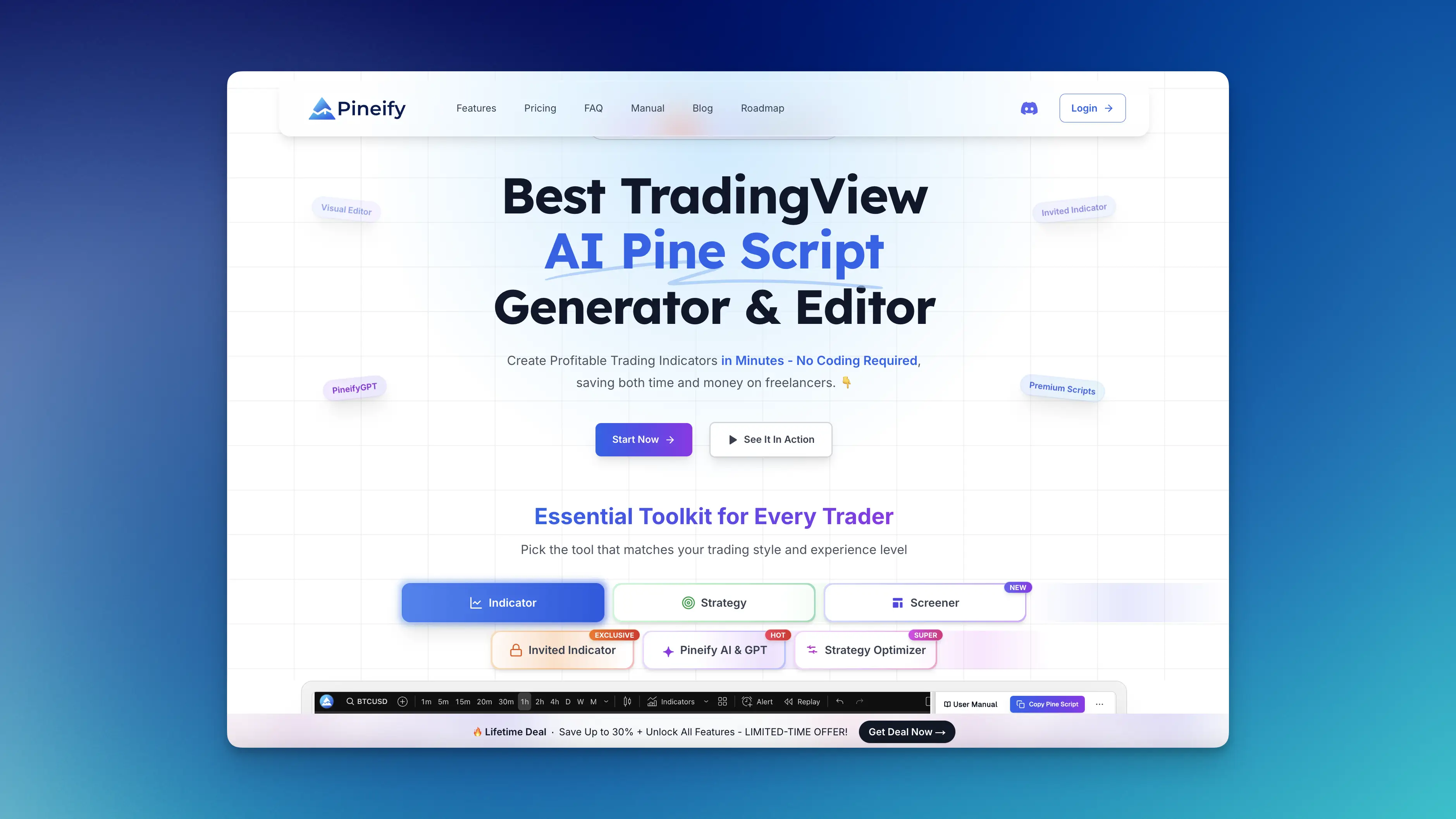
Speaking of Pineify, it’s more than just a backtester—it's a comprehensive suite for traders. Its Visual Editor lets you build complex TradingView indicators and strategies without writing a single line of code, while the AI Coding Agent can turn your trading ideas into error-free Pine Script in minutes. For those looking to supercharge their process, features like the Strategy Optimizer Extension and the new AI Stock Picker provide powerful edges. The platform's lifetime access plans offer incredible long-term value, making advanced tools permanently accessible for a one-time fee.
The Bottom Line
Your choice often comes down to your style. Do you enjoy tinkering with code and want maximum flexibility for free? The open-source tools are your ally. Do you prefer a more guided, integrated experience built on TradingView and are willing to pay for advanced, time-saving features? Then a Pineify plan could be a worthwhile investment.
The best tool is the one you'll actually use to rigorously test your ideas, so choose the path that fits your skills and goals.
Getting Help and Learning the Ropes
When you're picking a backtesting tool, it’s not just about the features. It’s also about the support you’ll get when you hit a wall. Here’s how these three options stack up in terms of community and learning resources.
Backtrader is like the wise elder of the group. It’s been around since 2013, and that time has built up a huge advantage. You’ll find loads of official documentation, step-by-step tutorials, and an active community that’s already wrestled with almost every common problem you can think of. Because it’s so mature, many of those tricky, rare situations (the "edge cases") have been documented and solved by other users. If you get stuck, chances are good someone has already posted the answer.
Backtesting.py took a different path. It won people over by being simple and clean. Its community has grown fast because of that, with lots of users sharing their code examples on GitHub and in trading forums. While its official documentation isn’t as massive as Backtrader's, many find the codebase itself easier to dig into. You can often figure things out just by looking at example code, which is a big plus for developers who learn by doing.
Pineify is the specialist. Its guides are thorough and laser-focused on connecting with TradingView. The community is naturally smaller because it serves a specific need—you’re mostly connecting with others who are also bridging that same gap between Pine Script and Python. The support is there, but it’s more niche.
Here’s a quick look at how they compare:
| Framework | Documentation Depth | Community Size & Activity | Best For Learners Who... |
|---|---|---|---|
| Backtrader | Extensive | Large & Active | Prefer thorough, official docs and solved forums posts. |
| Backtesting.py | Sufficient | Growing & Engaged | Learn best by reading clear, example code. |
| Pineify | Focused (on TradingView) | Niche | Need specific guidance on TradingView integration. |
In short, your choice might come down to how you like to learn. Do you want the deep, established library of a veteran (Backtrader), the clean-code examples of a popular newcomer (Backtesting.py), or the specialized manual for a specific task (Pineify)?
Your Questions, Answered
Q: Is it possible to use Backtesting.py, Backtrader, and Pineify together on the same project?
Absolutely. In fact, that's how a lot of experienced traders set up their workflow. Think of them as different tools in a toolbox. You might use Backtesting.py for an initial, quick check of an idea. If the strategy shows promise, you could graduate it to Backtrader for more rigorous, production-style testing and to eventually connect it to a live broker. Meanwhile, Pineify helps you translate or visualize that logic on TradingView to share with a community or see it on a different charting setup. Using them together based on what each does best is a smart, common approach.
Q: Which one of these frameworks will backtest my strategy the fastest?
It's a good question, but the honest answer is that your own code will have a bigger impact on speed than the framework itself. All three are "event-driven," which is a fancy way of saying they process data bar-by-bar to realistically model how a trade would actually execute. This is more accurate but not the absolute fastest method possible.
The real speed gains come from how you write the strategy. Avoiding slow operations inside your logic loops and caching repeated calculations can make any framework run dramatically faster—we're talking 100x improvements in some cases. So, focus on writing efficient code first.
Q: How much programming do I need to know to get started?
You'll need some basic Python knowledge. Here’s the breakdown:
- Backtesting.py is the most beginner-friendly if you're new to Python. Its simplicity helps you focus on the trading logic.
- Backtrader is powerful but has more features to learn. It's best if you're comfortable with Python and want more control.
- Pineify sits in the middle—it requires you to know Python and have some familiarity with TradingView's Pine Script language. It's perfect if you're already building ideas on TradingView.
You don't need to be a software engineer, but you should be okay with writing and debugging code.
Q: Can I use these to backtest strategies for cryptocurrencies like Bitcoin or Ethereum?
Yes, all three handle crypto data just fine.
- Backtrader has a direct advantage here because it can integrate with the CCXT library, letting you pull live data from many crypto exchanges.
- Backtesting.py works with any price data in a CSV file, so you can use historical crypto data from wherever you get it.
- Pineify, since it connects to TradingView, gives you access to their wide range of crypto markets and pairs directly on their charts.
Q: What's the best framework for testing Forex trading strategies?
For Forex, Backtrader is often the top choice, and here’s why:
- It handles multi-timeframe analysis really well (like checking a daily trend while executing on an hourly chart).
- It has built-in connections to brokers like Oanda, making the path to live trading smoother.
- It lets you accurately model Forex-specific costs like spreads and commissions in your backtest.
Backtesting.py is still a great option if you just want to validate your Forex strategy's logic and aren't yet worried about live trading integration.
Q: Are these good for high-frequency trading (HFT) strategies?
No, they aren't built for that. These frameworks are designed for algorithmic trading where decisions are made on minute, hourly, or daily charts—not in milliseconds or microseconds.
High-frequency trading requires specialized, custom-built systems usually written in languages like C++ or Rust for maximum speed. These Python frameworks would be a bottleneck for HFT. They're perfect for developing and automating your systematic trading ideas that don't require sub-second execution.
What Should You Do Next?
Ready to begin? Here’s a straightforward path to get started, based on where you're at right now.
If you're just getting started with algorithmic trading:
Begin with Backtesting.py. Download it and run through some basic examples—like a simple moving average crossover strategy. This helps you grasp the core ideas without getting overwhelmed. Think of it like learning to drive in a quiet parking lot before hitting the highway.
If you understand the basics and are ready for more:
Take a look at Backtrader. Browse its documentation to see all the features it offers. Ask yourself: do I need this level of detail and control, or is it more complexity than I currently need? It’s a powerful tool, but only if you’ll use that power.
If you already use TradingView and want portfolio-level insights:
Try Pineify’s free tier. It lets you connect your TradingView strategies and see how they work together as a portfolio. The free tier is plenty to figure out if the Pro or Ultra features would be worthwhile for you.
A helpful tip, no matter which you choose:
If you can, test your strategy idea on more than one framework. Each platform can show you slightly different results, and that extra perspective often highlights hidden assumptions or small errors you might have missed.
Don’t Go It Alone
Jump into the communities around these tools. Places like the r/algotrading subreddit on Reddit, GitHub discussions, and specialized trading forums are full of people who’ve been where you are. You can learn from their mistakes, get questions answered, and stay in the loop on updates.
Before You Risk Real Money
Consider paper trading first. This is simulated live trading that lets you see how your strategy would perform in real-time, without the financial risk. It’s especially crucial for understanding the gap between a backtest and reality—things like execution speed and your own gut reactions suddenly become very important.
The Most Important Part
Your documentation and process are more critical than the tool you pick. No matter which framework you use, write down your approach. Specifically, note how you’re avoiding overfitting, whether you’re using out-of-sample testing, and if you’re doing walk-forward analysis. Solid, disciplined testing habits will make a far bigger difference to your long-term success than any single piece of software.