Backtesting Trading Strategies: How to Validate Your Edge

Every trader dreams of finding a winning strategy, but most rush past one crucial step before risking real money: backtesting. Backtesting is the systematic process of applying your trading rules to historical market data to see how they would have performed. Think of it as a time machine for your trading idea. One study of 606,000 trades by QuantifiedStrategies found that proper backtesting can improve returns by up to 30%. I've watched traders blow through accounts betting on ideas that looked solid in their heads but collapsed under historical scrutiny. A single thorough backtest could have saved them thousands.
What Backtesting Actually Does for You
Backtesting simulates every buy and sell signal as if it happened in real time, using past prices as your testing ground. It checks vital stats—overall profit, risk-adjusted returns, and potential losses—before you ever put a dollar on the line. Instead of learning costly lessons with live cash, you get to fail fast and learn cheap.
I prefer to run at least two separate datasets: one for development and one reserved for validation. It's the only way I've found to trust the results.
How to Backtest a Trading Strategy, Step by Step
Think of backtesting like rehearsing for a big play. If you skip rehearsals, you'll probably forget your lines on opening night. In trading, skipping steps in backtesting means you risk losing real money on a strategy that only worked in your head.
1. Get Your Rules Crystal Clear Before you look at any data, write down your strategy's rules as if you were programming a robot. Exactly what has to happen for you to enter a trade? Where will you place your stop-loss and take-profit? How much of your capital will you risk on each trade? If your rules are fuzzy here, your results will be meaningless later. For a structured approach to defining these critical entry and exit points, our guide on Crafting a Winning Pine Script Strategy Entry is a good place to start.
2. Gather Good, Long-Term Data You need historical price data, and it has to be solid. More importantly, the data should cover different market types—booming bull runs, scary bear drops, and boring sideways periods. Why? A strategy that only works when prices are soaring might get crushed at the first sign of trouble. Aim for at least 10 years of data. This helps ensure you're not just seeing a lucky streak.
3. Run the Simulation Apply your rules to the old data, day-by-day or bar-by-bar, as if you were trading live. The key is to be realistic. You can't assume you bought at the perfect low and sold at the perfect high. Factor in slippage—the difference between the price you expected and the price you actually got—and commissions, the cost of making the trade. Ignoring these is like planning a road trip without accounting for traffic or gas money.
4. Keep a Detailed Trade Journal As your simulation runs, log every single trade. Write down the entry date and price, exit date and price, how long you were in the trade, the profit or loss, and a quick note like "stopped out" or "target hit." This log turns a bunch of numbers into a story you can learn from.
5. Dig Into the Numbers Now, analyze your trade journal. Look beyond just the total profit. How often did you win? What was your average win versus your average loss? How much did your account drop from its peak (maximum drawdown)? These metrics tell you if you have a real, repeatable advantage or just got lucky.
6. Tweak and Improve Rarely is a strategy perfect on the first try. Your analysis will show its weaknesses—maybe it loses too much in volatile markets, or the wins are too small. Use these insights to adjust your rules slightly, then go back to step 3 and test again. Be careful not to overfit by tailoring the strategy so perfectly to past data that it fails in the future.
The Numbers That Actually Matter in Your Backtest
Looking at your backtest results can feel overwhelming. There are so many numbers. But you wouldn't judge a car only by its top speed, so don't judge a trading strategy by one flashy figure. Focus on the handful of metrics that tell you if you can stick with the strategy through tough times.
| Metric | What It Measures | Benchmark to Target |
|---|---|---|
| Sharpe Ratio | Risk-adjusted return (reward per unit of risk) | Above 1.0 is good; above 2.0 is strong |
| Maximum Drawdown (MDD) | Largest peak-to-trough capital loss | As low as possible, relative to returns |
| Win Rate | Percentage of trades that are profitable | Context-dependent; 40% can be fine with high R:R |
| Profit Factor | Gross profits divided by gross losses | Above 1.5 signals a healthy strategy |
| Sortino Ratio | Like Sharpe, but only penalizes downside volatility | Higher is better |
A quick breakdown:
- Sharpe Ratio: Think of this as your smoothness score. Higher means you're getting more return for every bump along the way.
- Maximum Drawdown: This is your worst-case scenario. How much money did you lose from peak to trough? It tells you if you could emotionally—and financially—handle the ride.
- Win Rate: It's tempting to want a high win rate, but it's not everything. A strategy that wins 40% of the time can be hugely profitable if its winners are much bigger than its losers.
- Profit Factor: A quick gut-check. Are your total profits bigger than your total losses? You want a clear yes.
- Sortino Ratio: A sharper cousin of the Sharpe. It only worries about bad volatility, not the overall ups and downs.
Putting it together: The two most important numbers to look at side-by-side are the Sharpe Ratio and the Maximum Drawdown. The Sharpe tells you about the quality of your returns, while the MDD shows you the worst pitfall you faced. I've tested strategies with a Sharpe of 2.1 that I still wouldn't trade because the drawdown hit 45%. I prefer a Sharpe above 1.5 and a drawdown under 25% before I even paper trade a strategy.
Finding the Right Backtesting Tool for Your Strategy
Picking the right backtesting software is like choosing the right training ground. You want a place that mimics real market conditions so your strategies are battle-ready. The best tool depends on who you are and how you trade.
Great Starting Points for Beginners
These platforms focus on usability and a gentler learning curve.
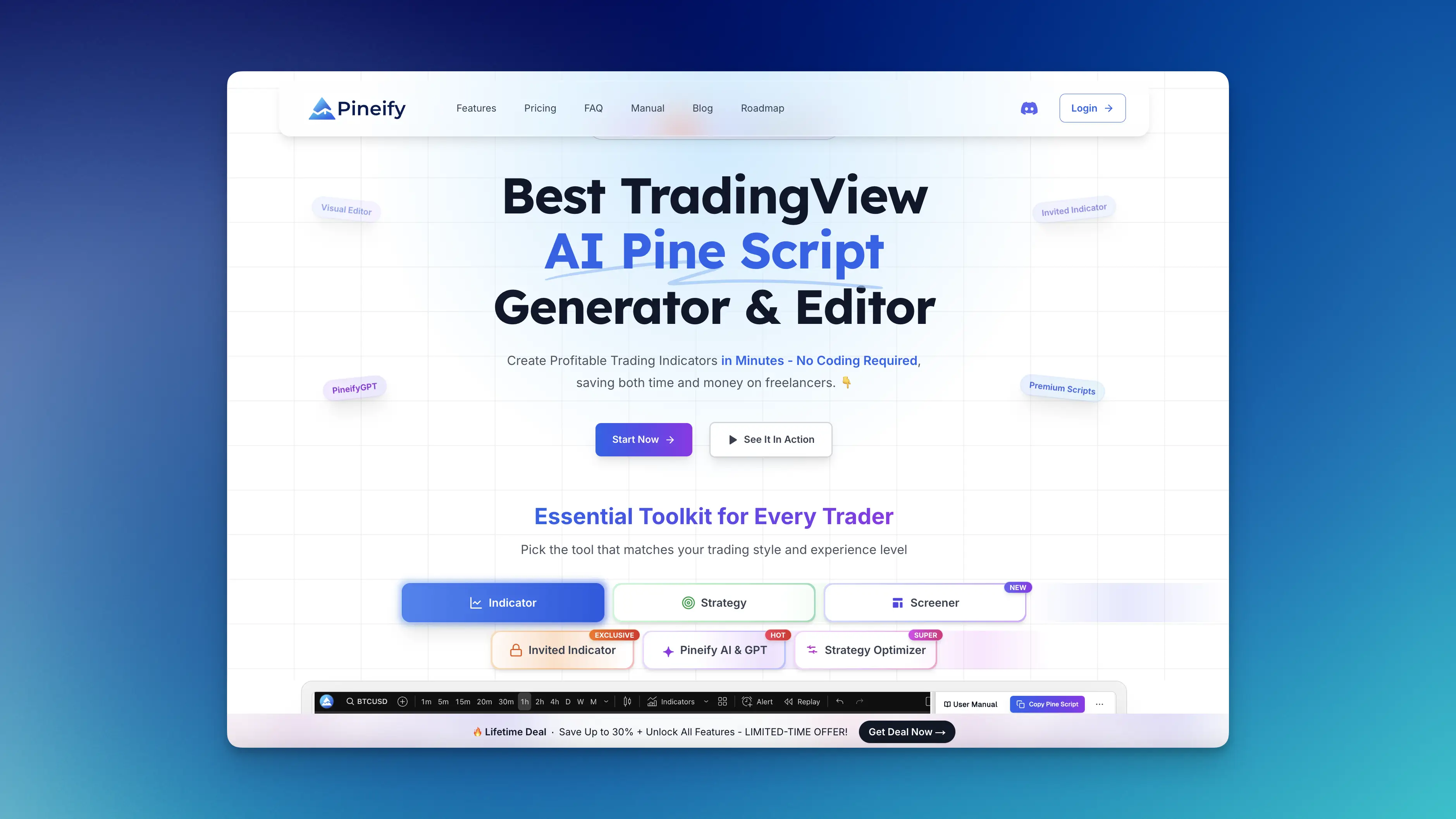
- TradingView (with Pine Script): This is where many retail traders start. Pine Script is relatively straightforward, letting you build custom strategies and sort backtests by metrics like win rate. It's versatile for stocks, forex, and crypto, all within a familiar charting interface. If you're new to the platform, our Best TradingView Tutorial: Master the Platform in 2025 is a good starting point. Writing Pine Script from scratch can be a hurdle. A tool like Pineify generates that same custom Pine Script code visually or through an AI agent, without needing to learn the syntax, letting you focus on your trading logic.
- MetaTrader 4 & 5 (MT4/MT5): The go-to hubs for forex traders. Their built-in Strategy Tester is designed for evaluating automated scripts (Expert Advisors) against historical data.
Powerful Tools for Intermediate to Advanced Traders
For those who need more depth, realism, or speed.
- ProRealTime: Features a dedicated backtesting environment known for high-quality historical data and strong execution realism. It's a favorite among active traders.
- NinjaTrader: Excels for day traders and scalpers. Its access to detailed Level 2 market data allows for more precise execution modeling, critical for strategies where every tick counts.
- Amibroker: Known for blazing-fast processing and flexible AFL scripting. It's a powerful choice for professional traders running complex, multi-asset portfolio strategies.
Frameworks for Developers and Algorithmic Traders
These offer maximum control through code.
- QuantConnect: A cloud-based platform for quantitative research. It supports Python and C#, letting you test strategies on a vast universe of data. I haven't personally tested it for futures, but for equities the data library is hard to beat.
- Backtrader: A popular, open-source Python framework. It gives you full programmatic control over your backtesting environment, perfect if you want to build from the ground up and integrate with other Python libraries.
Quick Comparison Table
| Tool | Best For | Key Strength |
|---|---|---|
| TradingView | Beginners and retail traders | User-friendly, great for visual learners, multi-asset |
| MetaTrader 4/5 | Forex traders and EA developers | Built-in tester, massive community, forex-focused |
| ProRealTime | Active and professional traders | High-quality data, execution realism |
| NinjaTrader | Day traders and scalpers | Detailed execution and Level 2 data modeling |
| Amibroker | Professional system traders | Extreme speed, flexible portfolio backtesting |
| QuantConnect | Quantitative developers | Cloud-based, vast data library, supports Python/C# |
| Backtrader | Developer-traders | Full open-source control, Python integration |
Which One Should You Try?
Your choice comes down to your experience and goals. If you're just starting out, TradingView will help you learn the concepts fastest. If your focus is forex automation, MetaTrader's ecosystem is unmatched. For serious algorithmic development in Python, QuantConnect or Backtrader offer the most power and flexibility.
A Note on Enhancing Your TradingView Workflow: If TradingView is your platform but writing Pine Script slows you down, consider a dedicated generator. Pineify provides a visual editor and an AI coding agent that understands TradingView's environment, helping you translate ideas into error-free indicators, strategies, and screeners faster, which you can then backtest directly in TradingView. Understanding key Pine Script concepts is crucial, and resources like our Pine Script TADMI Guide can deepen your knowledge.
The right tool doesn't just test your strategy—it helps you understand why it works or fails. Start with one that matches your current skill level; you can always graduate to more advanced platforms.
Avoid These Hidden Traps That Skew Your Results
Getting excited about a strategy's backtest results is normal, but sometimes that promise disappears when you try it for real. More often than not, it's because of a few sneaky mistakes that quietly poison the test.
Tailoring Too Much to the Past (Overfitting) Imagine adjusting a suit so perfectly to a mannequin that it fits no real person. That's overfitting. It happens when you tweak your strategy's rules endlessly to fit every bump in old market data. The result looks amazing on paper but fails with new data. I've made this mistake myself—spent two weeks optimizing a mean reversion strategy on BTC/USD that looked incredible, then watched it lose 12% in its first month live. The fix? Keep your strategy rules simpler, and always save a chunk of historical data you never use during development to serve as a final reality check.
Peeking into the Future (Look-Ahead Bias) This is a coding slip-up that accidentally gives your strategy information from the future. A classic example is using today's closing price to decide a trade you'd have to place at the open. Your backtest profits will look fantastic, but they're an illusion. Comb through your code to make sure every decision uses only the data that would have been on your screen at that moment.
Only Counting the Winners (Survivorship Bias) If you test a stock-picking strategy using only today's successful companies, you're ignoring all the ones that failed and disappeared. This paints a far too rosy picture. It's like judging a coach's skill by only looking at players who made it to the pros. For an honest test, you need data that includes every stock that was around during your test period—the losers and all.
Forgetting the Friction (Ignoring Costs) In the real world, trading isn't free. Commissions, the bid-ask spread, and slippage are all real costs. A strategy that turns a profit in a frictionless backtest can be a big loser once these are factored in. For TradingView backtesting, I'd caution against relying on the default settings without adjusting for slippage. Always subtract realistic costs, especially if you're trading often, where small costs add up fast.
Searching Until You Find Something (Multiple Testing) If you test enough different rules and parameters against historical data, you're bound to find a combination that looks profitable purely by random chance. It's like flipping a coin 100 times and only telling people about the stretch where it landed heads five times in a row. Be honest about how many variations you tried. The best practice is to use that reserved out-of-sample data to see if your great find holds up.
Here's a quick table to summarize the pitfalls and the core fix for each:
| Mistake | Why It's Misleading | The Essential Fix |
|---|---|---|
| Overfitting | Strategy is too customized to past noise, fails on new data. | Use simpler rules; validate with out-of-sample data. |
| Look-Ahead Bias | Uses future data, creating impossible profits. | Audit code for point-in-time accuracy of all data. |
| Survivorship Bias | Ignores failed assets, inflating performance. | Use a historical dataset that includes delisted assets. |
| Ignoring Costs | Presents theoretical, frictionless returns. | Model realistic commissions, spreads, and slippage. |
| Multiple Testing | Finds false positives by testing too many variations. | Apply statistical corrections or out-of-sample validation. |
Walk-Forward Testing: Getting It Right
Walk-forward testing is the most trusted way to check if a trading strategy actually holds up. Think of it like this: you wouldn't trust a runner's time if they only ever practiced on the same perfect track. You'd want to see how they perform on different courses, in real weather. That's what this method does for your trading idea.
It works by splitting your historical data into chunks and doing a repeated practice-then-real-world check.
- Slice Your Data: Take all your price history and divide it into segments.
- Practice on the First Chunk: Use the first segment (say, 70% of your starting data) to figure out the best settings for your strategy. This is your practice ground.
- Test for Real on the Next Chunk: Take those exact settings and test them on the next segment of data (the unseen 30%). This is your real-world test. No changes allowed.
- Move Forward and Repeat: Slide your window forward, do another practice session on new data, followed by another real-world test. Keep going until you've moved through your entire dataset.
The results that matter are only the ones from those real-world test windows. They give you a realistic picture of what to expect, not the perfect scores from the practice runs. Tools like TrendSpider's walk-forward optimizer automate this tedious process, and in choppy markets, this kind of testing has been shown to reduce overfitting by about 20%.
Moving From Backtest to Live Trading Safely
Once you're confident your strategy holds up—on both the data you tested it on and fresh, unseen data—it's time to take it to the stage.
Paper trade first. Before risking a single dollar, run your strategy in a simulated, real-time environment. Aim for at least 30 to 60 trades. This isn't about profits; it's about watching how your strategy handles live data feeds, fills, and the actual market speed. It's the best way to spot hidden issues you missed in the backtest. For a controlled practice environment, you can learn How to Reset Paper Trading on TradingView to start with a clean slate for each new test.
Start tiny. When you go live, begin with the smallest possible position size. This isn't the time for big wins. It's the time to confirm that what happened in your backtest actually happens with real money on the line. Scale up only once you see consistent, real-world results that match your expectations.
Keep a close eye on the numbers. As you trade live, compare your results to your backtest benchmarks. Are your win rates, profits, and losses in the same ballpark? A significant and persistent drop in performance might mean the market's personality has changed. Your strategy might need a fresh look.
Don't let your backtest get dusty. The market doesn't stand still. Re-run your backtest on new data every few months or at least once a year. This tells you if the edge you found is still there or if it's faded.
Find a supportive environment. Consider joining a trading community or a proprietary trading firm's evaluation challenge. These platforms let you test your strategy under real-market conditions and rules, often with the firm's capital.
The most successful traders don't see backtesting as a box to check once. They see it as an ongoing routine—a continuous cycle of testing, validating, and tweaking. Build this habit, and you'll put yourself miles ahead of traders who skip this work.
Frequently Asked Questions
How much historical data do I need for a reliable backtest?
Most traders recommend at least 10 years to see how a strategy performs across bull markets, bear markets, and sideways periods. A longer timeline reduces the risk of mistaking a lucky streak for genuine skill. I wouldn't trust results from anything less than five years.
Can a strategy that passes backtesting fail in live trading?
Yes, absolutely. A great backtest result is a starting point, not a guarantee. Real-world trading can trip up a strategy because market dynamics shift, the backtest might have accidentally used future data, or costs like fees and slippage were underestimated. Always validate with paper trading before going live.
What is the difference between in-sample and out-of-sample testing?
In-sample data is the historical data you use to build and optimize your strategy, like studying your notes for an exam. Out-of-sample data is a separate, untouched set of market data that you test your final strategy on, like a final exam. Out-of-sample testing reveals whether you have a genuine edge or just overfitted to the training data.
Is a high win rate always better?
Not at all. A strategy that wins only 4 out of 10 trades can still be highly profitable if the winning trades are much larger than the losers. Metrics like Profit Factor and Sharpe Ratio give a more complete picture than win rate alone. I've seen strategies with 35% win rates outperform ones with 70% win rates over a full year.
Should I use manual or automated backtesting?
For consistency, automated backtesting is the better choice. Platforms like TradingView with Pine Script, QuantConnect, and MetaTrader remove emotional bias and can analyze thousands of data points in seconds. For TradingView users, Pineify simplifies generating error-free Pine Script code for backtesting, letting you focus on refining your strategy logic.