Backtesting.py vs Backtrader vs Pineify: Choose Your Best Trading Strategy Testing Platform
Choosing the right tool to backtest your trading ideas can make all the difference. It's like picking the best compass before a hike—the right one gets you where you want to go efficiently, while the wrong one can lead you in circles. Backtesting.py, Backtrader, and Pineify offer three very different paths to test your strategies. Two are code-based libraries for Python, and one is a visual builder for TradingView. Let's break them down so you can pick the one that fits your skills and how you like to work.
A Closer Look at Each Tool
Backtesting.py: Simple & Straightforward Code
Think of Backtesting.py as the friendly, lightweight option for getting started with algorithmic trading in Python. It’s an open-source library built to be simple. You can set up a backtest with just a few lines of code, which is great if you’re new to programming or want to test a simple idea quickly.
It works directly with pandas DataFrames (a common data format in Python) and lets you visualize your results interactively. While it only includes a basic Moving Average indicator out of the box, it’s designed to play nicely with popular analysis libraries like TA-Lib if you need more complex indicators. If your priority is a no-fuss, code-based environment to prototype strategies, this is a fantastic starting point.
Backtrader: The Powerful, All-in-One Framework
Backtrader is the heavyweight champion of Python backtesting libraries. Developed over a decade ago, it’s a full-featured, event-driven framework for both backtesting and live trading. It’s built to handle complex, realistic trading scenarios.
You can feed it data from CSV files, pandas, or live streams. It supports analyzing multiple timeframes at once, optimizing your strategy parameters, and modeling real-world factors like trading commissions and slippage. Because it’s so comprehensive, it has a steeper learning curve. But if you’re serious about developing robust, systematic strategies and need professional-grade tools, Backtrader is one of the most complete free solutions available.
Pineify: Visual Building for TradingView
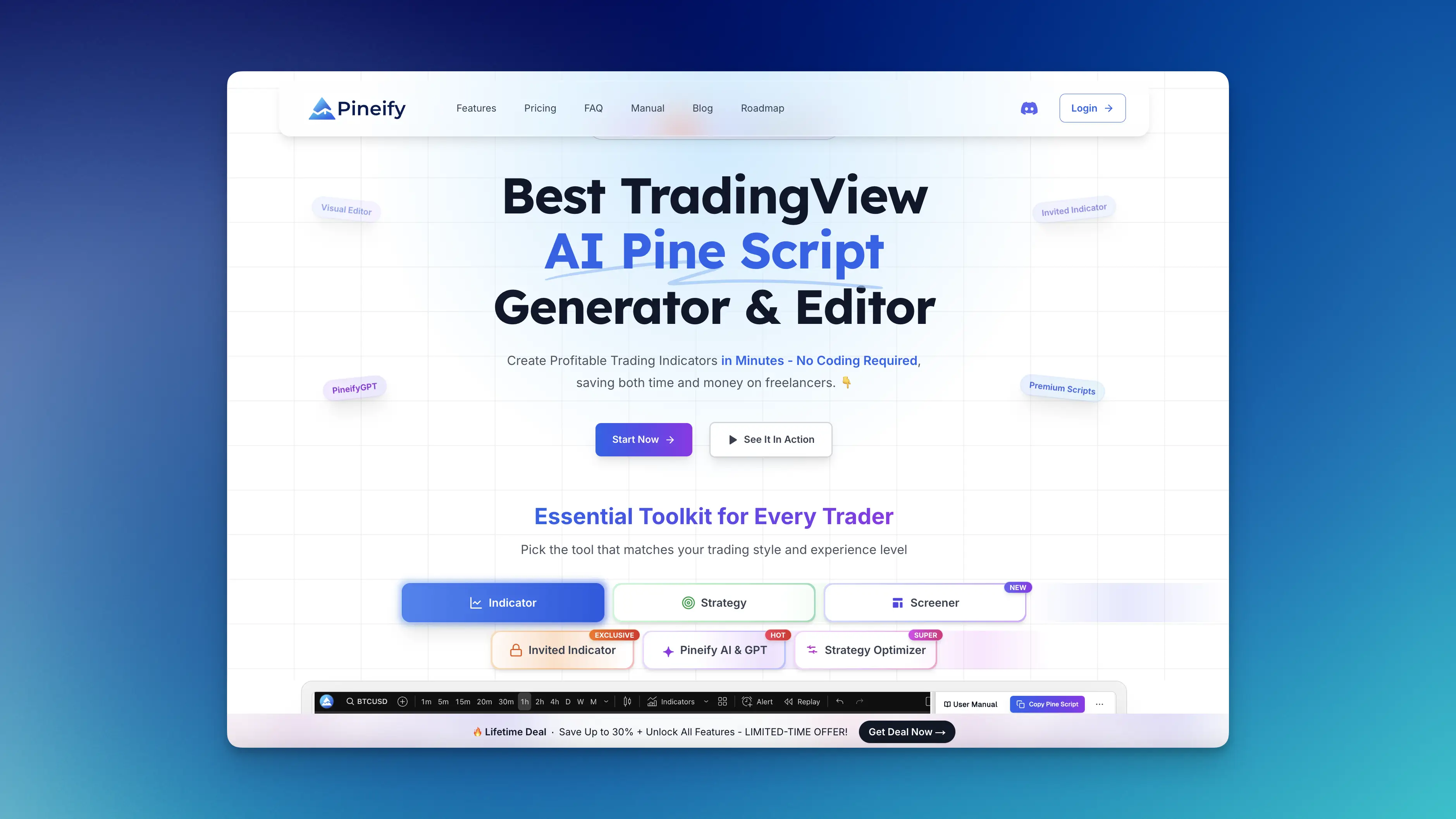
Pineify is for traders who love TradingView but don't want to write Pine Script code from scratch. It’s a visual strategy builder. You use a drag-and-drop style interface to combine conditions and indicators—like "Buy when the RSI is below 30 AND the price crosses above the EMA."
It gives you access to over 30 common indicators (like SuperTrend, Ichimoku, MACD, etc.). A huge plus is that it lets you build strategies using more than the three-indicator limit on TradingView’s free plan. Once you’ve built your strategy visually, Pineify generates the Pine Script code for you. You then paste that code into TradingView to run a full backtest on their extensive historical data. It’s the perfect bridge between visual thinking and algorithmic testing. For those looking to deepen their understanding of the language powering these automations, our guide on Mastering Pine Script 4: Concise Guide is an excellent next step.
Trying to choose a backtesting tool can feel overwhelming with all the technical terms floating around. It’s easy to get lost in the specs. To cut through the noise, let’s break down three popular options in a simple, side-by-side way.
Think of this as your quick-reference cheat sheet. We’ll look at the key differences in usability, features, and who each platform is really designed for.
| Feature | Backtesting.py | Backtrader | Pineify |
|---|---|---|---|
| Learning Curve | Beginner-friendly | Steep, advanced | No coding required |
| Programming Language | Python | Python | Visual editor (generates Pine Script) |
| Live Trading Support | Limited, manual adaptation needed | Built-in broker integration | TradingView alerts only |
| Data Sources | CSV, pandas DataFrames | CSV, pandas, live feeds | TradingView historical data |
| Multi-Timeframe Analysis | Supported via resample_apply() | Native support | TradingView capabilities |
| Indicator Library | External (TA-Lib, Tulip) | Built-in extensive library | 30+ built-in indicators |
| Optimization | Basic | Exhaustive parameter search | Visual parameter adjustment |
| Best For | Quick testing, beginners | Advanced simulations, professionals | TradingView users, visual learners |
So, what does this mean for you? Your choice really depends on where you're starting from and what you want to build.
If you're just getting your feet wet with Python and want to test a simple idea quickly, Backtesting.py is a fantastic, no-fuss starting point. When you need industrial-strength testing, complex strategies, and direct broker connections, Backtrader is the powerful, though more complex, toolbox for the job. And if you want to avoid code entirely and work within the TradingView ecosystem you already love, Pineify bridges that gap visually.
The best tool is the one that matches your current skill level and gets you testing your strategy without the biggest headache. Hopefully, this comparison makes that first decision a little clearer.
Finding the Right Fit: Ease of Use & Learning Curve
Choosing a backtesting tool often comes down to a trade-off: do you want something simple to start with quickly, or something powerful that takes more time to learn? Here’s how our three options stack up.
Backtesting.py: Straightforward and Speedy
If you want to test an idea fast, Backtesting.py is a fantastic choice. It’s built on being simple. You can often get a basic strategy coded, run, and see the results in just a few lines of understandable code. It feels intuitive, especially if you're comfortable with Python.
Think of it like a streamlined kitchen. It has everything you need to cook a great meal without a bunch of complicated, unused gadgets cluttering the counter. This makes it perfect for quickly validating straightforward strategies.
The catch? That same simplicity means it isn't built for highly complex, multi-layered trading logic. Also, it's designed specifically for backtesting. If you want to take a strategy live, you'll need to rework the code yourself for a production environment.
Backtrader: Feature-Rich but More to Learn
Backtrader is the powerhouse option. It gives you tremendous control and a huge set of features—like testing multiple assets at once or modeling realistic trade execution. This power comes with more initial complexity. Its event-driven structure can feel overwhelming at first if you're new to algorithmic trading.
It’s the professional kitchen with every possible tool and ingredient. Learning where everything is and how to use it all takes time. The documentation is thorough and will guide you, but there’s no denying the upfront learning investment.
For traders who need that depth—for complex strategies or a smooth path from backtesting to live trading—this investment is absolutely worth it. It’s a robust framework that grows with your needs.
Pineify: No Coding Required
Pineify takes a completely different, visual approach. Instead of writing code, you build strategies by connecting logical blocks: "If this indicator crosses above that value, then enter a trade." It uses dropdown menus and clickable logic, like building with puzzle pieces.
This completely removes the programming barrier. You can create sophisticated strategies with multiple conditions without ever looking at code. It’s incredibly accessible for anyone, regardless of their technical background.
The best part? It doesn’t lock you into a black box. While you build visually, Pineify generates clean, ready-to-use Pine Script code behind the scenes. If you ever want to peek under the hood, tweak something, or just learn, the code is right there for you.
Working with Your Data: Flexibility and Timeframes
Where Your Data Comes From
Different backtesting tools handle data differently. Here’s how they stack up, so you can pick the one that works with what you’ve got.
| Platform | Data Sources & Flexibility | Best For... |
|---|---|---|
| Backtesting.py | CSV files and pandas DataFrames. It’s simple and gets the job done. | Traders who have their historical data ready in standard files and don't need to connect to live feeds. |
| Backtrader | CSV files, pandas DataFrames, and live feeds from brokers (like Interactive Brokers) and data providers. | Traders who want to test on history and then run the same strategy live without rewriting everything. It’s also great for looking at multiple charts (timeframes) at once. |
| Pineify | Uses TradingView's own massive data library (stocks, forex, crypto, futures). | Anyone who loves TradingView's data coverage. You’re within their ecosystem, but it’s very comprehensive for most needs. |
Analyzing Multiple Timeframes
Many strategies need to check what’s happening on both a daily and an hourly chart, for example. Here’s how each tool helps you do that.
-
Backtesting.py uses a function called
resample_apply()to handle different timeframes. It’s a bit more of a manual setup, but it gives you precise control. -
Backtrader has this feature built-in from the ground up. You can tell it to watch a daily and a 4-hour chart simultaneously, and it automatically makes sure the data lines up correctly. This is a huge help for avoiding tricky timing bugs in your strategy code.
-
Pineify taps directly into TradingView’s native multi-timeframe functions. The visual editor makes it simple to set up rules like, "Buy when the daily trend is up but the 1-hour chart shows a pullback," without you worrying about the technical sync.
Live Trading Integration
Backtesting.py: You'll Need to Handle the Switch Yourself
Think of Backtesting.py as a powerful simulation tool. It’s built to test your ideas against historical data, but it doesn’t automatically connect to a live broker. When you're ready to go live, you're responsible for adapting your strategy code to work with your chosen trading platform’s API.
This means you'll be doing extra development work to bridge that gap. The main thing to watch out for is that sometimes, small differences can creep in between your backtest and the live version, which can affect performance.
Backtrader: Built to Go Live from the Start
Backtrader is designed with the next step in mind. It has built-in connections for live trading with a range of brokers, especially in forex and crypto. The biggest advantage here is that you can often use the exact same strategy code for both backtesting and live execution.
This removes a lot of the headaches and potential for bugs when moving from testing to real trading. For serious traders who want a reliable system, this seamless transition is a major plus. It also gives you flexibility, supporting different data sources and brokers across various markets.
Pineify: Trading on Alerts
Pineify creates strategies in Pine Script, which runs on TradingView. Here’s how live trading typically works: when your strategy’s conditions are met on the TradingView chart, it can trigger an alert.
That alert can be sent to a third-party platform or a custom webhook that you set up, which then places the trade with your broker automatically. It’s not a direct built-in broker connection like Backtrader, but for many individual traders using common platforms, this alert-based method is a very effective and popular way to automate trading. For a deep dive into executing trades directly from the chart, our guide on the TradingView Close Position Hotkey: The Complete Guide to Fast Trade Exits covers essential workflow optimizations.
Fine-Tuning Your Strategy and Understanding the Results
Finding the Best Settings for Your Strategy
Each tool helps you tweak and test your trading ideas, but they go about it in different ways.
Backtesting.py is great for getting started. It lets you test a range of parameters (like different moving average lengths) to see what works best. It won't run through every single possible combo, but it's perfect for efficient, focused testing. The charts it creates are interactive, so you can click and zoom to explore your results directly in your Python notebook.
Backtrader is built for deep testing. Its strong suit is exhaustive optimization—it can systematically hunt through all the parameter combinations you define to pinpoint the best-performing setup. Crucially, it lets you model real-world friction, like broker commissions and slippage (the difference between the price you expect and the price you actually get). Accounting for these costs is essential to see if a strategy would be profitable in reality, not just in theory.
Pineify works a bit differently. It generates the strategy code for you, which you then run inside TradingView's powerful backtester. This gives you a complete report with all the key stats: total profit/loss, win rate, maximum drawdown (your biggest peak-to-valley loss), and profit factor. The biggest advantage here is the interface; you can slide parameter controls and instantly see how each change affects your strategy's performance, making it very intuitive to refine your idea.
Making Sense of the Results: Charts and Graphs
Seeing your strategy's performance visually is just as important as reading the numbers. Here’s how each platform helps you visualize the data.
| Platform | Visualization Approach | Best For |
|---|---|---|
| Backtesting.py | Generates clean, interactive charts right in your browser or Python environment. You'll see your equity curve (how your money grows over time), drawdown periods, and markers for each individual trade. | Developers who want quick, integrated charts without leaving their coding workflow. |
| Backtrader | Offers highly detailed and customizable plots. You can create complex layouts showing multiple data series (price, indicators, volume) alongside your equity curve and trade log. | Users who need in-depth, customizable analysis and want everything in one Python script. |
| Pineify | Leverages TradingView's charting system. After a backtest, you can study the results on what many consider the best financial charts available—with every trade visually marked on the price chart. | Traders who prioritize professional-grade, familiar charting and want to analyze trades directly on the price action. |
In short, your choice depends on your process. Do you want deep customization within Python (Backtrader), quick and interactive testing in a notebook (Backtesting.py), or a seamless, visual experience in a trader-focused platform (Pineify via TradingView)?
Picking the Tool That Fits What You're Doing
When Backtesting.py is Your Best Bet
Think of Backtesting.py as your friendly, no-fuss starting point. It’s perfect if you're new to algorithmic trading and want to learn the core ideas without getting bogged down by complicated setup. You can test out simple ideas, or even moderately complex ones, using Python without a huge time investment. If your historical data is sitting in a CSV file or a pandas DataFrame and you're focused purely on testing (not live trading), this library gets you up and running fast.
It's also a great choice for teaching yourself, quickly prototyping a new trading hunch, or acting as a simple, lightweight testing ground alongside other systems.
When to Go with Backtrader
Choose Backtrader when you're moving past the basics and need a professional-grade toolkit. It's built for serious development. This framework fits you if you understand event-driven systems and want to build intricate strategies that might trade multiple assets across different timeframes. If your strategy needs to account for real-world friction like slippage, commissions, and order fill logic, Backtrader's detailed simulation features are essential.
It's the right platform when you want to develop a strategy and then run it live without rewriting everything from scratch. For systematically managing a portfolio across many instruments, Backtrader's robust engine is designed to handle that complexity.
When Pineify Makes the Most Sense
Pineify is the ideal solution if you live in TradingView. It’s for traders who want to build sophisticated, multi-indicator strategies without writing a single line of code. If you're a visual person who prefers dragging and dropping over typing scripts, this is for you. It specifically solves a big pain point: getting around TradingView's free plan indicator limit to test complex combinations.
Beyond the visual editor, Pineify's AI Coding Agent can turn your trading ideas into error-free Pine Script in minutes, acting as the perfect bridge between concept and code. Whether you're rapidly validating a trading concept before committing to a full build, or need a clean, functional blueprint to tweak directly in TradingView, Pineify streamlines the entire process from idea to execution. It's excellent for rapidly validating a trading concept before you commit to building it in Python. The Pine Script code it generates can also be a perfect blueprint for a developer to tweak and finalize directly in TradingView.
Making Connections: How These Tools Work with Your Existing Toolkit
One of the biggest wins when choosing a backtesting tool is how easily it fits into your existing workflow. Can it talk to your data sources, your favorite analysis libraries, or other platforms? Let's see how each one handles these connections.
Tapping into the Python Universe
If you’re already using Python for data work, you’ll feel right at home with Backtesting.py and Backtrader. Their real power comes from plugging directly into Python's massive ecosystem.
Think about it this way: maybe your strategy isn’t just about price charts. You might want to factor in earnings reports (fundamental data), scrape news headlines for sentiment, or even use a machine learning model to spot patterns. With these libraries, you can do that. You can pull in libraries like pandas for data wrangling, scikit-learn for a quick model, or yfinance for easy data access. It lets you build incredibly sophisticated strategies that blend different types of analysis.
- For Technical Indicators: While Backtesting.py keeps it simple out of the box, it plays nicely with powerhouse libraries like TA-Lib and Tulip, giving you instant access to hundreds of proven indicators. Backtrader comes packed with a huge built-in library of indicators, but it also makes it straightforward to code your own from scratch or wrap an indicator from another library.
Living in the TradingView World
Pineify has a different kind of superpower: it’s built right into the TradingView platform. This is a huge advantage if TradingView is your daily driver.
The benefit is seamless access. The Pine Script code it generates runs on TradingView, so you immediately get to use their extensive market data, their vibrant community of shared ideas and indicators, and all their charting tools. You can take the code from Pineify and tweak it further in TradingView’s own editor to add final touches.
There’s a trade-off, though. This tight integration also means you’re working within TradingView's walls. You’re limited by what the Pine Script language can do and by TradingView’s data access. If your strategy needs something that Pine Script or the platform doesn't support, you might hit a ceiling. For those advanced needs, moving to a flexible Python-based option like Backtesting.py or Backtrader is often the next logical step. If you're evaluating other professional platforms, our comparison of Sierra Chart vs TradingView: Which Charting Platform is Right for You? can help clarify the landscape.
What Will It Really Cost You?
When you're choosing a backtesting tool, the price tag is important, but the real cost isn't always what it seems. Let's break down what you're actually paying for with each option.
The "Free" Route: Backtesting.py & Backtrader
These are fantastic, truly open-source projects. There's no upfront fee to download or use them. But "free" here means freedom to build, not necessarily free to run. You'll need to account for:
- Data: Quality historical data often comes from a paid provider.
- Computing Power: Running complex, multi-year backtests can demand decent hardware or cloud server time.
- Broker Fees: If you graduate from Backtrader's backtesting to its live trading features, standard broker commissions apply.
You're trading money for total control and flexibility. The main investment is your own time and technical skill to set everything up.
The All-in-One Service: Pineify
Pineify is a commercial product, so it has monthly or annual subscription plans based on your needs. Here’s the value shift: it converts a time cost into a dollar cost.
For many traders, the biggest benefit is that it replaces the need for a paid TradingView plan. On a free TradingView account, you're limited in how many indicators you can use at once. Pineify removes that bottleneck for strategy development.
The real question becomes: Is the subscription fee worth the hours you save? Instead of writing code line by line, you're building strategies visually. If you want to test ideas quickly and don't want to deal with code, servers, or data pipelines, that convenience can easily justify the cost.
The Bottom Line
It boils down to your priorities:
- If minimizing cash expenditure is your top goal and you enjoy the technical process, the open-source tools are a powerful path.
- If your time is valuable and you want to streamline development, a Pineify subscription can be a worthwhile investment that speeds up your entire workflow.
There's no universally "cheaper" option—just the one that's right for how you prefer to work and where you want to spend your resources.
Your Questions, Answered: A Straight-Talk Guide on Backtesting Tools
We get it—choosing a backtesting tool can bring up a lot of questions. Here are clear, honest answers to some of the most common ones we hear.
Q: I'm new to coding. Can I still use Backtesting.py or Backtrader?
If you're just starting out, there's a bit of a learning curve. Both of these libraries require you to write in Python. Backtesting.py is generally considered more approachable if you already grasp Python basics. Backtrader is powerful but has a steeper climb, making it tough for true beginners. For folks who want to skip code entirely and build strategies visually, Pineify is the most accessible path to start with.
Q: Which tool gives me the most trustworthy backtesting results?
It depends on what you mean by "accurate." Backtrader is often praised for building more realistic market simulations because it factors in real-world costs like slippage and commissions. That said, all of these tools can produce reliable results if you set them up with good data and honest assumptions about how trading works. The biggest factor in your accuracy will always be the quality of your data and how well your strategy mirrors actual market conditions.
Q: Can I easily move my strategy from one platform to another?
You can, but it's not a simple copy-paste job. Each platform speaks a different language. Pineify creates Pine Script, which only runs on TradingView. Backtesting.py and Backtrader use Python. This means you have to re-write or adapt your logic for the new environment. That said, there are third-party services (like PyneComp) that can convert Pine Script to Python, which can help if you're moving a strategy from TradingView to a Python-based framework.
Q: Do these tools work with cryptocurrency data?
Yes, all three can handle crypto, but in different ways:
- Backtrader can connect directly to some crypto exchange data feeds.
- Backtesting.py works with crypto data you load yourself, typically from a CSV file or a pandas DataFrame.
- Pineify taps directly into TradingView's massive library of crypto data, which covers most major exchanges and trading pairs right out of the gate.
Q: Which one is best for high-frequency trading (HFT) strategies?
Honestly, none of these are built for true high-frequency trading, where decisions need to be made in microseconds. They lack the specialized infrastructure. For strategies that trade on slightly longer timescales (think minutes or hours), Backtrader's event-driven system is the most sophisticated of the three. Both Backtesting.py and Pineify are better suited for typical intraday or swing trading.
Q: Can I test a whole portfolio of assets at once?
This is a key difference between the tools.
- Backtrader is built for this. It natively supports backtesting across multiple assets and gives you portfolio-level performance stats.
- Backtesting.py is primarily designed for testing one asset at a time. You can get creative to test a portfolio, but it's not its main purpose.
- Pineify works within TradingView's single-chart system, so running a true, integrated multi-asset portfolio backtest isn't straightforward.
Next Steps
Alright, so you’ve got a handle on how backtesting.py, Backtrader, and Pineify stack up. What now? The real magic happens when you start putting that knowledge to work. Here’s a straightforward path to get you from idea to testing.
Pick the tool that feels right for you. If you’re comfortable writing code, grab Backtesting.py or Backtrader and dive in. If you’d rather click and drag your way to a strategy, Pineify’s visual editor is your friend. Whichever you choose, start simple. A basic moving average crossover is the perfect first project to learn the ropes of your platform. For a foundational tutorial, check out How to Run Pine Script in TradingView: A Complete Beginner's Guide.
Grow your own collection of strategies. Think of this like a garden. Start documenting your ideas and test them one by one in your chosen platform. Keep notes on what works and—just as importantly—what doesn’t. Look beyond just the win rate; pay close attention to the Sharpe ratio, max drawdown, and profit factor. These tell you a much fuller story about risk and reward.
See if it holds up to new data. Once a strategy looks good, the real test begins. Run it on a chunk of market data it’s never seen before (this is your "out-of-sample" data). This step is your best defense against accidentally creating a strategy that only works on past data and fails in the live markets.
Don’t go it alone. There’s a whole community out there. Hop into the forums, Discord servers, or social media groups for your platform. Seeing how others solve problems, asking questions, and sharing your own bumps in the road will speed up your learning dramatically.
Test drive with pretend (or tiny) money. Before you risk real capital, give your strategy a trial run. Use a paper trading account or trade with the smallest possible position size. This final check often uncovers little execution hiccups or psychological hurdles that backtesting just can’t show you.
The key is to pick the tool that matches your skills and goals, and then stick with it. Consistent, thoughtful testing and tweaking will get you much further than jumping from one idea to the next. Your edge comes from that discipline.