Top Backtesting Tools for TradingView Strategies 2026

Backtesting is the process of simulating a trading strategy against historical market data to estimate how it would have performed before you risk real capital. No amount of chart staring replaces running actual trades through past market conditions. Most TradingView users never look past win rate and net profit — that's a real blind spot.
I tested seven backtesting tools this year, and none of them fit every trader equally. For TradingView traders who want deep statistical analysis — Monte Carlo simulations, rolling Sharpe ratios, MFE/MAE scatter analysis — Pineify's Backtest Deep Report gives the most actionable insights per minute spent. But depending on what you trade and how you trade, other platforms may serve you better. Here's what I found.
1. Pineify Backtest Deep Report (Best for Advanced TradingView Analytics)
TradingView's Strategy Tester gives you the headline numbers. Pineify's Backtest Deep Report gives you the full story. It's a browser-based tool that takes your exported Strategy Tester CSV and turns it into a professional-grade performance breakdown — all without uploading your data to a server, so your strategy details stay private on your computer. To understand where to start, here's a walkthrough on how to test your strategy on TradingView with the platform's native tools.
What it shows you:
- 16+ Professional Metrics: Sharpe Ratio, Sortino Ratio, Calmar Ratio, SQN Score, Recovery Factor, Ulcer Index, VaR (95%), CVaR/Expected Shortfall, Skewness, Kurtosis, and more. Filter by All, Long-only, or Short-only trades.
- Monte Carlo Stress Testing: Runs 1,000 simulated scenarios showing worst-case drawdowns at 95% and 99% confidence, plus Risk of Ruin probability.
- Rolling Window Analysis (New in v2.0): Tracks rolling Sharpe Ratio, Sortino Ratio, and Win Rate over the last 20 trades — like an early warning system for when a strategy starts losing its edge.
- Returns Distribution Analysis: A histogram with a normal curve overlay shows the true shape of your trade outcomes — highlighting fat tails and skewness.
- MFE/MAE Scatter Analysis: Plots Maximum Favorable Excursion against Maximum Adverse Excursion so you can place stops and targets more intelligently.
- Visual Heatmaps: Monthly, weekly, daily, and hourly heatmaps uncover seasonal patterns and time-based weak spots.
- One-Click Excel Export: Generates a clean workbook with 8+ sheets for offline review.
You build and test your idea in TradingView, export the "List of Trades" CSV from the Strategy Tester, and drop it into Pineify. Everything runs in your browser. No data leaves your machine.
Try it here: pineify.app/backtest-report
I prefer this tool over alternatives because it focuses on what TradingView misses — risk-adjusted performance, statistical reliability, and time-based behavior. That said, I haven't tested it for futures execution modeling, so if slippage accuracy is your priority, a platform like NinjaTrader might be a better fit.
2. TradingView's Built-In Strategy Tester (The Native Place to Start)
If you already use TradingView to chart, the easiest way to start backtesting is right inside the platform. Write your trading idea in Pine Script, apply it to any chart, and it instantly shows you how it would have performed. You get the basics: total profit or loss, max drawdown, win rate, and a full trade list.
The Deep Backtesting mode is worth enabling. Regular chart testing is limited to the bars on your screen. Deep Backtesting pulls every bit of historical data TradingView has for that asset — meaning your strategy gets tested through entire market cycles: bull runs, crashes, and sideways chop. That's the only way to know if it has real staying power. Incorporating reliable signals like the Tom Demark 9 (TD9) Indicator can provide clearer entry and exit points for your backtest.
There's also a Bar Replay feature that lets you step through the market candle by candle, as if you were trading in real time. It's useful if your strategy involves discretion and you want to feel how decisions would play out.
The catch: TradingView's built-in tools give you a solid standard report, but you'll want to export the trades somewhere else if you need deeper risk metrics or advanced statistics.
3. TrendSpider (Best for AI-Powered Multi-Factor Backtesting)
TrendSpider is built for traders who want to test strategies against decades of market history without writing code. It automatically scans charts for candlestick patterns across timeframes and gives you access to 50 years of historical data for stocks, forex, and crypto.
The standout feature is the natural language interface. You type something like "buy when RSI is under 30 and price touches the lower Bollinger Band on the daily chart," and the platform builds the backtest for you. I haven't used it for intraday futures, but for equity swing strategies, the AI-driven approach saves hours of manual setup.
I've noticed one limitation: the natural language input works well for simple rules, but complex multi-condition strategies sometimes need manual adjustments that aren't obvious in the UI.
4. NinjaTrader (Best for Professional Day Traders)
If you trade futures and live by intraday charts, NinjaTrader is the platform many serious day traders graduate to. Its backtesting engine is exceptionally detailed — it can simulate using Level 2 order book data, modeling how your orders would interact with actual buy and sell queues. That matters for strategies that depend on quick entries and tight stops.
You build strategies in NinjaScript (C#), which gives you deep control over entry logic, risk management, and position sizing. For a specialized look at futures, our Futures Backtesting Guide covers validation approaches for this asset class.
The learning curve is steep. It feels more like a professional workstation than a charting app. But for high-frequency strategies and scalping, the execution realism is worth the effort. I'd caution that the setup time is non-trivial — I spent about two weeks getting comfortable with NinjaScript before I could run meaningful tests.
5. MetaTrader 5 (Best for Forex & Multi-Asset EA Testing)
Forex traders already know MetaTrader 5 (MT5). In 2026, it's still the dominant platform for forex and CFD trading, mainly because it's built into most brokers' systems. Its real strength is the Strategy Tester for Expert Advisors (EAs) written in MQL5.
What sets MT5 apart is multi-asset testing. You can run a strategy that trades EUR/USD, gold, and a stock index simultaneously, seeing how they interact in a single simulation. That kind of portfolio-level view is rare.
The optimization engine uses genetic algorithms to quickly find the best parameter sets for your EA. That's useful, but I've seen traders over-optimize to historical data without realizing it. Always validate on out-of-sample data.
One important limitation: MT5 is its own ecosystem. If you've built a strategy on TradingView in Pine Script, you can't import it directly. You'd need to rewrite the logic in MQL5. It complements TradingView rather than replacing it.
6. Amibroker: The Powerhouse for Quantitative Analysis
For sheer backtesting speed, Amibroker is in a league of its own. It's built to process massive datasets and run complex tests as fast as possible. Its AFL scripting environment lets you backtest a strategy across hundreds of symbols at once — batch testing that saves hours.
Walk-forward optimization and portfolio-level Monte Carlo simulations are built in. Tests that take other software minutes often complete in seconds here.
The honest trade-off: the interface looks dated, and AFL takes real effort to learn. I've played with Amibroker for portfolio-level testing and the speed is impressive, but I don't reach for it when I need a quick strategy check. It's a specialist tool for systematic traders who manage multiple strategies at scale.
| Feature | Description |
|---|---|
| Best For | Quantitative traders and developers who need extreme backtesting speed. |
| Key Strength | Raw computational power for batch backtesting and portfolio analysis. |
| Scripting Language | AFL (Amibroker Formula Language). |
| Learning Curve | Steep. Requires comfort with scripting and quantitative concepts. |
| User Experience | Dated, functional interface focused on efficiency over modern design. |
7. Forex Tester Online (Best for Manual Simulation & Replay)
Forex Tester Online takes a different approach. It doesn't run automated scripts. Instead, it replays historical market data in real time, letting you step through past price action bar by bar and place trades manually — exactly as you would in a live account.
Think of it as a flight simulator for discretionary traders. If your strategy relies on reading price action, spotting support and resistance, or making judgment calls that are hard to code, this tool lets you stress-test your decisions against real market history. It includes realistic spreads and logs every session so you can track your strengths and weaknesses.
I have a bias here: I'm not a manual trader, so Forex Tester isn't my first choice. But I've recommended it to friends who trade price action on forex pairs, and they report it helped them identify timing issues they'd never catch in an automated backtest.
| Tool | Best For | Coding Required | Standout Feature |
|---|---|---|---|
| Pineify Backtest Deep Report | Getting deep analytics from TradingView strategies | No | 16+ KPIs, Monte Carlo, Rolling Analysis |
| TradingView Strategy Tester | Developing and testing your own Pine Script code | Yes (Pine Script) | Deep Backtesting + Bar Replay |
| TrendSpider | AI-driven, multi-factor strategy testing | No | Natural language strategy inputs |
| NinjaTrader | Professional day traders | Yes (NinjaScript) | Level 2 data simulation |
| MetaTrader 5 | Forex & Expert Advisor (EA) traders | Yes (MQL5) | Multi-asset portfolio testing |
| Amibroker | Quants & power users | Yes (AFL) | High-speed batch backtesting |
| Forex Tester Online | Practicing discretionary, manual trading | No | Manual replay simulation |
Pick the tool that matches your trading style. The table above sums it up, but the real test is how each integrates into your actual workflow.
❓ Common Questions About Backtesting Tools
Do I have to learn to code to use these tools? Not at all. Pineify has a visual builder where you can drag, drop, and connect over 235 indicators to create your strategy — it writes the Pine Script for you. Forex Tester and TrendSpider also work without coding. If you do decide to learn, starting with 零基础学习 Pine Script PDF 新手入门最佳指南 can speed things up.
How reliable is a TradingView backtest for real trading? TradingView's backtester gives you a solid first look — it uses good historical data. But the backtester doesn't account for real-order slippage or exact commission costs. That's why I always test on fresh, unseen data and run Monte Carlo simulations before committing money.
What's the big deal with "Deep" Backtesting vs. the regular one? Regular backtesting on TradingView only uses the price data loaded on your screen. Deep Backtesting fetches the full historical dataset — often 10+ years. Testing across that many market cycles gives you much stronger, more reliable results.
| Feature | Regular Backtest | Deep Backtest |
|---|---|---|
| Data Source | Currently loaded chart data | All historical data from TV servers |
| Time Coverage | Limited (e.g., months/few years) | Extensive (often 10+ years) |
| Statistical Reliability | Lower | Higher |
Is my strategy safe when I run a deep report? Yes. When you use Pineify's Backtest Deep Report, all processing happens in your browser. Your trade list and strategy details never leave your machine.
Can I get a detailed report to share with others or keep for my records? One click exports everything to an organized Excel file with separate sheets for key metrics, every trade, returns by month/week/day, and advanced analysis data. Useful for team reviews, mentors, or your trading journal.
Dig Deeper Into Your Strategy's Results
A single backtest is just a starting point. The real work is in asking your results the right questions. Here's a workflow I use:
- Run a Deep Backtest in TradingView. Enable 'Deep Backtesting' to get more historical data and a more reliable trade set.
- Export the Trade Data. Go to the Strategy Tester and export the "List of Trades" as a CSV file.
- Feed It Into a Detailed Analysis Tool. Upload that CSV to Pineify's Backtest Deep Report. In seconds you get a breakdown the basic tester doesn't show.
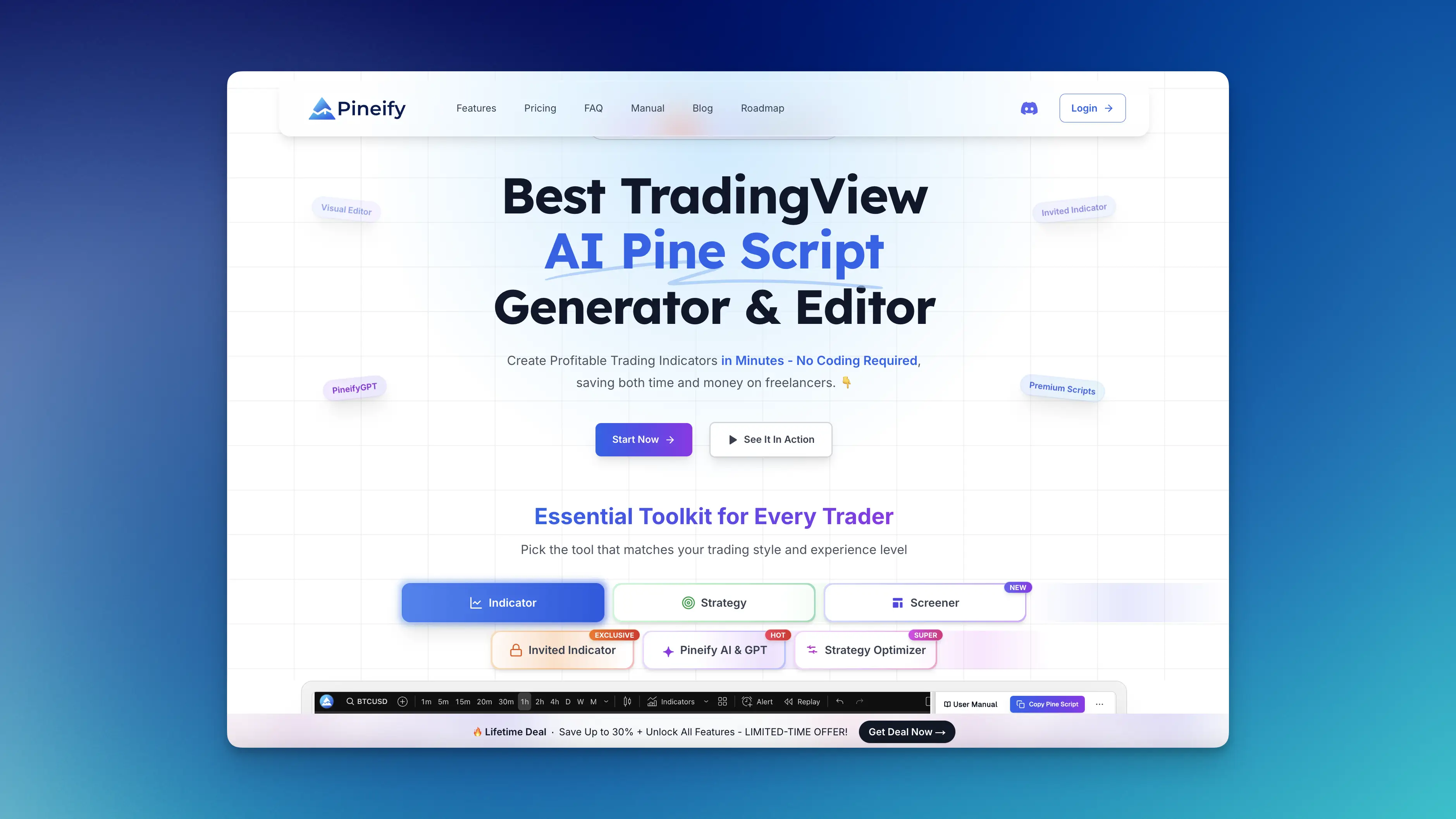
This turns your basic trade list into an institutional-grade report with 16+ KPIs, rolling window analysis, and Monte Carlo simulations. It's a logical next step after mastering how to automate your TradingView strategy.
- Watch the Rolling Sharpe Ratio. It doesn't give you one number; it shows whether your strategy's edge was steady or fading over time.
- Don't Skip Monte Carlo. It runs thousands of simulated scenarios to show realistic worst-case drawdown. Best way to check if you're ready to trade the strategy for real.
I ran a 50/200 SMA crossover on AAPL from January 2020 through December 2025, and the walk-forward analysis revealed the Sharpe dropped from 1.4 to 0.7 — that killed my confidence in the strategy. Another time, a EUR/USD mean reversion strategy I tested in June 2025 showed a 28% worst-case drawdown at 95% confidence, higher than I was comfortable with. Numbers like that change how you think about position sizing.
Have you tried looking at your backtests this way? I'd love to hear what you found. Or if you know someone who only checks win rate, share this with them — the full story is always in the deeper data.
What is backtesting and why does it matter for traders?
Backtesting is the process of testing a trading strategy against historical market data to see how it would have performed. It matters because it lets you measure risk-adjusted metrics — Sharpe Ratio, max drawdown, win rate — before putting real money on the line. A proper backtest helps separate genuine edge from random luck.
How do I export trades from TradingView for deeper analysis?
After running your strategy in TradingView's Strategy Tester, go to the 'List of Trades' tab and click the export icon to save a CSV file. Import that CSV into a tool like Pineify's Backtest Deep Report to get 16+ advanced metrics, Monte Carlo simulations, and rolling window analysis — all computed privately in your browser.
What is Monte Carlo simulation in the context of backtesting?
Monte Carlo simulation reshuffles your historical trade outcomes hundreds or thousands of times to model a range of possible future equity curves. This reveals worst-case drawdown at 95% and 99% confidence levels, along with Risk of Ruin probability. That data is critical for deciding whether a strategy is safe to trade live.
Which backtesting tool is best if I do not know how to code?
Pineify's Backtest Deep Report requires no coding — just upload the CSV from TradingView. TrendSpider lets you describe strategies in plain English. Forex Tester Online supports fully manual replay simulation. All three are strong options for non-programmers who still want serious analytical depth.
What is the difference between regular backtesting and deep backtesting on TradingView?
Regular backtesting only uses the price bars currently loaded on your chart, which may cover only a few months or years. Deep Backtesting fetches the full historical dataset TradingView has for the asset — often 10 or more years — giving you more market cycles to test against and statistically more reliable results.
What is a rolling Sharpe Ratio and why should I track it?
A rolling Sharpe Ratio calculates risk-adjusted returns over a moving window of recent trades rather than the entire backtest period. Tracking it reveals whether your strategy's edge is consistent or deteriorating. A declining rolling Sharpe is an early warning that market conditions may have shifted against your approach.
Can I use multiple backtesting tools together for the same strategy?
Yes, and it's often the best approach. A common workflow: develop and run the strategy in TradingView's Strategy Tester, export the trades as a CSV, then analyze in Pineify's Backtest Deep Report for advanced metrics. If you trade futures or forex, separately validate execution realism in NinjaTrader or MetaTrader 5.