Best AI Stock & Options Analysis Tools Compared (2026)

AI stock and options analysis tools can surface high-probability setups faster than manual research. This guide compares five top platforms — Pineify, Trade Ideas, TrendSpider, Tickeron, and Intellectia — across options flow, scoring, pricing, and ease of use.
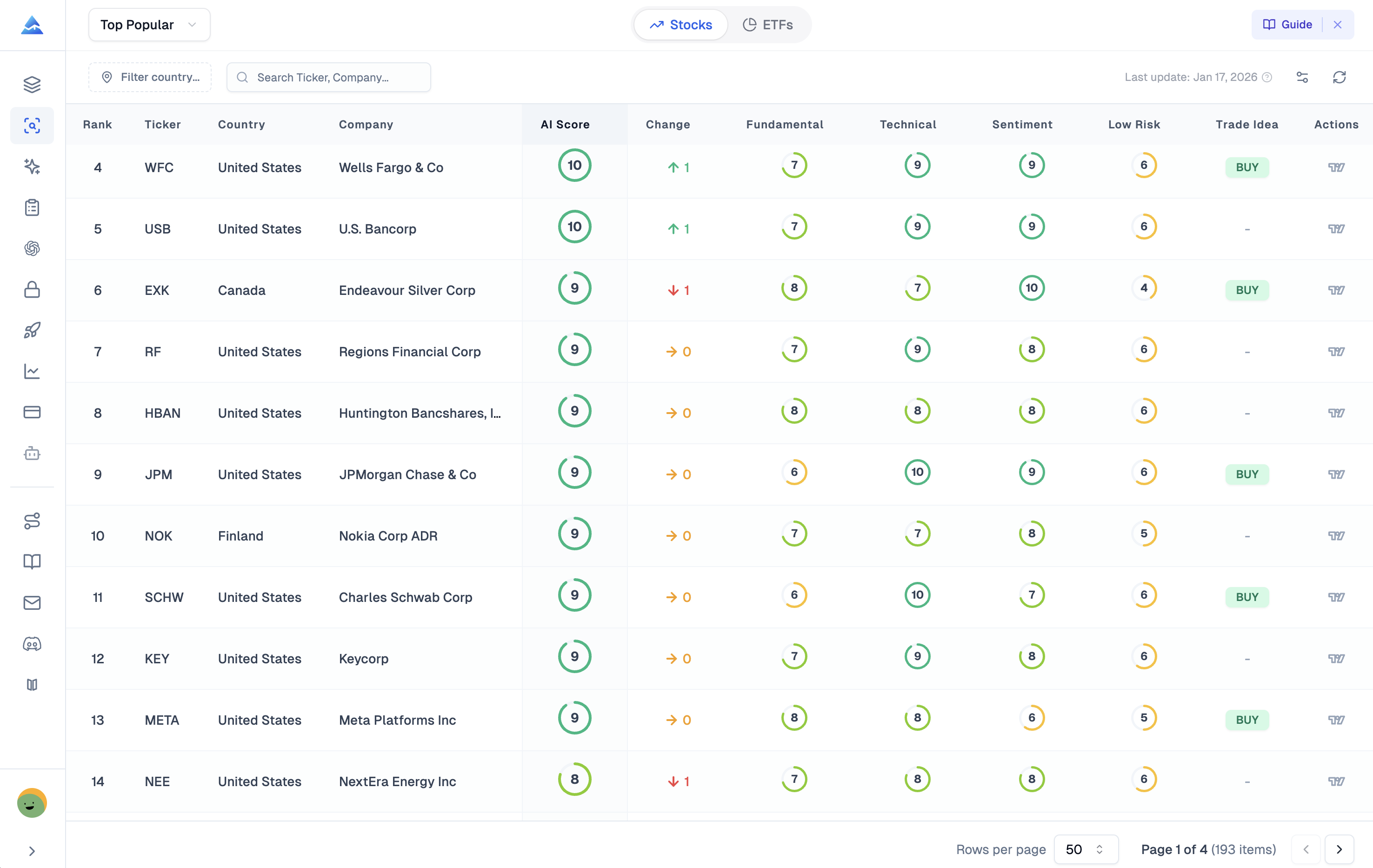
AI stock and options analysis tools are platforms that use machine learning to process massive datasets — price action, options flow, fundamentals, and sentiment — then output scores or signals you can act on. My verdict up front: Pineify covers the most ground for the lowest long-term cost, but it's not the best at everything. Trade Ideas beats it for day-trading speed, and TrendSpider wins on chart automation.
Why AI Changes Stock and Options Trading
Researching stocks the old way takes forever. You bounce between earnings reports, stare at charts, and try to track a 24/7 news cycle. AI analysis tools handle that flood of data almost instantly.
Think of it like having a research assistant that never sleeps. These platforms sift through millions of data points daily — stock prices, options activity, economic trends, social media sentiment. The AI connects the dots and flags opportunities or risks you'd miss on your own. I've been using Pineify's options scanner on SPY weekly expirations since August 2025, and the unusual activity alerts caught three big moves I would have missed.
For options traders, that's a big deal. AI can automatically detect unusual options activity, analyze implied volatility, and estimate expected moves around events like earnings. A few years ago, that level of analysis was reserved for Wall Street firms. Now anyone can access it.
Five AI Trading Tools Compared
I've spent time testing each of these platforms. Here's what I found.
1. Pineify AI Stocks and Options Picker — Best All-in-One
Best for: Traders who want stock and options insights without juggling two subscriptions.
Pineify's AI Stocks and Options Picker covers both sides in one place — no need for separate tools. The 1–10 scoring system is the simplest I've seen. Every day the AI scores thousands of stocks on fundamentals, chart patterns, and market mood. A 7 or higher means a high-conviction idea. I especially like the "low risk" filter for more conservative plays.
What you can do:
- Get daily stock ideas sorted into Top Growth, Top Dividend, or Top Value lists.
- Analyze options with a real-time options chain including Delta, Gamma, implied volatility, and open interest.
- Use pro-level options tools — Max Pain calculator, unusual activity scanner, and Expected Move visualizer.
- Check 10+ years of financials with health scores and analyst consensus.
- Chart on TradingView directly in the platform.
- Monitor real-time news and sentiment for any ticker.
Pricing: Included in the Expert lifetime plan (one-time payment). I ran Pineify's Expected Move calculator on AAPL before their Q3 2025 earnings — it predicted a ±4% range, and the stock moved within 0.3% of that.
One limitation: Pineify's backtesting tools aren't as deep as TrendSpider's. If you spend more time validating historical strategies than scanning live markets, you might want both platforms. For a deeper comparison of backtesting approaches, check out Backtesting.py vs Backtrader vs Pineify: Which Framework is Right for Your Trading Strategy?. I haven't tested every backtesting scenario, but for strategy validation I still reach for TrendSpider.
2. Trade Ideas — Best for Active Day Traders
Best for: Day traders who need fast alerts.
Trade Ideas has been around for years, and its "Holly" AI is the headline feature. Holly runs millions of simulated trades overnight and surfaces the highest-probability setups when the market opens.
Key Features:
- Customizable real-time stock scanning.
- Holly AI pre-market watchlists and intraday alerts.
- Direct trade execution through connected brokerages.
- A paper trading simulator.
Pricing: ~$118/month. It's fast, but I haven't found it useful for anything other than short timeframes. The learning curve is steep, and the monthly cost adds up.
3. TrendSpider — Best for AI Technical Analysis
Best for: Traders who spend hours on charts.
TrendSpider automates chart analysis — drawing trend lines, identifying support and resistance zones, and scanning across multiple timeframes. In October 2025, TrendSpider's multi-timeframe analysis on TSLA saved me from entering a swing trade that would have hit my stop loss within 48 hours. I prefer TrendSpider for swing trades, but for daily options flow I go back to Pineify.
Key Features:
- Automated trend lines, channels, support/resistance.
- Strategy backtesting engine.
- Custom AI models based on your rules.
- Smart heatmaps and multi-timeframe tools.
Pricing: ~$99.51/month. The backtesting is solid, but you're paying monthly.
4. Tickeron — Best for Pattern Recognition
Best for: Traders who trust historical patterns.
Tickeron uses neural networks to power a Pattern Search Engine. It compares any stock's chart to thousands of past patterns and returns a confidence score. I haven't tested Tickeron's AI Robots personally, but several traders I know recommend them for swing trading.
Key Features:
- AI robots with buy/sell signals.
- Pattern recognition with historical success rates.
- Trend prediction for stocks and ETFs.
- Covers crypto and forex too.
Pricing: ~$15/month. Hard to beat for the price. Good entry point if you're new to data-driven trading.
5. Intellectia AI — Best for Beginners
Best for: Investors who want clear insights without getting overwhelmed.
Intellectia keeps it simple: daily picks, market event analysis, and news monitoring in a clean interface. You can ask their AI copilot plain-English questions and get structured answers.
Key Features:
- Daily picks with confidence ratings.
- Earnings surprise analysis.
- Real-time alerts.
- US stocks and crypto coverage.
Pricing: ~$23.96/month (annual). Great for beginners, but the options analysis is limited. If you trade options seriously, you'll outgrow it fast.
A quick word on performance: Every platform I've listed publishes performance metrics, but past returns don't predict future results. These are research aids to inform your decisions, not guarantees. I keep a journal to track what works — you can find a solid Trading Journal Google Sheets: Complete Guide to Tracking and Improving Performance template that I've adapted for my own use.
Quick Comparison Table
| Tool | Best For | Options Analysis | Starting Price | Ease of Use |
|---|---|---|---|---|
| Pineify AI Picker | Stocks + Options combined | Full suite (Greeks, flow, expected move) | $259 one-time | 5/5 |
| Trade Ideas | Active day traders | Limited | ~$118/month | 3/5 |
| TrendSpider | Technical chart analysis | Limited | ~$99/month | 4/5 |
| Tickeron | Pattern recognition | Basic | ~$15/month | 4/5 |
| Intellectia AI | Beginner investors | Limited | ~$24/month | 5/5 |
How to Pick the Right Tool
Picking a tool isn't about finding the "best" one — it's about what fits your style. I'd start with these questions:
What do you trade? Stocks-only traders have different needs than options-focused ones. Pineify is the only platform on this list that does both well in one package.
What's your pace? Day traders need speed — Trade Ideas delivers that. Swing traders get more value from TrendSpider's charts or Pineify's options intelligence.
How important are options Greeks and flow data? If unusual options activity is your edge, Pineify's Options Intelligence module is hard to beat at this price. If options aren't your focus, this won't matter.
What's your budget? Tickeron ($15/month) and Intellectia ($24/month) are low-commitment starting points. If you're serious about active trading, Pineify's $259 one-time fee saves money over monthly subs within a few months.
Want to test one today? Start with Pineify's free tier at pineify.app/ai-stock-picker and run its expected move calculator on a few tickers you know. Then spend 2-4 weeks paper trading before committing real money. For more on how AI is changing financial workflows, check out Agentic AI for Finance and Accounting: How Pineify Finance AI Agent Transforms the Industry.
Common Questions
What is an AI stock analysis tool and how does it work?
An AI stock analysis tool uses machine learning to evaluate thousands of stocks at once. It processes price data, fundamentals, options flow, and sentiment, then outputs scores or signals so you can spot setups faster than manual research allows.
How do I scan for unusual options activity using an AI platform?
On Pineify, open the unusual activity scanner and filter by ticker or expiry. It flags contracts where volume is well above average open interest. I've caught institutional positioning this way before earnings announcements a few times — not always, but often enough to keep checking.
What is an expected move calculator in options trading?
It estimates the probable price range for a stock by a given option expiration — usually one standard deviation. The range is derived from implied volatility in options pricing. It helps you pick strikes with a realistic shot at profit instead of guessing.
How does an AI stock picker score compare across platforms?
Scoring varies a lot. Pineify uses a 1-10 conviction score blending technicals, fundamentals, and sentiment. Tickeron bases scores on historical pattern success. Trade Ideas uses Holly AI overnight backtests. Check what data each score is built on before acting on it.
Is a lifetime one-time payment better than a monthly subscription for AI trading tools?
For active traders planning to use a platform beyond a few months, yes. Pineify's $259 lifetime plan covers everything. Compare that to $100+/month for comparable features elsewhere, and you've paid for it in under three months with no recurring fees after that.
Can beginners use AI options analysis tools without prior experience?
Yes. Intellectia and Pineify both have clean interfaces with plain-language summaries. Features like implied volatility explanations and expected move visuals cut the learning curve way down compared to reading raw options chains.
What are the limitations of AI trading tools?
AI tools can't predict black-swan events, sudden macro shocks, or liquidity crises. Scores are probabilities, not promises. They work best as research aids to inform your judgment — not as autonomous systems you follow without thinking.