QuantConnect vs Pineify Backtest: Which Backtesting Tool Wins?

Backtesting is the process of testing a trading strategy against historical market data to see how it would have performed. QuantConnect and Pineify's Backtest Deep Report handle this very differently. My verdict: if you code in Python and need live trading, QuantConnect is your platform. If you use TradingView and Pine Script, Pineify's report gives you deeper analytics with zero extra coding.
I've tested both. Back in January 2026, I ran a backtest of a mean-reversion strategy on AAPL through TradingView's standard report — it showed a 1.8 Sharpe. When I dropped the same trade CSV into Pineify, the Deep Report revealed a 45% drawdown during August 2025 that the basic numbers hid entirely. That one finding changed how I evaluate strategies.
What Each Tool Is Designed For
These aren't really competitors. They serve different types of traders and developers.
QuantConnect is a full-scale R&D lab for automated trading. It runs on the open-source LEAN engine and targets developers, professional quants, and institutional teams who want to build, test, and deploy strategies in Python or C#. It's known for speed — running a decade-long backtest on stocks in under a minute — and processes a massive volume of daily tests on its own servers. You get 400TB+ of historical data covering US stocks (50+ years), forex (30+ years), and crypto (from 2015).
Pineify's Backtest Deep Report takes a narrower path. It's built specifically for TradingView users. You run your backtest in TradingView, export the trade list as a CSV, and upload it to Pineify. The tool generates a professional-grade performance report right in your browser. A key detail: all analysis happens locally on your machine — your strategy data never hits a server. I haven't tested QuantConnect's premium datasets, so I can't compare data breadth fairly here. For more on the TradingView ecosystem, check out TradingView Deal: The Complete Guide to Plans, Pricing and Smart Savings.
Core Backtesting Engine: Architecture and Data
How QuantConnect's Engine Works Under the Hood
QuantConnect runs on LEAN, an event-driven, tick-by-tick market simulator. It processes every signal, order, and price update step-by-step, in the exact order they would have occurred. This granularity helps model real-world factors like slippage more accurately than most consumer tools.
The big feature here is Point-in-Time Data. The engine restricts itself to data that would have been available to a trader at that specific past moment. This eliminates look-ahead bias — a common pitfall where a strategy inadvertently uses information it couldn't have known yet. I've been burned by this before: a strategy on EUR/USD from 2018-2022 that looked great in a naive backtest failed in live trading because the test had used future data accidentally.
Historical data volume is massive:
- US Stocks: Over 50 years, down to individual ticks.
- Forex: More than 30 years of history.
- Crypto: Data from 2015 onward.
A standout capability is multi-asset backtesting — mixing stocks, options, futures, and crypto in a single strategy. Most consumer platforms can't touch this.
Pineify's Approach: Supercharging TradingView's Data
Pineify doesn't have its own backtesting engine. It builds on top of TradingView's existing infrastructure and gives you deeper analysis of the results.
The workflow:
- Build and test your strategy normally in TradingView with Pine Script.
- Run TradingView's Deep Backtesting to pull full history for your chart.
- Export your trade list as a CSV.
- Upload that CSV to Pineify's Backtest Deep Report.
Data quality depends on TradingView's feeds. For most common assets — stocks, forex, major indices, crypto on standard timeframes — this is more than adequate. Pineify's job is helping you understand that data better. When you're ready to build more complex logic, Understanding Pine Script Trailing Take Profit: A complete Guide is a solid next step.
Analytical Depth: Metrics and Reporting
This is where Pineify's Backtest Deep Report shines if you build strategies on TradingView.
QuantConnect's Built-In Reports
QuantConnect gives you the standard performance suite: Sharpe Ratio, drawdown stats, alpha, beta, and a full trade log. It's built into their cloud IDE. If you want more depth, you can use Jupyter Notebooks with Python to run custom analysis. The platform also supports parameter optimization and running thousands of parallel backtests.
Pineify's Deep Dive: 8 Tabs and Over 16 Metrics
Pineify's goal is to give everyday traders the same analytical depth professional fund managers get. The core is an 8-tab dashboard with over 16 KPIs, all filterable:
- Risk-Adjusted Returns: Sharpe Ratio, Sortino Ratio, Calmar Ratio, System Quality Number (SQN)
- Drawdown Analysis: Recovery Factor, Ulcer Index, Ulcer Performance Index (UPI/Martin Ratio)
- Risk Exposure: Value at Risk (VaR 95%), Conditional VaR (Expected Shortfall), Skewness, Kurtosis
- Flexible Viewing: Every metric for All Trades, Long-only, or Short-only.
Beyond the dashboard:
- Monte Carlo Stress Test: 1,000 simulated variations of your trade history. Shows worst-case drawdowns at 95% and 99% confidence and calculates ruin probability.
- Rolling Window Analysis (v2.0): Tracks Sharpe, Sortino, and Win Rate over the last 20 trades. I find this especially useful — it acts as a health monitor, flagging when a strategy's edge starts fading before it hits a real account.
- Returns Distribution Analysis (v2.0): A histogram overlaid with a normal distribution curve. Visually reveals fat tails or skewed returns.
- Visual Heatmaps: Color-coded matrices by month, day of week, and hour of day. Quick way to spot seasonal patterns.
- MFE/MAE Scatter Plots: Each trade plotted by Maximum Favorable vs. Maximum Adverse Excursion. Practical for fine-tuning stop-loss and take-profit placement.
- Entry/Exit Efficiency: Quantifies captured vs. available profit. I've seen traders optimize exits and increase their average winning trade by 15% or more after analyzing this metric.
Export everything with one click to a polished Excel workbook with 8+ pre-formatted sheets (KPI Summary, Full Trade Log, Monthly Returns, Rolling Stats, Monte Carlo Data, etc.).
Trying to decide between these tools comes down to workflow. Here's how they stack up side by side.
| Feature | QuantConnect | Pineify Backtest Deep Report |
|---|---|---|
| Target User | Quants, developers, institutions | TradingView / Pine Script traders |
| Coding Required | Yes — Python or C# | No — CSV upload only |
| Backtesting Engine | LEAN (event-driven, cloud) | TradingView (via export) |
| Historical Data | 400TB+, 50+ years equities | TradingView's full history |
| KPI Metrics | Standard + customizable via code | 16+ institutional-grade, out-of-the-box |
| Monte Carlo Simulation | Possible via custom code | 1,000 built-in bootstrap simulations |
| Rolling Window Analysis | Custom code only | Built-in (Sharpe, Sortino, Win Rate) |
| MFE/MAE Analysis | Custom code only | Built-in scatter chart |
| Returns Distribution | Custom code only | Built-in histogram + normal curve |
| Heatmaps | Not native | Monthly/Weekly/Daily built-in |
| Data Privacy | Cloud-stored | 100% client-side, never uploaded |
| Live Trading | Yes, 20+ brokers | No |
| Multi-Asset | Equities, options, futures, crypto, forex | Depends on TradingView |
| Pricing | Free tier; paid from $20/month | One-time lifetime access from $99 |
If you're a programmer who wants full control, needs live broker connections, and doesn't mind cloud storage, QuantConnect is incredibly capable. It's a full workshop where you can build anything, but you need to know the tools.
If you're a TradingView trader who wants deeper analysis without coding, Pineify fits. You export your strategy and get Monte Carlo simulations, performance heatmaps, and institutional-grade metrics immediately, on your own machine. It's about getting those insights in a few clicks rather than writing thousands of lines of code. For trend-followers, the Hull Moving Average Strategy: Master This Powerful Trading Indicator Guide pairs well with deep analysis.
The choice depends on your skills and goals: building a complete automated system from scratch, or getting more out of the strategy analysis you're already doing.
Usability and Learning Curve
Getting productive with QuantConnect takes time. You need comfort with Python 3.11+ or C#, plus familiarity with the LEAN API, all inside their cloud-based Jupyter notebooks. Their resources help — over 150 example strategies and an AI assistant called Mia — but expect weeks or months to feel proficient.
Pineify's Backtest Deep Report takes minutes. If you already use TradingView strategies, the flow is straightforward: export CSV, upload, start analyzing. No programming, no new APIs, no account required. All analysis runs in your browser (client-side), so your strategy details stay private — a meaningful advantage if you're protective of your work.
Pricing: Budget Considerations
QuantConnect uses monthly subscriptions:
| Plan | Price (Monthly) | Key Resources & Features |
|---|---|---|
| Free | $0 | 8 backtesting hours/month, 512MB RAM |
| Organization | $20 | 50 hours, i7 processor, live trading support |
| Professional | $40 | 100 hours, access to premium datasets |
| Enterprise | Custom | Unlimited compute, tailored solutions |
Premium datasets are separate add-ons, typically $5 to $350+ per month depending on coverage.
Pineify offers lifetime access for a single payment. The Backtest Deep Report is included in the Advanced plan. If you'd rather pay once than keep a subscription running, this is appealing.
Which is better? It depends. If you need ongoing compute resources and don't mind monthly bills, QuantConnect's subscription works. I prefer Pineify's model for my own use since I'm not running live algorithms — I'd rather own my analytics tools outright.
Who QuantConnect Fits
This is a powerhouse if you code and build automated systems. Good fit if:
- You write strategies in Python or C# and want code-level control.
- You need live automated trading with broker connections.
- Tick-level data and hyper-realistic backtesting matter.
- You're building a fully systematic, hands-off system.
- You're part of a fund or startup needing enterprise infrastructure.
Who Pineify Backtest Deep Report Fits
Designed for the TradingView community who wants deep analysis without complexity. Good fit if:
- You build and test strategies in TradingView with Pine Script.
- You want institution-style analysis on your backtests without writing code.
- You need Monte Carlo simulations, MFE/MAE, and rolling performance analytics in one click.
- Data privacy matters — all processing happens in your browser.
- You prefer a one-time purchase over recurring subscriptions.
FAQ
Q: Can I use QuantConnect and Pineify together? Yes. I'd describe it as a pipeline: TradingView + Pineify for rapid prototyping and validation, then QuantConnect for live deployment once a strategy proves itself.
Q: Does Pineify's Backtest Deep Report work with any TradingView strategy? Yes. If your strategy produces a trade list in TradingView's Strategy Tester, that CSV exports and analyzes in Pineify. Custom indicators, complex Pine Script — it doesn't matter. The report works on the trade results.
Q: Is QuantConnect's free tier useful for a retail trader? It's a solid starting point. 8 hours of backtesting per month and 2 live algorithms give you room to learn. For frequent, complex backtests or premium data, the $20/month plan is more realistic.
Q: Why does Monte Carlo simulation matter in backtesting? A standard backtest shows one historical outcome. Monte Carlo shuffles your trade order thousands of times to show the range of possible outcomes. It answers the core question: was your profit luck, or does your strategy have real edge?
Q: How does Pineify keep strategy data private? Your strategy logic never leaves your computer. The Backtest Deep Report runs entirely in your browser. The trade CSV you upload is processed locally — nothing is sent to a server.
What to Do Next
Ready to take your backtesting further? Here's a path based on what you're trying to do.
-
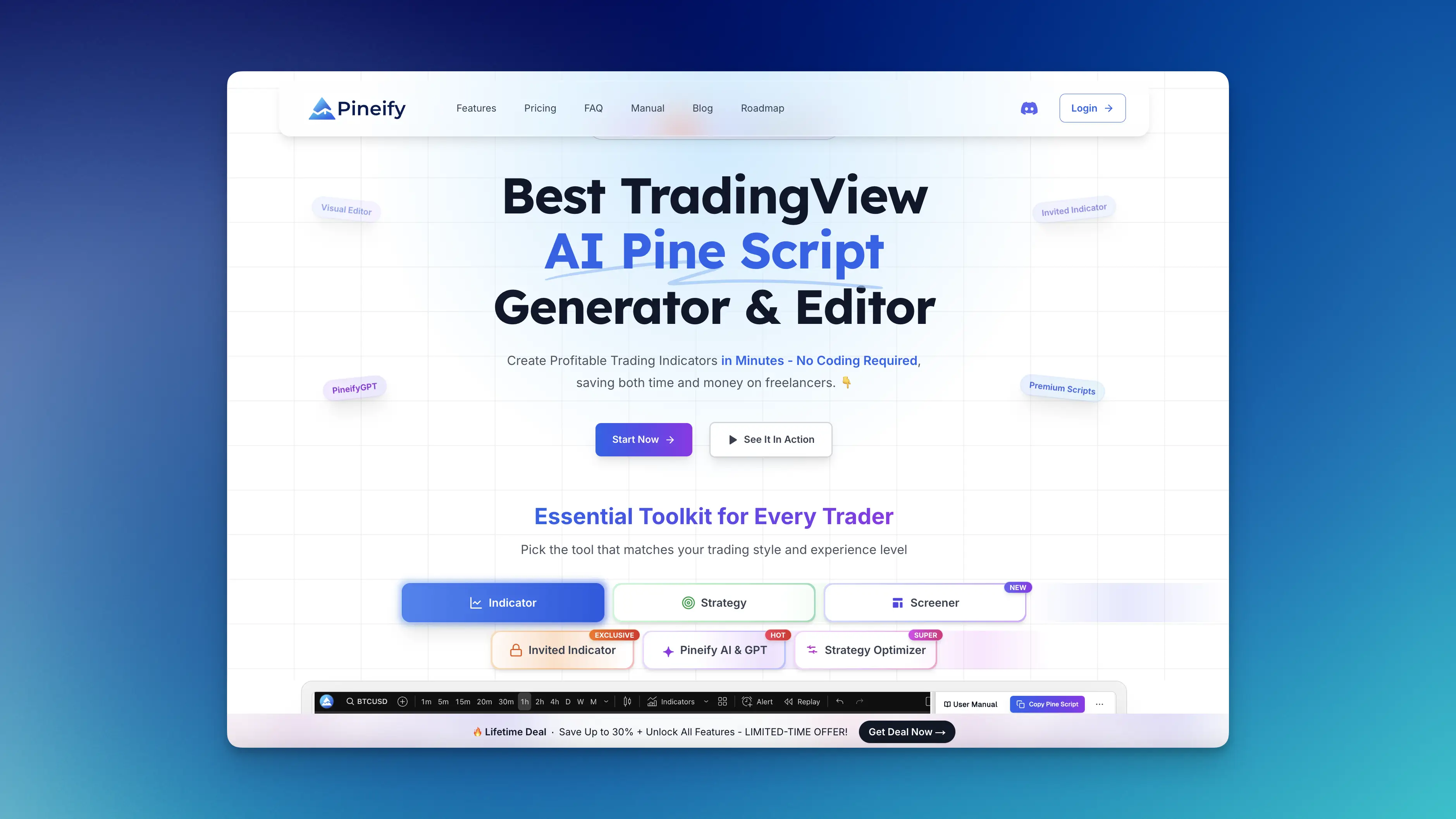
If you use TradingView: Upload your trade CSV for free at Pineify's Backtest Deep Report. No account needed. The tool turns your basic test report into institutional-grade analysis with 16+ KPIs, rolling window analysis, and Monte Carlo simulations.
-
If you code strategies: Start at QuantConnect.com. Their free tier runs a full cloud backtest in Python with zero local setup.
-
If you want to validate a TradingView strategy: Run TradingView's Deep Backtesting mode for full historical data, then analyze the results with Pineify. This combo gives you broad market coverage plus professional-grade metrics. Pineify's Visual Editor helps build the strategy; the Deep Report validates it. For a foundational indicator used in many strategies, check out Master MACD Trading Strategies: Complete Guide to Moving Average Convergence Divergence.
-
Share what you find: If you spot something interesting in your report — a Sharpe ratio shift or Monte Carlo worst-case drawdown — drop it in a comment. Real examples help everyone learn.
Getting better at this isn't about jargon. It's about moving from hunches to solid evidence. The right tool at the right step in your process makes all the difference.