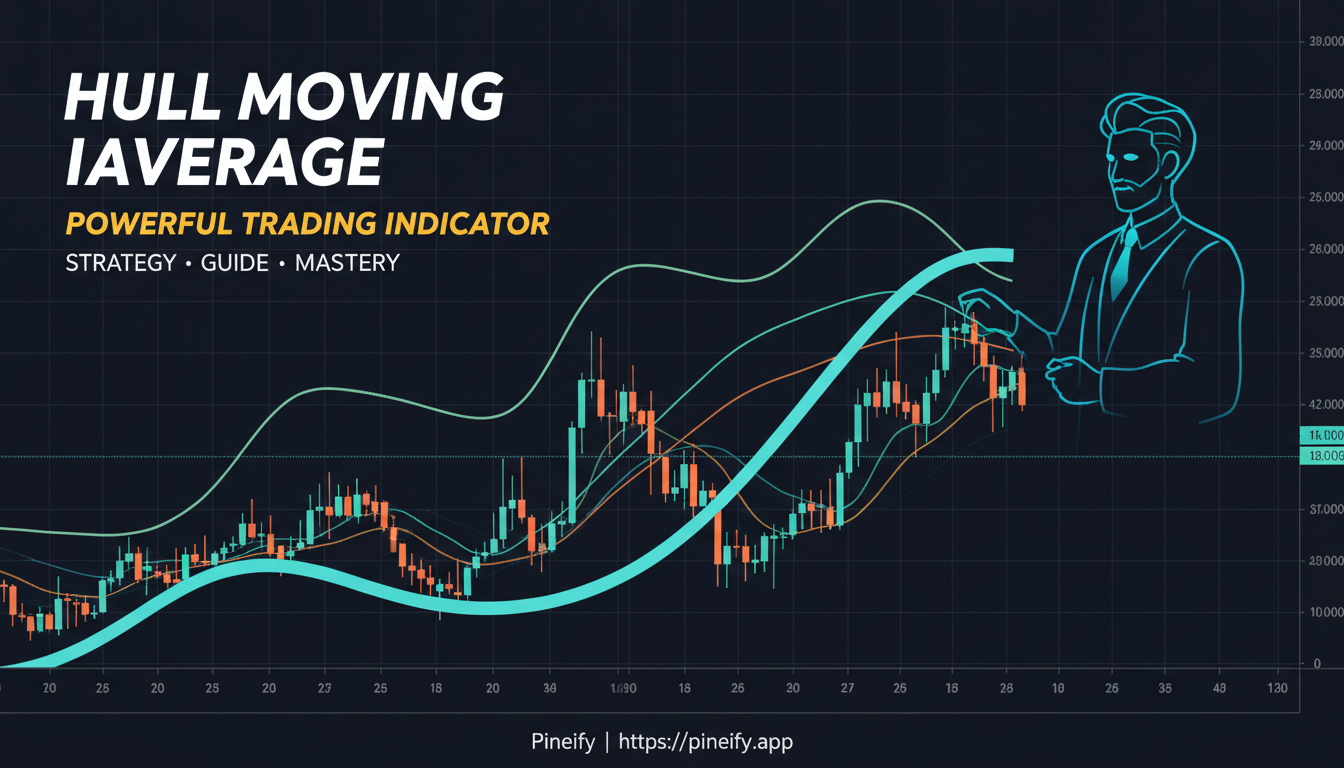
Hull Moving Average Strategy: Master This Powerful Trading Indicator Guide
If you've ever felt like traditional moving averages are always a step behind the market, you're not alone. That lag is a common frustration. The Hull Moving Average is a clever solution to that exact problem, dreamed up by Alan Hull back in 2005. It’s designed to give you a line that’s both smooth and quick to react, helping you see the trend clearly without getting tricked by every little market wiggle. It’s a favorite tool for fine-tuning when to get into and out of trades.
What is the Hull Moving Average?
In simple terms, the Hull Moving Average (HMA) is a smarter kind of average price line. It looks at past prices over a set time but is built to catch up to the current price much faster than the usual Simple (SMA) or Exponential (EMA) Moving Averages.
Think of it this way: regular moving averages often drag behind, like a shadow. The HMA manages to stick much closer to the actual price action, almost eliminating that delay, while still drawing a clean, easy-to-follow line that shows the real trend. For traders looking to identify potential market turns alongside this smooth indicator, exploring tools like the Best Reversal Indicator TradingView: Top Tools for Market Turns can provide complementary confirmation signals.
It pulls this off through a special calculation that pays more attention to recent price action. This means it can often give you a heads-up on potential trend changes noticeably earlier, especially when prices start to move fast.
How to Figure Out the Hull Moving Average
Getting a handle on how the Hull Moving Average (HMA) is calculated can really show you why it’s such a useful tool. It feels less like a lagging indicator and more like one that keeps up with the price. The whole process is built on Weighted Moving Averages (WMAs) and happens in a few clear steps.
Think of it as a recipe with four main ingredients:
- Find the WMA for your chosen number of periods (let's call this
n). - Find the WMA for half that number of periods (
n/2) and then double it. - Take that doubled value from step 2 and subtract the first WMA from step 1.
- Finally, take a third WMA of the result from step 3, but this time use the square root of
nas your period length.
If you prefer it as a formula, it looks like this:
HMA = WMA(2 × WMA(n/2) − WMA(n), √n)
The magic that makes it smooth yet quick comes from a special weighting factor. Here’s how that’s figured out:
| Term | What it Means | Example (n=20) |
|---|---|---|
| n | Your chosen lookback period | 20 |
| √n | The square root of `n** | √20 ≈ 4.47 |
| k | The final weighting factor | 2 / (4.47 + 1) ≈ 0.366 |
So, for a common 20-period setting, the final smoothing step uses a period of about 4.47 and applies a weighting factor of roughly 0.366. This specific math is what balances everything out—giving you a line that reacts to recent changes without being too jumpy.
Hull Moving Average Compared to Other Averages
When you're looking at charts, moving averages are like different types of lenses. Each one gives you a slightly different view of the trend. Some are slow and steady, while others are built for speed. Here’s a straightforward look at how some of the most common ones stack up.
| Indicator | Lag Level | Smoothness | Responsiveness | Best Use Case |
|---|---|---|---|---|
| SMA | High | Very Smooth | Slow | Long-term trend identification |
| EMA | Moderate | Smooth | Moderate | General trend following |
| WMA | Low-Moderate | Less Smooth | Fast | Short-term analysis |
| HMA | Very Low | Smooth | Very Fast | Quick trend changes and reversals |
Think of the Simple Moving Average (SMA) as your reliable but slower friend—it gives you a very clean line, but it’s usually the last to know when the price has actually turned.
The Exponential Moving Average (EMA) is quicker on its feet because it pays more attention to what the price did recently. It’s a great all-around tool for keeping up with the trend.
Where the Hull Moving Average (HMA) really stands apart is in its clever design. It manages to do something pretty special: it sticks to the price action much more closely than an SMA (so you get signals earlier), but it doesn’t get jagged and choppy like some other fast indicators can. It gives you that smooth, easy-to-follow curve, which helps you make clearer decisions without the constant second-guessing. While an EMA can still hesitate during a sharp price swing, the HMA is built to adapt almost immediately, making it particularly useful when you’re watching for those quick reversals or trying to catch a new trend right as it starts.
How to Trade with the Hull Moving Average: Key Strategies
Spotting the Trend's Direction and Strength
The Hull Moving Average (HMA) is really good at showing you not just which way the market is moving, but also how hard it's pushing. Think of it like this: if the HMA line is climbing, the trend is up. If it's dropping, the trend is down. You can learn even more by looking at the angle of the line. A steep, rising HMA means a strong, energetic uptrend. If the line starts to flatten out or curve, it’s a hint that the momentum might be slowing down, which could mean the trend is getting tired and a change might be coming.
The Simple Price Crossover
This is one of the easiest ways to use the HMA. You just watch where the price is relative to the HMA line.
- Potential Buy Signal: When the price bar or candle crosses above the HMA line from below, it’s like the market is finding a new floor of support and starting to push higher. It suggests bullish momentum could be kicking in.
- Potential Sell Signal: When the price crosses below the HMA line from above, it indicates the price is breaking down through a level that was previously holding it up. This can signal growing bearish pressure.
These crossovers can help you spot moments to potentially enter or exit a trade, especially if you see other clues on the chart that agree.
The Two-HMA Crossover System
This strategy uses two Hull Moving Averages to help filter out the market's noise. You typically put a fast HMA (like a 10-period) and a slow HMA (like a 50-period) on your chart together.
- Bullish Signal: When the faster HMA crosses above the slower HMA. This tells you that recent price action is starting to outpace the longer-term trend, suggesting a fresh upward move might be starting.
- Bearish Signal: When the faster HMA crosses below the slower HMA. This shows that recent momentum has turned down compared to the broader trend, hinting at a potential down move.
The fast HMA reacts quickly to new prices, while the slow HMA gives you the bigger picture trend. Using them together helps you stay responsive to real changes while ignoring little false alarms.
Catching Breakouts with the HMA
This approach is about catching those big, powerful moves that happen when the price finally smashes through a key barrier. Here’s how it works:
- Find the Floor and Ceiling: First, look for clear support (the floor where price keeps bouncing up) and resistance (the ceiling where price keeps falling from) on your chart.
- Check the HMA's Trend: Use the HMA to understand the underlying trend direction and strength.
- Trade the Break:
- If the price breaks above a resistance level and the HMA is already sloping upward, it confirms the breakout has real bullish power behind it.
- If the price breaks below a support level and the HMA is sloping downward, it confirms strong bearish momentum.
The HMA helps you tell the difference between a weak "fake out" and a strong, tradable breakout. For more strategies on identifying high-probability breakouts, our guide on the Best Squeeze Indicator TradingView Guide for Breakout Trading offers complementary techniques.
Team Up the HMA with Other Tools
Using the HMA with other indicators can give you more confidence in your signals. It’s like getting a second opinion.
- With MACD: The MACD is a great partner for the HMA. When both give you a similar signal (like both turning bullish at the same time), it strengthens the case for taking a trade. You can learn more about implementing this powerful oscillator in our Pine Script MACD: A Comprehensive Guide.
- With Support & Resistance: As in the breakout strategy, always be aware of key price levels on your chart. An HMA signal that occurs right at a major support or resistance zone often carries more weight.
- With the RSI: Pairing the HMA with a momentum oscillator like the RSI helps you see the whole picture. For example, if the HMA shows an uptrend but the RSI is in "overbought" territory, it might warn you that the move is extended and due for a pause. This combo helps you understand both the trend and the market's energy level.
Finding the Right Hull Moving Average Settings for You
Getting the most out of the Hull Moving Average comes down to choosing settings that match how you trade. There's no single perfect number for everyone. Think of it like adjusting the seat in a car—you change it to fit you, so you can drive better.
A good place to start is with the period 16, which is what Alan Hull, the creator, often suggested. But don't just stick with that. The real trick is to try different settings and see what feels right for your specific approach.
Here’s a breakdown of common settings based on different trading styles, to give you a practical starting point.
| Trading Style | Typical Holding Period | Suggested HMA Periods | Useful Chart Timeframes |
|---|---|---|---|
| Short-Term & Intraday | Minutes to hours | 9, 14, 16 | 5-minute, 15-minute |
| Swing Trading | Several days to weeks | 21, 50, 55 | 1-hour, 4-hour, Daily |
| Long-Term & Investing | Months to years | 89, 144, 200+ | Daily, Weekly |
For short-term and intraday trading, you need the HMA to react quickly. Using shorter periods like 9 or 14 on a fast chart (like a 5-minute or 15-minute view) helps you catch those swift price moves that happen during the day.
If you're a swing trader, you’re probably looking at moves that unfold over days or weeks. Medium-term settings become more useful here. A period of 21 on a daily chart is a favorite for many, as it roughly covers a trading month. On slightly shorter charts, like the 4-hour, settings like 50 or 55 can help smooth out the noise while keeping you in the trend.
For long-term investors, the goal is to ignore short-term ups and downs and focus on the major trend direction. Using longer periods like 89 or 144 on a daily chart does a great job of filtering out volatility, giving you a clearer picture of where the market is headed over the long haul.
The beauty of the HMA is its flexibility. You can adapt it to any chart and any style. The key is to test a few different periods on your preferred charts and see which one gives you the clearest, most actionable signals for your strategy.
Why the Hull Moving Average Works So Well
If you’re tired of watching standard moving averages lag behind the price, you’ll appreciate the Hull Moving Average (HMA). Its biggest strength is how it catches trend changes much faster. Think of it like getting a text message the moment a friend arrives, instead of finding out ten minutes later. That reduced delay can make a real difference, especially when markets are moving fast.
What’s clever is that it manages to be both quick and smooth. It cuts through a lot of the random market "noise" that can trick you into false moves with other indicators. This gives you cleaner, more trustworthy signals, so you can act with more confidence and less second-guessing.
Is it actually useful? Backtesting shows it can be, whether you like to follow trends or trade reversals. It’s a flexible tool that doesn’t force you into one style, adapting well to different market moods and timeframes you might want to trade on.
What to Watch Out For When Using the HMA
The Hull Moving Average is a powerful tool, but like anything, it’s not perfect. It’s important to know its quirks so you don’t get caught off guard.
The main thing is that because it’s designed to be so fast and responsive, it can sometimes be too sensitive. In choppy or sideways markets, it might pick up every little move and give multiple buy/sell signals that quickly reverse—this is called a "whipsaw." Following these false signals without a second opinion can lead to a string of small, frustrating losses.
Interestingly, Alan Hull, who created the indicator, has said not to just trade simple crossovers with the HMA. He suggests a smarter approach: watch for the HMA to change direction and align with the actual structure of the price chart to decide on your entry and exit. It’s always better to team the HMA up with other tools for confirmation, rather than using it all by itself.
Finally, it’s crucial to remember that the HMA, and every indicator like it, is lagging. It’s doing complex math on past prices to show you a smoothed-out picture of what has already happened. It can’t see the future. That’s why solid risk management—like always knowing where you’ll place a stop-loss and not risking too much on any single trade—is non-negotiable, no matter how clever your chart setup looks.
Trading with the Hull Moving Average: How to Protect Your Money
Using the Hull Moving Average (HMA) can help spot trends, but it doesn't guarantee a win. The real key to staying in the game is how you manage your risk. Think of it like this: the HMA suggests when to maybe get in the car, but risk management is your seatbelt and airbags. It's what keeps a bad trip from wrecking your whole journey.
Here’s a straightforward way to think about protecting your trades when using HMA signals.
Your First Defense: The Stop-Loss Order
Before you enter any trade, decide exactly where you’ll get out if it goes wrong. This is your stop-loss. It's not a failure; it's a pre-planned exit that saves your capital for the next opportunity.
With HMA trades, a logical place for your stop is just beyond a recent market turn:
- For a LONG trade (entered on a bullish HMA signal), place your stop-loss just below the most recent swing low or a clear support level.
- For a SHORT trade (entered on a bearish HMA signal), place your stop-loss just above the most recent swing high or a clear resistance level.
This method gives the trade a little "breathing room" from normal market noise while clearly defining where your initial idea is invalid.
Aim for Profits That Are Worth the Risk
Let's talk about the math that keeps traders profitable over time. A common and sensible rule is to aim for a risk-to-reward ratio of at least 1:2.
What does that mean in practice?
- If your stop-loss is 50 points away (your risk), your profit target should be at least 100 points away (your potential reward).
- This way, even if you only win 40% of your trades, you can still make money overall. One good win can cover the cost of two small losses.
Trading isn't about being right every time. It's about making sure your winning trades pay you more than your losing trades cost you.
The Golden Rule: Size Your Positions Wisely
This might be the most important part. How much of your money should you bet on one HMA signal? The answer depends on your account size and how far away your stop-loss is.
A disciplined approach is to never risk more than 1-2% of your total trading capital on a single trade.
Here’s a simple way to calculate it:
- Determine your account risk: 1% of your $10,000 account is $100.
- Find your trade risk: If your entry is at $50 and your stop-loss is at $48, you're risking $2 per share.
- Calculate your position size: Divide your account risk by your trade risk ($100 / $2 = 50 shares).
This way, a loss doesn't seriously hurt your account, and you can handle a string of losses without getting knocked out. It lets you stay calm and follow your HMA strategy through its natural ups and downs. For a step-by-step walkthrough on implementing this crucial risk management tool directly on your charts, be sure to read our guide on How to Set Trailing Stop Loss in TradingView: A Step-by-Step Guide.
By combining the HMA's signals with these protective rules, you build a complete strategy that focuses on long-term survival and growth, not just the next exciting trade.
Your Hull Moving Average Questions, Answered
Q: What’s the best period setting for the Hull Moving Average?
A: There’s no single "best" setting—it really comes down to how you trade. Alan Hull, who created it, suggests starting with 16. From there, it’s about your style:
- Short-term traders (like day traders) often find 9 to 16 works well.
- Swing traders, holding for days or weeks, usually lean toward 21 to 55.
- Long-term investors might use settings from 89 up to 144. The best way to figure it out? Try a few different periods in a demo account and see which one feels right for your strategy.
Q: Does the HMA work on everything—stocks, crypto, forex?
A: Absolutely. You can use it on any chart: stocks, forex pairs like EUR/USD, cryptocurrencies, commodities like gold, or market indices. It’s built purely on price action, which is the same in every market. Just keep in mind that a super-volatile crypto chart might need a slightly tweaked setting compared to a steady blue-chip stock.
Q: What happens with the HMA when the market moves sideways?
A: This is its tricky spot. Because the HMA is designed to be fast and smooth, it can get "whippy" during choppy, sideways markets, potentially giving false signals. When the market is stuck in a range, it’s smart to wait for a clear breakout or use other clues—like key price levels where the market has bounced before—to confirm any HMA signal.
Q: Should I use the Hull Moving Average by itself?
A: It’s stronger with a little help. While the HMA is great at showing the trend direction, pairing it with another tool or two makes your signals more reliable. Think of it like this:
- Add the MACD to check if momentum supports the HMA’s turn.
- Use the RSI to see if the market is overextended and due for a pullback.
- Look at volume to see if a price move has real backing. Using it with other indicators helps filter out the noise.
Q: Is the HMA better for catching trends or trading reversals?
A: It’s surprisingly flexible for both. You can use it to follow strong trends (buying when price breaks above the HMA). But some interesting backtests show that in certain markets, a mean-reversion approach—like buying when price dips below the HMA in an uptrend—can also work really well. The lesson? Don't assume one method is best. Test both ideas in the markets you trade to see what fits.
What to Do Next
So you've got the basics of the Hull Moving Average strategy down. What now? Here's a straightforward path to actually using it.
First, pull up your trading platform and add the HMA indicator. You'll usually find it built right into popular platforms like TradingView, MetaTrader, or thinkorswim—just search for it in the indicators list. If you're using TradingView and want to build a more complex, multi-indicator strategy around the HMA without writing code, tools like Pineify's Visual Editor make it incredibly simple. You can drag, drop, and combine the HMA with 235+ other technical indicators to create a unified, custom script in minutes.
Before risking real money, start with a demo account. Play around with the HMA’s period settings on different time charts and for various stocks or currencies you’re interested in. Keep a simple journal of what happens. Which settings gave you a clearer, more timely heads-up? This helps you find what fits your rhythm. For a more powerful analysis, you could use Pineify's Professional Backtest Deep Report to transform your demo trades into institutional-grade performance reports, uncovering hidden risks with metrics like Sharpe ratios and Monte Carlo simulations.
You can also try pairing the HMA with one or two other tools you already trust, like RSI or volume indicators. Sometimes, using it alongside something else creates a fuller picture and can help confirm signals. This process of combining indicators is exactly what platforms like Pineify are built for, allowing you to visually layer conditions or even use their AI Coding Agent to articulate your idea in plain English and generate the complete, error-free Pine Script for you.
Once you’re more comfortable, sketch out a simple trading plan. Write down:
- How you’ll decide to enter a trade using the HMA.
- Where you’ll place your stop-loss to protect yourself.
- Your target for taking profit.
- How much of your capital you’ll use per trade.
Sticking to this plan and reviewing your past trades weekly is where the real learning happens. You’ll start to see what mistakes you repeat and what setups work best for you. Consider using a dedicated Trading Journal to systematically track your trades, calculate your win rate and profit factor, and identify patterns in your performance.
Don’t learn in a vacuum. There are plenty of online forums and social trading groups where people share their experiences with the HMA. Lurking in these spaces or asking questions can give you practical tips you won’t find in a manual.
Finally, remember that this takes time. No strategy works perfectly right away. Focus on making consistent, disciplined decisions rather than chasing big wins. Start small, be patient with yourself, and let your skill with the HMA develop naturally as you get more screen time. The right tools can remove the technical friction, letting you focus purely on honing your strategy and discipline.