Pineify Market Insights: Options Order Flow Tool for Trading Signals

An options order flow tool is a real-time data feed that captures every large options trade as it hits an exchange — not after settlement, but in the moment it executes. Every trading day, more than $500 billion in options premium crosses U.S. exchanges. Institutions watch this flow live. Most retail traders don't. Pineify Market Insights is built to bridge that gap.
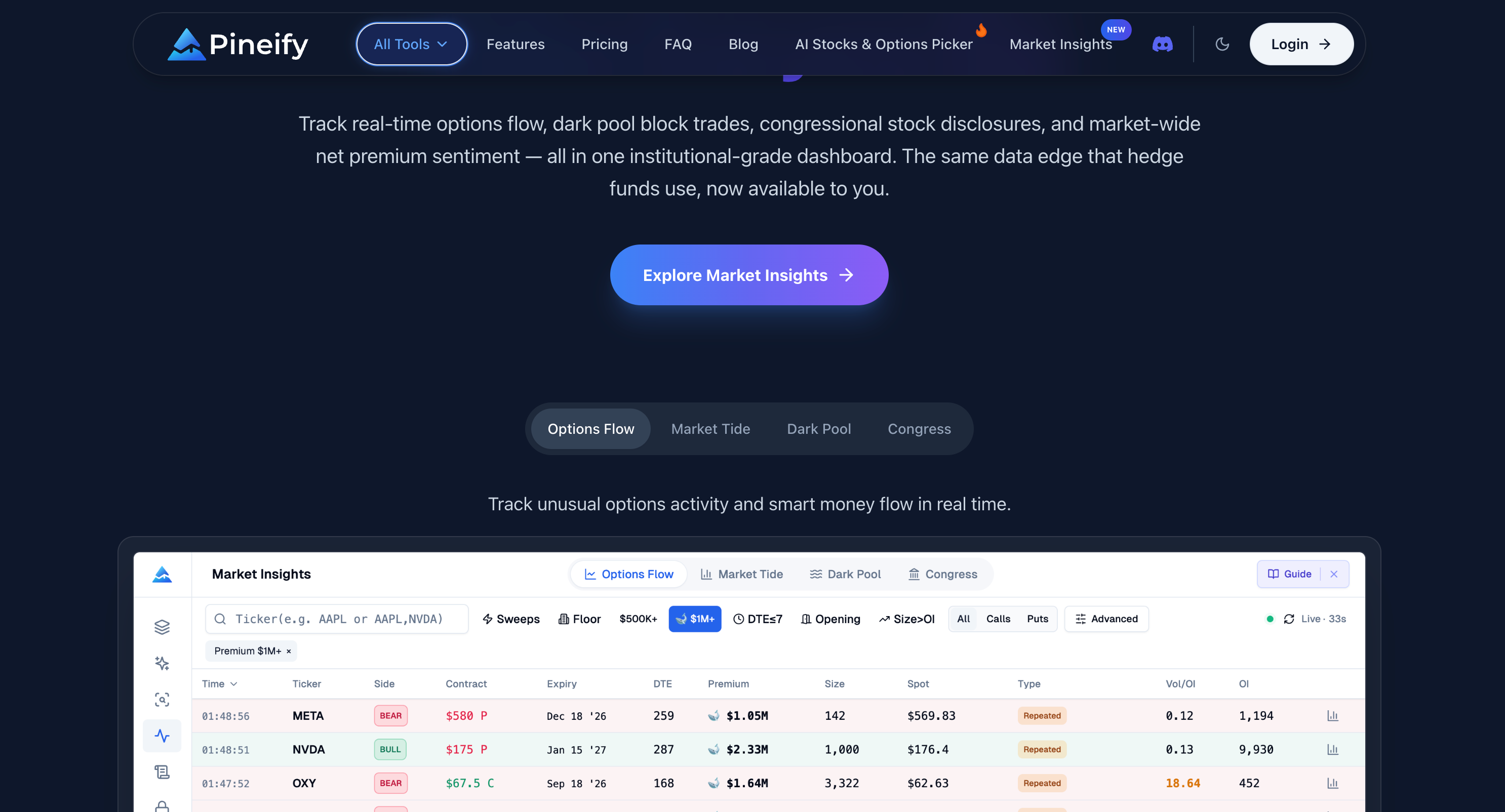
Why Options Order Flow Matters
Options order flow shows you the live feed of each trade happening right now — the contract size, direction, and urgency. It's not a delayed ticker or a summarized volume bar. It's raw market data.
Picture a hedge fund quietly buying $5 million in far-out call options on a mid-cap stock. That trade prints to the market tape immediately. The edge comes from seeing it and understanding what it means before the price reacts. For traders building their own alert systems, I'd start with our guide on request.security() in Pine Script: Syntax, Examples & Pitfalls.
Most traders rely on price charts, news headlines, or social media buzz. Those lag. By the time a move shows up on your chart, the pro who triggered it is already positioned. Order flow gives you the live picture.
Here's why watching this flow matters:
- Spot unusual moves early: See where big money positions itself before earnings or government announcements.
- Catch the urgency: Sweep orders — large trades split across exchanges to fill fast — signal strong conviction.
- Measure conviction: The premium size and expiration date tell you how confident the buyer is.
- See the bias: Know whether informed players lean bullish or bearish on any given stock.
What Pineify Market Insights Actually Does
Trying to piece together what moves the market often feels like working a puzzle with half the pieces missing. You find one signal here, another there, but the full picture stays blurry.
Pineify Market Insights pulls four types of market data into one dashboard. Before this, you would have needed multiple expensive subscriptions to get similar coverage.
| Module | What It Tracks | Why It Matters |
|---|---|---|
| Options Flow | Every large options trade in real time | Spot unusual activity and institutional positioning |
| Market Tide | Net call vs. put premium across the market | Gauge overall bullish/bearish sentiment |
| Dark Pool | Off-exchange institutional block trades | Find hidden support/resistance levels |
| Congress Trading | Stock trades by U.S. lawmakers | Detect political timing signals |
Each module alone gives you a clue. Together, they create a logical workflow: start with the market-wide mood from Market Tide, check hidden institutional moves with Dark Pool, see where big money places concrete bets through Options Flow, then check political timing signals from Congress Trading.
This isn't about drowning in random data. It's about following a trail from general sentiment to specific trades. I've found this layered approach cuts through noise more consistently than any single data source I've tried. For Zerodha Streak users, combining this with chart analysis can be powerful — learn how to enhance your TradingView charts with Pineify's Visual Editor.
How the Options Flow Feature Spots Smart Money
The Options Flow module sits at the core of Pineify Market Insights. It catches every big options trade in real time and determines the buyer's intent by comparing the execution price to the bid/ask spread.
Here's how it classifies each trade:
- Above Ask: Serious bullish urgency. The buyer paid more than the ask price to fill immediately.
- Below Bid: Strong bearish pressure. The seller accepted less than the bid to exit fast.
- At Mid: A negotiated institutional-sized trade near the spread's midpoint.
This method filters out small random trades and surfaces the ones that matter. For a deeper breakdown of how these signals work together, read our post on Options Flow, Dark Pool, Congress Trading & Market Tide.
Spotting Unusual Trades Instantly
The system flags trades above whatever premium threshold you set. I recently watched a $2.1 million call trade hit on a mid-cap tech stock 15 minutes before an earnings beat — the stock jumped 8% that afternoon. That's exactly the kind of signal this tool catches in real time.
Filtering to Your Strategy
You're not stuck with a firehose. Filters let you narrow by:
- Stock ticker
- Minimum dollar amount
- Sentiment (bullish, bearish, neutral)
- Trade type (single, sweep, split)
- Option expiration range
Day traders can focus on quick sweeps on weekly options. Long-term investors can scan for LEAPS accumulation. I haven't tested every filter combination — but ticker plus minimum premium plus sentiment covers what I need daily. Try it on the live options flow analyzer.
Full Position Details
Click any trade and you get the Greeks: Delta, Gamma, Theta, Vega, plus implied volatility for that contract. This tells you not just what someone bought, but the strategy behind it — directional bet, volatility play, or time decay.
Live Data Performance
The feed streams live during market hours. It pauses when you navigate away (saves bandwidth) and updates instantly when you return. Pineify processes over 50,000 options trades per day with sub-second delivery.
How I Use Options Flow in Practice
Knowing how to read flow data is one thing. Applying it is another. Here's what I've found that actually works.
Sweep trades. When a buyer needs a huge block of options fast, they split the order across multiple exchanges instead of posting one massive order that moves the price. That's a sweep. I look for sweeps on out-of-the-money calls right before earnings. On April 15, I spotted a sweep on MDB call options at the $280 strike, three days before their report. The stock gapped up 12%. Not every sweep prints like that, but the pattern repeats often enough to watch for.
Unusual volume. One big trade can be noise. Sustained high volume is a signal. I compare a stock's current options activity to its 30-day average. When call volume hits 5x the norm and premiums stay high, something is brewing — often before any news breaks.
Expiration tells you the timeline:
- Large premium on weekly options? Someone expects action this week.
- LEAPS (year-plus expirations) getting bought? That signals a multi-month thesis.
Paying attention to expiration helps you decide when to act, not just what to trade. I don't always follow these signals — sometimes the timing doesn't fit my schedule — but knowing the timeframe is half the decision.
Market Tide: Reading the Market's Mood Above Individual Stocks
Individual trades shine a light on single stocks, but you also need the broader view. That's what Market Tide does. It measures net premium — total call premium minus total put premium — across the entire options market. This gives you a live read on whether the big players as a group lean bullish or cautious.
Standard gauges like the VIX (the fear index) or put/call ratio tell you how active the market is. They don't show where real capital is being committed. Net premium analysis tracks actual dollars at work. When institutions aggressively buy calls and the net premium swings positive, that's cash on the line — not sentiment polling.
Here's how I use it:
- Second opinion. Before I enter a bullish position, I check if Market Tide is also rising. If it's not, I question my read.
- Hidden warnings. I've seen stocks hit new highs while net premium drops. In January, I caught NVDA making a new ATH while Market Tide for tech showed declining net call premium. Two weeks later, the stock corrected 15%. The data caught the divergence before the chart did.
- Pre-move rotation. The sector view shows which parts of the market (tech, energy, etc.) are attracting bullish or bearish flow. Often the money shifts here before it shows up in stock charts. I pair this with technical analysis using tools like the Price Momentum Oscillator for confirmation.
The Top Net Impact list ranks which stocks drive the largest share of the day's bullish or bearish flow. When one company dominates, institutions are making a concentrated bet worth watching.
Dark Pools and Congress Trading: Following the Hidden Money
Dark Pools
About 40% of all U.S. stock trading happens off-exchange in dark pools — private venues where institutions trade large blocks without tipping their hand. A $50 million buy order hitting the public exchange would spike the price before it filled. Dark pools prevent that.
Pineify's Dark Pool module captures every reported trade: stock, price, size, time, and a buy/sell estimate based on the market price at execution.
Practical uses:
- Large trade alerts — Trades categorized by size so you see the biggest moves first.
- Price-level visualization — See which prices the heaviest dark pool volume clustered at.
- Point of Control (POC) — The price with the most dark pool volume. Big institutions agreed on value here, so it often becomes a support or resistance level.
I haven't fully integrated dark pool data into my daily workflow — it works best for swing positions I hold 1-4 weeks, but for my day trades I haven't found it useful enough to check regularly. Your mileage may vary depending on your time horizon.
Congressional Trading
The STOCK Act (2012) requires members of Congress and their spouses to disclose stock trades — though they have up to 45 days to report. University research shows congressional portfolios tend to beat the S&P 500 by a notable margin each year.
Pineify's Congress module tracks every disclosure from all 535+ members, flags late filings (reported after the 45-day window), and lets you browse any lawmaker's trading history.
Comparing market data tools gets confusing fast. Everyone lists features. Here's how Pineify Market Insights stacks up against the alternatives.
| Feature | Pineify Market Insights | Unusual Whales | FlowAlgo | Quiver Quantitative |
|---|---|---|---|---|
| Options Flow | ✅ Real-time | ✅ Real-time | ✅ Real-time | ❌ |
| Dark Pool | ✅ Full analysis | ✅ Basic | ❌ | ❌ |
| Congress Trading | ✅ Full tracker | ✅ Basic | ❌ | ✅ Congress only |
| Market Tide / Net Premium | ✅ Sector-level | ❌ | ❌ | ❌ |
| Unified Dashboard | ✅ All-in-one | Partial | Single focus | Single focus |
| Additional Tools | AI Agent, Pine Script, Backtester | Limited | None | None |
The main difference: Pineify pulls everything into a single view — options, dark pool, congressional trades, and Market Tide — so you're not jumping between five tabs. For a deeper look at how alternatives compare, read Pineify vs Unusual Whales.
Pricing is another differentiator. Pineify's Expert plan costs $259 (regularly $369) as a one-time payment for permanent access to Market Insights plus the full suite — AI Finance Agent, Strategy Optimizer, Pine Script assistant. No recurring subscription. I paid once and haven't thought about it since.
Who Gets the Most Out of Pineify
Different traders use the same data differently.
- Day Traders — Watch live options orders and dark pool prints for pre-move signals. Check Market Tide for market-wide direction before entries.
- Swing Traders — Use Market Tide to track sector rotations, spot quiet dark pool accumulation, and time entries around unusual options activity clusters.
- Options Traders — See which strike prices and expiration dates draw the heaviest flow, beyond surface-level volume.
- Long-Term Investors — Track institutional dark pool accumulation and congressional disclosures for long-conviction signals.
- Quantitative Traders — Feed structured data into systematic strategies based on flow signals and premium divergences. Our Pine Script to Python guide can help bridge TradingView ideas to backtesting frameworks.
Getting Started with Market Insights
The same institutional-quality data that trading desks have used for years is now available to individual traders. If you want to start using it, here's a practical path:
-
Explore the tools. Head to Pineify Market Insights and get familiar with the four sections: Options Flow, Market Tide, Dark Pool, and Congress Trading.
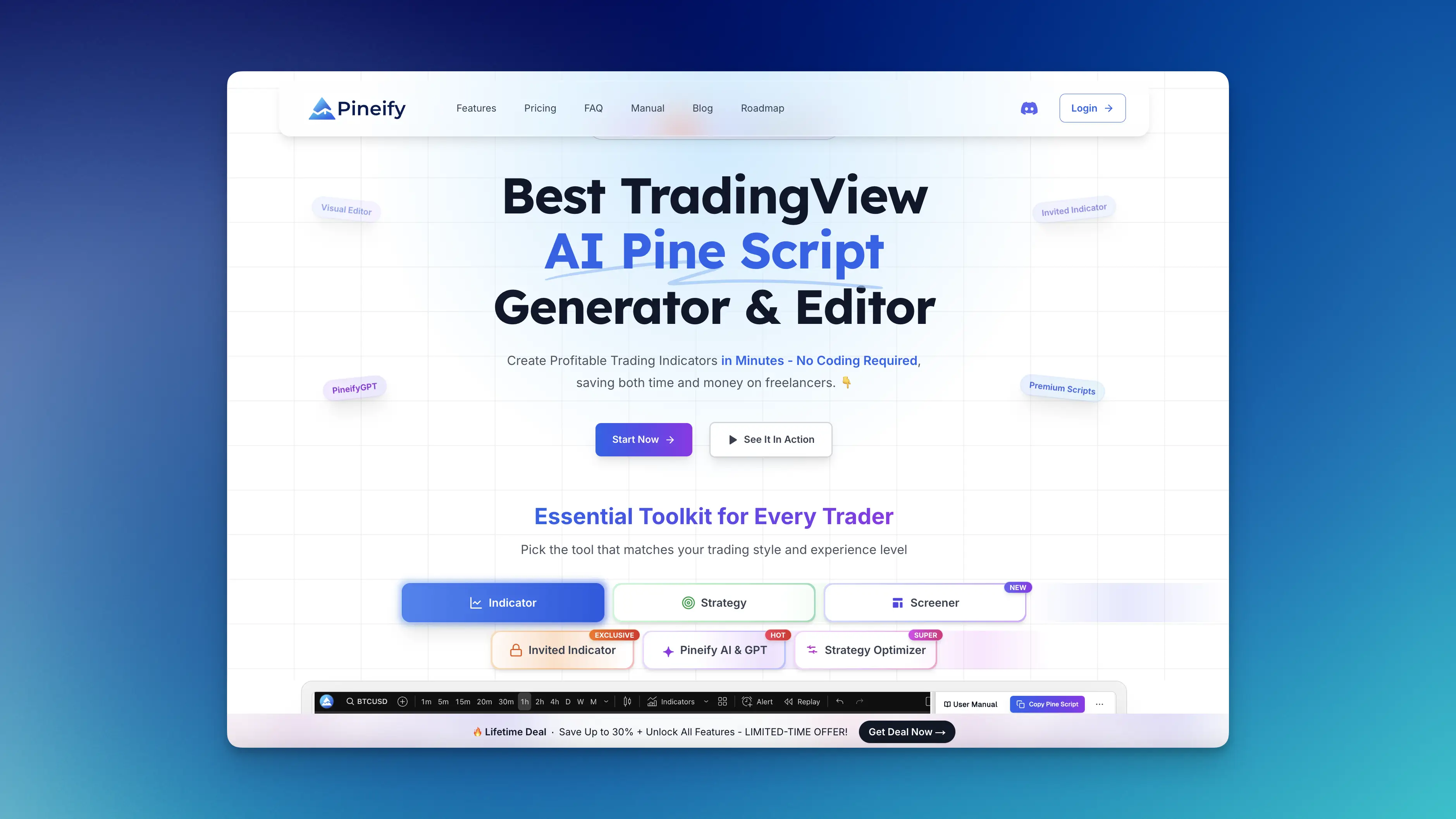
This is part of Pineify's 10-in-1 AI trading workspace, bringing institutional-grade data — real-time options flow, dark pool activity — directly to your screen. Over 100,000 traders use it to spot smart-money moves before they hit mainstream news.
-
Focus your options view. Set a filter for trades with a minimum premium of $25,000 and bullish sentiment. This cuts through noise and shows higher-conviction moves.
-
Look for signal agreement. When the same stock shows notable activity in Options Flow, Dark Pool, and Market Tide simultaneously, that multi-source confirmation is much stronger than any single signal.
-
Start each day with Market Tide. Before looking at individual stocks, check the Market Tide module each morning. It frames the market's current direction so every other signal has context.
-
Join the conversation. Share what you're seeing with the Pineify trading community. As you get comfortable, explore the AI Finance Agent for research and the Strategy Optimizer for fine-tuning TradingView strategies. For a comparison of AI tools in finance, see AlphaSense vs Pineify AI Finance Agent.
What is an options order flow tool and how does it work?
An options order flow tool captures every large options trade in real time and compares the execution price to the bid/ask spread to determine intent. Trades above the ask signal aggressive bullish buying. Trades below the bid indicate bearish urgency. It lets you see where institutional money moves before the price shows up on your chart.
How does Pineify Market Insights differ from traditional options screeners?
Traditional screeners show historical volume and open interest. Pineify streams live data across four integrated modules — Options Flow, Dark Pool, Market Tide, and Congress Trading — giving you a multi-source view instead of a single data point.
What are dark pool trades and why do they matter for retail traders?
Dark pools are private off-exchange venues where institutions trade large share blocks without moving the public price. About 40% of all U.S. stock trading happens off-exchange. Tracking these prints reveals hidden accumulation and distribution zones that often become key support or resistance levels.
How accurate and fast is the real-time options flow data?
Pineify processes over 50,000 options trades per market day with sub-second delivery. Options Flow and Dark Pool update in real time during market hours. Market Tide refreshes every 60 seconds. Congress Trading updates automatically when new disclosures are filed.
Can I use options flow data alongside technical analysis?
Yes. Options flow works best as a confirmation layer over technical setups. If a stock tests a key support level and you see large bullish sweeps in the flow simultaneously, that agreement between signals is stronger than either one alone.
What is the Market Tide metric and how is it different from the VIX?
Market Tide measures net premium — total call premium minus total put premium — traded across the entire options market. The VIX reflects implied volatility expectations. Market Tide shows where real capital is committed, making it a more direct read on institutional direction.
Is Pineify Market Insights a one-time purchase or a recurring subscription?
The Expert plan is a one-time payment of $259 (regularly $369) that grants permanent access to all four Market Insights modules plus additional tools including the AI Finance Agent, Strategy Optimizer, and Pine Script coding assistant. No recurring fees.