Option Flow Data: The Institutional Trading Edge

Big moves in the markets rarely happen completely in the dark. When hedge funds and institutional traders place huge options bets, they leave behind clues in the data. This trail of clues is known as option flow data. Learning how to spot and interpret this flow can shift how you see the market, whether you're trading in and out of positions daily or building a portfolio for the long run.
What Is Option Flow Data?
Option flow data is the real-time record of large, out-of-the-ordinary options trades happening across all U.S. exchanges. It's like having a window into where the big money is moving, almost in real time.
Stock traders often watch the "tape" — the stream of buy and sell orders — to get a feel for activity. Option flow serves a similar purpose for the options market. By tracking the flurry of calls and puts, you can see where serious capital is being put to work with conviction. For traders who also use technical analysis, understanding tools like the Moving Average Channel: How to Spot Breakouts and Trends Before Everyone Else can help confirm whether the price action aligns with the institutional flow you're seeing.
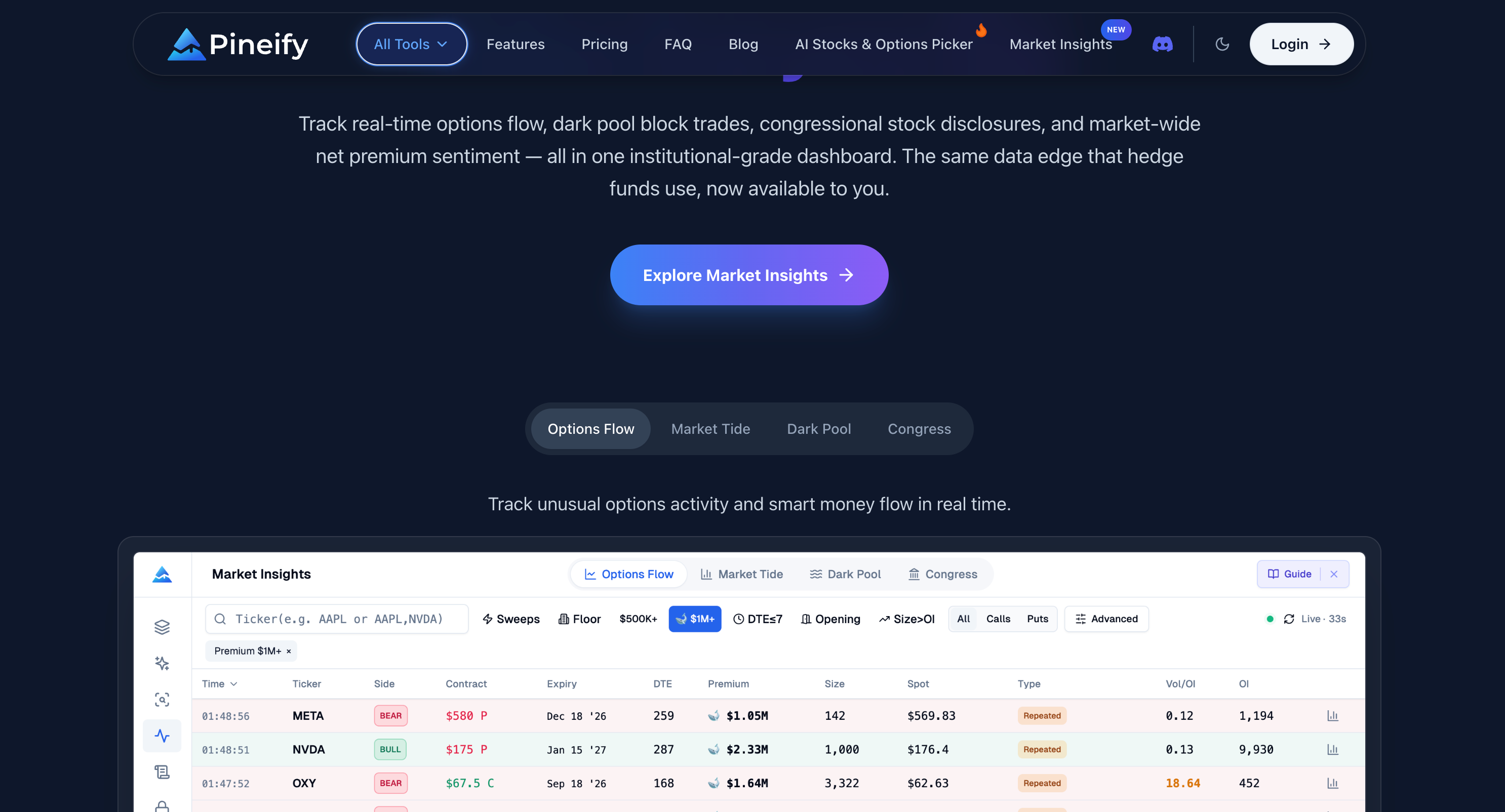
This kind of data isn't typically front-and-center on your average trading app. To find the meaningful signals, you usually need a dedicated scanner or dashboard built for this purpose. Some tools, like Pineify Market Insights, have started bringing this institutional-level view to everyone, pulling together options flow, dark pool activity, and other key signals into one clear snapshot.
The main idea here is straightforward: pay attention to where the big money goes. If an institution quietly spends millions on a specific option with a unique strike and expiration, it's a signal. That bet is often backed by deep research, complex models, or insights most of us don't see.
Why Paying Attention to Option Flow Can Change Your Trading
For a long time, individual traders were always a step behind. Big moves would flash across the screen, and by the time the story hit the news, the people who placed the early bets were often already cashing out. It felt like showing up to a party after all the good food was gone.
I've been watching option flow data for about three years now, and I still remember how it changed the way I see price action. I prefer to start my day scanning NVDA and AAPL flow before I look at a single chart. Here's what makes it useful in practice:
- Seeing what the big players feel: When you see huge amounts of call options being bought, it shows real bullish belief. On the flip side, massive put buying hints at serious concerns. It's about reading the room.
- Spotting the unusual: A sudden, out-of-nowhere surge in trading on a specific option strike, especially if there wasn't much open interest there before, can be a heads-up. It often happens right before a stock makes a big swing.
- Getting a clue before big news: Events like earnings reports are major catalysts. Often, institutional money starts building positions in the options market well in advance. This data lets you see those preparations.
- Staying in sync with the market: Having access to live flow means you can spot these opportunities and make decisions in real time, not hours later when the chance may have passed.
To give you a sense of scale, trading in U.S. options hit a record 9.87 billion contracts in 2021 — more than double the volume from just two years earlier, with a lot more individual traders participating now. With all that activity, knowing how to spot the important signals in the noise matters more than ever. Enhancing your workflow with the right tools, like exploring the Best TradingView Chart Colors for Enhanced Trading Experience, can reduce eye strain and help you process this complex data more effectively.
So you're looking at this stream of options trades and wondering what it all means. Think of each trade as a footprint — it tells you where big money is walking. To make sense of it, you need to know what each part of the data is pointing to.
Here's a breakdown of the key pieces you'll see in any options flow feed:
| Data Field | What It Tells You |
|---|---|
| Ticker Symbol | The underlying stock or ETF being targeted |
| Expiration Date | When the contract expires — shorter dates imply urgency |
| Strike Price | The target price the buyer expects the stock to hit |
| Premium Paid | Total dollar value of the trade; larger = higher conviction |
| Call / Put | Call = bullish bet; Put = bearish or hedge |
| Sentiment Tag | Above Ask = aggressive buyer; Below Bid = aggressive seller |
| Volume vs. OI | If volume exceeds open interest, activity is unusually high |
Once you get familiar with those fields, you can start connecting the dots. One of the most telling signs is that last row: Volume vs. Open Interest. When the trading volume for a contract is higher than its existing open interest, it's a strong clue. It means these are likely new positions being opened up aggressively, not just old ones closing out. Many traders watch for this specific signal because it shows fresh, committed money moving into a bet.
What Is Unusual Options Activity (UOA)?
Think of the options market as a constant hum of activity. Unusual Options Activity (UOA) is the moment that hum becomes a loud, distinct signal. It's when a specific options contract trades at a volume that's way above normal — often 5 to 10 times its average — in a very short period.
Why does this matter to everyday traders? Because this kind of spike often means someone with deep pockets and serious research has taken a strong position. It could be a hedge fund, a large institution, or a professional trader acting on a strong conviction about a coming price move, perhaps ahead of an earnings report or news event. While not a guaranteed win every time, spotting this activity gives you a clue about what the smart money might be doing, which is why so many pros keep a close eye on it.
The Three Main Types of Unusual Trades
When you see unusual activity, it usually falls into one of these three categories. Here's what each one can tell you:
| Trade Type | What It Is | What It Often Signals |
|---|---|---|
| Sweeps | A large order split across multiple exchanges to get filled fast. | Urgency and a clear directional bet. Someone wants in now. |
| Block Trades | A single, massive order executed all at once, often off-exchange. | Typically institutional activity. It's a big move, but with less immediate market impact. |
| Splits | A large order broken into smaller chunks to hide, then pieced together. | A desire to disguise size and intention to avoid moving the price while building a position. |
Tools like Pineify Market Insights can help make sense of this data. They automatically flag this kind of activity and use methods like Above Ask / Below Bid classification to gauge whether the trade is bullish or bearish. They also show you the full details — like the "Greeks" (Delta, Gamma, etc.) — so you can understand the trade's intent without having to crunch the numbers yourself.
How to Read and Use Option Flow Data
Understanding option flow isn't about chasing every big trade you see. Think of it more like putting together a puzzle. You want to see multiple pieces pointing to the same picture before you get confident. Here's a straightforward way to approach it that I've found helpful.
Step 1: Check the big picture first Begin your day by looking at which stocks are showing the most lopsided activity — either lots of bullish bets or lots of bearish ones. This quick scan helps you narrow down a huge list to just a few interesting names to look at more closely.
Step 2: Focus on the meaningful trades Not all trades are worth your attention. Prioritize the big ones, usually where the total premium paid is over half a million dollars, and that are marked as block trades or sweeps. These are more likely to be institutional moves. Many data services filter out the tiny trades for you (like only showing the top 100 trades per stock for contracts of at least 100 lots) to help cut through the clutter.
Step 3: See if the stock price agrees This is crucial. Never take a trade just because you saw a big options order. Pull up the stock chart and see if the price is actually moving in the direction the options flow suggests. If someone is buying a ton of calls and the stock is starting to break higher through a key level, that's a much stronger signal than if the stock is falling. I made the mistake of chasing a big TSLA call sweep in August 2024 without checking the chart first — the stock never confirmed and I watched that premium evaporate. You can refine your chart analysis with tools like those covered in Top TradingView Indicators for Institutional-Grade Signals and Market Reversals.
Step 4: Look at the "when" and "where" The details of the trade tell you about the trader's expectation.
- Short-dated, out-of-the-money options: This often signals a bet on a fast, sharp move in the stock.
- Longer-dated, in-the-money options: This could be a more conservative position or part of a larger hedging strategy, not necessarily an aggressive directional bet.
Step 5: Be patient with your entry When you see a compelling flow signal, the instinct is to jump in immediately. Sometimes it's better to wait. Big players often build their positions over days. Look for a slight pullback or a retest of a support level to enter, which can give you a much better price and a clearer place to manage your risk if you're wrong.
Seeing the Bigger Picture: Combining Options Flow with Market Signals
The most successful traders know that one signal isn't the whole story. Think of it like checking the weather: you wouldn't just look at the wind direction. You'd check the radar, the barometric pressure, and the forecast. It's the same in the market.
Tools like Pineify Market Insights help you do this by layering options flow with two other powerful types of data.
The Market Tide (Net Premium Sentiment): This is like the big-picture mood of the entire market. Instead of just looking at one stock, it measures whether more money is flowing into calls (betting on prices going up) or puts (betting on prices going down) across everything. When you see unusual activity in a single stock and the overall Market Tide is moving the same way, it adds more weight to your idea. It's like having the wind at your back.
Dark Pool Intelligence: Big institutions (like pension funds or mutual funds) often trade in private venues called "dark pools" to avoid tipping their hand. When a large, hidden buy order happens at a certain price, and at the same time you see bullish options flow for that same stock, it's a much stronger hint. Pineify tracks these big block trades and helps identify key price levels where this is happening, giving you clues about potential support or resistance.
Congress Trading Tracker: This one is unique. U.S. lawmakers are required to disclose their stock trades. Some traders watch this because studies suggest these trades, especially those reported late, have a track record of doing well. Pineify keeps an eye on all members of Congress, flags late filings, and lets you see each politician's activity.
When all three pieces of the puzzle — options flow, dark pool moves, and the overall Market Tide — start pointing in the same direction for a stock, it creates what many traders look for: a high-probability setup. It's like getting the same forecast from three different weather models. Your confidence in the trade idea grows.
I'll be honest about one limitation though. Option flow data won't tell you exactly when to enter or exit. It's a directional clue, not a timing signal. And during low-volume periods, like the last two weeks of December, the signals can be misleading — small trades look bigger than they are because the overall market is quiet. I haven't found a reliable fix for this, so I just trade less during those weeks.
Common Pitfalls to Avoid When Using Option Flow Data
Getting started with options flow can feel like learning a new language. It's easy to misinterpret the signals, and even seasoned traders can stumble on a few key points. Here are some common missteps to watch out for.
-
Chasing sweeps without waiting for confirmation. Seeing a big, aggressive order (a sweep) is exciting, but it's not a standalone "buy" signal. Think of it as a loud shout — you need to look at the chart to see if the market is actually listening and moving in that direction. Always check the price action for confirmation before following.
-
Forgetting the expiration date context. The time left on an option changes everything. A huge call trade with only two days until expiration is likely a desperate, short-term gamble. The exact same trade on an option with 60 days left is a completely different story — it's a patient, directional bet. Always note the expiration.
-
Reading all puts as bearish bets. This is a classic mix-up. When a big institution buys a large block of puts, your first thought might be "they're betting on a drop." Often, they're just buying insurance. If they hold a massive amount of a stock, buying puts is a hedge to protect that investment, not a vote against it.
-
Getting distracted by the dollar amount alone. A $2 million trade sounds huge, right? But on a stock trading at $500 per share, it's a relatively modest move. Meanwhile, a $500,000 trade on a $20 stock is a much more significant proportional bet. Focus on the relative size, not just the flashy headline number.
-
Missing the signal in volume vs. open interest. Volume tells you how many contracts traded today. Open Interest tells you how many total contracts exist. The magic happens when volume exceeds open interest at the end of the day — it's a strong clue that someone is opening a brand new, aggressive position, not just closing an old one. This is the fresh momentum you want to spot.
Gone are the days when option flow was a secret tool only for the big players. These days, the data that shows what the smart money is doing is out there for anyone to see. The real trick is knowing how to use it.
Think of it like having a live feed into the market's biggest moves. If you want to get started, here's a path that's worked for me:
-
Take a Look at Pineify Market Insights. Start at pineify.app/market-insights. It pulls together options flow, dark pool activity, and other useful signals into one view, so you're not jumping between a dozen screens. This suite consolidates institutional-grade data — real-time options flow, dark pool block trades, and congressional trading disclosures — into a single, actionable dashboard.
-
Begin Your Day with a Summary. Before the market opens, check which stocks are showing the most bullish or bearish activity. It's a simple habit that sets you up for the trading day ahead.
-
Practice Reading the Tapes. Don't just watch live flow. Go back and see what happened after big trades were placed in the past. Did the stock move as the flow suggested? This practice is how you build a feel for what the data is really saying. Complementing this analysis with a tool like an AI Trading Journal: Boost Your Trading Performance with Automated Insights can help you systematically track the outcome of these signals and refine your process.
-
Never Rely on One Signal. Option flow is a powerful clue, but it's not a crystal ball. Always see how it lines up with the stock's actual price chart, what's happening in its sector, and the broader market mood. Tools like Pineify's AI Finance Agent can help here, providing real-time analysis that combines flow data with financials, news, and social sentiment for a more complete picture.
-
Filter the Noise. There are thousands of trades every day. Use filters and alerts to highlight only the activity that matters for your style of trading. This keeps you focused and stops you from getting overwhelmed.
The information that gives traders an edge has always been hidden in plain sight, within the data. Now that it's accessible, it's really about whether we choose to learn its language. Platforms that integrate this data directly into a broader trading workflow — from AI-powered research and stock picking to strategy building and journaling — remove the friction and let you focus on making informed decisions.
What is the difference between option flow data and standard options volume data?
Standard options volume tells you how many contracts traded. Option flow data goes deeper — it highlights large, unusual trades in real time, flags whether orders were executed above the ask or below the bid, and identifies sweeps, block trades, and splits. It's specifically designed to surface institutional-level activity, while basic volume is just a raw count.
How do I know if an unusual options trade is a directional bet or just a hedge?
Context is everything. Look at whether the institution already holds a large stock position — puts on a stock they own are likely a hedge, not a bearish bet. Deep in-the-money puts on a long position are classic hedges, while out-of-the-money calls with short expiration on a stock with no existing position are usually directional bets. Combining flow with dark pool data and the stock chart helps clarify intent.
What is a sweep order in options flow and why does it matter?
A sweep order is a large options order split and routed across multiple exchanges simultaneously to get filled as fast as possible. It signals urgency — the buyer wants in right now. Sweeps are often a sign of strong directional conviction and are among the most watched signals in options flow analysis.
Can retail traders access real-time option flow data without expensive institutional terminals?
Yes. Platforms like Pineify Market Insights have made real-time options flow, dark pool block trade data, and market sentiment signals accessible to individual traders at a fraction of institutional terminal costs. These tools automatically filter for meaningful large trades, classify them as bullish or bearish, and display the Greeks so you don't have to calculate them manually.
How should I combine option flow data with technical analysis for better trade decisions?
Use option flow as a directional hypothesis generator, then confirm with your chart. If you see heavy bullish call sweeps on a stock and the price chart shows a breakout above a key resistance level with rising volume, the confluence is much stronger than either signal alone. Wait for price confirmation before entering, and use the options expiration date as a guide for your trade time horizon.
What does it mean when options volume exceeds open interest?
When daily options volume on a specific contract exceeds the total open interest for that contract, it strongly suggests new positions are being opened aggressively rather than existing positions being closed or rolled. This is a key signal in option flow analysis because it points to fresh institutional conviction entering the market, which often precedes a meaningful price move in the underlying stock.