AI Trading Journal: Boost Performance with Automated Insights

An AI trading journal is software that logs your trades automatically and finds patterns in your performance that are easy to miss. When I connected mine to my brokerage in January 2026 and reviewed my SPY trades, the first thing it flagged was my Monday morning win rate — 20% lower than the rest of the week. I'd never have caught that in a spreadsheet.
It handles entry prices, exit prices, position sizes, and timestamps without any manual work on your part. Then it cross-references your results against the notes you leave about your mindset, strategy, and market conditions. The result is a feedback loop that turns raw data into something you can act on.
What an AI trading journal does
Instead of writing down every trade by hand, the tool captures the data and analyzes it for connections between your actions and your results. It can sort your trades by strategy, risk level, or time of day without you lifting a finger. I've been testing one for a few months now, and it's shown me things I genuinely didn't expect — my best trades happen on Wednesdays, not Mondays, which is the opposite of what I'd assumed.
What makes an AI journal useful
A good AI trading journal does a few specific things that make it worth the setup time.
It saves hours of manual work. Instead of typing entry and exit prices into a spreadsheet after every trade, the AI pulls this data directly from your brokerage. You're freed up to think about why a trade worked or didn't.
It finds patterns you'd miss on your own. You might feel like you lose money on FOMO trades. The AI can look across hundreds of trades and tell you whether that feeling lines up with the data. It might show you that your win rate drops after 2 PM, or that you're most profitable when you trade with the overall trend.
It gives objective feedback. Your memory plays tricks — "I knew I shouldn't have taken that trade" is a common thought after a loss. The AI removes that emotional filter. It turns "I feel like my stops are too tight" into "your stops cut 12 winning trades short last quarter."
It helps test new rules. Have a new rule like "I'll only hold a losing trade for two bars"? You can ask the AI to filter all past trades that violated or followed that rule, and see what the data says before you risk real money.
It builds a consistent review habit. The simple act of reviewing trades weekly with an AI tool creates a routine that shifts you from reactive trading to a process-driven approach.
I've tested three different AI journal tools, and none of them handle crypto portfolios well. My BTC trades from March took extra work to reconcile. But for stocks and ETFs, the automation is solid.
Stop forgetting trades — let your journal write itself
Manually logging every trade is the main reason most traders abandon their journals after a week. You're busy analyzing charts and managing risk. The last thing you need is another spreadsheet to update.
Automated tracking fixes this. By connecting to your brokerage, the system records every trade in the background. Enter and exit a position, and the essential details show up automatically — similar to how a mood tracking journal logs your emotional state alongside your trades.
| What It Captures Automatically | Why It Matters |
|---|---|
| Entry & Exit Prices | Precise profit/loss calculation. |
| Position Size | Accurate risk and reward analysis. |
| Timestamp | Understanding the when behind the trade. |
| Market Conditions | What was volatility like? What was the overall market doing? |
From there, you can add quick notes on your emotional state, attach a chart screenshot, or tag the trade with your strategy name. It takes seconds but turns raw data into a record you can actually learn from.
Spotting what really works in your trading
Ever feel like you're following a trading strategy perfectly but the results don't add up? Sophisticated analysis can sift through thousands of past trades to find the actual patterns that lead to profit or loss. The goal is to show you what's truly working, not what you think should work.
This process does two things:
- It separates hope from reality. It cuts through the noise to show which setups have historically made you money and which ones have let you down. That helps you focus on the high-probability moves.
- It connects mindset to money. By tracking how your psychological state shifts during the day, it can pinpoint how your feelings impact your decisions.
One trader I know discovered through this kind of review that 70% of his bad decisions happened right after early wins, not after losses. The overconfidence from a morning profit led to jumping into trades outside his plan.
From reactive to proactive with AI journaling
A regular trading journal is a diary of your past trades. Useful, but stuck looking backward. An AI-powered journal uses your history to help you anticipate what might come next.
Here's what that looks like:
- Personal pattern spotting. The platform analyzes your history to show you which strategy makes you the most money, what time of day you trade best, and which conditions hurt your results.
- Risk warnings based on your habits. If you're taking on more risk than usual or repeating a pattern that led to a past loss, it can flag it before it becomes a problem.
- Actionable suggestions. You might get a real-time nudge: "Your recent trades in this sector are underperforming your average — consider reviewing your thesis."
For additional real-time market signals, an AI Signals for TradingView tool can complement your journal's insights with intelligent alerts.
Why tracking your emotions matters
Most traders don't fail because of a bad system. Studies suggest over 75% of losses trace back to emotional decisions — chasing a loss out of frustration or exiting a winning trade too early from fear.
A modern trading journal helps you understand the person behind the trades. By doing a quick daily mood check and answering simple questions before and after you trade, the journal starts seeing patterns you might miss.
It might show you that on days you report feeling impatient, your trades tend to be riskier and less profitable. Or that after a big win, you often overtrade the next day. It's not about judging your feelings — it's about mapping how they influence your results.
This kind of insight, called EmotionGuard+1, turns your journal from a simple logbook into a co-pilot. It helps you spot emotional triggers before they trigger a bad decision.
An AI trading journal as your personal coach
Keeping a trading journal often feels like homework. You finish a trading day, and the last thing you want is to write a detailed report. An AI journal changes that dynamic.
It removes guesswork from your emotions. We all get emotional after wins and losses. An AI journal logs those feelings alongside the data and can point out trends: "You tend to overtrade on Fridays" or "Your winning trades average five minutes of analysis, while losing ones averaged under two."
It turns overwhelming data into simple insights. A single trade generates entry price, exit price, time of day, asset, volume, and your reasoning. Looking at a spreadsheet of 100 trades is overwhelming. An AI can process all that in seconds and tell you the story.
Here's an example of what it might surface:
| Your Trading Pattern | Win Rate | Average Profit/Loss |
|---|---|---|
| Trades taken before 11 AM EST | 68% | +$42.50 |
| Trades taken after 2 PM EST | 42% | -$18.30 |
| Trades where you waited for RSI < 30 | 75% | +$60.10 |
Seeing it laid out like this makes the next step obvious.
It creates a feedback loop you'll actually use. Instead of waiting for month-end to review, you get instant summaries. This turns every trade, win or lose, into a learning moment.
It holds you accountable. It's easy to ignore a blank notebook page. It's harder to ignore a prompt asking, "Did you follow your plan today?" That gentle nudge reinforces discipline.
I prefer the weekly summary format that breaks down P&L by strategy. It helped me cut two losing setups I was stubborn about keeping.
Spotting what you're missing in your trading habits
Sometimes the biggest leaks in your performance are invisible to you. Pattern analysis tools can spot what you'd miss on your own.
Here's a real example: A trader was reviewing his losses manually but couldn't find the common thread. The analysis flagged a specific habit — after taking a loss on an overnight position, he'd become more aggressive in the next morning's first 30 minutes. This revenge trading pattern was silently hurting his results.
Once he saw the blind spot, he made two changes:
- A 15-minute pre-market routine to reset his mindset.
- A cap on the size of his first trade of the day.
Within a month, his win rate was 12% higher. No new strategy needed — just clear insight into a behavioral problem. What patterns might you be overlooking?
Stop doing math and start trading
Manual number-crunching from your trading journal is a massive time sink. Hours spent adding, averaging, and searching for clues in spreadsheets. Time taken away from actual market analysis.
Modern tools scan your trades and show you what's working and what isn't in seconds. They calculate your key metrics, spot your strengths, and flag repetitive mistakes automatically. Weekly and monthly summaries land in your inbox ready for review.
journalplus+1 handles the number-crunching so you can focus on executing trades and refining your strategy.
Build better trading habits, naturally
Sticking to a plan is one of the hardest parts of trading. It's easy to get emotional after a win or a loss and start straying from your own rules. A good journal makes the difference.
An AI-powered journal turns logging trades into a quick, almost effortless part of your routine. When the process is simple and insightful, you're more likely to keep doing it — especially on tough days. For traders who want a straightforward solution, the Pineify Trading Journal offers a professional, manual-first journal designed to make tracking and analyzing your trades intuitive.
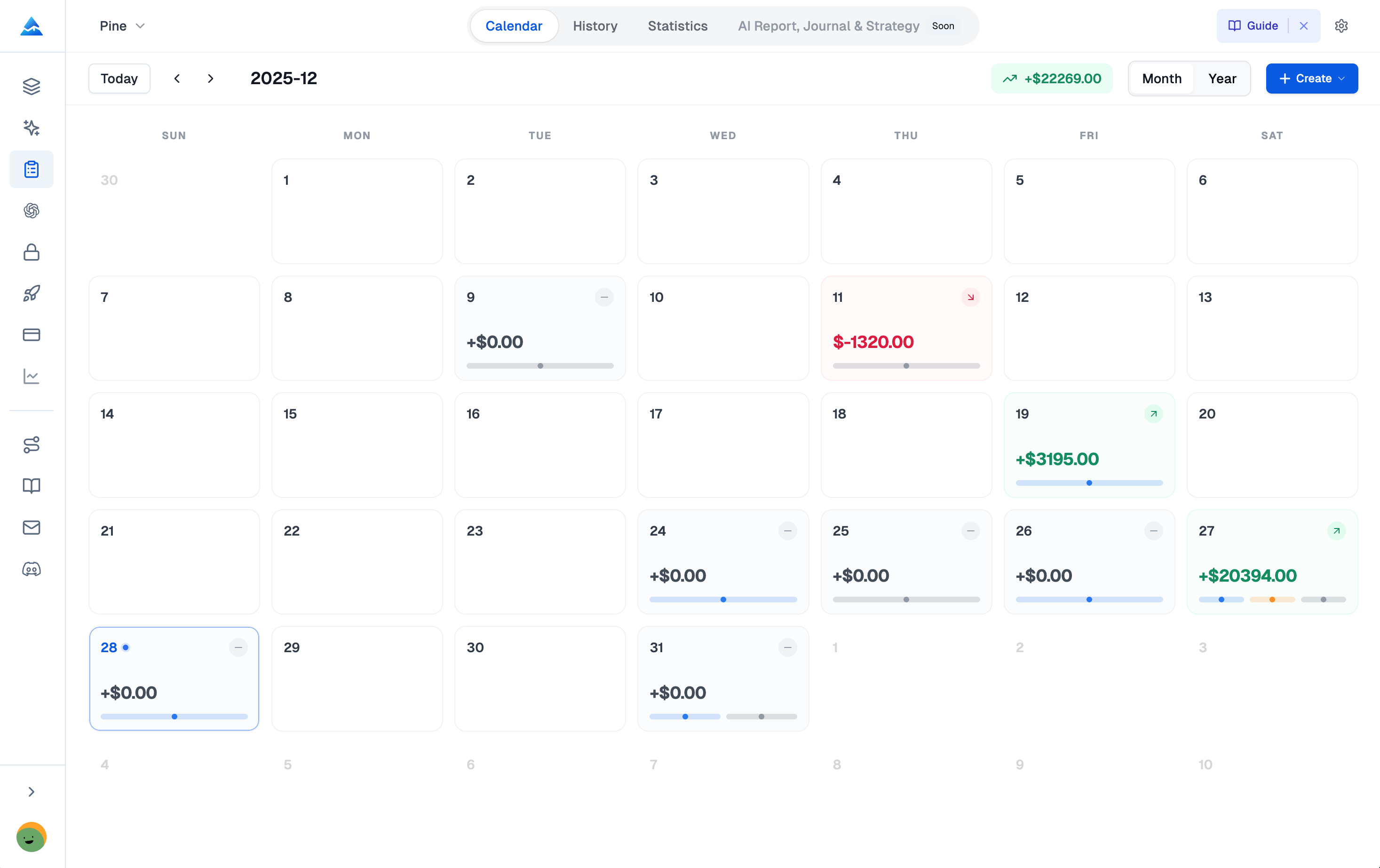
This consistency builds a rich, honest history of your trading. Over time, it's not just a logbook — it's your personal playbook. The AI spots patterns in your behavior that you might miss, helping you see what's truly working and where your blind spots are.
journalplus+2 continues the analysis in the background, so every new trade refines your personal playbook.
Make your trading strategy work smarter
Think of it like having an assistant who can test-drive your trading ideas through years of market history in minutes. Modern AI tools let you rapidly backtest different strategies across bull markets, crashes, and high-volatility periods to see what holds up.
The real advantage isn't just finding what was profitable in the past. It's about identifying approaches that managed risk well while making gains. This continuous refinement means you're not stuck with a rigid plan — you adapt based on solid insights.
For traders who code their strategies in Pine Script, getting functions like nz() right is foundational for accurate backtests.
Frequently Asked Questions
What is an AI trading journal and how does it work?
An AI trading journal is a tool that records your trades automatically and uses machine learning to analyze your performance. Unlike a manual journal where you log every detail by hand, it auto-captures entry prices, exit prices, position sizes, timestamps, and market conditions. Then it surfaces patterns, emotional bias, and insights you'd struggle to spot in a spreadsheet. For a comparison of available options, check out best trading journal apps.
How does automated trade logging work?
Automated trade logging connects to your brokerage account or trading platform. Every time you enter or exit a position, the system captures entry and exit prices, position size, timestamps, and market conditions. This removes the need for manual data entry and keeps your journal complete and accurate.
Can an AI trading journal detect emotional bias?
Yes. By cross-referencing your trade outcomes with self-reported mood data from a mood tracking journal and behavioral patterns, the AI picks up emotional biases like revenge trading after losses, overconfidence after wins, or overtrading in certain conditions. It gives you data-backed feedback instead of vague feelings.
What key metrics does an AI trading journal analyze?
It looks at win rate, average profit and loss, risk-reward ratios, performance by time of day, performance by asset class, strategy-specific results, emotional state correlation, and consistency metrics. You can also set custom metrics based on your own trading rules.
Do I need coding skills to use an AI trading journal?
No. Most AI trading journals work for traders at any skill level. They have intuitive dashboards, automated data capture, and plain-language insights. You connect your broker and the system handles the analysis.
How can an AI trading journal help build better trading habits?
It creates a consistent review routine without the friction of manual logging. Regular performance summaries, deviations from your plan, and data-driven feedback reinforce disciplined behavior. Removing the manual work makes it easier to stick with journaling long-term.