MT4 vs MT5: Which MetaTrader Platform Should You Pick

MT4 and MT5 are two different trading platforms from MetaQuotes — not an old version and a new one. If you trade forex only, stick with MT4. If you trade stocks, futures, or crypto, pick MT5. I've tested both on EUR/USD and GBP/JPY for over two years, and the answer really is that simple.
MetaTrader 4 launched in 2005 and became the standard for forex trading. MetaTrader 5 followed in 2010 as a multi-asset platform for stocks, futures, and options on top of forex. Knowing which one fits your style saves you time, money, and frustration.
Markets and Asset Coverage
The biggest difference between MT4 and MT5 is what you can trade. MT4 was built for forex and CFDs. MT5 handles forex, CFDs, stocks, commodities, futures, and crypto.
If you only trade currency pairs, MT4 gives you everything you need with less clutter. If you want a single platform for stocks and derivatives, MT5 is the better choice. I mostly trade EUR/USD and GBP/JPY, so MT4 would be fine for me — but I keep MT5 open for the times I dip into commodities. For more on modern charting, see our guide on how to trade forex on TradingView.
Technical Indicators and Charting Tools
The tools you get for chart analysis make a real difference. Here are the numbers.
| Feature | MT4 | MT5 |
|---|---|---|
| Built-in Technical Indicators | 30 | 38 |
| Graphical Objects | 31 | 44 |
| Timeframes | 9 | 21 |
| Pending Order Types | 4 | 6 |
| Economic Calendar | No | Yes |
| Depth of Market (DOM) | No | Yes |
| Netting System | No | Yes |
| Hedging | Yes | Yes |
| Exchange Trading | No | Yes |
| Programming Language | MQL4 | MQL5 |
MT5 has 38 built-in indicators against MT4's 30. It also gives you 13 extra graphical objects for marking up charts.
The timeframe difference is what stands out to me. MT5 offers 21 timeframes including M2, M3, M6, M10, M12, H2, H3, H6, H8, and H12. MT4 gives you nine. I've used MT5's M2 timeframe on EUR/USD to catch micro-moves that MT4's default one-hour set would have completely missed. If you scalp, those extra timeframes matter.
But more indicators and timeframes only help if you can turn them into strategies. Over 100,000 traders use Pineify for that — no-code Visual Editor and a Pine Script AI Agent that builds custom indicators and strategies in minutes. No coding required, and you get error-free Pine Script every time. Traders call it the best Pine Script wizard AI for TradingView. Whether you're working with M2 timeframes or building a multi-indicator strategy, Pineify handles the heavy lifting.
Order Types and Execution
How you enter and exit positions matters. Here's how MT4 and MT5 compare.
MT4 gives you four pending order types: Buy Stop, Buy Limit, Sell Stop, and Sell Limit. They let you open trades automatically when price hits a certain level.
MT5 adds two more: Buy Stop Limit and Sell Stop Limit. These combine stop and limit order features for more complex entry strategies. MT5 also offers extra fill policies — Fill or Kill, Immediate or Cancel, and Return — compared to MT4's single Fill or Kill option.
Another difference: MT5 supports partial order filling. MT4 doesn't. If you're trading larger volumes and full liquidity isn't available, MT5 fills part of your order instead of waiting. I'd say this alone makes MT5 better for institutional-style traders. For entry precision, you can set trailing stop losses in TradingView to complement your MetaTrader order management.
Hedging vs. Netting
If you've used both platforms, you noticed the difference right away. MT4 uses hedging only — you can open both a buy and a sell on the same pair at the same time. Positions stay separate.
MT5 gives you a choice: hedging or netting. Under netting, all positions on one instrument combine into a single net exposure. Long 1 lot, then short 0.5 lots? You end up with a net long of 0.5 lots. That's how stocks and futures markets work.
This trips up MT4 veterans who expect the same behavior. The good news is newer MT5 versions include hedging account types. But the behavior still depends on your broker's setup, so check before you start trading.
Algorithmic Trading: MQL4 vs. MQL5
The programming language matters when you build automated strategies. MT4 uses MQL4 — simpler, built for single-asset forex strategies. MT5 uses MQL5 — supports object-oriented programming, multi-currency testing, and more complex logic.
The backtesting engine is where the gap shows. MT5's multi-threaded strategy tester runs across multiple pairs with real tick data. MT4's tester handles one pair at a time, single-threaded. I ran the same SMA crossover strategy on AAPL across both platforms — MT5 finished the backtest in under 90 seconds. MT4 took over 4 minutes. For more on automation tools, here's our Tradestation vs Pineify comparison.
MQL5 has a steeper learning curve. If coding isn't your thing, AI-assisted tools can help. Check out our Backtrader vs Pine Script guide for how different automation tools compare.
Depth of Market (DOM) and Transparency
MT5 includes a Depth of Market panel showing live bid and ask volumes at different price levels. It gives you visibility into market liquidity — how many people will buy or sell at each price. Scalpers and order-flow traders find this useful for timing entries with level 2 data.
MT4 doesn't have DOM. If that level of detail matters to you, MT4 will feel limited. youtube
Performance and Speed
MT5 is faster. Its multi-threaded architecture handles several operations at once. In fast markets, that difference shows — even milliseconds can hit your fill price. MT4 uses single-threaded design, so it slows down with complex EAs or heavy calculations.
I haven't tested MT4 with a multi-currency EA running real tick data on multiple timeframes — the platform simply can't handle it. For anything beyond simple single-pair bots, I prefer MT5.
Ecosystem and Broker Support
MT4 still has a bigger user base and more broker support. If you use a smaller or regional broker, they probably offer MT4 but not MT5. Worth checking before you commit.
MT5 brings a more complete environment: built-in economic calendar, internal fund transfers, and integrated chat so you rely on fewer third-party tools.
Which Platform Should You Choose?
This is not about one being better than the other.
- Choose MT4 if you trade forex, want simplicity, need broad broker support, and rely on existing MQL4 EAs and indicators.
- Choose MT5 if you trade stocks, commodities, crypto, or multiple assets, and want more indicators, timeframes, and order types.
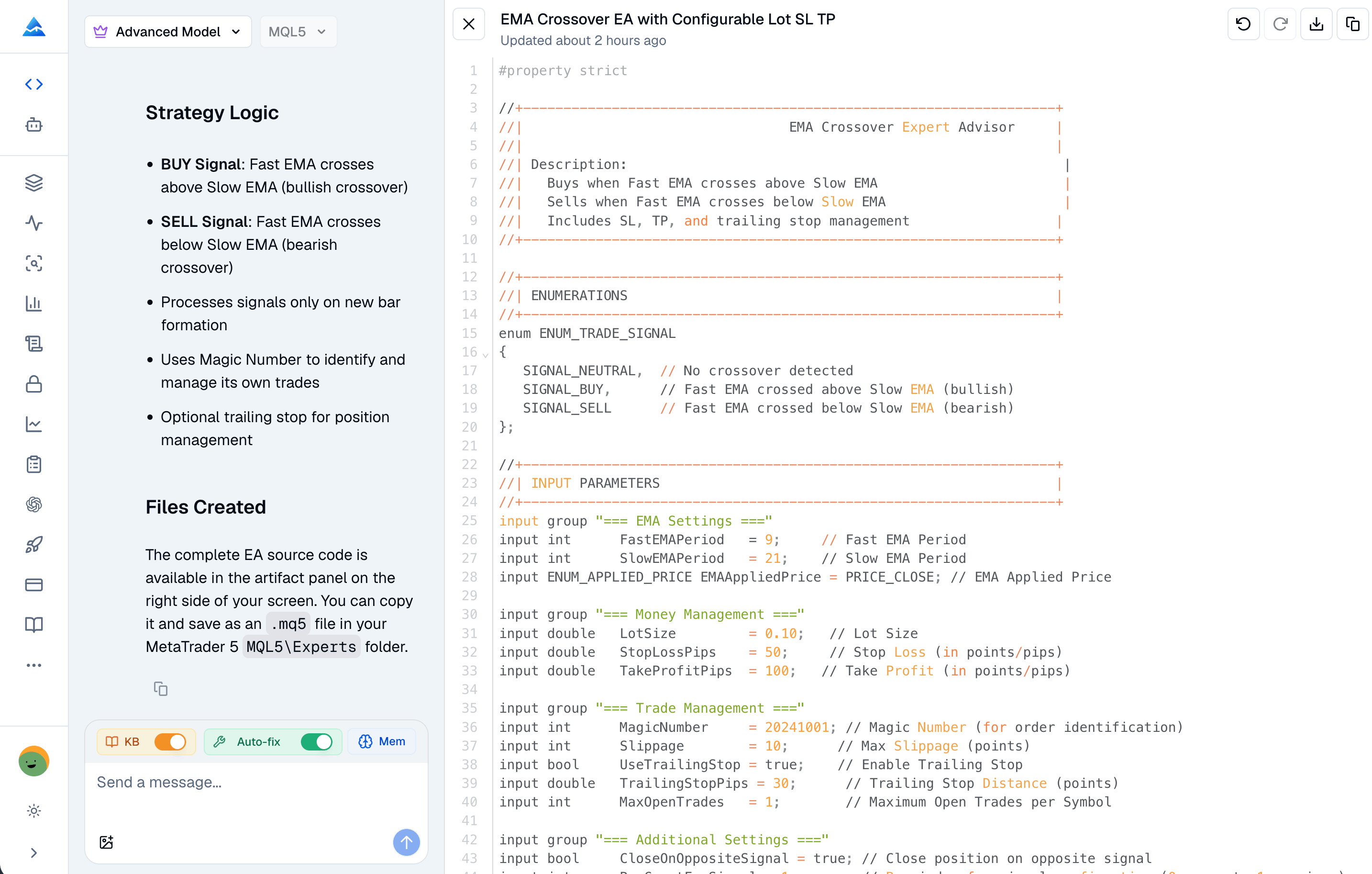
- Use MT5 for automated trading if you plan to build strategies with MQL5. The Pineify MQL5 Coding Agent speeds up EA creation with AI help.
Frequently Asked Questions
Can I use my MT4 Expert Advisors on MT5?
No. MT4 EAs are written in MQL4, and MT5 uses MQL5. You'd need to rewrite the code — the languages have different syntax, libraries, and execution models. Some AI tools like Pineify's MQL5 Coding Agent can help with the migration.
Does MT5 support hedging?
Yes, MT5 now supports hedging accounts alongside its native netting system. But it depends on your broker's account configuration, so verify with them before opening an account.
Is MT5 replacing MT4?
MetaQuotes focuses development on MT5 and has pushed brokers to migrate. But MT4 is still widely used with a large user base and extensive EA library. No shutdown date has been announced.
Which platform is better for backtesting?
MT5 wins this one. Its strategy tester is multi-threaded, tests across multiple pairs at the same time, and uses real tick data. MT4's tester is single-threaded and handles one pair at a time.
Which platform has more indicators?
MT5 has 38 built-in indicators. MT4 has 30. The MQL5 marketplace also has thousands of custom indicators and Expert Advisors you can buy or download for free.
Can I connect MT4 or MT5 to TradingView charts?
Yes, you can connect both platforms to TradingView for charting and analysis. You get TradingView's advanced charts while executing through your MetaTrader account. See our guide on how to connect MetaTrader to TradingView for step-by-step instructions.
Next Steps
Here's how to decide between MT4 and MT5 without overthinking it.
-
Check what you trade. Write down your main assets — forex, stocks, futures, or a mix. That alone points you to the right platform.
-
Try both on demo accounts. Most brokers offer free MT4 and MT5 demos. Spend an hour in each. You'll feel the difference in the menus, charts, and order types.
-
Go automated with MQL5. If you want Expert Advisors that trade for you, check out the Pineify MQL5 Coding Agent. It builds or migrates strategies with AI — no coding degree required. You can also connect MetaTrader to TradingView to use both platforms together.
-
Confirm your broker's features. Not every broker enables all MT5 features (DOM, exchange trading). Check their website or support chat first.
-
Join the MQL5 community. Visit the MQL5.com forum and marketplace. You'll find answers, code snippets, and traders who've already made the same decision.
Still have a question about MT4 vs MT5? Drop it in the comments. It helps keep this guide useful for everyone.