Spot 16 Candlestick Patterns on TradingView Automatically

Ever missed a perfect Hammer pattern right at a support level? Or watched a Doji form at resistance but only noticed it three candles later? Yeah, me too. That's exactly why I started using a candlestick pattern indicator — it catches everything I miss when I'm juggling multiple charts.
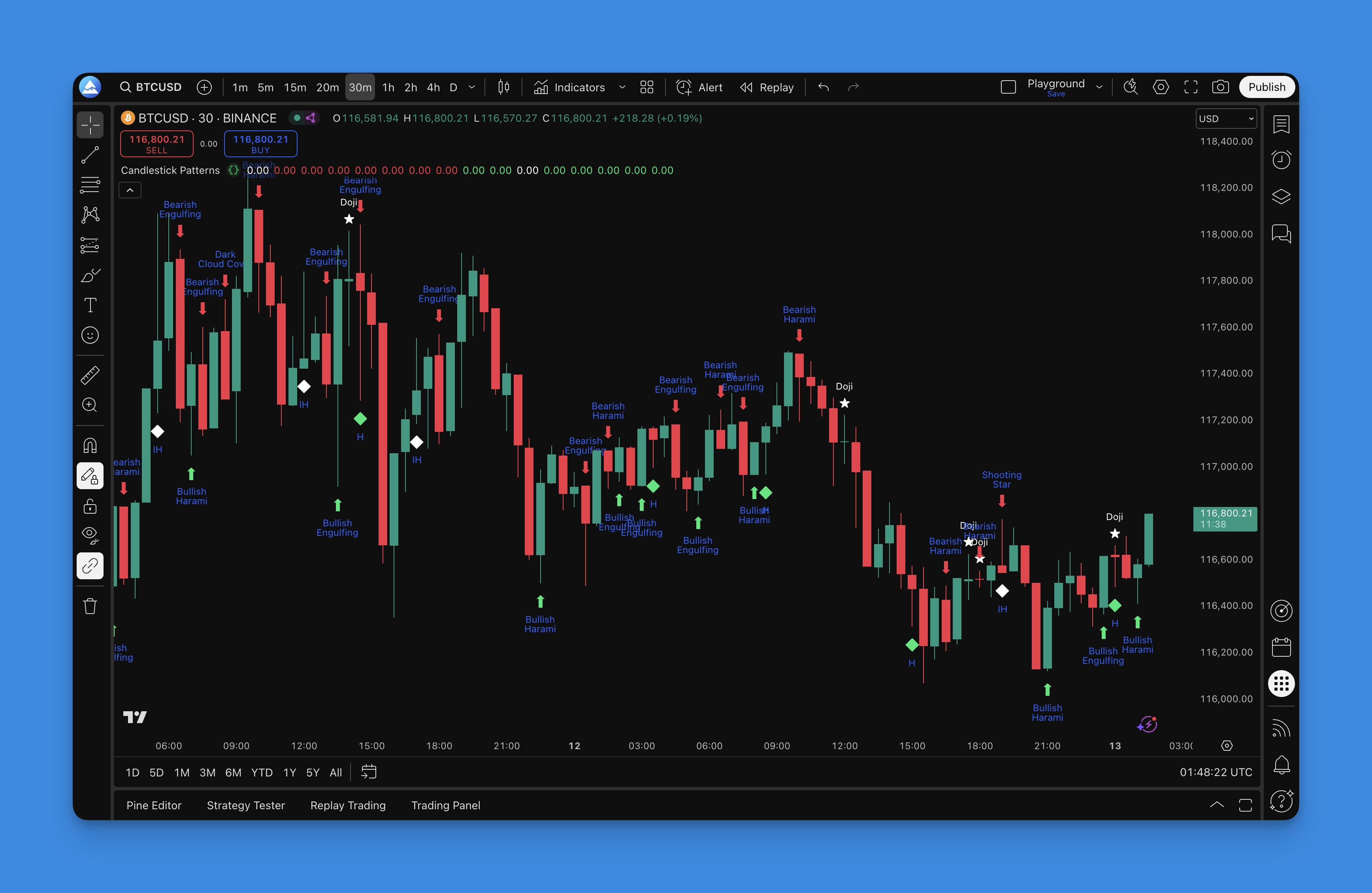
A candlestick pattern indicator is a Pine Script tool that scans for 16 common formations — Doji, Hammer, Engulfing, Morning Star, Evening Star, Harami, and others — and labels them directly on your TradingView chart as they appear. It runs in real time so you never second-guess what you're seeing.
What Makes This Indicator Different
Most traders I know can spot the obvious stuff — like a massive Hammer after a selloff on AAPL. But the subtle ones? Harami patterns that signal trend exhaustion on EURUSD daily charts? Evening Stars on SPY that look almost like regular candles until you zoom out?
This indicator removes the guesswork entirely. It continuously monitors your charts and instantly marks any of these 16 pattern types:
Reversal Patterns
- Doji: Shows market indecision — great for spotting potential reversals
- Hammer & Inverted Hammer: Classic bottom-fishing signals
- Shooting Star: Often marks temporary or major tops
- Morning Star: Three-candle bullish reversal pattern
- Evening Star: Three-candle bearish reversal pattern
- Engulfing Patterns: When one candle completely "eats" the previous one
Continuation Patterns
- Harami Patterns: Inside bars that often lead to trend continuation
- Belt Hold Patterns: Strong single-candle moves in the trend direction
- Kicker Patterns: Gap openings that confirm momentum
Visual System That Actually Makes Sense
Instead of cluttering your chart with confusing symbols, the indicator uses an intuitive color-coding system:
- Green arrows: Bullish patterns (potential buying opportunities)
- Red arrows: Bearish patterns (potential selling setups)
- White diamonds: Neutral patterns (market uncertainty)
- Clear labels: So you know exactly which pattern triggered
Everything appears in real time. No more missing patterns because you were looking at another chart or stepped away for coffee.
Why I Switched from Manual Pattern Recognition
Before using this indicator, I spent way too much time staring at individual candles. I'd spot a potential Doji on TSLA, then waste five minutes debating whether the wicks were close enough to qualify. On March 12, I missed a clean Hammer on NVDA at the $95 support level because I was busy analyzing a different timeframe. That trade would've netted a 4:1 risk-reward.
Now I monitor multiple instruments simultaneously while the indicator handles the pattern recognition. It's like having a trading assistant that never gets tired.
How the Detection Logic Works
The indicator compares each candle's open, close, high, and low against predefined criteria for each of the 16 patterns. A Doji triggers when the body (|open - close|) is less than a configurable percentage of the total range. A Hammer requires a small body in the upper half of the candle with a lower wick at least twice the body size. Engulfing patterns fire when the current candle's body completely covers the previous candle's body in the opposite direction.
These conditions evaluate on every tick, so the moment a candle closes that satisfies the rules, the pattern is marked. I've adjusted the sensitivity parameters on mine to avoid false signals during low-volatility sessions.
Recommended Timeframes
| Pattern Type | Best Timeframe | Notes |
|---|---|---|
| Doji | 15m - 1H | Works on any timeframe, fewer false signals on higher ones |
| Hammer / Shooting Star | 30m - 4H | Needs enough wick length — lower timeframes produce noise |
| Morning / Evening Star | 1H - Daily | Three-candle patterns need room to form |
| Engulfing | 15m - 1H | Reliable on intraday charts with decent volume |
| Harami | 1H - 4H | Best in trending markets, not choppy ones |
| Kicker | Daily+ | Gap-based — more meaningful on higher timeframes |
On the 5-minute chart I get too many false positives. Stick to 15-minute or above for consistent results.
Setting Up Your Detection
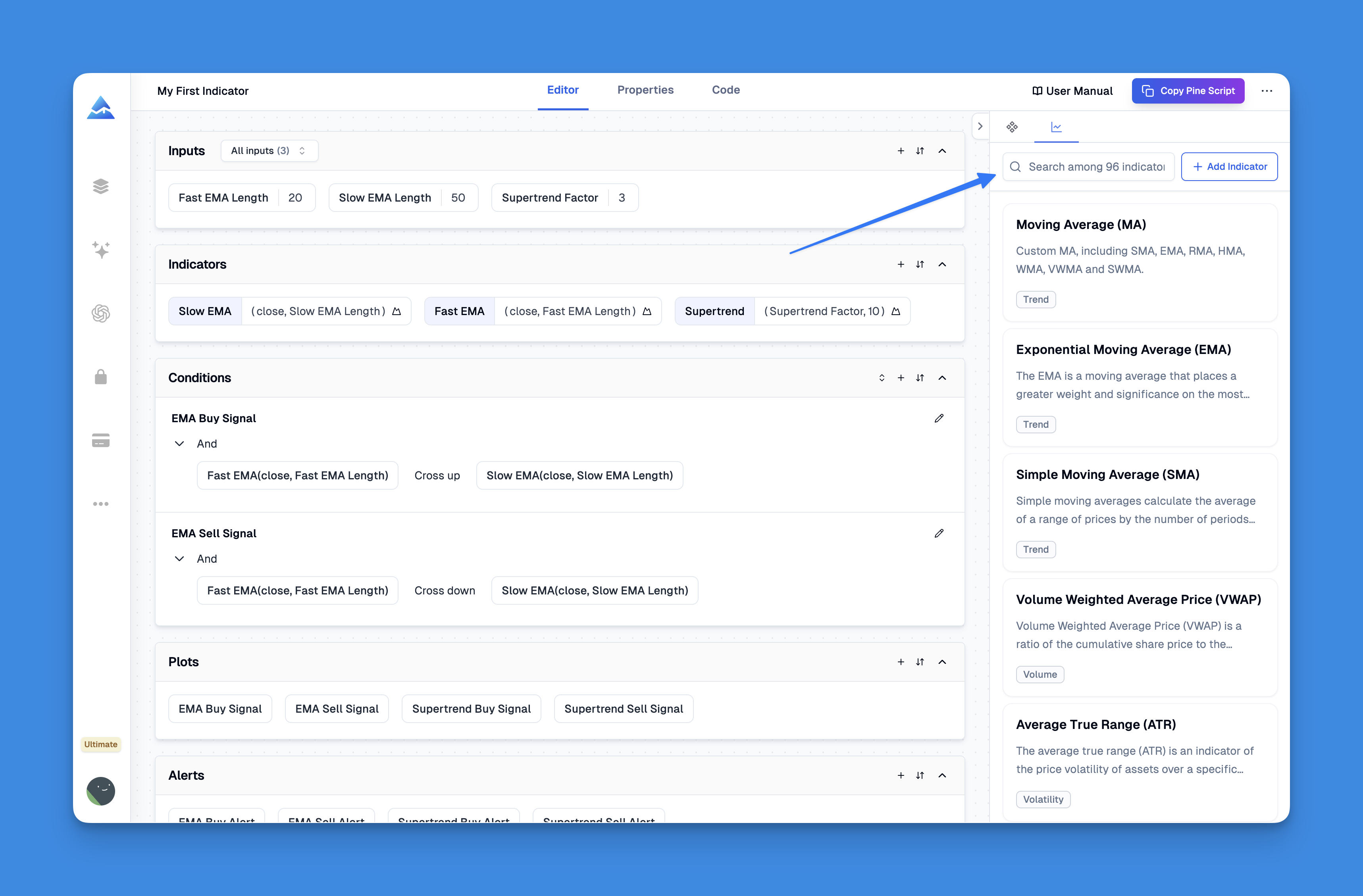
Getting this running on your charts takes about two minutes:
- Visit Pineify.app and search for "Candlestick Patterns"
- Customize the sensitivity — I usually keep Doji detection at medium sensitivity because too high gives false signals on TSLA's 15-minute
- Generate the Pine Script code with one click
- Copy and paste into TradingView's Pine Editor
- Apply to your chart and start seeing patterns immediately
The customization options let you fine-tune each pattern type. You can adjust how perfect a Doji needs to be, or modify the minimum size requirements for Engulfing patterns.

How to Actually Trade These Patterns
Here's where most people mess up — they see a pattern and immediately hit buy or sell. That's like driving by looking only at street signs while ignoring traffic lights.
What Each Signal Actually Means
Bullish Patterns (Green Arrows):
- Morning Star: Usually signals the end of a downtrend, but wait for volume confirmation
- Hammer: Shows buyers stepped in, but make sure you're near actual support
- Bullish Engulfing: Strong momentum shift — especially powerful after a pullback
Bearish Patterns (Red Arrows):
- Evening Star: Often marks trend exhaustion, but watch for follow-through
- Shooting Star: Rejection at highs — more reliable at known resistance levels
- Bearish Engulfing: Sellers took control — pay attention if it breaks key support
Neutral Patterns (White Diamonds):
- Doji: Market indecision — could go either way, wait for next candle
- Inverted Hammer: Potential reversal, but needs confirmation
My Three-Rule System
- Never trade a pattern in isolation — I always check if it aligns with support/resistance levels
- Wait for confirmation — One more candle in the expected direction before entering
- Combine with other indicators — I pair these patterns with volume analysis tools and moving average signals for higher probability setups
The best trades happen when multiple signals align. On October 15, a Hammer at SPY's $436 support level combined with oversold RSI gave me a clean long that ran 3 days. Any single signal alone wouldn't have given me that confidence.
Backtesting Your Strategy
Before risking real money, test how these patterns perform on your preferred instruments and timeframes. Some work better on forex, others shine in stock trading.
My Simple Backtesting Approach
- Choose your testing period — I use 6-12 months of recent data
- Define entry rules:
- Enter long on bullish patterns near support
- Enter short on bearish patterns near resistance
- Set consistent exits:
- Stop loss: 1-2 ATR below/above entry
- Take profit: 2:1 or 3:1 risk-reward ratio
- Track performance by pattern type and market conditions
When I backtested Engulfing patterns on EURUSD 1-hour from January to December 2025, I got a 62% win rate with a 1.8:1 average RR. Not bad, but I haven't tested it on crypto yet — volatility there might change the numbers.
If you're new to backtesting, check out this guide on TradingView backtesting with Pine Script to get started properly.
Advanced Pattern Combinations Worth Watching
After using this candlestick pattern scanner for several months, I've noticed certain combinations that produce higher win rates.
The Double Confirmation Setup
When a Doji forms at resistance, followed by a Bearish Engulfing pattern — that's often a strong shorting opportunity. The Doji shows uncertainty, then the engulfing confirms sellers took control.
The Trend Continuation Play
Harami patterns within strong trends often lead to continuation moves. If you're in an uptrend and see a Harami after a small pullback, it frequently signals the trend will resume.
The Reversal Stack
Morning Star or Evening Star patterns that form right at major support/resistance levels carry much more weight than those appearing mid-trend.
Common Mistakes I See
Mistake #1: Trading every signal the indicator shows
Fix: Be selective — only trade patterns that align with broader market context
Mistake #2: Ignoring timeframe analysis
Fix: Check higher timeframes before trading lower timeframe patterns
Mistake #3: Not accounting for market volatility
Fix: During high volatility periods, patterns need more confirmation
Mistake #4: Setting stops too tight
Fix: Give patterns room to work — candlestick signals need breathing space
Overriding all of these: don't trust a single Doji on a 5-minute TSLA chart during earnings week. I've made that mistake twice.
Getting Better Results with Additional Indicators
This candlestick pattern tool works well on its own, but combining it with complementary indicators improves your success rate.
I've found these particularly effective:
- Bollinger Bands + Candlestick Patterns: Perfect for identifying reversal zones (learn about Bollinger Band strategies here)
- MACD + Pattern Recognition: Great for confirming momentum shifts (explore MACD techniques)
The Reality Check: What This Indicator Won't Do
Let me be straight — this tool won't make you rich overnight. Candlestick patterns are one piece of the trading puzzle. They work best when combined with:
- Proper risk management using Pineify's position sizing tools
- Understanding of market context
- Patience to wait for high-quality setups
- Discipline to stick to your trading plan
The indicator eliminates the tedious work of pattern spotting, but you still need to make smart trading decisions based on what it shows you. I haven't tested it on crypto futures at all, and my experience with ultra-low timeframe patterns (1-minute, 3-minute) has been mostly disappointment.
Frequently Asked Questions
What are the 16 candlestick patterns detected by this indicator?
It scans for Doji, Hammer, Inverted Hammer, Shooting Star, Morning Star, Evening Star, Bullish Engulfing, Bearish Engulfing, Harami patterns, Belt Hold patterns, Kicker patterns, and several other common reversal and continuation formations. Each pattern gets a color-coded label — green arrows for bullish signals, red arrows for bearish ones, white diamonds for neutral.
How do I install this candlestick pattern indicator on TradingView?
Go to Pineify.app, search for "Candlestick Patterns", tweak the sensitivity settings to your liking, generate the Pine Script code with one click, paste it into TradingView's Pine Editor, and apply it to your chart. Whole setup takes about two minutes.
Can I adjust the sensitivity of pattern detection?
Yes. You control how close a candle must match the ideal Doji shape, set minimum body size for Engulfing patterns, or adjust wick length thresholds for Hammer and Shooting Star detection. I dial mine down on lower timeframes to cut down false signals.
How is this indicator better than manual candlestick pattern recognition?
Manual recognition is slow and error-prone, especially when you're watching multiple charts or timeframes. This indicator scans in real time across all open charts, marks patterns instantly with clear labels, and never misses a formation because you blinked.
Which candlestick patterns work best in different market conditions?
Reversal patterns like Morning Star, Evening Star, and Hammer work best at key support and resistance levels. Continuation patterns such as Harami and Belt Hold are more reliable during strong trending markets. Doji patterns work well in ranging markets where indecision often precedes a breakout.
What are the limitations of using a candlestick pattern indicator?
No indicator guarantees profitable trades on its own. Candlestick patterns shouldn't be traded in isolation — they work best alongside support/resistance analysis, volume confirmation, and proper risk management. The indicator handles detection and labeling, but final trading decisions are yours.