QuantConnect vs Backtrader vs Pineify: Comprehensive Algorithmic Trading Platform Comparison
Picking the right tool is a big deal when you're building automated trading strategies. It can make the difference between a smooth process and a constant headache. You've got three very different paths you can take: the all-in-one cloud setup, a flexible open-source toolkit, or an AI assistant that writes the code for you.
Let's break down what QuantConnect, Backtrader, and Pineify really offer, so you can see which one fits your style, skills, and budget.
A Look at Your Three Main Options
QuantConnect: The All-in-One Cloud Platform
Think of QuantConnect as a full professional workshop in the cloud. It’s built to handle everything from initial research to live trading, all through your browser. You code in Python or C#, and it takes care of the heavy lifting—historical data, realistic backtesting (with fees and slippage factored in), and even deployment to live markets.
It’s popular, with over 275,000 users, and runs thousands of backtests every day. This scale means it’s been tested under pretty much every condition. You start with a free tier, and paid plans begin around $20/month, scaling up for teams and institutions. It’s a solid choice if you want an integrated, professional environment without managing your own servers.
Backtrader: Your Flexible, Free Python Toolkit
Backtrader is the hands-on coder's choice. It’s a free, open-source Python library you download and run on your own computer. This means you have total control: over your code, your data, and how everything connects. There's no monthly fee and no dependency on someone else's servers.
Its biggest strength is flexibility. You can tweak every component, plug in various data sources, and connect to different brokers. The documentation is thorough, making it accessible even if you're still getting comfortable with Python. Just remember, with great power comes great responsibility—you’re in charge of data management and making sure your backtests are sound.
Pineify: The AI Partner for TradingView Scripts
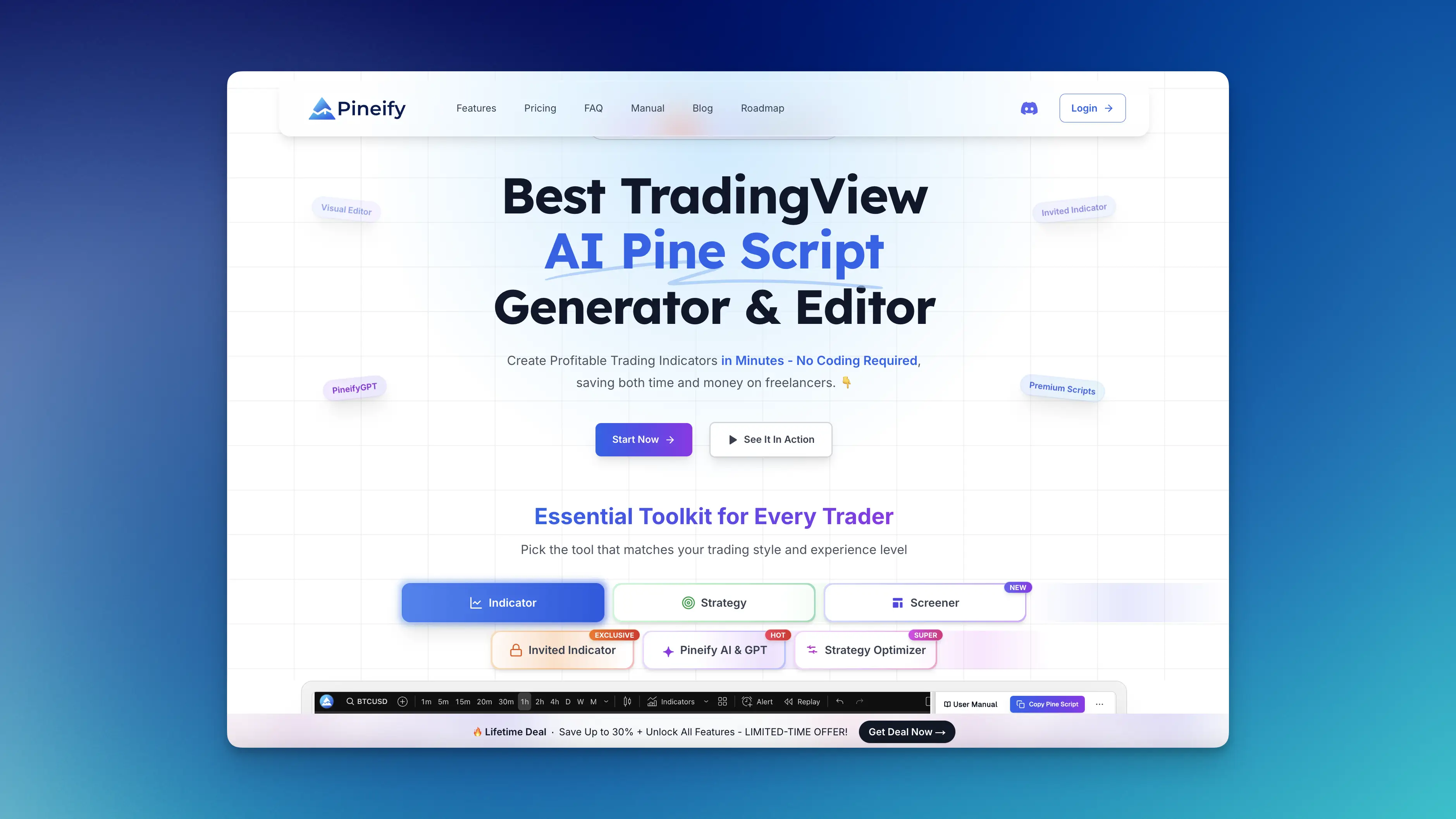
Pineify does something completely different. It’s not a backtesting platform itself. Instead, it’s an AI expert built to write TradingView Pine Script code for you. You describe your trading idea in plain English, and it generates the clean, ready-to-use indicator or strategy code. This approach is perfect for traders who want to dive into the vast TradingView ecosystem but prefer a more guided, efficient coding experience.
It’s built for speed and accuracy, turning concepts into working scripts in minutes. Beyond just code generation, it includes tools like an AI Stock Picker for daily predictions, a Strategy Optimizer, and deep backtest analysis. If your goal is to build and test ideas rapidly on TradingView, Pineify acts like a turbocharged assistant that knows Pine Script inside and out.
Choosing the right platform for building and testing your trading strategies is a big decision. To help you see the differences at a glance, we’ve put together a straightforward comparison of three popular options: QuantConnect, Backtrader, and Pineify.
Think of this as a quick cheat sheet to understand their core approaches, costs, and where they run.
| Feature | QuantConnect | Backtrader | Pineify |
|---|---|---|---|
| Programming Language | Primarily Python and C# | Python | Turns your plain-English descriptions into Pine Script code |
| Cost | Monthly subscription plans, typically starting around $20-$80 | Free and open-source | Subscription model that includes access to its AI assistance |
| Deployment | Fully cloud-based; you build and run everything in your browser | Runs locally on your own computer | Works directly inside TradingView |
| Data Coverage | Extensive built-in data across stocks, futures, forex, and crypto | You need to source and provide your own market data | Uses the broad market data available within TradingView |
| Community Size | Large, with over 275,000 users | Has a dedicated and active developer community | A newer platform with a quickly growing user base |
| Live Trading | Connects directly to various brokers through its cloud | Requires you to set up the integration with your broker yourself | Executes trades through your linked TradingView account |
In short, your choice often comes down to your style. QuantConnect is a powerful all-in-one cloud solution, Backtrader is a flexible toolkit for hands-on coders, and Pineify is your shortcut if you want to create TradingView strategies without writing Pine Script yourself.
How They Handle Code and Development
Coding and Architecture: How They Handle the Heavy Lifting
Let's break down how each platform is built and what it feels like to code on them.
QuantConnect is built for the pros. It gives you a full-fledged environment for Python and C#, built around an event-driven system. This means you can test portfolios with thousands of stocks at once, and it does a good job modeling real-world factors like margin requirements. A huge plus is how it handles data: you can bring in your own custom datasets and easily attach them to stocks or ETFs, which helps prevent sneaky errors like accidentally using future data in your test.
Backtrader is a pure Python framework that also uses events to drive the backtest. Its strength is in taking some tedious work off your plate, especially around data cleaning. It comes with ready-made templates for common data sources, so getting your data in is pretty straightforward. One thing to watch out for, though, is that it doesn't cache data by default. Every time you run a test, it might re-download the data, which can slow things down, especially if you're trying lots of different parameters.
Pineify takes a completely different approach. Instead of asking you to write all the code, it uses an AI assistant. You describe what you want, and it generates the Pine Script code for TradingView in real-time, checks for errors, and even remembers the context of your conversation. This can significantly speed up development, similar to how using a specialized tool like the PineConnector Webhook streamlines connecting TradingView alerts to other platforms. It's deeply integrated with TradingView's own docs, so it's like having a guide right there with you. This makes building strategies accessible even if you're not a seasoned programmer.
Putting Strategies to the Test: Backtesting & Optimization
This is where you see if your idea holds up. Here’s how each platform handles the simulation.
QuantConnect is built for speed and scale. You can develop your strategy and then run a cloud-powered backtest with minimal code changes. It uses high-quality data from its Dataset Market for these cloud tests, so you get broad historical coverage. It also goes the extra mile to model real trading friction, like transaction costs and how your own trades might move the market, which is crucial for realism.
Backtrader lets you optimize by tweaking your strategy's parameters through code. Its optimizer can use multiple CPU cores to speed things up. However, that speed boost can be limited by the data caching issue mentioned earlier. One functional gap is that it uses a brute-force search for optimization—it tests every single combination of parameters you give it. It doesn’t have more advanced methods, like genetic algorithms, to intelligently narrow down the search.
Pineify’s tools are built around the TradingView ecosystem. Its Strategy Optimizer runs a grid search across multiple parameters to automatically find the most profitable settings for your Pine Script strategy. After a test, the Backtest Deep Dive gives you a professional-grade report. It doesn't just show profits and losses; it breaks down key risk metrics like the Sharpe ratio and drawdowns, and presents performance visually with heatmaps, so you can understand why a strategy performed the way it did. For a more detailed walkthrough of Pineify’s testing workflow, our guide on how to backtest a trading strategy provides a step-by-step look.
The Real Deal: Comparing QuantConnect, Backtrader, and Pineify
Choosing a backtesting platform is a bit like picking tools for a workshop. Each one has a specialty, and the "best" one depends entirely on the job you need to do and how you like to work. Let's break down the key strengths and limitations of QuantConnect, Backtrader, and Pineify in plain terms.
QuantConnect: The Power Grid
Where it shines:
- Built for serious work: It offers rock-solid, professional-grade infrastructure. If you're running a fund or a team, the reliability and available support are major pluses.
- Trades everything: You can test strategies across the board—stocks, forex, crypto, futures, and options—all on the same platform.
- From test to real money: It’s designed to make the jump from backtesting to live trading smooth, with built-in connections to major brokers.
- Grows with you: Need more computing power? You can scale up in the cloud. This is a huge advantage for teams that need to run many complex tests at once.
Things to keep in mind:
- It’s a subscription service: Monthly costs add up, especially for the advanced tiers and features that teams often need.
- You’re in their cloud: This is convenient, but it means you have less control over the exact environment compared to running everything on your own computer.
- There’s a learning process: You’ll need to spend time getting comfortable with their specific way of doing things (their API) and how to deploy your strategies.
Backtrader: The DIY Workshop
Where it shines:
- Completely free: No subscriptions, no fees, no usage limits. This is its biggest appeal.
- You own everything: Your code and your data stay on your machine. You have full control and maximum confidentiality.
- No surprises: Since it's open-source, you don’t have to worry about the platform being discontinued or forced updates changing how your strategies work.
- Endless tinkering: The open-source nature means you can customize and modify almost anything if you have the programming know-how.
Things to keep in mind:
- You’re the IT department: You’re responsible for setup, maintenance, and sourcing your own data.
- Data can be slow: The platform doesn’t automatically cache market data, so you might find yourself re-downloading it, which can slow down your testing cycle.
- Features you’ll need to build: Want to connect to a less common broker or use advanced optimization techniques like genetic algorithms? You’ll likely have to build or find that functionality yourself.
- Steeper start: The initial setup and learning curve can be higher than with a managed cloud service.
Pineify: The Turbocharged Assistant
Where it shines:
- AI as your co-pilot: Its AI helps generate and fix Pine Script code, which can dramatically cut down the initial development and debugging time.
- Huge indicator library: Instant access to over 235 built-in technical indicators without writing them from scratch, including powerful tools like the Matrix Series Indicator.
- Built on TradingView: It plugs directly into TradingView’s excellent charts and vast, real-time market data.
Things to keep in mind:
- You’re locked into Pine Script: The platform is fantastic for TradingView strategies, but it’s not a general-purpose tool. You can’t use Python or build complex, multi-asset portfolio strategies here.
- Runs on credits: You need a subscription, and the AI features use credits that can run out during heavy development sessions.
- Scope is focused: It’s optimized for creating and testing individual trading strategies on TradingView, not for large-scale, institutional-grade backtesting or portfolio management.
Which Platform Is Right For You?
Choosing the right backtesting tool depends a lot on your experience, your goals, and how you like to work. Here’s a straightforward look at who gets the most out of each platform.
👨💻 Who QuantConnect Is Best For
QuantConnect is built for serious, professional traders and research teams. Think of it like enterprise-grade software. It shines if you’re developing complex strategies that need deep, high-quality historical data across stocks, crypto, futures, and forex—all in one place. It’s also a great fit for teams that need to collaborate on strategy development in the cloud. If you want to move a strategy from a research idea to live trading with as few steps as possible, QuantConnect’s integrated environment is designed for that exact journey.
🖥️ Who Should Choose Backtrader
Backtrader is the champion for independent developers and traders who want total control and value their privacy. If you’re comfortable writing Python code and prefer to run everything on your own computer (without any monthly fees or subscriptions), this is your tool. You keep 100% ownership of your code and data, with no need to upload your strategies to someone else’s server. It’s ideal if you want maximum flexibility and don’t mind handling more of the setup and infrastructure yourself.
✨ Who Pineify Suits Perfectly
Pineify is for the TradingView crowd. If you live on TradingView for your charting and analysis, and you wish you could test your trading ideas faster, Pineify is your shortcut. It’s perfect if you don’t have a deep programming background but want to build custom indicators or strategies. You can describe what you want in plain English, and the AI helps write the code. It also brings powerful tools like an AI Stock Picker and Strategy Optimizer to traders who want that advanced analysis without needing to become a full-time coder.
Quick Comparison Table
| Platform | Best For | Key Strength | Development Style |
|---|---|---|---|
| QuantConnect | Professional teams, multi-asset research | Institutional data & cloud deployment | Cloud-based, collaborative |
| Backtrader | Independent developers, privacy-focused traders | Full local control & no costs | Python library, local execution |
| Pineify | TradingView users, rapid prototyping | AI-powered, natural language to code | Web-based, integrates with TradingView |
Your Questions, Answered
Which platform is best if I'm just starting out? If you're new to coding, Pineify is the most approachable because it lets you describe what you want in plain English. For those comfortable with Python and wanting to learn the fundamentals with no cost, Backtrader is a fantastic free starting point.
Can I mix and match these tools? Absolutely. It's common to use them together. Think of it like this: you could build and test a trading idea for free in Backtrader, then scale it up on QuantConnect's powerful cloud servers. Meanwhile, you might use Pineify to create a custom indicator and watch it play out visually on TradingView's charts.
With Pineify's AI Coding Agent, you can turn those trading ideas into error-free Pine Script code in minutes, without needing to learn programming. It's like having a dedicated developer who understands both trading and TradingView's unique language, making the process of moving from concept to a working chart indicator incredibly smooth.
I need strong community support. Where should I go? It depends on what you're looking for:
- QuantConnect has a massive, focused community of over 275,000 developers and quants for deep strategy discussion.
- Backtrader has very active forums and a dedicated developer community for troubleshooting.
- TradingView (which Pineify connects to) has the broadest reach with over 90 million users, great for general market talk and idea sharing.
Do they let you trade with real money? Yes, but the setup varies.
- QuantConnect has the smoothest path, with direct connections to brokerages for live trading.
- Backtrader can execute live trades, but you'll need to handle the broker connection yourself.
- Pineify enables live trading by generating code for TradingView, which can then send alerts to your chosen brokerage platform.
What level of coding is required? Here’s a quick breakdown:
| Platform | Programming Skill Needed |
|---|---|
| QuantConnect | Intermediate to Advanced (Python or C#) |
| Backtrader | Solid Python skills |
| Pineify | Minimal; uses AI to write code from your descriptions |
How much do they cost for regular use? Pricing is quite different for each:
- Backtrader is completely free and open-source.
- QuantConnect uses monthly subscriptions, generally ranging from $20 for individuals to $80 for teams, with custom pricing for larger firms.
- Pineify works on a lifetime access model, providing a one-time payment for all its tools—including the Visual Editor, AI Coding Agent, and AI Stock Picker—which can save significant money compared to recurring freelancer costs or other subscription services.
What Should You Do Next?
Feeling ready to dip your toes into algorithmic trading? The best way to start is to pick a tool that fits your current situation and just try it out. Think about what you actually need right now.
To help you decide, here’s a quick breakdown of the options we discussed:
| Platform | Best For... | Key Thing to Know |
|---|---|---|
| QuantConnect | A professional, all-in-one cloud environment. | Great if you don’t want to manage your own servers and need access to lots of market data. |
| Backtrader | Developers who want full control and to learn by building. | You run everything on your own computer; it’s powerful and completely free. |
| Pineify | TradingView users who want to write Pine Script faster. | Uses AI to help turn your strategy ideas into code, saving you time on syntax. |
Here’s how to take the first step:
If the professional cloud setup sounds appealing, you can try QuantConnect for free. Their free tier lets you explore their tools and data library, which is a fantastic way to see if it clicks for you.
If you’re watching your budget and love getting into the technical details, download Backtrader. Start by working through a simple example in their docs to build your very first strategy locally on your laptop.
Are you already living in TradingView? Then check out Pineify. Its AI helper can speed up your Pine Script coding, letting you test ideas much quicker.
No matter which path you choose, remember this:
- Start Simple. Your first strategy should be basic. The goal is to understand the whole process—coding, backtesting, checking results. You can tackle complex ideas later.
- Don't Go It Alone. Join the platform’s community forum or Discord. Reading questions and answers from other users is one of the fastest ways to learn.
- Paper Trade First. Always, always test with pretend money (paper trading) for a good while before you ever consider using real capital. This is your safety net.
The world of algorithmic trading is always changing. Keep an eye on the updates and roadmaps for your chosen platform to make the most of new features as they come out.
Finally, share what you learn! Talk about your experiences online, contribute code or documentation to open-source projects like Backtrader, and always refine your strategies based on what your backtests and live data tell you. The community gets better when everyone shares.