MT5 Risk Manager: Complete Guide to Protecting Your Trading Capital

An MT5 risk manager is an Expert Advisor (EA) built with MQL5 that automatically handles position sizing, stop-loss enforcement, and account-level risk controls inside MetaTrader 5. I've lost count of how many traders I've seen blow accounts on EURUSD and GBPUSD because they skipped this step. A properly configured risk manager EA is the best tool for protecting your capital — whether you scalp, swing, or trade prop firm challenges. It does the math so you don't have to.
What Is an MT5 Risk Manager?
Think of an MT5 risk manager as a smart assistant that lives inside MetaTrader 5. It's an Expert Advisor or a panel tool, built with MQL5, that takes over the boring but critical parts of trade management — position sizing, stop-loss enforcement, and account-level risk controls. Unlike a fully automated trading bot that hunts for setups, a risk manager EA acts as your co-pilot: you still decide when to enter and exit, but it handles the math and the guardrails.
At its simplest, the MetaTrader 5 risk manager reads your account currency, balance, and the instrument you're trading. Based on your inputs — entry price, stop loss, and take profit — it automatically calculates the lot size that fits your chosen risk tolerance and places the order with a single click. No mental math, no guessing.
Why Every MT5 Trader Needs a Risk Manager EA
Manually figuring out your lot size during a fast-moving market is really easy to mess up. You're watching price action, maybe sweating a little, and it's tempting to just click a button. That's exactly when mistakes happen. A risk manager EA takes that guesswork out. It sticks to your plan, no matter how the market feels.
Here's why this matters:
- You stay consistent: No matter if you just won three trades in a row or lost one, the EA sizes each trade the same way. No more doubling up when you're feeling lucky or cutting size because you're scared. It keeps your risk steady.
- Protects your account from yourself: Most of us set daily, weekly, or monthly loss limits in our head. But when it's happening, we ignore them. A risk manager EA can automatically close all trades or even stop trading for the day once you hit that number. Your capital stays safe.
- Helps pass prop firm challenges: If you're trading for a funded account, a prop guard feature is a lifesaver. One of the biggest reasons people fail challenges is hitting the drawdown limit. The EA watches that for you, so you don't accidentally blow past it.
- Faster than you can calculate: In volatile seconds, you can click once and get a pre-calculated lot size. No fumbling with a calculator or spreadsheet. That speed can make a difference.
- Keeps your emotions in check: We all have that moment where something inside says "just one more trade" after a loss. The EA doesn't have feelings. It follows the rules you set when you were calm and thinking clearly. That discipline is huge.
Key Features to Look For in an MT5 Risk Manager
Not every risk manager EA works the same way. Here are the things you should check before picking one or building your own.
Automatic Lot Size Calculation
The most basic job of any MT5 risk manager is figuring out the right position size. It should take your account balance, the stop-loss distance in pips, and what instrument you're trading, then calculate the lot size automatically. Make sure it also respects your broker's minimum, maximum, and step limits so orders go through without errors.
Stop-Loss and Take-Profit Automation
A solid risk manager won't let you place a trade without a stop-loss and take-profit. Some advanced ones even adjust the stop based on Average True Range (ATR), which means the distance changes with market volatility instead of using a fixed number of pips. I personally won't touch a risk manager that doesn't offer ATR-based stops at this point.
Daily, Weekly, and Monthly Loss Limits
This is huge for prop traders and anyone who wants to stay disciplined. Your risk manager should keep an eye on:
- How much you've lost today (as a percentage or a fixed dollar amount)
- Your total drawdown for the week and the month
- How many trades you've opened in a session
- The ability to close everything and stop trading automatically if you hit any limit
Dynamic Risk Adjustment
The best risk managers don't just use a flat lot size forever. They adjust your exposure based on recent performance — more when you're doing well, less when you're in a drawdown. That way you can grow your account while still protecting it. Much smarter than keeping the same lot size all the time.
Trade History and Reporting
You shouldn't need to jump to another app just to see how you're doing. A good risk manager includes a built-in panel that shows your daily, weekly, and monthly profit and loss. It'll also overlay your trade history right on the chart so you can visually review them, and let you generate reports by symbol or for your whole account.
MT5 Risk Manager Settings: A Practical Configuration Guide
Setting up your risk manager correctly from day one prevents costly mistakes. Here is a reference table for recommended parameter configurations:
| Parameter | Conservative | Moderate | Aggressive |
|---|---|---|---|
| Risk per trade | 0.5% | 1–2% | 3–5% |
| Daily loss limit | 2% | 4% | 6% |
| Max trades/day | 3 | 5 | 10 |
| Max drawdown | 5% | 10% | 15% |
| Stop-loss type | Fixed pips | ATR-based | ATR-based |
If you're just starting out, a good rule of thumb is to risk no more than 1–2% of your account balance per trade. That way, any single loss won't wipe you out, and you'll have enough left to recover from a bad streak. For prop firm traders, pay close attention to their specific rules — they usually cap daily losses at 4–5% and overall drawdown at 8–10%. Always adjust your settings to match those limits before you trade a cent.
Installing an MT5 Risk Manager EA: Step-by-Step
Getting your risk manager running on MetaTrader 5 is pretty simple. Here's how:
- First, grab the EA file (it'll be
.ex5format) from the MQL5 Market, your broker, or a custom developer you're working with. - Open MetaTrader 5 and go to File → Open Data Folder.
- Inside that folder, navigate to
MQL5 → Expertsand drop the EA file in there. - Head back to MT5, right-click Expert Advisors in the Navigator panel, and hit Refresh.
- Click the AutoTrading button at the top of the platform until it turns green.
- Drag the EA onto your chart and set up the inputs you want — things like risk percentage, daily loss limit, and default stop-loss distance.
- In the Common tab, check the box for Allow live trading, then click OK.
Once it's running, you'll see a smiley face icon at the top-right corner of the chart — that's the signal everything's good to go.
Building a Custom MT5 Risk Manager with AI
Pre-built EAs work well for getting started, but if you're serious about trading, you'll often need something more specific — like custom drawdown rules, risk pooling across multiple symbols, or integrating your own strategy. That's where MQL5 AI coding tools come in handy.
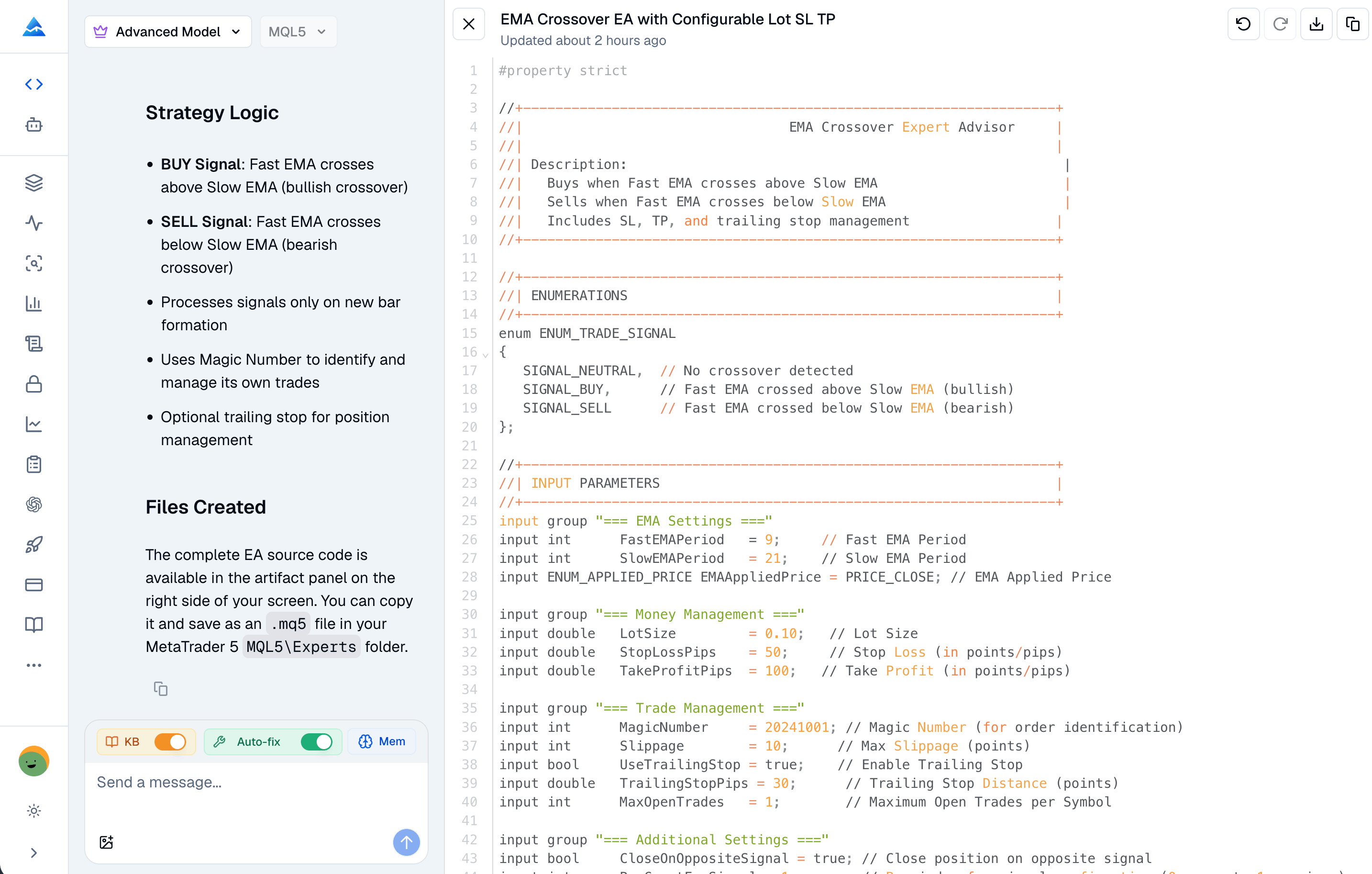
Right now, one of the most popular options is the Pineify MQL5 Coding Agent. It's built for MetaTrader 5 and lets you create Expert Advisors, custom indicators, and scripts without needing to know how to code. You just describe what you want in plain English — for example, "ATR-based dynamic stop-loss" or "multi-timeframe risk filter" — and it turns that into working MQL5 code. For traders who also want to compare different trading platforms, our eSignal vs TradingView comparison provides detailed insights.
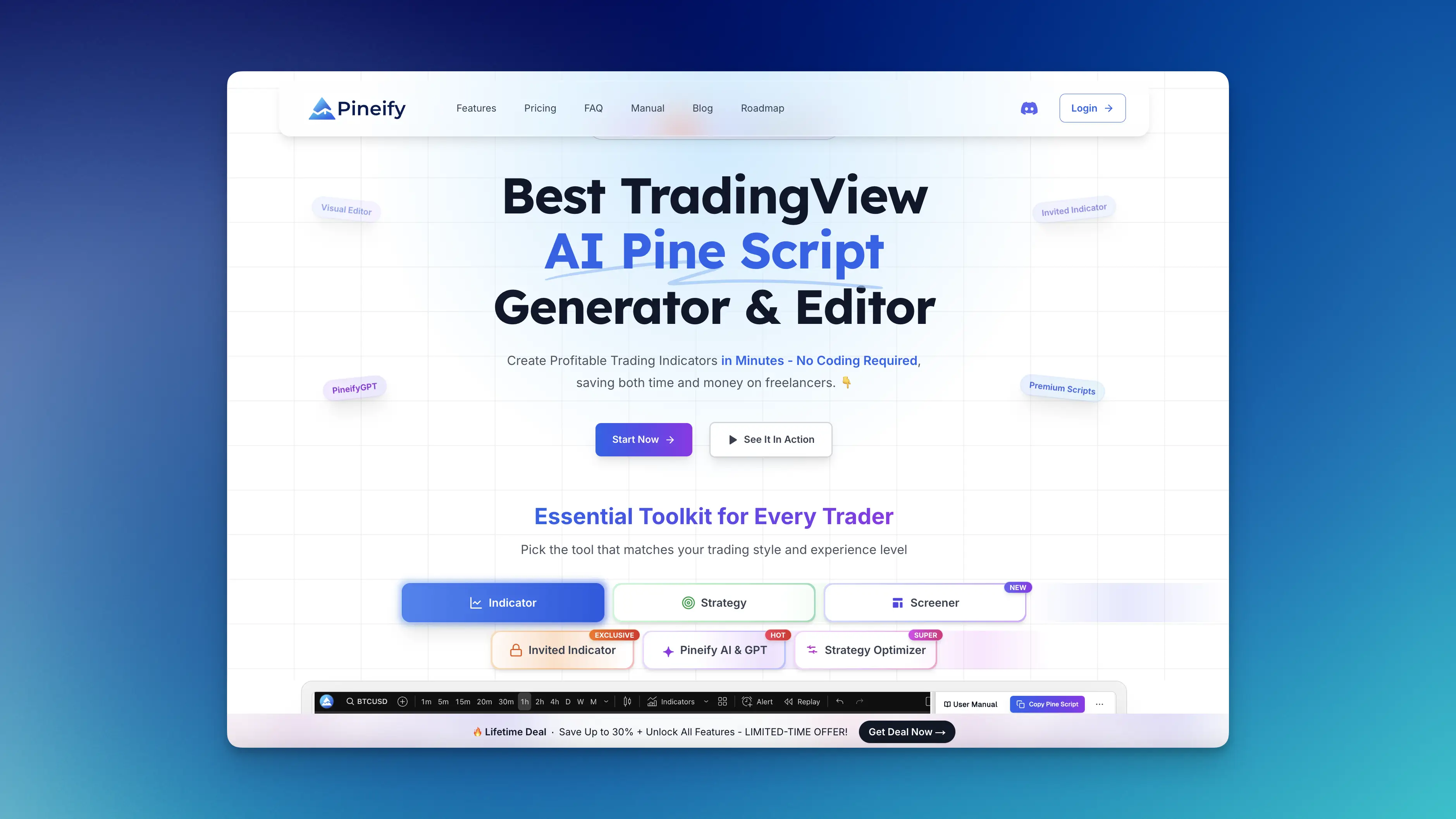
Pineify isn't just for Pine Script — its AI coding engine also supports MQL5, giving you the same effortless code generation for MetaTrader. Whether you're building a custom risk manager or a full trading bot, you can describe your logic in plain language and get production-ready code in seconds, with no coding required and a lifetime license starting at just $99.
Why is this useful? Writing a solid MT5 risk manager from scratch means you have to understand MQL5 event handlers, broker normalization functions, and account info APIs. That's a steep learning curve, even for experienced developers. Using AI to help with the code cuts down development time a lot and helps avoid common bugs and logic errors.
What You Can Build with an MQL5 AI Coder
- Position sizing EA that adjusts for broker pip value differences across instruments
- Prop firm guard EA that tracks drawdown in real time and can close everything at once
- ATR-adaptive stop-loss manager that changes risk based on market volatility
- Multi-symbol risk aggregator that keeps an eye on combined open risk across your portfolio
- Session-based trading limiter that stops trading after a certain loss within a session
To further refine your strategies, check out our Python backtesting library guide for algorithmic traders.
MT5 Risk Management for Prop Firm Traders
If you're trading for a prop firm, you already know the rules are strict. That's why setting up a solid risk manager in MT5 isn't just nice to have — it's pretty much a must. These challenges usually come with:
- Maximum daily loss – often around 4–5% of what you started with
- Maximum total drawdown – typically 8–10% of your starting balance
- Consistency rules – they'll flag you if your position sizes bounce around wildly from day to day
An automated risk manager takes the guesswork out of staying within those limits. It can step in before you hit a threshold, send you a push notification or email alert, and even close all your open trades if you reach the daily cap. The thing is, most people who blow a prop challenge don't fail because their strategy was bad. Usually it's one oversized trade taken in a moment of emotion — exactly the kind of mistake a risk manager is built to prevent.
Common MT5 Risk Manager Mistakes to Avoid
Even when you've got a risk manager installed, a few slip-ups can still leave you unprotected. Here are the most common ones I've seen:
- Leaving AutoTrading off: Your EA can't open or close a single trade if this button isn't toggled on. It's like having a guard dog that's asleep.
- Setting risk way too high: If you're configuring 5% or more per trade, you're basically defeating the whole purpose of having a risk manager in the first place. Keep it sensible.
- Ignoring correlated pairs: Trading EURUSD, GBPUSD, and AUDUSD at the same time triples your real USD exposure. Your risk manager needs to know about this or you're taking on way more risk than you think. I've seen traders lose 8% in an afternoon because they didn't account for pair correlation.
- Using demo settings on a live account: When you switch from demo to live, always double-check your risk percentage and limits. What worked in play money can be disastrous with real funds.
- Never reviewing the performance: Your risk manager gives you reports for a reason. Use them to tweak your settings — otherwise you're flying blind.
Next Steps: Start Managing Your Trading Risk Today
You've got the full picture now — how to understand, choose, set up, and even build your own MT5 risk manager. Here's a simple way to turn that into real action:
- Check your recent trades – Look back at your last 20 trades. Were lot sizes all over the place? Did any single trade put more than 2% of your account at risk? That's the first thing to fix.
- Pick or build a tool that fits you – You can browse the MQL5 Market for a ready-made EA, or use the Pineify MQL5 Coding Agent to build a custom one that matches exactly what your strategy needs.
- Test it on demo first – Run the EA on a demo account for at least two weeks. Watch to make sure every limit and stop fires correctly before you ever risk real money. You can also explore our QuantConnect backtesting guide for cloud-based backtesting options.
- Start small with your settings – Begin with 1% risk per trade and a 3% daily loss limit. You can always tweak up once you see how it behaves.
- Review once a week – Use the reporting features your EA provides. Look for patterns — are you consistently taking too much risk at certain times? Adjust based on what the data tells you.
Drop a comment below with your current risk per trade and the one risk-management issue that trips you up most. Your experience might be exactly what another trader reading this needs to hear.
Can an MT5 risk manager work alongside a fully automated trading EA?
Yes. You can run a risk manager EA at the same time as your main trading EA, just on different chart windows. The risk manager keeps an eye on your account as a whole. If something goes over your set limits — like daily loss or number of trades — it can close all open trades and override your trading EA if needed.
What is the difference between a risk manager EA and a position size calculator?
A position size calculator simply tells you the right lot size to trade. You still have to manually open the trade. A risk manager EA, on the other hand, calculates the lot size for you and places the trade automatically. It also enforces account-wide rules, like how much you are allowed to lose in a day or how many trades you can open.
Is 1% risk per trade really enough to grow an MT5 account?
Yes. If you risk 1% per trade with a 1:2 risk-reward ratio and you win 50% of the time, your account will grow steadily. And more importantly, you will survive when you hit a losing streak. Over the long run, compounding at 1% risk consistently beats out taking higher risks.
Can I build a custom MT5 risk manager without knowing MQL5?
Absolutely. With the Pineify MQL5 Coding Agent, you just describe your risk rules in plain English, and it creates MQL5 code that compiles right away. That means anyone — no matter their technical background — can build a custom EA without writing a single line of code.
Do I need a VPS to run my MT5 risk manager EA?
If you want it monitoring your account 24 hours a day, 5 days a week — especially if you are trading with a prop firm — it is a good idea to run the EA on a VPS. That way, it stays active even when you shut down your computer.
What risk per trade is recommended for prop firm challenges on MT5?
For prop firm challenges, most traders keep risk at 0.5–1% per trade to stay well within daily loss limits of 4–5%. This conservative approach ensures a single bad trade cannot trigger the drawdown cap and end your challenge prematurely.
How does ATR-based stop-loss work in an MT5 risk manager?
An ATR-based stop-loss uses the Average True Range indicator to set stop distances that adapt to current market volatility. When volatility is high, stops are placed further away to avoid premature exits; when volatility is low, stops are tighter. This dynamic approach produces more consistent risk per trade than fixed-pip stops.