MT5 Fibonacci Tools: Anchor Selection, Levels, and Testing

MT5's Fibonacci Retracement is a drawing object that divides a selected price move into proportional levels. It can make a pullback rule measurable, but it does not identify the correct swing automatically or establish a reversal probability. The first task is to choose and record the anchors consistently.
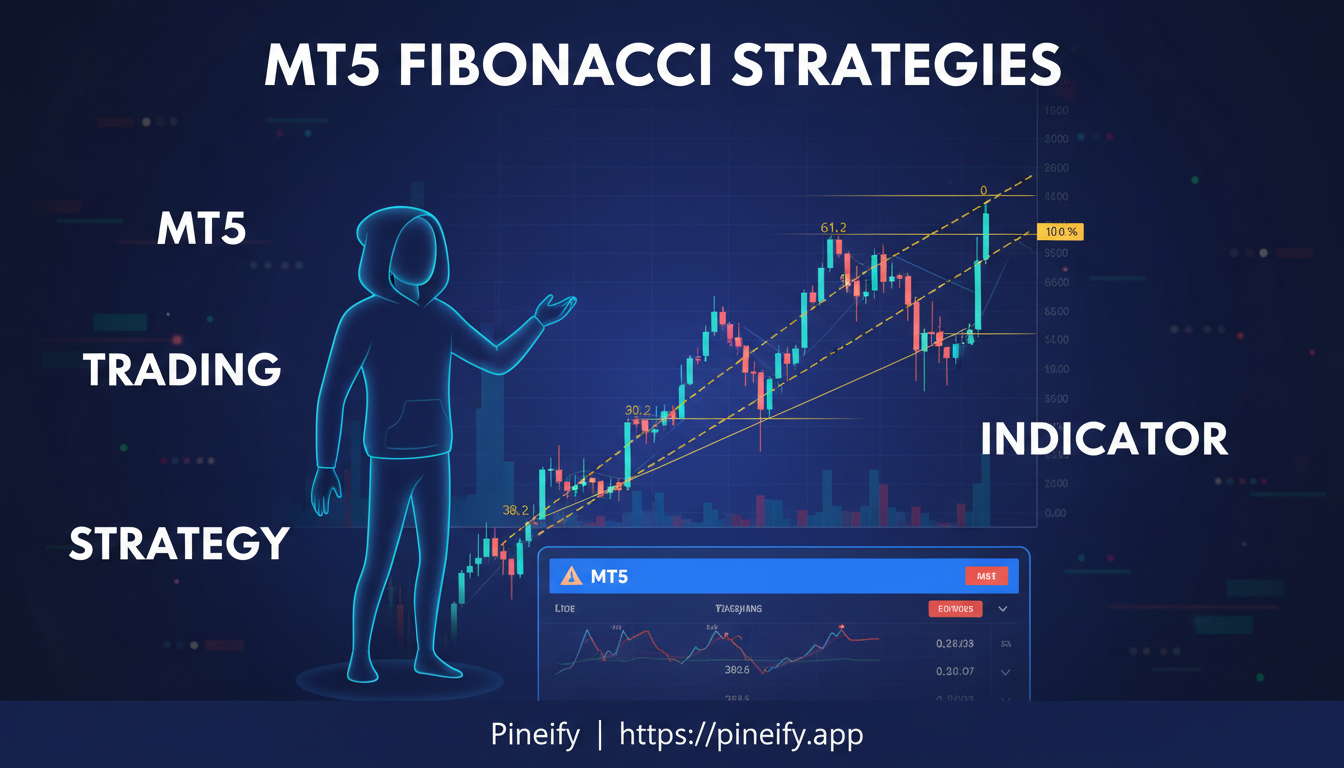
Choose the Right Fibonacci Tool
MT5 includes Retracement, Expansion, Fan, Arcs, Time Zones, and Channel drawing objects. Retracement compares prices with a two-point move. Expansion projects the size of an initial move from a third point. The remaining tools place ratios on time, diagonal, curved, or channel geometry; their presence on a chart is not evidence that price must react there.
The official retracement documentation lists the default horizontal levels and the controls for anchors, labels, and rays. The familiar 50% midpoint is a trading convention rather than a ratio of successive Fibonacci numbers. The 61.8% approximation is related to the reciprocal golden ratio; that mathematical relationship does not make it the most reliable trading level.
Draw and Verify a Retracement
Select Insert → Objects → Fibonacci → Retracement. For an upward move, select the swing low and drag to the swing high; for a downward move, select the high and drag to the low. Then inspect the displayed level prices. Drawing orientation and label configuration matter: verify which endpoint is being treated as zero before using a percentage as an entry rule.
Open the object's properties to set the exact anchor dates and prices. This avoids small differences caused by dragging near a candle wick. In Levels, add or edit ratios and descriptions; 0.786 represents 78.6%. The price placeholder %$ can be included in a description to show the level's price. These display controls are described in MetaQuotes' object guide.
For an independent arithmetic check, define an upward move from low L to high H. A pullback of fraction r from the high has price H − r × (H − L). For a downward move, a recovery of fraction r from the low has price L + r × (H − L).
Here is a hypothetical upward move from 100 to 120:
| Pullback fraction | Calculated price |
|---|---|
| 23.6% | 115.28 |
| 38.2% | 112.36 |
| 50% | 110.00 |
| 61.8% | 107.64 |
| 78.6% | 104.28 |
| 100% | 100.00 |
These are calculated reference prices, not observed support levels or backtest results. If the chart labels do not match the convention you intend, correct the orientation or labels before placing orders.
Make Swing Selection Reproducible
A large part of a Fibonacci strategy is the rule for selecting anchors. “Choose an obvious swing” can produce different trades depending on what later prices reveal.
Define the chart timeframe, eligible session, and confirmation rule in advance. A pivot that requires two later bars cannot be used at the original pivot time; it becomes available only after those bars have completed. A rolling highest-high/lowest-low method may move its anchors as new bars arrive. Log when an anchor was chosen and when it changed.
Do not repeatedly redraw a failed setup until it appears successful. Keep invalidated setups in the record. Multiple-timeframe levels may share the same underlying price movement, so overlapping levels are not automatically independent confirmation.
Understand Three-Point Expansion
Fibonacci Expansion uses points A, B, and C: an initial move from A to B, followed by a pullback ending at C. A projection in the original direction is C + k × (B − A). The sign of B − A handles upward or downward moves.
For a hypothetical A = 100, B = 120, C = 110, the 100% projection is 130 and the 161.8% projection is 142.36. A two-point extension measured from A uses a different origin and can produce a different target. Record the tool and anchors rather than saying only “take profit at 161.8%.”
A target is a proposed exit price. A 61.8% pullback does not establish that the next expansion will be reached, and a deeper pullback does not create a universal cutoff for projection validity.
Evaluate an Automatic Fibonacci Indicator
Automatic indicators choose anchors according to their own rules. Some scan a fixed lookback; others use ZigZag or confirmed pivots. Their historical levels may change when a swing extends or a pivot is confirmed. Ask for the algorithm, confirmation delay, update policy, and any higher-timeframe inputs.
Compare the indicator with hand calculations using the same anchors. Comparing two different swing-selection methods does not tell you which one is “correct.” Record the first available anchor and level values during forward observation, then compare them with the chart after reloading.
For a standalone custom indicator, open File → Open Data Folder, place it and its dependencies under MQL5/Indicators, compile .mq5 source in MetaEditor if needed, and refresh Navigator. MQL5 Market products use their own installation and activation workflow. Check licensing, permissions, and compatibility before assuming a downloaded file can run in every terminal.
Turn a Level into a Testable Trading Rule
A Fibonacci level alone does not define an order. The following is an unvalidated research specification, not a proven strategy:
- Freeze an upward swing once the predefined confirmation rule is met.
- Consider only the first return into the 50%–61.8% pullback zone after confirmation.
- Require a completed candle to close back above a defined boundary; specify exactly which price triggers entry afterward.
- Define the stop, target, time exit, and behavior if the anchors are invalidated before entry.
- Size the position from the monetary risk and instrument specifications, including costs and the possibility of a worse fill.
Compare this rule against a simple midpoint-pullback baseline. If adding an oscillator or candle pattern, test that change separately with the same dataset and cost assumptions. More conditions can reduce trades while increasing the opportunities to fit historical noise.
A visual indicator test shows drawings. To obtain a trading report in MT5, implement the full rules in an EA or use a clearly documented manual simulation. Include losing and skipped setups, report the sample size, and reserve a period untouched during rule selection. Fifty trades or a visually attractive chart is not a universal threshold for live use.
Using Pineify for Implementation
Pineify's AI coding workflow can help draft MQL5 rules, while its Pine Script visual editor targets TradingView. Specify the platform, swing-confirmation policy, and anchor-update behavior in the request. Compile and test the result in its target environment; an automatic drawing or successful compile does not validate a trading advantage.
For execution and testing decisions, use the MT5 EA workflow after the level calculations are checked.
Questions About MT5 Fibonacci Tools
Does MT5 select Fibonacci swings automatically? The built-in drawing object uses the points you select. Automatic anchor selection requires a separate indicator or program with its own algorithm.
Is 61.8% the most accurate level? No comparative evidence is established here. Accuracy would need a defined outcome, market, period, anchor rule, and complete test sample.
Can I use the same levels on every timeframe? The ratios can be drawn on different timeframes. Signal frequency, costs, confirmation delay, and holding periods change, so that does not imply equivalent trading results.
Does adding RSI or a moving average prove the setup is stronger? No. Compare the filtered and unfiltered rules on reserved data. Filters derived from the same prices may carry overlapping information.