MQL5 Coding Best Practices: Build Cleaner, Safer EAs

Your EA runs fine for three weeks. Then one Monday, without warning, it opens 47 EURUSD positions in six seconds. The broker blocks your account before you even get the email. That's not bad luck — it's unconditioned OnTick() logic. MQL5 coding best practices are the patterns and conventions that keep your Expert Advisors safe, readable, and maintainable in live MT5 environments. Clean syntax, solid error handling, defensive checks — those are what separate reliable EAs from ones that quietly lose money.
Why MQL5 Still Matters in 2026
MetaTrader 5 is still the platform most brokers support, from forex to futures to crypto CFDs. MQL5 is the natural language when you want to execute orders directly without stitching together external tools. Python gives you flexibility, but you'd need to build your own broker connector, backtester, and data pipeline. MQL5 ships with all of it. And while Pine Script on TradingView is good for charting, it can't automate live trades the same way — if you want to automate TradingView analysis, see Automate TradingView Analysis with Pineify Strategy Optimizer. With MQL5, your EA places, manages, and closes real orders 24/5 on a VPS without manual oversight.
MQL5's multi-threaded strategy tester, standard library, and MetaEditor features still make it the most practical pick for traders who want automation that's repeatable and deployable on any MT5 broker.
Master the MQL5 Event Model First
Before you worry about naming conventions or performance tuning, you need to understand how MQL5 actually runs. Your EA isn't a top-to-bottom script — it's event-driven. It waits for specific triggers, then reacts. Here are the events you'll use the most:
OnInit()— Runs once when you attach the EA to a chart. Set up variables, validate inputs, register timers. It's the setup phase.OnTick()— Fires on every market tick. Ticks can arrive multiple times per second, so never put unconditional trade logic here. I've seen EAs open dozens of orders in seconds because there were no state checks.OnTimer()— Fires at intervals you define. Good for periodic tasks and helps you avoid tick-by-tick noise.OnDeinit()— Runs when you remove the EA or shut down the platform. Clean up handles, close files, log the final state.
The single biggest beginner mistake I've run into is treating OnTick() like a loop that runs your strategy once per bar. Without state flags, cooldowns, or position checks, it can fire off orders faster than your broker allows. Learn these events first — everything else will click.
Naming Conventions and Code Readability
I've opened other people's code and stared at variables named x or val with zero context. Naming things clearly saves time for you, your collaborators, and anyone who buys your EA. MQL5 has community conventions that make code scannable:
- Variables and functions → camelCase, like
calculateProfit()ortradeEntryPrice - Classes → PascalCase, like
OrderManagerorRiskController - Constants → UPPER_CASE, like
CONST_PIP_VALUEorMAX_SPREAD - Avoid vague names like
x,temp, orval— unless they're truly throwaway (like a loop counter)
I also add a header block at the top of every file. It's a small habit that helps when you're collaborating or selling EAs on the marketplace:
/*
  EA Name:    TrendCatcher
  Purpose:    Trades EMA crossovers with ATR-based stops
  Author:     YourName
  Version:    2.1
  Date:       May 2026
*/
Think of it like labelling your cables before you box up the server — you'll thank yourself later.
Indentation, Bracket Style, and Code Structure
Good indentation matters when your logic nests several levels deep. Consistent spacing shows you what belongs where and prevents mismatched blocks that introduce silent bugs. Stick with 2–4 spaces, never mix tabs and spaces. Pick one and stay consistent.
The Egyptian bracket style — opening brace on the same line as the function or condition — is what I prefer for MQL5. It keeps code compact and easy to scan:
void OnTick() {
   if(IsNewBar()) {
      double maFast = iMA(NULL, 0, 10, 0, MODE_EMA, PRICE_CLOSE);
      double maSlow = iMA(NULL, 0, 50, 0, MODE_EMA, PRICE_CLOSE);
      if(maFast > maSlow) {
         Print("Bullish EMA crossover confirmed");
      }
   }
}
Always use braces, even for single-line if statements. It feels like extra typing, but it's worth it. A future edit that adds a line inside the if will silently break your logic if you assumed the block only had one statement. Braces make your intent explicit. I've debugged enough "mysterious" trading behavior to know this one matters.
Error Handling: Your EA's Safety Net
Your EA runs on a live trading account. When something goes wrong, it costs real money. Every time your EA sends an order, initializes an indicator, or reads a file, check whether it worked. Here's a simple OrderSend() check:
if(!OrderSend(Symbol(), OP_BUY, 0.1, Ask, 3, 0, 0, "MyEA", 0, 0, clrGreen)) {
   Print("Order failed. Error #", GetLastError());
}
That's the minimum. I go further and build safe defaults into every EA:
- Always validate indicator buffers — they can return
EMPTY_VALUEon the first few ticks of a new bar - Check
AccountInfoDouble(ACCOUNT_MARGIN_FREE)before sending an order — no margin, no trade - When the state is unclear (incomplete data, ambiguous signal), default to doing nothing
- Set limits: cap trades per day, max open positions, and maximum spread your EA will accept. This prevents runaway execution in weird market conditions
I use a daily limit of 5 trades and a max spread of 3 pips on my EURUSD EA. That alone has saved it from getting chopped up during NFP releases.
Modular Functions and OOP
MQL5 brings full OOP support over MQL4. Even if you don't build complex class hierarchies, splitting logic into focused functions makes code safer and simpler to test:
bool IsProfitTargetHit(double entryPrice, double targetPips) {
   return Bid >= entryPrice + targetPips * Point;
}
For a serious EA, I prefer splitting the code into three modules:
- Signal module — Calculates indicator values and decides entries and exits
- Risk module — Figures out lot sizes, checks margin, applies daily loss limits
- Execution module — Places orders, manages positions, handles slippage
Each module can be tested on its own. When something breaks during live trading, you know exactly where to look.
Logging, Debugging, and the Strategy Tester
Every EA destined for a real account needs logging. During development, I use Print() constantly to track variables, which conditions fire, and how orders get placed. If you can't read your logs and explain what the EA did step by step, it's not ready for real money.
I follow a three-stage testing habit:
- Strategy Tester — Check entries, exits, stop-loss management, and order handling with historical data.
- Demo forward test — Let it run on a live demo account for at least two to four weeks. You'll catch spread spikes, disconnects, and broker-specific quirks.
- Small live test — Go live only after you understand every edge case and have monitoring alerts set up.
MetaEditor's debugger lets you set breakpoints and step through code. I use it for complex logic instead of drowning in Print() output.
Production Reliability
Writing clean code is half the job. Running it around the clock is what separates hobby EAs from production systems. Before deploying with real funds, I set up:
- A VPS in the same region as my broker — My EURUSD EA runs on a Frankfurt VPS, which cut latency by about 30ms compared to my local machine.
- Auto-restart plan — After an MT5 crash or reboot, the EA should resume safely without creating duplicate orders.
- Version backups — I keep versioned copies of every working build and never edit live code without a rollback path.
- Monitoring alerts — Notifications for disconnects, repeated order errors, or unusual position sizes.
I haven't tested every broker's MT5 setup, but a Frankfurt VPS with automatic MT5 restart monitoring handles about 99% of the operational issues I've seen.
Accelerate Development with AI: Pineify MQL5 Coding Agent
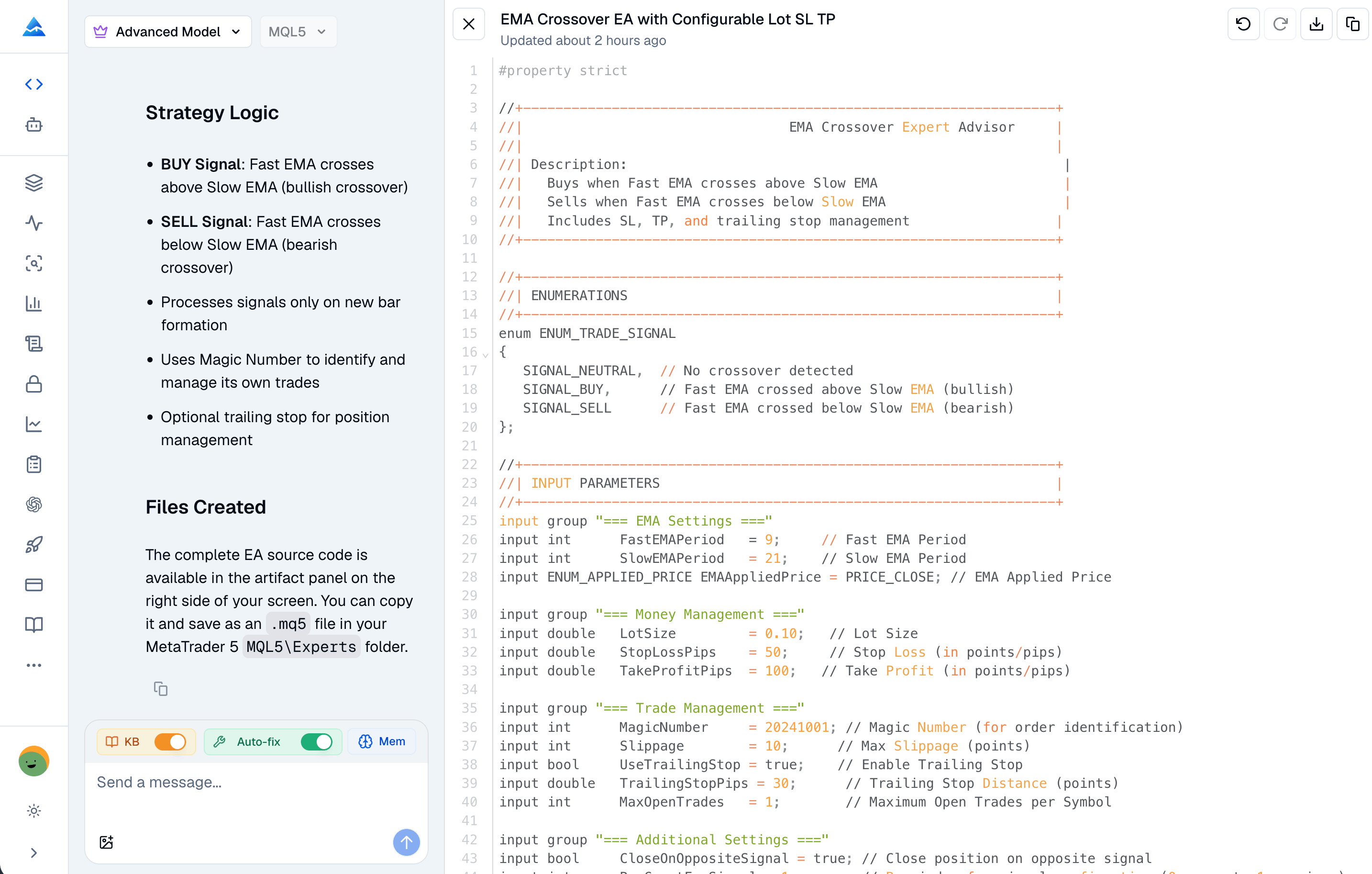
Heading into 2026, AI-powered coding agents that generate, review, and fix MQL5 code are changing how developers work. The Pineify MQL5 Coding Agent is built specifically for MetaTrader 5 development. You describe your strategy in plain English, and it gives you production-ready MQL5 code.
Here's what it can do:
- Real-time code generation and editing — Describe what you want changed, and the code updates in front of you
- Automatic syntax error detection and fixing — Catches common MQL5 mistakes before compile
- Multi-modal input support — Paste existing code for review, optimization, or refactoring
- No deep coding experience required — Good for traders who understand strategy logic but want to skip the syntax learning curve
For more AI tools beyond MQL5, check out the Best AI for Pine Script guide.
For experienced developers, this agent speeds up iteration — you can prototype, test, and refine EA logic faster than writing from scratch. For traders newer to MQL5, it gives you a starting point that already follows best practices. I haven't used it for every strategy type, and you still need to review the output carefully before going live.
MQL5 Coding Best Practices 2026 Checklist
Here's a quick-reference of everything covered:
| Area | Best Practice |
|---|---|
| Event model | Always gate logic in OnTick() with state flags and position checks |
| Naming | camelCase variables, PascalCase classes, UPPER_CASE constants |
| Structure | Egyptian bracket style, 2–4 space indentation, always use braces |
| Error handling | Check every OrderSend(), validate buffers, default to "do nothing" |
| Modularity | Separate signal, risk, and execution into distinct functions or classes |
| Testing | Strategy Tester → Demo → Small live test in sequence |
| Production | Use a VPS, set up monitoring, keep versioned builds |
| AI tooling | Use Pineify MQL5 Coding Agent for faster, error-free code generation |
Frequently Asked Questions
Is MQL5 still worth learning in 2026?
Yes, if you're working inside MT5. MQL5 gives you real-time order execution, tick data, and MT5's fast backtesting engine without any extra tools. Python is more flexible across brokers, but for MT5 automation, MQL5 is the most direct route.
What's the biggest mistake beginners make in MQL5?
Not planning for failure. Most blown accounts come from missing safety checks — OnTick() loops firing dozens of orders, hardcoded lot sizes, unvalidated indicator buffers, no margin checks. Write your risk control logic before your signal logic.
How do I stop my EA from silently failing in live markets?
Run MT5 on a VPS that's always on, set up automatic restarts, add monitoring alerts for disconnects and order errors, and make your EA default to "no trade" when the state isn't clear. Silent failures are usually operational problems, not code bugs.
Can Pineify's AI coding agent generate production-quality MQL5?
Pineify can generate MQL5 code fast and fix syntax errors automatically. It's useful for getting a starting point. But you still need to review everything — use this article's best practices to check output before running it live. For a detailed comparison, see the Best AI for Pine Script guide.
What's the fastest way to learn MQL5?
Focus on five areas first: how events trigger your code, managing orders and positions, tracking your EA's state, logging and debugging, and disciplined testing. Skip advanced OOP until you have a strategy that behaves safely. You can accelerate with the Pineify MQL5 Coding Agent.
What to Do Next
Reading practices is one thing. Applying them is where it counts.
- Audit your existing EA — Check for unconditioned
OnTick()logic, missing error checks, and hardcoded lot sizes. Fixing these first saves you headaches later. - Add a logging layer — If your EA can't explain what it's doing through
Print(), add tracing before everything else. It makes debugging easier. - Try the Pineify MQL5 Coding Agent — Use it at pineify.app/mql5-ai-coding-agent to generate a new EA prototype or get an AI review of your existing code.
- Run a full three-stage test — Don't skip the demo forward-test stage. Real market conditions expose hidden flaws that backtesting misses.
- Share your questions — Drop a comment with your biggest MQL5 challenge. Error handling, position sizing, deployment — talking it out helps everyone.
Apply even half of the mql5 coding best practices 2026 covered here and you'll already be ahead of most traders building automation on MetaTrader 5.
📈 Supercharge Your Entire Trading Workflow with Pineify
If you're building EAs on MQL5, you already value clean code and automation. That same efficiency can apply across your entire trading workflow. Pineify delivers it.
Pineify is a 10-in-1 AI trading workspace trusted by over 100,000 traders. It's a Pine Script generator, AI Stock Picker, Market Insights tool (options flow, dark pool data, congress trading), Finance AI Agent for real-time research, and a full Trading Journal. It's a one-time payment with lifetime updates — no subscriptions. Whether you code in MQL5 or build indicators on TradingView, Pineify gives you the same tools the pros use.