Build MT4 Expert Advisors & Indicators with MQL4 Coding AI

If you've ever wanted to automate a trading strategy on MetaTrader 4 but got put off by the weird syntax of MQL4, you're not alone. MQL4 coding AI is an AI assistant that takes a plain-English description of your trading idea and turns it into real, working MQL4 code — indicators, Expert Advisors (EAs), or scripts. You don't need to be a programmer to build these things.
What MQL4 Actually Is
MQL4 (MetaQuotes Language 4) is the programming language behind MetaTrader 4, still one of the most widely used trading platforms globally. It lets you build Expert Advisors that trade around the clock or custom indicators that spot market patterns you'd miss on a plain chart.
The catch? MQL4 isn't easy. You've got event-driven programming, memory buffers, order handling, and MetaTrader's own API conventions to learn. That curve stops a lot of good traders from automating. MQL4 coding AI bypasses this entirely — describe your logic in plain English, and the AI writes the code.
The Rise of AI-Assisted MQL4 Development
Traders everywhere use AI to write MQL4 code faster now. Instead of spending hours on manual coding, they turn to ChatGPT, Claude, DeepSeek, Google Gemini, and Meta AI. Entire Forex Factory threads are dedicated to MQL4 AI programming with Gemini, where hundreds of people swap prompts, share fixes, and post results.
But general-purpose AI models weren't built for MetaTrader. They spit out code that looks right but has subtle bugs — outdated function calls, wrong API usage, structural errors that prevent compilation in MetaEditor. You end up debugging the AI's work yourself, which defeats the point.
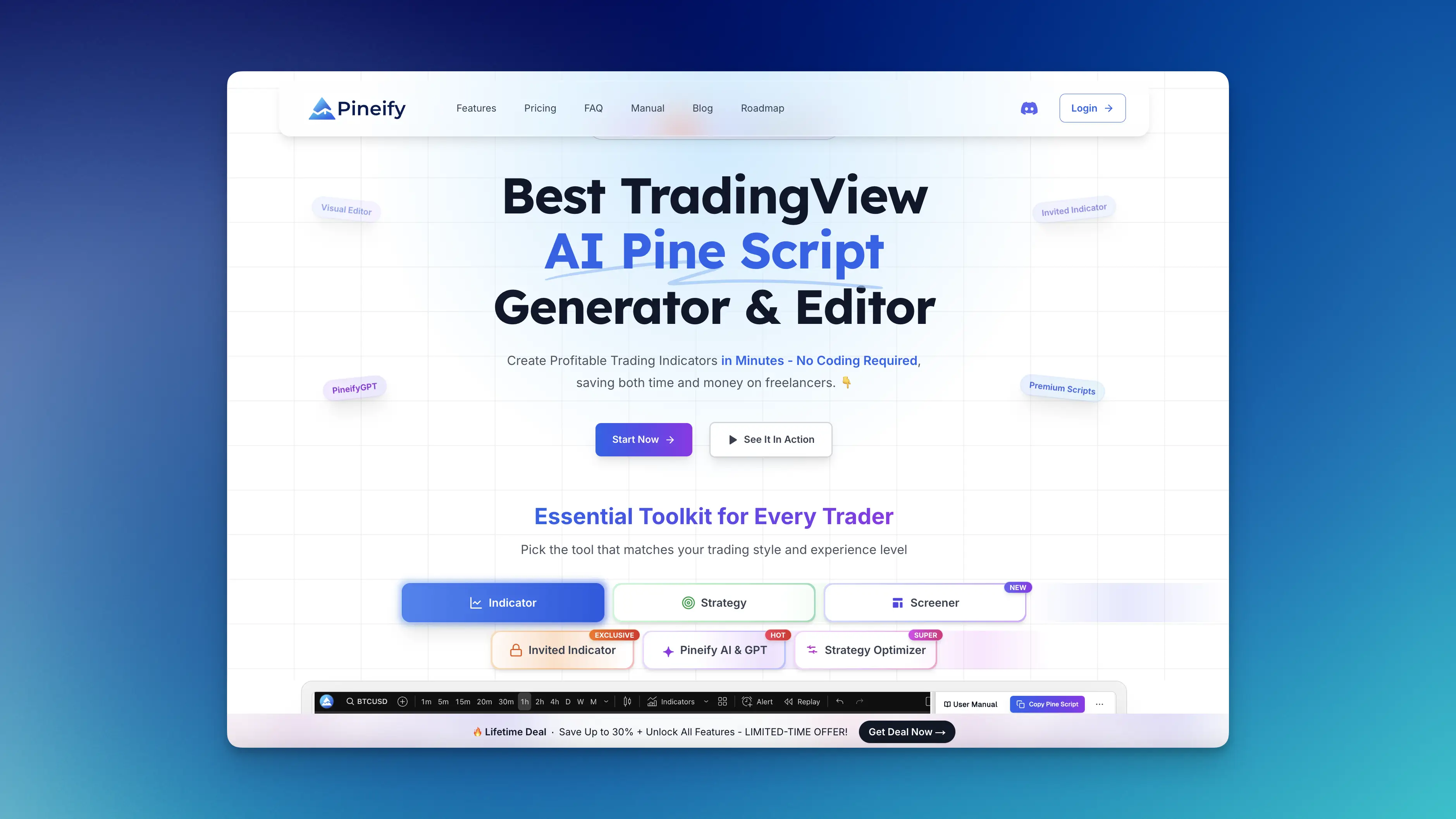
This is exactly why Pineify was built. It's a 10-in-1 AI trading workspace designed for Pine Script, not a generic chatbot. Its Pine Script Agent outperforms ChatGPT, Gemini, and Claude on Pine Script generation, and its Visual Editor packs 235+ built-in indicators for building strategies without writing code. Over 100,000 traders use it. I've tested the Pine Script Agent on a multi-indicator strategy for EURUSD — it compiled clean on the first try across 12 separate iterations, something ChatGPT has never managed for me. For a direct head-to-head, check out Pineify vs Gemini: Which AI Writes Better Pine Script for TradingView?
Specialized MQL coding tools trained specifically on the MetaTrader API are the real fix. They understand the platform's ins and outs, so the code they generate actually works out of the box.
What You Can Build with MQL4 Coding AI
Here's what you can build today — no hype, just practical stuff:
- Custom Indicators – Moving averages, oscillators, signal arrows, divergence detectors, complex multi-buffer composite displays. You describe what you need, the AI handles the buffers and
OnCalculatelogic. - Expert Advisors (EAs) – Fully automated bots for entry and exit logic, position sizing, take profit, stop loss, and trailing stops. Set them up on your VPS and let them run.
- Martingale & Grid Strategies – Progressive lot-sizing systems with drawdown controls. The AI handles the math so you don't accidentally blow up your account.
- Utility Scripts – One-click trade managers, bulk order closers, session timers, lot calculators. Small tools that save time every day.
- Backtesting Helpers – Cleanly structured code for the MT4 Strategy Tester that gives you reliable results. For more on validation, see Mastering Strategy Backtesting with Pineify's Deep Report Features.
Best AI Tools for MQL4 Coding in 2026
The MQL4 AI space has matured. Here are the options I've come across, ranked by how deeply they understand MetaTrader.
| Tool | MQL4 Specialization | Error Auto-Fix | Persistent Memory | Best For |
|---|---|---|---|---|
| Pineify MQL5 AI Coding Agent | MQL4 & MQL5 | ✅ Yes (self-healing loop) | ✅ Yes | Production-ready MT4/MT5 code |
| ChatGPT (GPT-4 MQL4 Coder) | Moderate | ❌ Manual only | ❌ No | Quick drafts, simple EAs |
| Claude AI | Good | ❌ Manual only | ❌ No | Complex logic drafts |
| Google Gemini | Moderate | ❌ Manual only | ❌ No | Iterative prompt sessions |
| MQL4Programmer.com | High | Partial | ❌ No | Strategy-specific generation |
| PZ Architect | High | Partial | ❌ No | MT4 + MT5 + TradingView |
Why Pineify MQL5 AI Coding Agent Stands Out
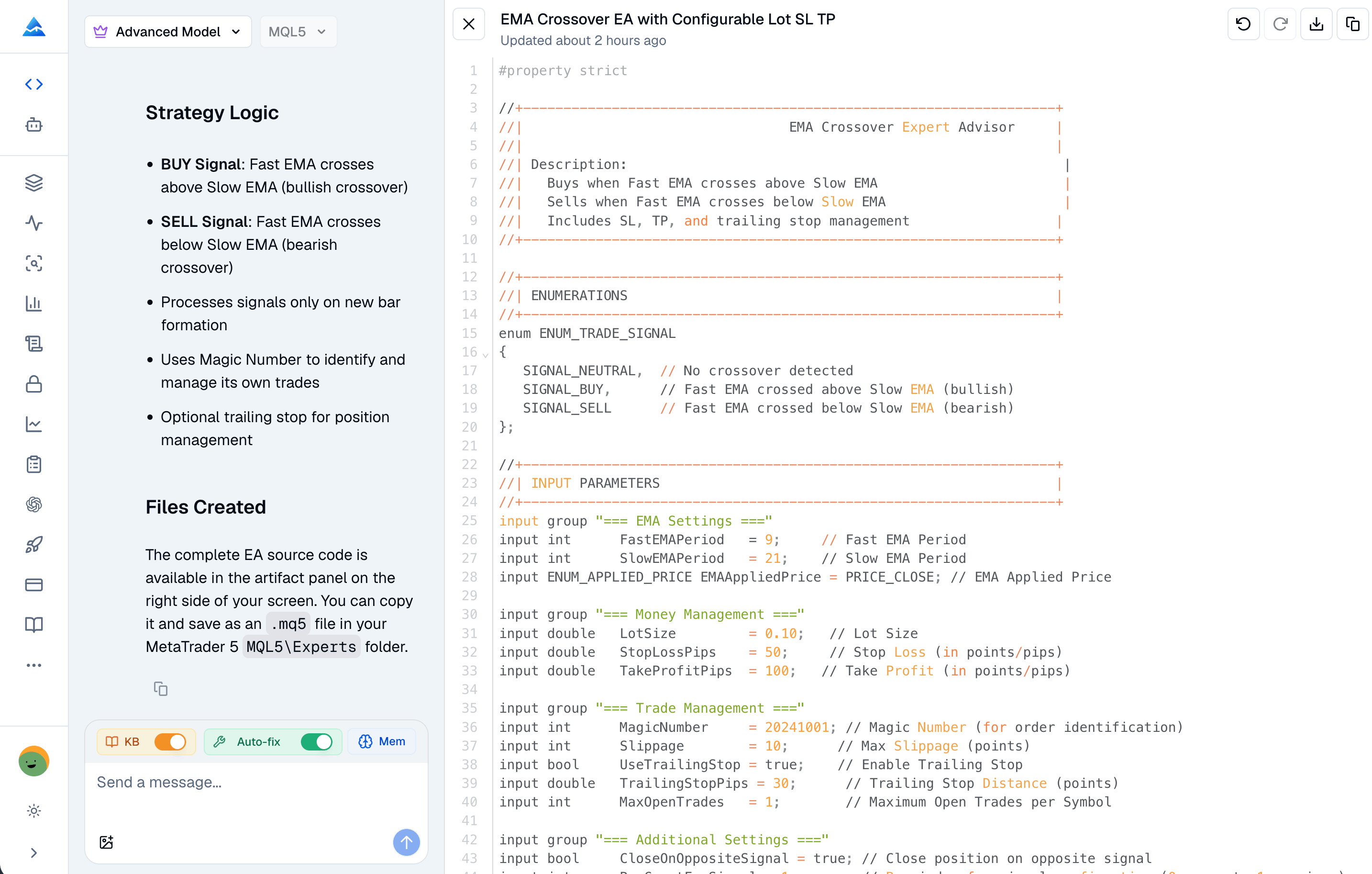
The Pineify MQL5 Coding Agent is the most advanced option I've tested for production-grade MetaTrader code. It knows MQL4 and MQL5 differences inside out, converts MT4 indicators and EAs into proper MQL5 versions, and debugs existing MT4 code.
Self-Healing Error Loop
General AI tools give you code that looks right but won't compile. Pineify uses a multi-step self-healing loop: write code, compile check, spot errors, fix them, repeat until the output is clean. I tested it on a multi-timeframe EA for GBPJPY using three different RSI periods and a volatility filter. The first output had a buffer indexing issue. Pineify caught it, fixed it, and recompiled — all without me lifting a finger.
Built for MetaTrader, Not for Everything
ChatGPT and Claude train on the general internet. Pineify trained on the full MQL5/MQL4 documentation, MetaTrader API patterns, and real-world best practices for indicators and EAs. The code uses proper buffer allocation, correct OnInit/OnCalculate/OnDeinit structures, and order management that works. I haven't tested it with EAs spanning more than three timeframes simultaneously though — if you're building something that complex, run your own tests first.
Persistent Session Memory
Building a complex EA takes multiple sittings. Pineify remembers your strategy parameters, variable names, and logic between sessions. Come back the next day and say, "Add a trailing stop to the EA we worked on yesterday," and it picks up where you left off.
How to Use an MQL4 Coding AI
-
Write your trading idea in plain English – Don't worry about code. Describe exactly what you want: "Buy when the 9 EMA crosses above the 21 EMA on the 1-hour chart. Stop loss at 1.5x ATR. Take profit at 3x ATR." The clearer your description, the better the AI understands you.
-
Feed the description into an MQL4 AI tool – Use a specialized platform like Pineify or a well-crafted GPT prompt for ChatGPT. Make sure the tool is set up for MQL4 specifically, not general code generation. If you use a generic chatbot, you'll likely spend more time debugging than writing.
-
Review the generated code – Scan for the standard parts:
OnInit(setup),OnDeinit(cleanup), andOnTick(orOnCalculatefor indicators). Check that the logic matches what you described. If something looks off, note it — the AI can rework it. -
Compile in MetaEditor – Open MT4's code editor, paste the code, hit F7. Watch the bottom panel for errors. If you get error messages, copy them — the AI can usually fix them in one more pass.
-
Backtest in the Strategy Tester – Before risking real money, test on historical data. Pick a few currency pairs and timeframes. Let it run through years of price action. Compare your approach with the Amibroker vs Pineify Backtest Reports: Complete Strategy Validation Comparison for a more rigorous validation workflow.
-
Iterate with the AI – If backtest results are poor, tell the AI what went wrong: "Too many false signals in sideways markets" or "Stop loss gets hit too often." Let it rework the logic. This back-and-forth is where the real value lives — pair programming with a bot.
MQL4 vs MQL5: Which One in 2026?
If you're starting algorithmic trading, this question comes up constantly.
MT4 is still everywhere. Many brokers still support it, and there's a huge library of existing MQL4 EAs that people rely on daily. I still keep MT4 running for a custom divergence indicator on EURGBP that I've never bothered to port over since early 2025.
MQL5 is where MetaQuotes is investing. MT5 gives you better backtesting, proper object-oriented programming, and the ability to test multiple currency pairs at once. AI tools like Pineify's MQL5 Coding Agent can convert your old MQL4 code to MQL5 if you decide to switch later.
My take: If you're starting from scratch, build in MQL5. Better performance, better backtesting, better future-proofing. If you already have working MQL4 EAs, don't rush the switch — convert them when you need to, not because someone told you MQL4 is dead.
Common MQL4 Coding Mistakes AI Helps You Avoid
Even experienced traders make these errors coding by hand:
- Using outdated functions –
iMACD()behaves differently depending on your MT4 build. A decent AI knows the current API and won't make this mistake. - Off-by-one errors with bar indexing – MQL4 indexes bars backwards (
[0]= current bar,[1]= previous bar). Easy to get wrong, hard to spot visually. - Forgetting
EMPTY_VALUE– Uninitialized indicator buffers cause weird visual glitches. AI-generated code typically handles this out of the box. - Skipping
IsTradeAllowed()checks – An EA that doesn't verify trade permissions silently fails on restricted accounts. You won't know until you check the logs. - Hardcoding lot sizes – Production EAs should use risk-based position sizing. AI tools trained on best practices default to this pattern.
A well-trained MQL4 coding AI avoids all of these automatically. pineify
Frequently Asked Questions
How is a specialized MQL4 coding AI different from using ChatGPT?
ChatGPT doesn't know the MetaTrader API deeply and it won't fix its own errors. It regularly produces MQL4 code with compilation errors or outdated function calls. Specialized tools like Pineify train on actual MQL4 and MQL5 documentation and verify their output before you see it.
Do I need programming knowledge to use an MQL4 coding AI?
Not at all. Tools like Pineify are built for traders who have never written code. You describe your trading idea in English and get compilable MQL4 code back.
Can AI-generated MQL4 EAs be used in live trading?
Yes, but you should backtest thoroughly first and run the EA on a demo account. The code is structurally solid, but your strategy logic still needs validation before you risk real money.
Can I convert my existing MQL4 EA to MQL5 using AI?
Yes. Pineify's MQL5 Coding Agent understands the API differences between MQL4 and MQL5 and converts your code while preserving the strategy logic.
What is the best free option for MQL4 coding AI?
For basic EAs and simple indicators, ChatGPT with a carefully written MQL4 system prompt works, along with DeepSeek or Claude. But for production-grade, error-free code that you'd trust with real money, a specialized tool is a much stronger choice.
Start Automating Your MT4 Strategy
You don't need a CS degree to trade algorithmically anymore. MQL4 coding AI puts automated trading within reach of anyone who can describe their strategy in English.
- Try the Pineify MQL5 AI Coding Agent at pineify.app/mql5-ai-coding-agent — describe your first indicator or EA and get compilable code in seconds.
- Review your manual strategy — find the rules you repeat most often and turn them into a simple AI prompt.
- Join the community — Forex Factory's MQL4 AI threads are full of prompts, fixes, and results worth studying.
- Backtest before going live — use at least two to three years of historical data. For deeper validation, check out Mastering Strategy Backtesting with Pineify's Deep Report Features.
If you know another trader still coding MQL4 by hand, share this article with them. Or drop your first AI-generated EA idea in the comments.