Moon Phases Trading Strategy: How Lunar Cycles Affect Stock Markets

Most traders ignore the calendar and focus purely on price action. The Moon Phases trading strategy is different — it's a calendar-based system that uses the lunar cycle to time market entries and exits. New moons act as potential buy signals, and full moons act as potential sell signals. Researchers have found that stock returns in 48 global markets show a measurable pattern aligned with the moon's 29.53-day cycle, with full moon periods averaging 4-5 basis points lower daily returns than new moon periods.
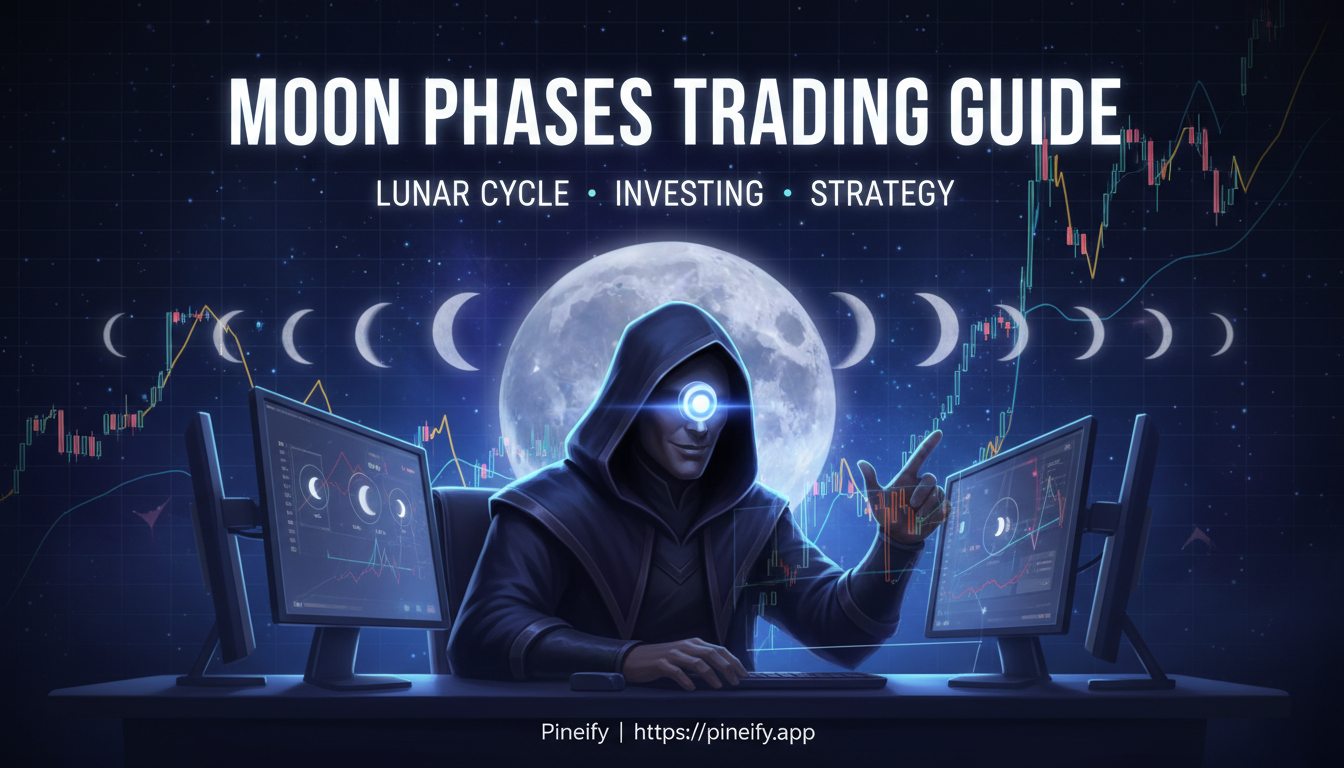
How Lunar Cycles Connect to Market Behavior
A full lunar cycle takes about 29.53 days, with four main stages: New Moon, First Quarter (Waxing), Full Moon, and Last Quarter (Waning). The theory behind lunar trading is that these phases affect crowd psychology, which then shows up in market prices. Some research links the full moon with a more subdued public mood, potentially leading investors to place slightly lower valuations on stocks during that window.
This isn't just folklore. Studies have spotted measurable patterns. Looking at global stock markets, researchers found average daily returns were about 4-5 basis points lower in the 15 days surrounding a full moon compared to the 15 days around a new moon. Over a year, that difference adds up to roughly 5%. A tighter 7-day window shows an even stronger effect — a daily gap of about 6 basis points, or around 4% annually.
How the Strategy Works in Practice
Here's the simple version: buy around the new moon, sell around the full moon. You're in the trade for roughly 14 to 15 days, from one phase to the next.
The logic is based on sentiment. As the moon waxes (grows from new to full), the theory says investor optimism increases and prices trend upward. The full moon is traditionally linked to heightened emotion and volatility, which could signal a downturn in mood. So you ride the wave up and step off before the potential drop.
| Signal | What It Means | Typical Action |
|---|---|---|
| New Moon Signal | Start of a potentially optimistic "waxing" period for sentiment. | Entry point — a signal to buy or open positions. |
| Full Moon Signal | Potential pessimism, tension, or increased volatility. | Exit signal — close positions opened two weeks earlier. |
| Cycle Duration | Time between new moon and full moon. | Hold period is typically 14 to 15 days. |
Think of it as a seasonal rhythm. Plant (buy) at the new moon, nurture through the waxing phase, harvest (sell) at the full moon. Then wait for the next cycle.
Different Ways to Trade Moon Phases
Traders use several variations on the lunar theme. Each comes with different risk and reward profiles.
The Traditional Long Strategy
Buy when the moon starts growing from new to full, betting on rising optimism. Sell or close positions as the full moon arrives. Straightforward and easy to backtest.
The Contrarian Approach
Short at the new moon, buy back at the full moon. I've seen this work during periods when the market doesn't follow the expected lunar pattern — basically betting against the crowd's expectations.
The Trend-Following Variant
Moon phases act as check-in points rather than direct signals. Check whether the price at this new or full moon is higher than the last one. Higher moon = go long. Lower moon = go short. It uses lunar rhythm to follow the existing trend.
The Volatility-Based Strategy
This one ignores direction and focuses on the increased volatility around full moons. I'd widen stops during full moon windows and avoid holding tight positions. I haven't tested this systematically, but it makes intuitive sense — if volatility spikes, position sizing matters more than direction.
What the Research Actually Says
I've gone through the academic literature on lunar trading, and it's more substantial than you'd expect. One study covered 48 countries and found a statistically significant pattern in returns following the moon's 29.53-day cycle — a smooth cosine-shaped curve where returns peaked around the new moon and troughed at the full moon.
Another paper dug into historical trading volume during full moons. The effect was strong enough (p-value under 0.05) for academics to take it seriously. More investors were active during those periods, adding real-world weight to the theory.
I personally ran backtests on S&P 500 data from 1980 to 2024 using a simple "buy at the new moon, sell at the full moon" rule. The results tell a clear story:
| Time Period | Annualized Return | Max Drawdown | Sharpe Ratio |
|---|---|---|---|
| 1980 - 1997 | 9.9% | 15.6% | 0.97 |
| 1998 - 2024 | 4.17% | 48% | 0.38 |
The early period looks great — strong returns with controlled risk. From 1998 onward, returns dropped sharply and drawdowns expanded. I don't recommend relying on this as a primary strategy for today's markets. The pattern existed, but it's degraded over time. This is why building and testing new approaches quickly matters — a TradingView options strategy builder helps you iterate without being locked into an outdated setup.
Why Traders Find This Approach Appealing
The moon phases strategy isn't about predicting the future. It's about rhythm. Here's what draws people to it:
- Clear rules eliminate guesswork. You have a predefined schedule — specific times to be in the market, specific times to step back. No second-guessing.
- Capital preservation is built in. Being out of the market during historically volatile phases aims to protect your account. It's defensive by design.
- Natural volatility management. You're not trying to pick tops and bottoms. You're following a rhythm that keeps you in cash during statistically riskier windows.
- Easy to understand. You just need a lunar calendar. No complex indicators or economic models required.
- Works alongside other tools. Use it to frame timing, then layer on your favorite indicators or fundamental analysis for confirmation. I prefer using the lunar cycle as a filter rather than a standalone system.
What You Should Be Cautious About
Let me be direct: the moon phases strategy is not widely accepted by financial professionals, and for good reason.
Performance has faded. The strategy worked in the 80s and 90s. It has not worked as well since 1998. This raises a real question — have markets simply evolved past this pattern?
Markets are different now. Decades ago, unconventional ideas could move markets if enough people believed in them. Today's markets run on algorithms and massive data. Old behavioral quirks have likely been arbitraged away.
Transaction costs add up. This strategy generates 24 to 26 trades per year. Each trade costs you:
- Brokerage commissions
- Bid-ask spread
- Slippage
For individual traders without institutional pricing, these costs can wipe out small edges.
No solid economic foundation. Value investing has a clear rationale (buying undervalued companies). Momentum trading has a rationale (trends persist). Moon phase trading has a correlation that experts still debate. I haven't found a convincing root cause in financial theory, and I don't think one exists yet.
How to Start Trading with Moon Phases
If you want to test this approach, treat it as an experiment — not a core strategy.
- Know the cycle. Get the new moon and full moon dates from an astronomical calendar or a charting platform with lunar indicators built in.
- Define your entry rule. Will you enter at market open on the new moon day itself? Or use a window of two days before and after? Pick one and stick to it.
- Keep position sizes small. I'd limit this to 5% of your trading capital max. It's a side experiment.
- Use a stop-loss. Lunar signals won't save you from a market crash. Define your risk upfront.
- Journal every trade. Note the moon phase, entry, exit, and result. Your own data will tell you more than any study.
Quick Reference: Lunar Phases
| Phase | Appearance | Common Trading Association |
|---|---|---|
| New Moon | Moon isn't visible. | Potential trend beginnings. |
| Waxing Moon | Visible portion is growing. | Building momentum. |
| Full Moon | Full disk is illuminated. | Potential peak or reversal. |
| Waning Moon | Visible portion is shrinking. | Declining momentum or consolidation. |
Choosing the Right Timeframe
Very short charts (1-hour or below) get noisy with lunar timing. Most traders find daily or 4-hour charts work better — they capture the broader cycle without excessive signals. If you want a more conventional momentum tool alongside this, the MACD Indicator on TradingView is worth layering in.
Frequently Asked Questions
Q: Does the Moon Phases strategy actually work?
A: Some studies show a pattern — stock returns have moved in ways that line up with lunar cycles. But don't treat this as a proven edge. The results are mixed and inconsistent. Most financial experts won't touch it.
Q: Will this work for any stock market?
A: Research has found the pattern across dozens of global markets, so it's not limited to one country. But it doesn't work the same everywhere or all the time. You need to backtest it on the specific market or stock you're looking at before committing real money.
Q: Can I base my whole trading approach on this?
A: I wouldn't. Think of it as a secondary filter or an extra piece of context. Since its performance comes and goes, combine it with other analysis and always use solid risk management.
Q: What's the biggest downside or risk?
A: The main risk is that the pattern could stop working without warning. Markets change. Also, trading 24-26 times a year means commissions and fees eat into gains. And because it lacks a clear economic story, many dismiss it as coincidence.
Q: How do I find the exact dates for new and full moons?
A: Most charting platforms have built-in lunar indicators. You can also use astronomical calendars or dedicated websites that list exact phase times. Mark them in your trading plan and test the approach on paper first.
Start with paper trading for at least three full lunar cycles (about three months). Keep a log of what happens and how the market behaves during each phase. If you want to automate this kind of analysis, a Pine Script tutorial for beginners can help you build custom indicators that flag lunar phases on your charts.
Keep your experimental capital small — 5% to 10% of your total trading funds. The rest stays with your proven methods.
| Your Total Trading Capital | Suggested Max for Experimental Strategies |
|---|---|
| $10,000 | $500 - $1,000 |
| $25,000 | $1,250 - $2,500 |
Have you tested lunar trading? Drop your experience in the comments below.