How to Backtest a Trading Strategy: Step-by-Step Guide

Backtesting is a method for running a defined set of trading rules through historical market data to measure how a strategy would have performed. It replaces hunches with numbers. I have run hundreds of these simulations over the past three years, and the pattern is consistent: strategies that fail in backtesting almost never survive live markets, but strategies that pass still need real-world validation before you commit capital.
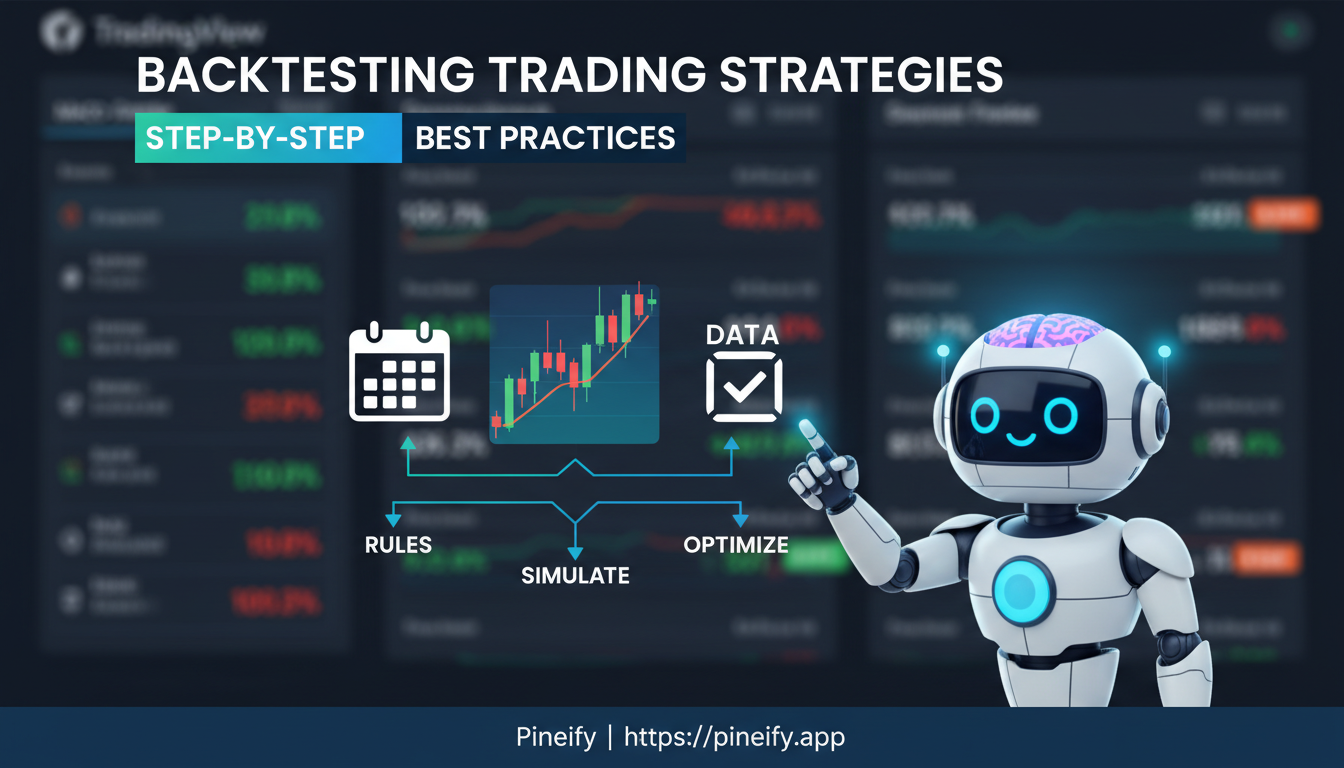
What Is Backtesting and Why Does It Matter?
Think of a backtest as a time machine for your strategy. You feed in your rules — when to buy, when to sell, how much to risk — and replay history bar by bar. The output tells you whether the idea holds water without risking a cent of real money.
Why go through this? Because trading an untested idea is guessing. Backtesting maps the field before you walk through it. It replaces feelings with hard numbers: win rate, drawdown, profit factor, Sharpe ratio. You fix problems on your computer, not with your savings. I have watched traders blow through months of gains chasing a strategy they never validated. It is an avoidable mistake.
If you cannot define your rules precisely enough to backtest, you do not have a strategy. You have a wish.
Step 1: Get Crystal Clear on Your Trading Plan
You need rules so specific that a computer — or a half-asleep version of you — could follow them without hesitation. Ambiguity in the plan means garbage in the output.
Here is what you lock down before touching any data:
- Entry signals — What must happen before you buy? Example: RSI drops below 30 AND price closes above its 20-day moving average.
- Exit signals — When do you sell? A fixed profit target, a trailing stop, or a flip in another indicator?
- Position sizing — How much capital per trade? I prefer 2% fixed per position for most swing strategies.
- Stop-loss and take-profit levels — Where are the floor and the ceiling?
- Market and timeframe — Stocks, forex, crypto? Daily, 4-hour, 1-minute?
Vague ideas like "buy when it feels right" are untestable.
Instead of saying: "I do trend-following on the Nifty."
Write: "I trade long-only on the Nifty 50 daily chart. I enter when the 50-day EMA crosses above the 200-day EMA, and I exit when it crosses back below. I risk 2% of my capital per trade with a stop-loss 5% below entry and take profit at 10%."
That is a testable plan. That is what you need.
Step 2: Find Reliable Historical Market Data
Your backtest is only as good as the data feeding it. Incomplete or low-quality data produces results that look fine on paper and fall apart in real trading.
The resolution depends on your style:
- Scalpers and day traders need tick-by-tick or minute-level precision.
- Swing traders can work with daily OHLCV (open, high, low, close, volume).
A common mistake: testing only in bull markets. Your dataset must span different conditions — uptrends, downtrends, sideways chop. If you only test during a rally, you have no idea what happens when the trend flips.
As a rule, gather at least 2 to 3 years of clean data. I typically pull 5 years for swing strategies, which usually covers at least one full market cycle.
Free data is available on TradingView and Yahoo Finance. For high-frequency scalping, you may need a paid feed for tick-level precision. I have not tested IQFeed or similar data vendors personally, but the serious day traders I follow rely on them. That trade-off is worth understanding before you commit to a strategy.
Step 3: Choose a Backtesting Platform
The right platform depends on your experience level, the assets you trade, and how much control you need.
| Platform | Best For | Scripting Language | Backtesting Strength |
|---|---|---|---|
| TradingView | Retail traders, stocks & crypto | Pine Script | Easy to learn; basic strategy tester |
| NinjaTrader | Futures & forex pros | NinjaScript (C#) | Tick-level data, walk-forward analysis |
| MetaTrader 5 (MT5) | Forex & CFD traders | MQL5 | Real-time visualization, EA testing |
| Python (Backtrader/Zipline) | Quants & developers | Python | Maximum flexibility and customization |
| Thinkorswim (OnDemand) | U.S. equity traders | thinkScript | Manual replay mode, great for psychology |
If you are starting out and want quick results, TradingView is the easiest path. Pine Script lets you define rules in near-English and run backtests in seconds. For traders who want to build strategies without writing code from scratch, Pineify acts as an AI-powered Pine Script generator, producing indicators and strategies in minutes. You can see more about maximizing this setup in our guide on Pine Script Alert Conditions for Custom TradingView Alerts.
On the other end, NinjaTrader targets serious futures and forex traders. Its Strategy Analyzer processes individual ticks and supports walk-forward analysis — a more reliable way to validate a strategy across different market regimes. The learning curve is steep, but for futures work it is hard to beat.
MetaTrader 5 (MT5) is the standard for forex. Real-time visual backtesting and Expert Advisor (EA) automation make it purpose-built for currency pairs.
If you have programming experience, Python with Backtrader or Zipline gives complete control over data, execution logic, and reporting. It takes the most setup and offers the most flexibility.
Thinkorswim's OnDemand replay mode steps through market history one bar at a time. It is less about crunching numbers and more about training your discipline.
I prefer TradingView for quick concept validation — the feedback loop from idea to result is under a minute. For deeper analysis, I export the trade log and work through it in a spreadsheet. I have not used NinjaTrader personally, but futures traders on forums consistently rate it for tick-level work.
For a head-to-head comparison, read our analysis on Sierra Chart vs TradingView to see which setup fits your workflow.
Step 4: Run Your Backtest in the Real World
Once the platform and data are ready, run the simulation. The trick is to model realistic conditions, not a controlled lab. Here is how to stay honest:
- Include trading costs. Commissions, spreads, and overnight fees eat into profits. In one of my recent backtests on BTC/USD from January 2022 through June 2024, ignoring spread costs inflated the net profit by nearly 18%.
- Model slippage. Real fills are almost never at the price on your chart. Assume a few ticks of slippage per trade.
- Do not use future data. Your backtest can only know what was available up to the bar being processed. This sounds obvious, but it is the easiest mistake when optimizing manually.
- Process bar by bar. Walk through the data sequentially. This prevents your brain from leaking hindsight into decisions.
A widely trusted technique is walk-forward analysis. Split your data:
| Data Segment | Purpose |
|---|---|
| First 70% of your data | Development Set: Build and optimize your rules here. |
| Remaining 30% of your data | Testing Set: Apply the finished rules to unseen data and see how they hold up. |
This separation proves your strategy is finding real patterns, not just memorizing noise. Platforms like TrendSpider can automate this split-testing, which helps traders build more resilient strategies.
Step 5: Make Sense of Your Backtesting Results
The test finishes and shows a profit number. Do not stop there. Profit alone tells you nothing about the risk it took to earn it.
| Metric | What It Tells You | A Good Benchmark |
|---|---|---|
| Total & Annual Returns | Raw profitability | Should justify the risk taken |
| Win Rate | Percentage of profitable trades | 50–70% paired with good risk/reward |
| Sharpe Ratio | Return per unit of volatility | Above 1.0 is decent; above 2.0 is strong |
| Maximum Drawdown (MDD) | Worst peak-to-trough drop | Know your personal comfort level |
| Profit Factor | Gross profit divided by gross loss | Above 1.5 is favorable |
| Calmar Ratio | Annual return divided by max drawdown | Above 2.0 is a reasonable target |
| Sortino Ratio | Like Sharpe, penalizes downside volatility only | Above 2.0 is a good target |
I have not found a single metric that tells the whole story. A Sharpe ratio of 2.5 looks great, but if the max drawdown is 40%, you would likely panic and close the strategy before it recovers. Always check drawdown alongside returns.
The losing periods matter most. Pull the trade log and find the drawdown clusters. Did they cluster around a specific market event, after news releases, or during a particular time of day? Understanding when and why your strategy fails is more valuable than celebrating the wins.
Write it down. Two sentences about the conditions that break your strategy will save you from repeating the same mistakes.
7 Backtesting Pitfalls Every Trader Needs to Know
A backtest is a flight simulator for your strategy. Pilots develop bad habits in simulators, and traders make predictable mistakes in backtests. Here are the seven most common:
-
The Overfitting Trap — You tweak parameters until the strategy perfectly matches past data. It looks brilliant in the backtest and fails immediately in live markets. If your strategy has more than a handful of optimized parameters, you are probably overfitting.
-
Hindsight Bias — You subconsciously use knowledge of what happened to guide test decisions. In real trading, you do not have that information until the candle closes.
-
Ignoring Transaction Costs — A strategy that barely breaks even on paper turns into a loser after you account for spreads, commissions, and slippage.
-
Too Little Data — Testing on a few months or a handful of trades produces noise, not signal. Aim for at least 100 historical trades.
-
Sampling Bias — Testing only in a bull market tells you nothing about how the strategy handles a crash or a sideways grind.
-
No Out-of-Sample Validation — This is the worst one. If you develop and test on the same data, the results are meaningless. Reserve a separate chunk for final validation.
-
Skipping Paper Trading — A backtest is historical. Paper trading tests your execution and psychology in real time. Do not skip it.
Finding Your Trading Footing: Backtesting, Paper Trading, and the Real Deal
Think of the journey from idea to live capital as a progression. Each stage has a different level of risk and a specific purpose.
| Stage | Risk | Data Type | Purpose |
|---|---|---|---|
| Backtesting | Zero | Historical | Validate strategy logic |
| Paper Trading | Zero | Real-time (simulated) | Validate execution and psychology |
| Live Trading (small size) | Low | Real | Confirm live performance |
| Full Deployment | Full | Real | Scale a proven strategy |
Backtesting validates the logic. It is your rehearsal.
Paper trading is the dress rehearsal with live data but no real money. This is where execution, emotions, and discipline get tested. Most traders want to skip this step. Do not. The real market has friction — tiny delays, slippage, and your own nerves. Paper trading surfaces those issues before they cost you. For a deeper look at automated strategy testing, our guide on Automated Trading in TradingView covers the full pipeline from backtest to automation.
Live trading with small capital is the final check. If the strategy works with real emotions and real fills, then scale up to full deployment.
It is a patient process, but it is the only reliable path from idea to consistent results. If you want to strengthen your technical analysis alongside your backtesting, our breakdown of the Top 10 TradingView Indicators is a solid reference.
Q&A
Q: How much historical data do I need for a reliable backtest? A: Enough to generate at least 100 trade signals. For most strategies, 2 to 3 years covers a variety of market conditions — trending up, trending down, and sideways. More data is rarely a problem as long as the quality holds up.
Q: Can I backtest a strategy for free? A: Yes. TradingView, MetaTrader 5, and Thinkorswim ship with built-in backtesting tools and free historical data. They work well for most standard strategies. If you are testing a high-frequency scalping strategy, the free feeds are probably not detailed enough — you would need paid tick-level data.
Q: What is a good Sharpe Ratio for a backtested strategy? A: Above 1.0 means the strategy is compensating you for risk. Above 2.0 is genuinely strong. Above 3.0 is exceptional and deserves extra scrutiny — extraordinary numbers often hide overfitting. Always pair the Sharpe ratio with maximum drawdown. A strategy that drops 50% is unworkable no matter how pretty the ratio looks.
Q: What is the difference between in-sample and out-of-sample testing? A: In-sample data is your training set. You build rules and optimize parameters on it. Out-of-sample data is a separate chunk the strategy has never seen. If the strategy performs well on both, you can trust it more. If it only works on in-sample data, it has memorized the past instead of learning a pattern.
Q: Is backtesting guaranteed to predict future performance? A: Not at all. Backtesting shows what worked historically. Markets shift, regimes change, and old patterns break. Think of it as a filter: it eliminates bad ideas and strengthens good ones. It is not a crystal ball. You still need paper trading and small-position live testing before scaling up.
Your Next Move: From Learning to Doing
Knowing the steps is one thing. Running your first real backtest is where the learning happens. Here is an action plan:
- Start simple. Pick a moving average crossover — 50-day and 200-day EMA on a daily chart. Master the process with one clear idea before adding complexity.
- Choose a tool you will actually use. TradingView is the fastest path for most people. Pine Script lets you write rules and see results on the same screen.
- Find 3+ years of clean data. Daily OHLCV for any major stock or ETF — SPY is a good starting point.
- Run the test with real costs. Include commissions, a few ticks of slippage, and the bid-ask spread.
- Read the metrics, not just the profit. Focus on max drawdown and profit factor alongside the return number.
- Validate on unseen data. Hold out the most recent 30% of your data. Test the finished strategy on it.
- Paper trade for at least a month. Run the strategy in real time with zero capital. Watch how it behaves before risking money.
Share your process — the wins and the losses — with a trading journal or a community you trust. Another set of eyes catches blind spots.
The goal is not to manufacture a perfect profit machine. It is to build a repeatable process for testing ideas. The traders who stick with this process are the ones who improve over time.