Convert MQL4 to MQL5: A Practical Migration Guide for Traders

If you've been running automated trading strategies on MetaTrader 4, you've probably heard the news: brokers are slowly moving away from MT4, and MetaTrader 5 (MT5) is taking over. MQL4 to MQL5 conversion is the process of migrating MetaTrader 4 code — Expert Advisors, custom indicators, and scripts — to work on the MetaTrader 5 platform. That means you'll need to convert MQL4 to MQL5, and the sooner you start, the smoother the transition.
I've converted about a dozen EAs from MQL4 to MQL5 this year alone, and the order management refactoring tripped me up every single time until I switched to the CTrade class. Some of those EAs ran on EURUSD with scalping logic, and getting the position sizing right took multiple passes.
Why Convert MQL4 to MQL5?
MetaQuotes has made it clear — MT5 is the main platform going forward. Many brokers already announced end-of-support dates for MT4, so your MQL4 tools may stop working in live markets sooner than you expect.
It's not just about broker support. MT5 brings real performance gains. MQL5 programs run up to 20 times faster than their MQL4 versions, thanks to better compilation and memory handling. MQL5 also supports object-oriented programming, multi-timeframe and multi-currency analysis, and a richer standard library — features MQL4 doesn't have.
MQL4 vs. MQL5: Key Differences
Before converting, you need to know exactly where these two languages diverge. MQL5 isn't a newer version of MQL4 — it's a completely restructured language. Code that compiles fine in MQL4 will either fail to compile or behave unexpectedly in MQL5.
| Feature | MQL4 | MQL5 |
|---|---|---|
| Platform | MetaTrader 4 | MetaTrader 5 |
| Programming approach | Procedural only | Procedural + Object-Oriented |
| Timeframe Support | Single timeframe | Multi-timeframe |
| Currency Pair Analysis | Single currency | Multi-currency |
| Built-in Indicators | 30 | 38 |
| Supported Timeframes | 9 | 21 |
| Pending Order Types | 4 | 6 |
| Execution Speed | Standard | Up to 20x faster |
Lifecycle Functions
The most noticeable syntax difference is event handling. In MQL4, you use init(), start(), and deinit(). In MQL5, these are replaced with:
init()→OnInit()start()→OnStart()(scripts) /OnTick()(EAs) /OnCalculate()(indicators)deinit()→OnDeinit()
I've seen people make this swap mechanically and miss that OnTick() expects a different function signature than start(). That's the kind of detail that compiles fine but breaks at runtime.
Order and Position Management
MQL4 uses OrderSelect() to access both open positions and pending orders from a single pool. MQL5 splits this into three separate systems:
- Positions — accessed via
PositionSelect()andPositionGetDouble() - Orders — accessed via
OrderSelect()for pending orders - Deals — historical filled transactions via
HistoryDealSelect()
This is the biggest headache when converting an MQL4 EA to MQL5, especially if your EA has complex position management. I prefer to use the CTrade class here — it saves a ton of boilerplate.
Price Array Indexing
MQL4 indexes price arrays from oldest to newest, where index 0 is the current bar. MQL5 does the same when you use ArraySetAsSeries(), but by default standard indicator buffers go in the opposite direction. If you're used to MT4-style indexing, always call ArraySetAsSeries(array, true) explicitly in MQL5.
Back in March 2026, I spent an afternoon debugging an ArraySetAsSeries issue that shifted all my signals by one bar — not a mistake I'll make again.
Step-by-Step: How to Convert MQL4 to MQL5
Step 1 — Audit Your Current MQL4 Code
Before touching a single line, understand what your code does. Write down the indicators it uses, how it opens and manages trades, and any custom functions you've built. Why it matters: I've seen people jump straight into conversion only to discover halfway through that their EA uses custom indicator buffers they forgot about. What can go wrong: You'll miss dependencies and the converted code won't compile.
Step 2 — Replace Lifecycle Function Names
Swap out the MQL4 function names for their MQL5 equivalents. For an EA, start() becomes OnTick(). For indicators, start() becomes OnCalculate(). init() turns into OnInit(), and deinit() becomes OnDeinit(). Why it matters: MQL5 uses an event-driven model — the old procedural pattern won't work. What can go wrong: Your EA compiles but never triggers a single trade because the entry point is wrong.
Step 3 — Refactor Order Management
The biggest change is how trades work. Use the CTrade class from the standard library — it's much cleaner and saves tons of boilerplate. Instead of writing lengthy OrderSend() calls, use CTrade::Buy(), CTrade::Sell(), and CTrade::PositionClose(). Why it matters: MQL5 splits orders, positions, and deals into separate systems. What can go wrong: If you translate OrderSend() literally, your code won't compile.
Step 4 — Fix Price Array Indexing
Check every place you access Close[], Open[], High[], Low[], or custom indicator buffers. Add ArraySetAsSeries() calls to make indexing behave the same way as in MQL4. Why it matters: MQL5 defaults to reverse indexing for indicator buffers. What can go wrong: Skip this and your signals fire on the wrong bar.
Step 5 — Update Indicator Calls
In MQL4, you grab an indicator value directly with something like iMACD(NULL,0,12,26,9,PRICE_CLOSE,MODE_MAIN,0). In MQL5, it's a two-step process: create a handle with iMACD(), then copy values into a buffer with CopyBuffer(). Why it matters: The handle + CopyBuffer pattern is more flexible and efficient. What can go wrong: If you don't store the handle, you get runtime errors on every tick.
Step 6 — Compile and Debug in MetaEditor
Open your converted .mq5 file in MetaEditor and hit compile. Fix errors starting with HIGH severity, then work down through NOTICEs. Why it matters: MetaEditor catches syntax and type errors before they hit your live account. What can go wrong: Ignoring NOTICE warnings often hides real runtime issues.
Step 7 — Backtest and Validate
Run your converted EA through MT5's Strategy Tester using historical data, then compare results to your original MT4 backtest. If indicator values or trade signals don't match, double-check your array indexing and order logic. Small differences are normal, but big divergences mean something's off. For a deeper look at backtesting methodology, check out How to Backtest on TradingView — the validation principles apply across platforms.
Best Tools to Convert MQL4 to MQL5
Manual conversion gives you full control but takes time. AI-powered tools can speed things up considerably.
Pineify MQL5 Coding Agent
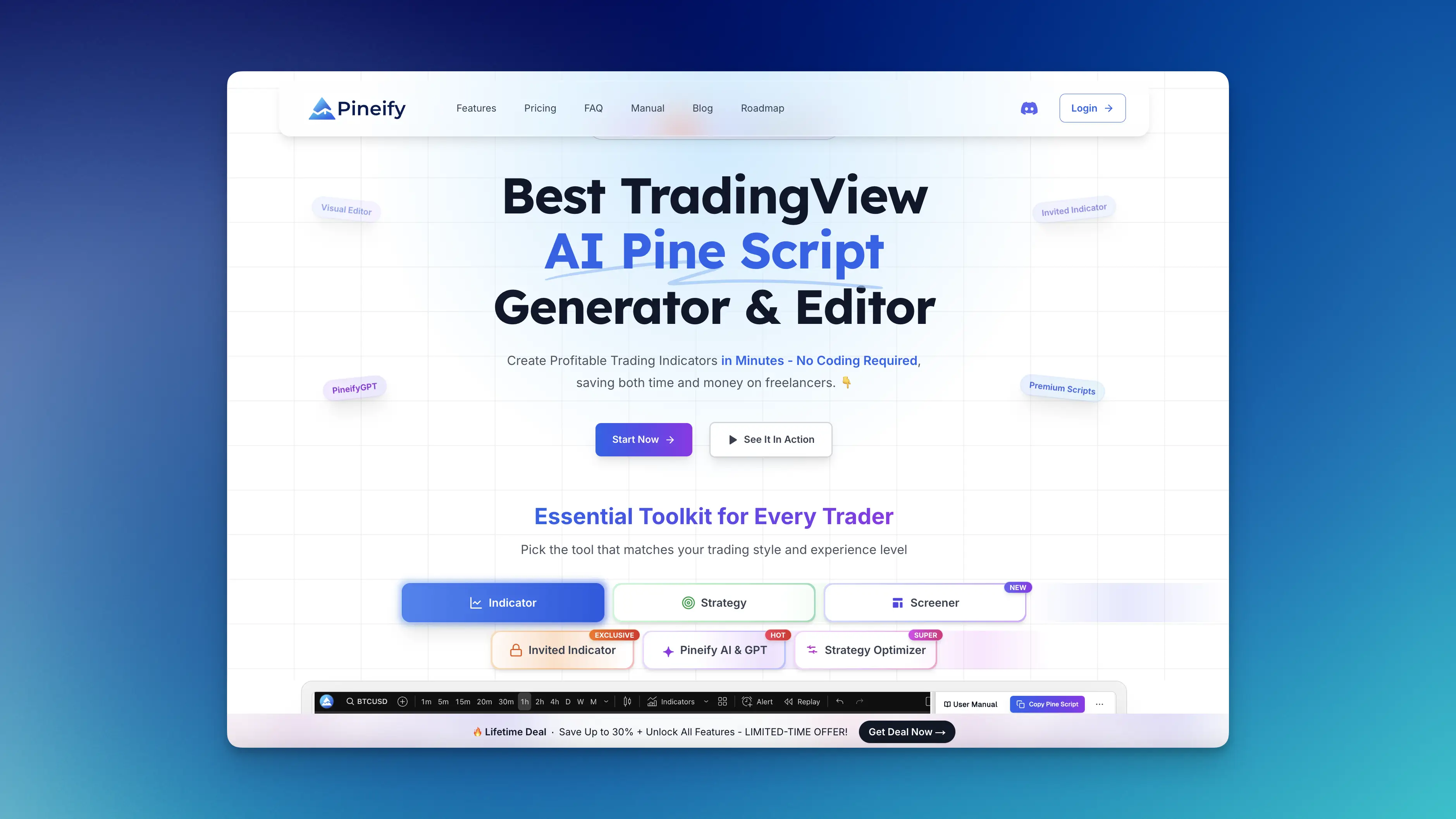
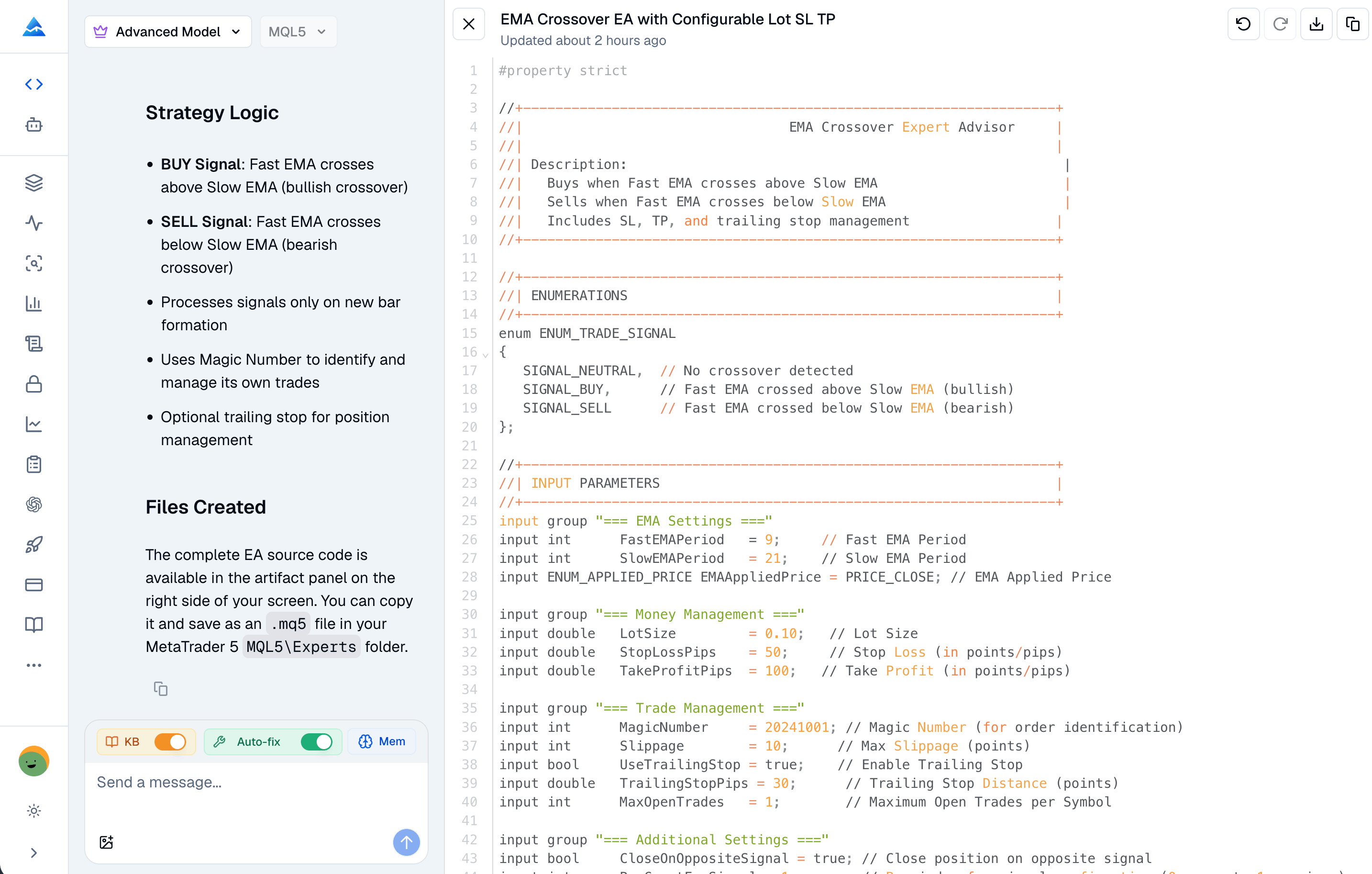
For professional-grade results without deep coding experience, the Pineify MQL5 Coding Agent is my current go-to for MQL5 conversion. It's built specifically for MetaTrader 5, so it generates compilable Expert Advisors, custom indicators, and scripts — something generic AI tools usually can't do.
I tested it on a scalping EA that ran on EURUSD with a 15-tick stop loss. It produced working code in under 30 seconds. That said, I still review every line before deploying — no AI catches every edge case.
ChatGPT often generates unreliable MQL5 code in my experience. Pineify's agent trains only on MQL5 syntax, MetaTrader's standard library, and real trading logic. It handles CTrade, CopyBuffer(), position management, and multi-timeframe structures that confuse general-purpose AIs.
If you're also generating TradingView code with AI, our Master Pine Script with AI Coding Agent article shows how Pineify handles Pine Script.
JBlanked MQL4-to-MQL5 Converter
JBlanked's converter uses ANTLR parsing with an MQL4-to-MQL5 AI agent to translate syntax automatically. It works for simple indicators and scripts. I haven't tested it on anything more complex than a 50-line indicator, so I can't vouch for its reliability on full EAs — manual debugging is still needed for complex strategies.
mq4-to-mq5 Bridge Script (Community Tool)
There's a community-built script that uses compatibility header files (like mql4compat.mqh) to partially automate conversion inside MetaEditor. It wraps MQL4 function calls in compatibility shims so the converted file compiles in MT5. Success rates are decent for simple indicators (around 65%) but drop significantly for complex EAs.
Common Conversion Mistakes to Avoid
Even experienced developers trip on these during an MQL4 to MQL5 migration:
- Forgetting
ArraySetAsSeries()— Skip this and your price data shows up in reverse order. Trading signals will be completely off. - Using the old
OrderSend()syntax — MT5 requiresMqlTradeRequeststructs and theCTradeclass. The old way won't compile. - Missing indicator handles — Call
iMA()and don't store the handle? You'll get runtime errors on every tick. - Assuming hedging mode — MT5 defaults to netting mode. Hedging requires manually turning it on in your account settings.
- Skipping the Strategy Tester — Compiling doesn't mean the logic is correct. Always backtest before going live.
Frequently Asked Questions
What is MQL4 to MQL5 conversion?
It's the process of migrating MetaTrader 4 code — Expert Advisors, custom indicators, and scripts — so it runs on MetaTrader 5. You'll rewrite lifecycle functions, refactor order management, update indicator calls to use handles and CopyBuffer(), and fix price array indexing.
How do I convert an MQL4 Expert Advisor to MQL5?
Replace init() with OnInit(), start() with OnTick(), and deinit() with OnDeinit(). Then refactor order management using the CTrade class with PositionSelect() and OrderSelect(). Fix price array indexing with ArraySetAsSeries(), update indicator calls to use handles and CopyBuffer(), then compile and backtest in the MT5 Strategy Tester.
What is the difference between netting and hedging in MT5?
In MT4, you can keep both a buy and a sell open on the same pair simultaneously — that's hedging. MT5 supports both modes, but most brokers default to netting, which allows only one position per symbol. Your converted EA needs to match your account type or it won't behave correctly.
What are the best tools for MQL4 to MQL5 conversion?
I prefer the Pineify MQL5 Coding Agent for AI-assisted conversion. JBlanked's converter works for automated syntax translation. Community bridge scripts with compatibility headers are an option for simple cases. For complex EAs, combine AI tools with manual debugging.
How long does MQL4 to MQL5 conversion take?
A simple indicator takes 30-60 minutes by hand. A full Expert Advisor with complex position management can take hours or a couple of days. An AI coding agent like Pineify cuts that down significantly.
Will my converted EA produce identical backtest results?
Not necessarily, and that's actually a good thing. MT5 uses a more detailed tick data model than MT4, so backtest numbers usually differ. MT5 results are generally closer to what you'd see in live trading, making them more reliable for strategy validation.
Next Steps
If you're moving your trading tools from MT4 to MT5, converting your MQL4 code to MQL5 is worth doing now. Here's where to start:
- Take stock of what you have — list every Expert Advisor, indicator, and script you use. This shows you the full conversion scope.
- Start with the easy stuff — convert simpler indicators first so you get comfortable with the new syntax.
- Use the Pineify MQL5 Coding Agent — head over to pineify.app/mql5-ai-coding-agent. It converts your code and produces compilable results.
- Test everything — run a backtest in the MT5 Strategy Tester before putting any converted EA on a live account. For more advanced techniques, see Advanced TradingView Backtesting — the metrics there also apply to MT5 strategies.
- Get help when you're stuck — the MQL5 community at mql5.com is useful for edge cases and debugging questions.
Already tried converting and hit errors? Drop a comment below with the specific error message and which part of your code is failing.