Best TV Indicators Marketplace Alternatives for Pine Script Traders

TradingView indicator marketplace alternatives are curated platforms that offer premium Pine Script tools outside the public library. Pineify Premium Scripts is the strongest option for traders who want full source code access and one-time pricing. LuxAlgo, Zeiierman, BigBeluga, and Flux Charts each serve different trading styles, but none match Pineify's combination of transparency and lifetime value.
If you've ever dug through TradingView's public script library looking for a reliable indicator, you know it's a mixed bag. Thousands of options, but you're wading through broken code, vague descriptions, and tools that look good in theory but fall apart in real trading. That gamble doesn't cut it when real money's on the line.
TradingView indicator marketplace alternatives are curated platforms that collect premium Pine Script tools from verified developers. They prioritize quality control, source code access, and proper documentation over sheer volume.
The public marketplace works for discovery. But serious traders need more: consistent quality, source code access, and proper support. You're not just downloading an indicator -- you're choosing a tool that drives your decisions. To understand how these tools work, I'd suggest starting with the basics, like learning to code the RSI in Pine Script. It demystifies the logic behind common indicators.
The best option I've tested is Pineify Premium Scripts. You get the source code, detailed tutorials, and a one-time price -- no recurring bills. That combination isn't something LuxAlgo or Zeiierman offer. Here's how Pineify compares to the typical marketplace experience:
| Feature | Typical Public Library | Pineify Premium Scripts |
|---|---|---|
| Quality & Testing | Hit or miss; often untested on live markets. | Each script is backtested and validated in real trading conditions. |
| Source Code Access | Almost always hidden ("closed-source"). | Full, open-source access so you can learn, verify, and modify. |
| Support & Learning | Little to no support; rarely any documentation. | Detailed tutorials and direct developer support. |
| Curation & Focus | Overwhelming volume with no quality filter. | Hand-picked selection focused on utility and proven logic. |
The goal is to move from browsing a crowded closet into a well-organized workshop. Pineify works because it's built by traders who value transparency. You get the tool, the blueprint, and the manual.
Why Generic Marketplaces Often Waste Your Time
Think of TradingView's Public Library like a massive flea market for indicators. Tons of free stuff, built by a passionate community -- great for getting started. But if you're trading with real money, sorting through it all becomes a job. You spend hours testing scripts that might be unreliable, poorly explained, or misleading.
The main issues aren't just about quality. They're about trust and efficiency:
- You can't see the source code. With "premium" scripts, you're often buying a black box. How can you trust a tool with your trades if you can't verify its logic?
- Instructions are unclear, if they exist. Most scripts come with zero guidance on proper use.
- No quality filter. Anyone can upload anything. One indicator might be great; the next one is broken or repaints -- and you can't tell by looking.
- They ignore real risk. Few free indicators help you manage probability or position size. You get a signal but not the context to use it safely.
- You're stuck with what you get. Can't access the code, can't tweak the indicator for your strategy.
This frustration drives traders toward curated sources. They want tools built with the same seriousness they bring to their own trading. Full transparency and proper documentation should be standard, not a luxury.
For creating custom chart elements, I've found that drawing lines with Pine Script is a skill that lets you build rather than just browse.
Finding a Better Home for Your Pine Script Trading Tools
So you're looking beyond the usual marketplace. Maybe you're tired of subscription fees, or you want to understand the code you're using. Smart move. But what makes one platform genuinely better than another for a serious Pine Script user?
Think of it like finding a new workshop. You don't just want pre-built tools; you want the blueprints, the instruction manual, and confidence the tools won't change while you're using them.
Here's what to prioritize:
Access to the Actual Code: The best alternative gives you the full Pine Script source code, no black boxes. You can see how the strategy works, tweak it for your style, and learn from it. It's the difference between buying a cake and getting the recipe.
Clear, Step-by-Step Guidance: Look for platforms where each script comes with proper documentation or a tutorial. You should understand not just what the indicator does, but how to use it in different market conditions.
Signals You Can Trust: You need indicators that are non-repainting. Once a bar closes, the signal stays put. Repainting indicators look perfect in hindsight but give false signals in real-time.
Diverse Trading Styles: A great platform covers different approaches -- trend-following, mean reversion, momentum strategies. This lets you build a more complete toolkit.
Straightforward Pricing: One-time purchase options or transparent subscription models. Own your tools rather than getting locked into a never-ending payment cycle.
I've tested most of the platforms below against these criteria. Here's what I found.
Pineify Premium Scripts: A Curated Toolkit for Pine Script Traders
If you trade on TradingView and use Pine Script, you've probably sifted through countless public indicators wondering which ones actually work. Pineify Premium Scripts solves that problem. It's a carefully selected collection for traders who want professional-grade tools plus the ability to see the code behind them.
Every script is hand-picked, covering trend, momentum, and advanced methods. The key difference? You get the complete Pine Script source code, clear documentation, and tutorials that teach the why behind the strategy.
What You Get in the Premium Collection
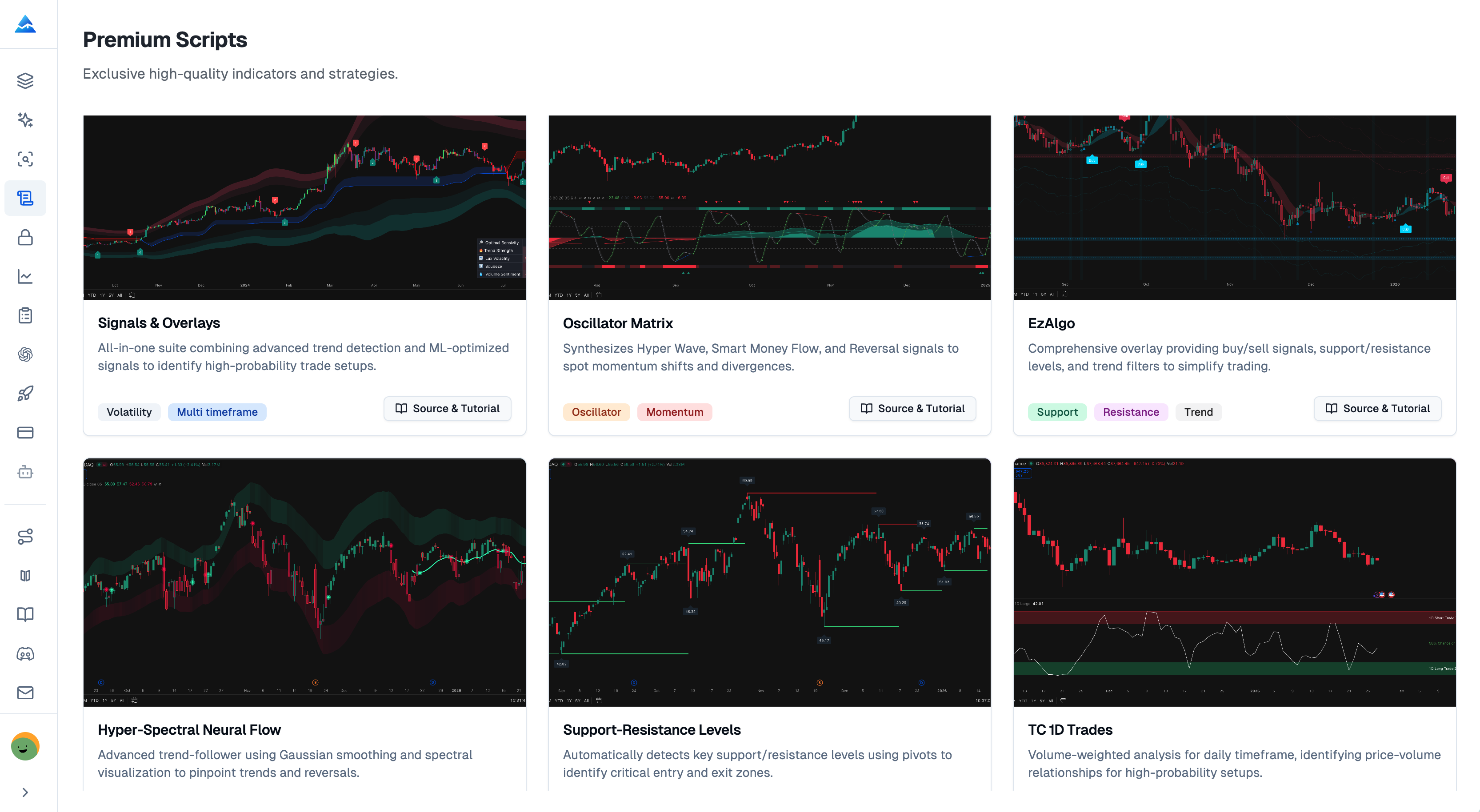
The core of Pineify is its six flagship tools:
| Script | Type | Key Features |
|---|---|---|
| Signals & Overlays | Trend + ML Signals | Advanced trend detection, ML-optimized signals, high-probability setups |
| Oscillator Matrix | Momentum Oscillator | Hyper Wave, Smart Money Flow, Reversal signals, divergence detection |
| EzAlgo | All-in-One Overlay | Buy/sell signals, support/resistance, trend filters |
| Hyper-Spectral Neural Flow | Trend Following | Gaussian smoothing, spectral visualization, reversal pinpointing |
| Support-Resistance Levels | S/R Detection | Pivot-based automatic key level detection |
| TC 1D Trades | Volume Analysis | Price-volume relationships, daily timeframe, high-probability setups |
Why Pineify Feels Different
The real value isn't just having the scripts. It's the approach. Pineify is built on the idea that you should understand your trading tools. Every premium script includes:
- Full source code access: Open, review, modify the Pine Script yourself.
- Step-by-step tutorials: Learn the trading logic so you can use the tool with confidence.
- Quality signal design: Probability-focused entries and clear chart visualization.
- Simple TradingView setup: Copy, paste, you're ready to go.
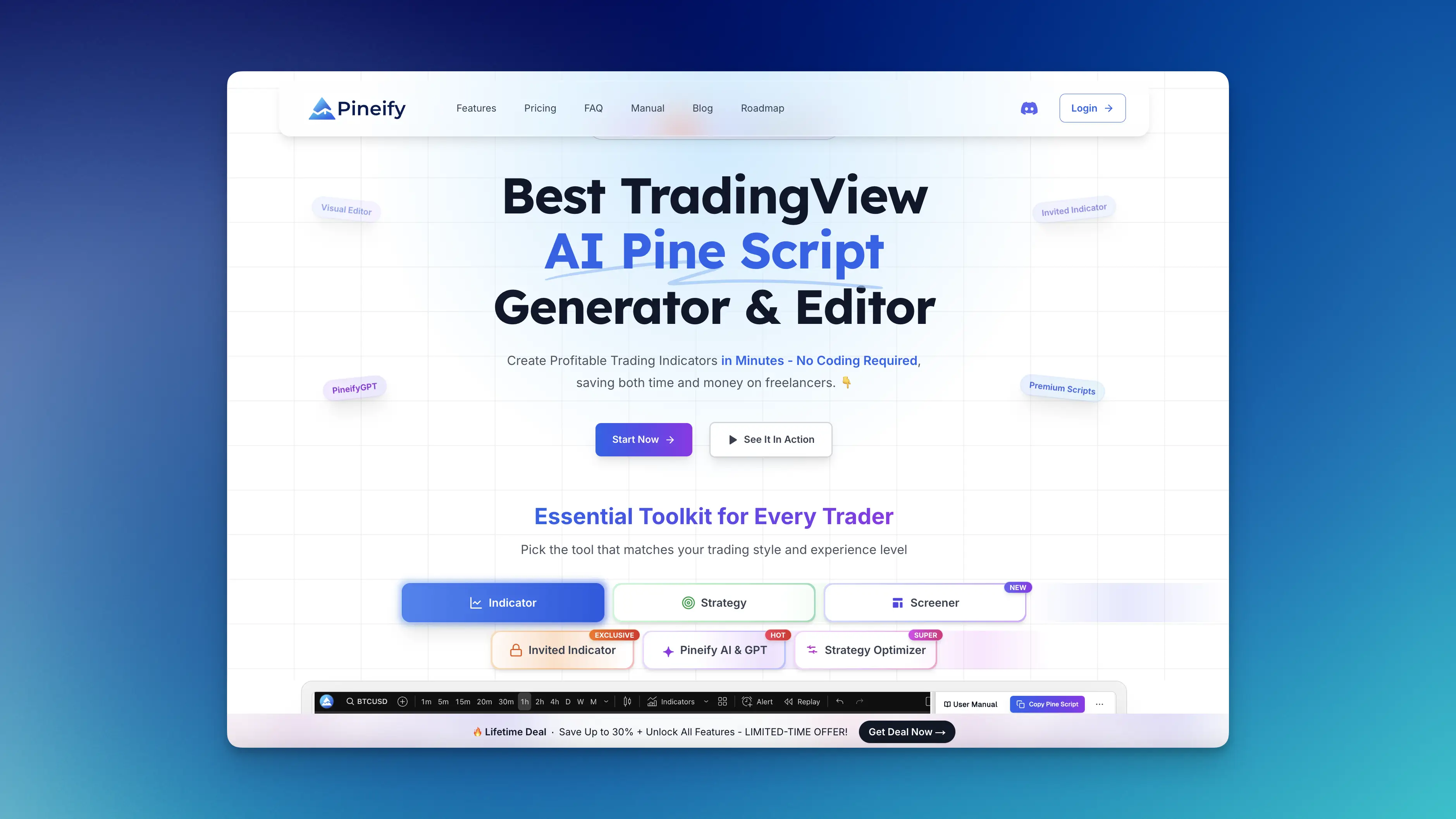
Pineify connects to a wider platform: an AI helper for Pine Script coding, a drag-and-drop builder with 235+ technical indicators, a strategy optimizer, and a multi-symbol screener. I've used the AI assistant to build custom indicators in under 10 minutes -- something that would have taken me hours writing from scratch.
The Plus plan is a one-time $99 fee (often 20% off) for 18 premium scripts, unlimited indicators and strategies, and 500 monthly AI credits. The Advanced plan at $149 adds the exclusive Pineify Signals & Overlays indicator, the strategy optimizer, and a trading journal with backtest reports. I haven't tested the Expert plan yet, but the Advanced tier has covered everything I've needed so far.
If you're moving your logic to other platforms, converting Pine Script to C is worth learning.
LuxAlgo -- Popular Tools with a Big Community Catch
If you spend time on TradingView, you've seen LuxAlgo. They're the most-followed premium indicator provider on the platform with over 800,000 traders. Their tools -- Signals & Overlays, Price Action Concepts, Liquidity Indicators -- focus on institutional or "smart money" analysis: order blocks, market structure shifts (CHoCH, BOS), and liquidity sweeps.
The community is a major draw. Over 150,000 members in their Discord sharing ideas and setups. It's a polished, well-supported experience.
But here's the limitation I see: LuxAlgo runs on a subscription model. You pay regularly or lose access. And the source code isn't provided for most tools. You're using a powerful black box. You can't peek under the hood or tweak the logic.
I prefer platforms where I can verify the code myself. If you're fine with a subscription and don't need to modify scripts, LuxAlgo's community and tool quality are hard to beat.
Zeiierman: Smart Money Tools Without the Complexity
Zeiierman keeps popping up in TradingView and Reddit discussions. It's designed for traders who want smart money concepts without the high cost or complexity.
Its main tools:
| Tool | What It Does |
|---|---|
| Adaptive Trend Indicator | Shows core trend direction, adapting to volatility. |
| Liquidity Hunter | Highlights where stops likely cluster -- areas price often targets. |
| Smart Money Concepts Toolkit | Packages Fair Value Gaps, Order Blocks, and Break of Structure into a visual workflow. |
What stands out is the clean interface. Learning these concepts feels less daunting. Zeiierman offers free and paid plans, so you can explore before committing. I haven't tested every tool in their suite, but the Adaptive Trend Indicator performed well on BTC/USD 4-hour charts during March 2026.
BigBeluga: Volume and Momentum with Open Code
If you trade based on momentum and volume, BigBeluga's tools cut through the noise. They focus on algorithmic momentum detection, volume flow tracking, and early trend spotting.
The standout feature: they share scripts openly. You can grab the Gaussian Filter and Whalemap for free on TradingView's public library. Their premium membership bundles the Market Waves Toolkit, Market Core Toolkit, and Beluga Nautilus Oscillator, plus community access.
BigBeluga offers a balanced approach -- open-source core scripts so you understand the signals, plus advanced paid tools if you need them. I prefer this model over fully closed alternatives.
Flux Charts: Multi-Timeframe Supply and Demand
If you trade forex, crypto, or futures, you know the big moves happen around key supply and demand zones where institutions buy or sell. The hard part is spotting these zones clearly.
Flux Charts is a premium TradingView suite (by invitation) built for this. It consolidates multiple timeframes into one view:
- The SFX Algo Signal: Entry signals that don't repaint, with a 1-to-5 strength rating.
- Multi-Timeframe Zone Overlay: Maps supply and demand zones across three timeframes on your main chart.
Flux Charts offers a 7-day money-back guarantee. I haven't tested it personally, but traders I respect in the Swing Trading Discord rate the zone overlay highly for EUR/USD and S&P 500 futures.
| Platform | Source Code | Pricing Model | Best For |
|---|---|---|---|
| Pineify Premium Scripts | ✅ Full access | One-time lifetime | Serious Pine Script learners and traders |
| LuxAlgo | ❌ Invite-only | Monthly subscription | Community-driven smart money traders |
| Zeiierman | ❌ Limited | Subscription | SMC and trend structure traders |
| BigBeluga | ✅ Core scripts open | Mixed (free + premium) | Volume and momentum traders |
| Flux Charts | ❌ Invite-only | Subscription | Multi-timeframe supply/demand traders |
| TradingView Public Library | ✅ Open source | Free | Beginner to intermediate DIY traders |
You can find excellent starting points in my roundup of the best community indicators on TradingView.
Your choice comes down to your goals. If you want to learn how indicators are built and have control over the code, go with a platform that gives you source access. If you'd rather use proven tools and join a community, subscription-based platforms may justify their cost. And if you're starting out, the public library is a fantastic free resource.
Think about where you are in your trading journey. Do you want to just use tools, or understand how they're built? What's your trading style -- patterns, supply and demand, order flow? What's your budget?
- If you're curious about how indicators work and want to learn to code, go with Pineify Premium Scripts. Source code plus tutorials and an AI helper turn it into a real learning platform.
- If you want community discussion and advanced concepts like order flow, check LuxAlgo or Zeiierman.
- If you prefer free, transparent tools for volume and momentum analysis, BigBeluga is a solid starting point.
- If your strategy lives on supply and demand zones across timeframes, Flux Charts is worth testing.
Scrolling through generic marketplaces eats hours. The real edge comes from a small set of well-documented tools you truly understand -- especially when you can read the code. That's what separates confident traders from those reacting to flashing lines.
Your Questions About TradingView Indicator Alternatives, Answered
Can I use Pineify scripts with TradingView's free plan?
Yes. Pineify gives you the complete Pine Script code, so you paste it directly into TradingView's Pine Editor. Works on the free plan and any paid plan. No special access needed.
Do these premium indicators repaint or change signals after the fact?
Repainting can make a strategy look great in hindsight but fail in real trading. Pineify indicators are designed to generate signals that stay fixed once a bar closes. That gives you a reliable foundation for decisions.
I'm not a programmer. Can I still use and customize these scripts?
Definitely. No coding knowledge required to start. Each script includes simple setup instructions. If you want to tweak settings, the visual editor handles it with clicks. And the AI coding assistant can build custom ideas without you learning Pine Script from scratch.
Is there a monthly subscription fee?
No. Pineify uses a one-time, lifetime payment model for Plus, Advanced, and Expert plans. You pay once and get access plus all future updates without recurring bills.
Why choose a paid script over the thousands of free ones on TradingView?
Reliability and intent. Free scripts vary wildly in quality and upkeep. Some are abandoned, lack instructions, or aren't built with solid trading logic. Premium scripts from curated marketplaces like Pineify include professional-grade risk management, thorough backtesting, and clear documentation. They're designed to be a serious part of a trading system, not a casual experiment. For a deeper look at finding quality tools, check this guide to TradingView indicators and strategies.
What is the difference between LuxAlgo and Pineify?
LuxAlgo is subscription-based with closed-source tools and a large community. Pineify is a one-time purchase with full open-source access. I prefer Pineify because I can verify and modify the code myself.
Which platforms provide full source code access for their premium scripts?
Pineify Premium Scripts and BigBeluga (core scripts) provide full source code. LuxAlgo, Zeiierman, and Flux Charts keep their premium scripts closed-source or invite-only. You use them as black boxes without being able to inspect the logic.
To see the scripts and tools mentioned, visit pineify.
Building Your Trading Toolkit with Pine Script
Moving from watching charts to actively using Pine Script comes down to the tools you choose. If the usual indicator marketplaces feel limiting, here's a straightforward path.
Think of it as upgrading your workspace. Instead of cluttering your chart with random tools, you pick a few reliable ones and learn them inside out.
-
Browse the full collection first. Check the Pineify Premium Scripts library. Read what each script does, see which trading styles it fits, verify source code is included. Find the right fit, not just the shiniest tool.
-
The Plus plan is a solid starting point. If you want well-built indicators and the ability to learn how they work with code and guides, start here.
-
Consider Advanced later. Upgrade if you need exclusive signals, the optimizer, or detailed backtest reports.
-
Don't trade alone. The Pineify Discord community connects you with others using the same scripts. Helpful for sharing charts and seeing how tools behave in different conditions.
-
Go slow to learn fast. Pick one script per week and really test it. The goal isn't to collect indicators. You want to understand how one behaves in trending, sideways, and volatile markets. That understanding builds real confidence.
What about you? Found other quality Pine Script sources outside the main marketplaces? When you look at your strategy, what matters more right now -- spotting trends, catching momentum shifts, or reading volume? Drop a comment. Your experience could help another trader figure out their next move.