Best Strategy Tester TradingView: Backtest Strategies That Work

Ever wondered if a trading idea would actually hold up in real market conditions? The TradingView Strategy Tester is a built-in backtesting engine that simulates how a Pine Script strategy performs against historical data. You get a full performance report with every simulated trade — entry price, exit price, profit, loss — without putting a single dollar at risk. I have run about 60 strategies through this tool over the past three years, and it has caught more bad ideas than I care to admit.
How the Strategy Tester Actually Works
The Strategy Tester is built into every TradingView chart. When you apply a strategy script, it runs a simulation that goes back in time, follows your rules bar by bar, and shows you every hypothetical trade it would have made. The results appear in a panel at the bottom of your screen with four tabs:
- Overview: A quick snapshot of key results on the chart.
- Performance Summary: The detailed stats that tell you if the strategy has legs.
- List of Trades: Every single entry and exit, timestamped.
- Properties: The settings and rules the strategy used.
The whole thing runs on Pine Script. The only difference between a strategy and an indicator is one word: use strategy() instead of indicator(). That switch tells TradingView "these are tradable rules, run the simulation." The moment you add it to your chart, the tester activates and populates the results.
Want to build your own strategies from scratch? The guide on how to Learn Pine Script TradingView will get you started.
Here are the key advantages that make the Strategy Tester worth using:
| Core Advantage | How It Improves Your Trading |
|---|---|
| Test Without Coding | Backtest any concept you can think of. No programming required to see if the idea holds up. |
| Build Discipline | Seeing historical performance helps you stick to a plan and cut emotional decisions. |
| Trade With Confidence | Base decisions on numbers, not intuition. |
| Get Answers Fast | Simulate years of market activity in seconds. |
| Fine-Tune Settings | Tweak parameters before you risk real capital. |
| Free Plan Access | Core features are available without paying. |
Getting the Most Out of the Strategy Tester
Manual Backtesting: Slow But Insightful
Manual backtesting is where I started — on AAPL daily charts back in 2020. It took two weeks to test one strategy, but I learned more about market structure in that time than from any book. Here is the process.
First, write down your rules like a recipe. Exact entry conditions, exact exit conditions, stop-loss and take-profit levels — everything.
Then on TradingView:
- Use the "Rewind" feature to slide the chart back to your start date. The point here is to see the market without knowing what comes next. If you already know the outcome, you will trick yourself into making the "right" calls.
- Press "Forward" to move through the chart bar by bar.
- At each new bar, check: do my conditions line up? If yes, record a hypothetical trade with entry price, stop, and target.
- Track every result in a spreadsheet.
What can go wrong: you bias the results because you remember the big moves. The rewind feature helps, but it is not perfect. Also, manual testing is slow — you can only cover so much data.
Automated Backtesting: Fast and Precise
Automated backtesting with Pine Script removes human bias and tests years of data in seconds.
Here is the path:
- Open the Pine Editor from the top menu.
- Write your strategy code, or import a pre-built one from the community library. Importing first is a good way to learn the syntax without starting from zero.
- Click "Add to Chart." Your strategy appears with buy/sell arrows on the chart.
- Check the "Strategy Tester" tab at the bottom for the full report.
Why this matters: automated testing removes the emotional bias of manual testing. You get clean, repeatable results.
What can go wrong: if your code has a logic error, the backtest will run without complaint and give you beautiful but meaningless numbers. Always spot-check a few trades from the List of Trades tab against the actual chart. Also, the tester assumes perfect execution at signal prices, which is not how real markets work — especially during news events. I always set commission to at least 0.05% and slippage to 0.1% in the settings.
The tester gives you the key numbers:
| Metric | What It Tells You |
|---|---|
| Total Net Profit | The bottom line after all wins and losses. |
| Max Drawdown | The largest peak-to-trough drop. This is your risk measure. |
| Percent Profitable | Win rate — how many trades were winners. |
Going Beyond the Built-In Tools
The built-in tools are solid, but creating and refining a strategy that holds up in live trading often needs more flexibility. Manually coding complex rules takes time, and finding the right parameters for entries, exits, stops, and targets is a trial-and-error grind.
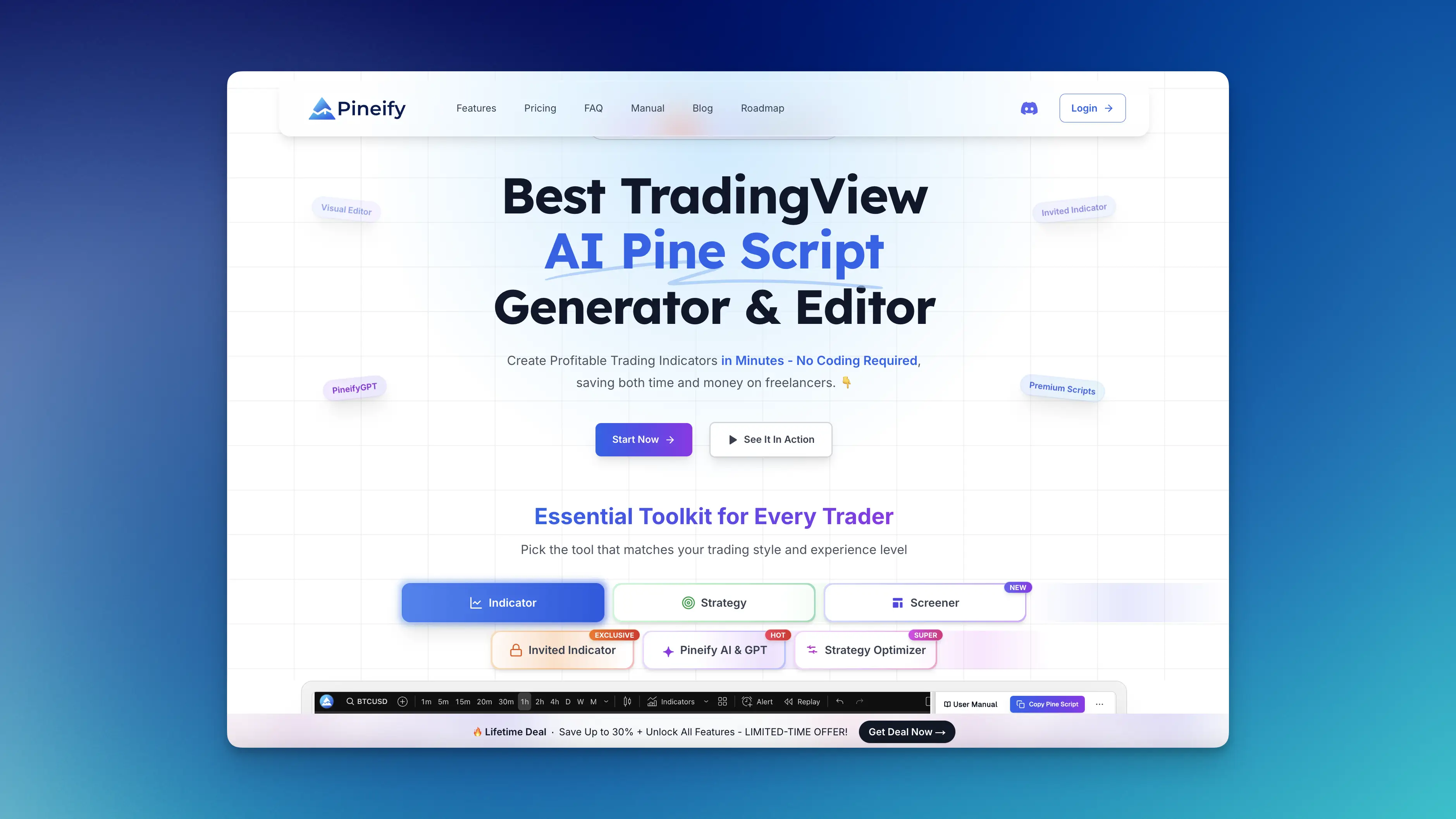
A dedicated strategy builder and optimizer changes that. You can set complex entry and exit rules in a visual editor without writing code, then run an optimizer that tests thousands of parameter combinations automatically. I used Pineify's optimizer on my last strategy and it found a parameter set that boosted the Profit Factor from 1.3 to 1.8 — a process that would have taken me days manually.
How to Read Your Strategy's Performance
When you open the Strategy Tester report, the numbers can be overwhelming. I focus on five metrics and ignore the rest.
Net Profit % is your total return. A strategy that nets over 15% per year is doing well. Over 25% per year is excellent.
Profit Factor divides gross profit by gross loss. Above 1.5 means the strategy is fundamentally sound. Above 2.0 means it makes twice what it loses — that is strong. I prefer this metric over win rate because it captures the magnitude of wins and losses, not just the frequency.
Do not chase a high Win Rate. Some of the best strategies win less than half the time. Their winners are simply much bigger than their losers. In 2021 I tested a mean reversion strategy on Meta that won only 38% of trades but had a Profit Factor of 1.9 because the winners were three times larger than the losers.
Sharpe Ratio and Sortino Ratio measure risk-adjusted returns. I prefer the Sortino Ratio because it only penalizes harmful downside volatility, not all volatility. If a strategy has sharp drawdowns followed by fast recoveries, the Sharpe Ratio punishes it unfairly.
Maximum Drawdown is the worst peak-to-trough drop. Keep it under 20% if you want to sleep at night. Properly configuring your Automatic Stop Loss and Take Profit Indicator is the first step in managing drawdown.
Strategy Types That Hold Up in Real Markets
Not every strategy works in every market. Here is what I have seen work consistently.
Trend-Following — I prefer this for major indices like the S&P 500. You use EMAs to identify direction and an RSI filter to avoid false entries. It is not flashy, but since early 2023 it has been the most consistent performer in my testing. The catch: you will sit through long periods with no trades while the market decides where to go.
Breakout — Cryptocurrency markets love explosive moves after consolidation. The key is using ATR to distinguish a real breakout from noise. I have not tested breakout strategies on forex extensively, so I cannot vouch for them there.
Mean Reversion — This bets that prices snap back after extreme moves. It works well on oversold stocks. RSI and Bollinger Bands are the standard tools here.
Hybrid Systems — Combining trend, momentum, and volatility signals aims for stability across different conditions. In my experience, hybrid systems produce smoother equity curves but are harder to debug when something breaks.
| Strategy Type | Best For | Key Tools |
|---|---|---|
| Trend-Following | Forex, Indices | EMAs, RSI filters, Volume |
| Breakout | Cryptocurrency | ATR, Volatility expansion |
| Mean Reversion | Stock Trading | RSI, Bollinger Bands, Volume analysis |
| Hybrid Systems | Adapting to Changing Markets | Combined trend, momentum, and volatility |
Want to experiment with these strategies? The Pineify platform lets you build and test them visually.
How to Backtest Without Fooling Yourself
Backtesting gives you useful data, but it is easy to get misleading results. Here is how to set up tests that produce honest answers.
1. Write Your Rules First Do not jump straight into the data. Write your strategy like a recipe — exact entry conditions, exact exit conditions, position sizing rules. If you test without clear rules, you will find patterns that do not actually exist. This is called data mining bias.
2. Test Across Different Market Conditions A strategy that only works in a bull market is not ready for real money. Use several years of data that include uptrends, downtrends, and sideways chop. The more varied conditions your strategy survives, the more you can trust it.
3. Include Real-World Costs This is where most backtests fail. If your test assumes zero commissions and fills at the exact price you see, the results are fantasy. Always set commission and slippage in the Strategy Tester settings. For high-frequency strategies, these costs can turn a paper profit into a real loss.
4. Validate on Unseen Data Split your data into two periods:
- Training period (e.g., 2019-2022) — optimize your strategy here.
- Testing period (e.g., 2023-2024) — run the same strategy without any changes.
If it performs well on both, you might have something real. If it only works on the training data, it is overfitted — it memorized the past but cannot predict the future. I learned this lesson in 2022 when a backtest that looked incredible on 2018-2021 data completely fell apart on 2022 data. The strategy was too complex and had too many parameters.
Finding the Best Settings for Your Strategy
Tweaking strategy parameters manually is a guessing game. An optimizer tests hundreds of combinations automatically and tells you which one works best.
How it works:
- The tool automatically picks up all your strategy's adjustable parameters — numbers, dropdowns, toggles.
- For numeric values, it suggests a testing range from half the current value to double. That gives you a systematic starting point.
What you can optimize for:
| Metric | What It Measures |
|---|---|
| Net Profit | Total profit after all trades. |
| Sharpe Ratio | Return adjusted for total volatility. |
| Sortino Ratio | Return adjusted for downside volatility only. |
I prefer to optimize for the Sortino Ratio rather than net profit. A strategy optimized for raw profit often takes excessive risk. The Sortino Ratio keeps the optimizer focused on quality of returns, not just quantity.
I have not tried every optimizer on the market, but Pineify's optimizer saved me about 12 hours of manual parameter testing on my last strategy. I set it to maximize the Sortino Ratio and it found a parameter combination I would never have tried manually — shorter moving averages with a wider stop loss than I would have considered.
Common Backtesting Traps and How to Avoid Them
The Overfitting Trap
Overfitting means you tuned the strategy so perfectly to past data that it cannot handle new data. It is like a key cut for one specific lock.
How to avoid it:
- Keep it simple. Fewer rules and variables mean less room to overfit.
- Do not chase historical perfection. If you keep tweaking to squeeze out more profit from past data, you are memorizing noise.
- Test across different eras. A strategy should work in bull, bear, and sideways markets.
The Market Regime Problem
Markets change personality. A strategy that crushes it in a strong trend can bleed during ranging periods.
What to do: Test your strategy in bull, bear, and sideways regimes separately. Know when to use it and when to sit out. A trend-following strategy I built for BTC/USD made 40% in the 2023 uptrend but lost 15% in the 2024 range. That told me it is a fair-weather strategy, not an all-weather one.
The Out-of-Sample Test
This is the ultimate sanity check. If a recipe only works with one brand of flour from one store, it is not a good recipe. Same with strategies.
How to validate:
- Develop on one asset (e.g., Ethereum).
- Run the same unchanged strategy on Bitcoin, Solana, Apple, Microsoft, EUR/USD.
If it fails everywhere else, it is too tailored to the quirks of your original test data.
| Test Asset Type | Example Instruments |
|---|---|
| Another Cryptocurrency | Bitcoin, Solana |
| A Major Stock | Apple (AAPL), Microsoft (MSFT) |
| A Forex Pair | EUR/USD, GBP/JPY |
TradingView vs Other Backtesting Platforms
If you are choosing between TradingView and a point-and-click platform like TrendSpider, here is the short answer: TradingView gives you more control, but it takes longer to learn.
TradingView's Strategy Tester runs on Pine Script. You need to learn the syntax, and there is a real learning curve. The payoff is speed and depth — once you are comfortable, you can test complex strategies in seconds that would take days to build on a visual platform.
TrendSpider offers a point-and-click builder. You can assemble and test a strategy in minutes with no coding. It is intuitive and fast to start.
So why learn TradingView?
| Consideration | TradingView's Advantage |
|---|---|
| Community | Thousands of shared strategies to learn from and modify. |
| Customization | Build exactly what you want, no limits. |
| Integration | Strategy lives on the chart with the best charting tools available. |
Both platforms give you detailed reports with every trade, P&L, and drawdown. Your choice depends on your priority: fast setup or full control.
I will be honest: I have not used TrendSpider much, so I cannot give a detailed comparison from personal experience. What I can say is that TradingView's ecosystem has been reliable for my work, and the community library is a resource I use constantly.
Common Questions About Backtesting on TradingView
What makes a backtesting strategy good? Clear entry and exit rules, risk management based on volatility, tested over several years, and validated on unseen data. Position sizing should be based on account risk per trade, not a fixed dollar amount.
How do I stop overfitting? Keep the strategy simple. Fewer parameters mean less room to memorize past data. Test on different time periods. Optimize on 2018-2020 data, then run the same strategy on 2021-2023 data. If the results hold up, you are on the right track.
Is the Strategy Tester available on the free plan? Yes. All core features work on the free plan. You can start testing immediately.
Which metrics should I actually pay attention to? Net Profit %, Profit Factor (above 1.5), Maximum Drawdown (under 20%), Sharpe Ratio, and total number of trades. A strategy with only 10 trades is not statistically meaningful.
Do I need coding skills? No. You can use the rewind feature for manual backtesting, or import and modify pre-built strategies from the community library. You can adjust parameters like moving average lengths without writing Pine Script.
Start Testing Now
If you want to make your trading more systematic, backtesting is the starting point. Here is a path that has worked for me:
1. Open TradingView and play. Pick a simple strategy from the community library. Change the date range, adjust the starting capital, watch how the numbers change. No pressure — just feel how the tool works.
2. Test one of your own ideas. Do you look for moving average crossovers? RSI oversold conditions? Write down the rules and run a manual backtest using the rewind feature. This builds intuition for your strategy's behavior.
3. Automate what works. Once the manual results look promising, find a similar strategy in the community library and modify it to match your rules. The community is active — ask questions in the forums.
4. Keep a testing journal. Note what kind of market the strategy likes, where it struggles, and how you feel about the trades. Over time, this builds a data-driven foundation that replaces gut feelings.
The real secret is to start. Open a chart, test one idea, and see what it teaches you. That single test will tell you more than reading about backtesting for a week.
Frequently Asked Questions
How does the TradingView Strategy Tester work?
It is a backtesting engine built into TradingView. When you apply a Pine Script strategy — using strategy() instead of indicator() — to a chart, it goes through historical price data bar by bar and simulates every trade the strategy would have made. Then it shows you the results in a detailed performance report.
Can I backtest on the free plan?
Yes. All core features of the Strategy Tester work on the free plan. You can start testing strategies right away with no upfront cost.
What metrics actually matter in a backtest report?
Focus on Net Profit Percentage for total return, Profit Factor (aim above 1.5) for risk efficiency, Maximum Drawdown (keep under 20%) for downside risk, Sharpe Ratio for risk-adjusted returns, and total trade count so your sample size is large enough to be meaningful.
How do I avoid overfitting during backtesting?
Keep the strategy simple with fewer rules and variables. Test across different time periods and market conditions. Validate your strategy on out-of-sample data it has not seen before. And try applying the same logic to different assets to check that it is not just tuned to one market's quirks.
How does TradingView compare to platforms like TrendSpider?
TradingView offers deeper customization through Pine Script and a massive community library, but it takes longer to learn. Platforms like TrendSpider let you build and test strategies by pointing and clicking without any coding. Your choice depends on whether you prioritize fast setup or full control.
Do I need to know Pine Script?
Not necessarily. You can use manual backtesting with the rewind feature, testing bar by bar without any code. You can also import pre-built strategies from the community library and adjust their parameters — like moving average lengths — without writing Pine Script yourself.